
Blogs
Discover insights, tutorials, and stories from our team.













All Blogs
Page 11 of 20 (234 total posts)
Agentic AI in B2B Sales: A Practical Guide for Modern Revenue Teams
Agentic AI in B2B sales connects research, enrichment, buying signals, and CRM updates into governed workflows, so reps spend more time selling.
B2B Sales and Marketing Alignment: A Practical Guide for Modern Revenue Teams
B2B sales and marketing alignment built on shared ICPs, CRM governance, buying signals, RevOps, and automation so pipeline metrics match across teams.
B2B Databases: How Modern Revenue Teams Build Better Pipeline in North America
North America B2B databases compared across six providers, with a RevOps-focused framework for enrichment, buying signals, CRM sync, automation, and compliance.
12 Best B2B Website Visitor Identification Tools for Revenue Teams in 2026
Website visitor identification tools ranked for B2B revenue teams in 2026. Compare features, CRM fit, workflow automation, and pricing transparency.
AI Sales Assistant: Should Your Sales Team Use One in 2026?
AI sales assistant evaluation for 2026: what it automates (research, enrichment, CRM sync, buying signals), where it breaks, and rollout guidance by team size.
12 Best B2B Email Finder Tools for Sales Teams in 2026
Best B2B email finder tools for 2026, compared on verification, enrichment, phone data, CRM sync, and fit by team size.
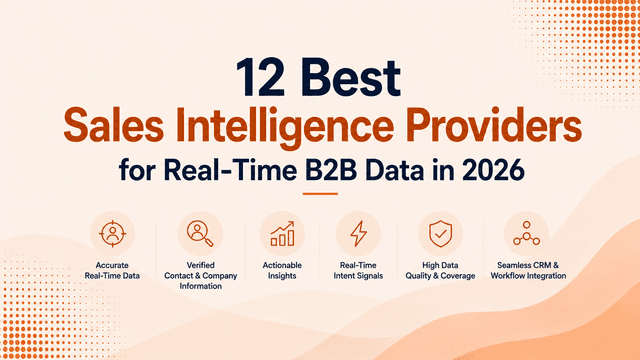
12 Best Sales Intelligence Providers for Real-Time B2B Data in 2026
Sales intelligence providers compared: data freshness, enrichment depth, intent signals, automation, and pricing so you can pick the right fit for your GTM motion.
Automated LinkedIn Prospecting: Smarter Workflows for Modern B2B Sales Teams
Automated LinkedIn prospecting that stays compliant: AI research, contact enrichment, CRM sync, and multi-channel follow-up workflows for revenue teams.
12 Best Enrichment Software Platforms for GTM Teams in 2026
Enrichment software comparison for GTM teams: 12 platforms ranked on waterfall enrichment, CRM sync, AI features, pricing transparency, and fit.
12 Best AI Lead Generation Solutions for B2B Teams in 2026
AI lead generation tools compared: 12 options ranked on prospecting, enrichment, buying signals, CRM sync, workflow automation, and pricing transparency.
B2B Sales Productivity: How Modern Revenue Teams Sell More by Doing Less Manual Work
B2B sales productivity improves when teams automate research, enrichment, CRM sync, and routing, so reps spend more time with buyers and less on admin.
CRM Data Enrichment: The Best Way to Keep Your CRM Accurate for B2B Sales Teams
CRM data enrichment keeps B2B CRM records current with verified contacts, firmographics, buying signals, AI research, and automated workflows.
Trusted By
1000+
Revops and GTM leadersaround the world