AI Sales Emails: Best Practices for Modern Revenue Teams
Table of Contents
Explore Bitscale
Find decision makers, more insights and contact information about this company on Bitscale
AI sales emails are no longer a party trick. Over the past few years, AI adoption among sales reps has grown rapidly, with more teams integrating AI into their outreach workflows every quarter. Still, adoption alone doesn't explain the split between teams that get real lift from AI-assisted outreach and teams that pump out robotic notes that trip spam filters or disappear into silence.
The gap usually isn't the model. It's the operating system around it. When AI sits inside a workflow that starts with prospect research and buying signals, pulls in CRM history, and ends with a human editor's judgment, outreach improves. When a rep pastes a prompt into an AI sales email generator and ships the first draft, the output looks like what it is: generic copy dressed up as personalization. This piece lays out the workflow, step by step, so your B2B sales emails have a better shot at earning replies.
What Makes AI-Assisted Outreach Different from Traditional Sales Emails
Most AI outreach talk gets stuck on the writing step, as if the hard part is choosing adjectives. It isn't. The leverage shows up earlier: research, signal detection, and assembling enough context that the message can be specific without being creepy. A well-researched email written by a human will beat a poorly researched email written by a large language model every time. Pair strong research with an AI draft and a human pass, though, and you get compounding gains: more relevance per minute, at a quality level the team can actually sustain.
| Dimension | Traditional Sales Emails | AI-Assisted Sales Emails |
|---|---|---|
| Prospect Research | Manual LinkedIn browsing, significant time per prospect | AI-led prospecting pulls firmographics, technographics, and recent news in seconds |
| Personalization | First name, company name, maybe a recent post | Layered: role-specific pain points, company initiatives, tech stack, and buying signals |
| Drafting Speed | Substantial manual effort per email | Dramatically faster drafting (including human review) |
| Follow-up Timing | Calendar reminders or gut feel | Sequence timing shaped by engagement data and CRM context |
| Consistency | Swings with rep skill and energy | Baseline quality stays steadier across the team |
| Scalability | Linear: more emails = more hours | Sublinear: AI covers research and drafts, humans cover judgment |
| The gap isn't just prose. It's how much context gets assembled before the first sentence exists. |
The Complete AI Sales Email Workflow: From Research to Reply
Treating AI email writing as a single step is how teams end up with more output and fewer replies. Outbound has at least six phases, and AI does a different job in each one. AI is increasingly becoming the default starting point for seller research and prospecting, and that trend is accelerating. That's the real shift: the center of gravity moves upstream, toward research and intelligence, not downstream toward copy generation.
Stage 1: AI Prospect Research and Company Intelligence
Before you draft a word, use AI to gather context. That includes firmographics (industry, headcount, revenue range, funding stage), technographics (what the company runs on), and recent events (leadership changes, product launches, earnings calls). Platforms like Bitscale's sales intelligence solution pull those layers into a single prospect profile so reps aren't living in six browser tabs. If you want to see how teams turn that into better lists, this breakdown of AI-powered prospect research goes deeper.
Stage 2: Buying Signals and Timing
Cold email AI that ignores timing is still cold email spam, just with cleaner punctuation. Buying signals answer the question of when a prospect is more likely to care: a new title, a competitor evaluation, a tech adoption, a funding round. Strong sales engagement workflows surface those signals automatically and push the right accounts to the top of the queue. For the full taxonomy and examples, this guide on how to identify buying signals in B2B sales is a solid reference.
Stage 3: CRM Context and Historical Intelligence
Your CRM is the one dataset no enrichment vendor can recreate: prior calls, deal stages, objections, content downloads, and the awkward history of who said what to whom. If AI drafts an email without that context, it will eventually recommend messaging that contradicts your last touchpoint. Pulling CRM intelligence into the drafting flow prevents those own-goals. It also lets AI shift tone appropriately: warmer for re-engagement, crisper for accounts already deep in evaluation.
Stages 4-6: Drafting, Review, and Analysis
Once research, signals, and CRM context are in place, then AI should draft. Treat that draft as scaffolding, not a finished email. Human review is where you catch tone drift, factual errors, and the subtle overconfidence models like to sprinkle into claims. After the send, performance analysis (open rates by segment, reply rates by variant, bounce patterns) should feed back into research and drafting so the system improves over time instead of repeating the same mistakes at higher volume.
AI Email Personalization: Moving Beyond First Name and Company Name
Relevant, personalized outreach consistently outperforms generic messaging. Today, that doesn't mean mail merge tokens. It means proving you understand the prospect's situation well enough to be useful. When personalization is grounded in real context (role, company stage, tech stack, recent activity), it earns attention in a crowded inbox because it signals that the sender did the work to be relevant.
| Aspect | Manual Personalization | AI-Assisted Personalization |
|---|---|---|
| Data Sources | LinkedIn profile, company website | LinkedIn, 10-K filings, job postings, technographic databases, news feeds, CRM history |
| Time Per Email | Significant manual research effort | Minimal (AI assembles context automatically) |
| Depth | Surface-level (recent post, job title) | Multi-signal (tech stack changes, hiring patterns, competitive moves, intent data) |
| Consistency | Depends on rep effort and skill | Standardized research depth across all prospects |
| Scalability | Limited by manual effort per prospect | AI helps teams personalize outreach at greater scale while maintaining consistency |
| Risk of Errors | Lower volume, but fatigue still causes mistakes | AI can hallucinate facts; human review is essential |
| AI doesn't replace the instinct for what matters. It supplies richer inputs, fast. |
Strong personalization points at something the prospect cares about, not something you happened to notice. "I saw you went to Stanford" is flattery dressed up as relevance. "Your team's shift from Salesforce to HubSpot last quarter suggests you're rethinking your GTM stack" is a hypothesis grounded in observable change. AI makes the second version scalable by stitching together data points a rep would otherwise spend considerable time collecting.
Best Practices for AI Sales Emails
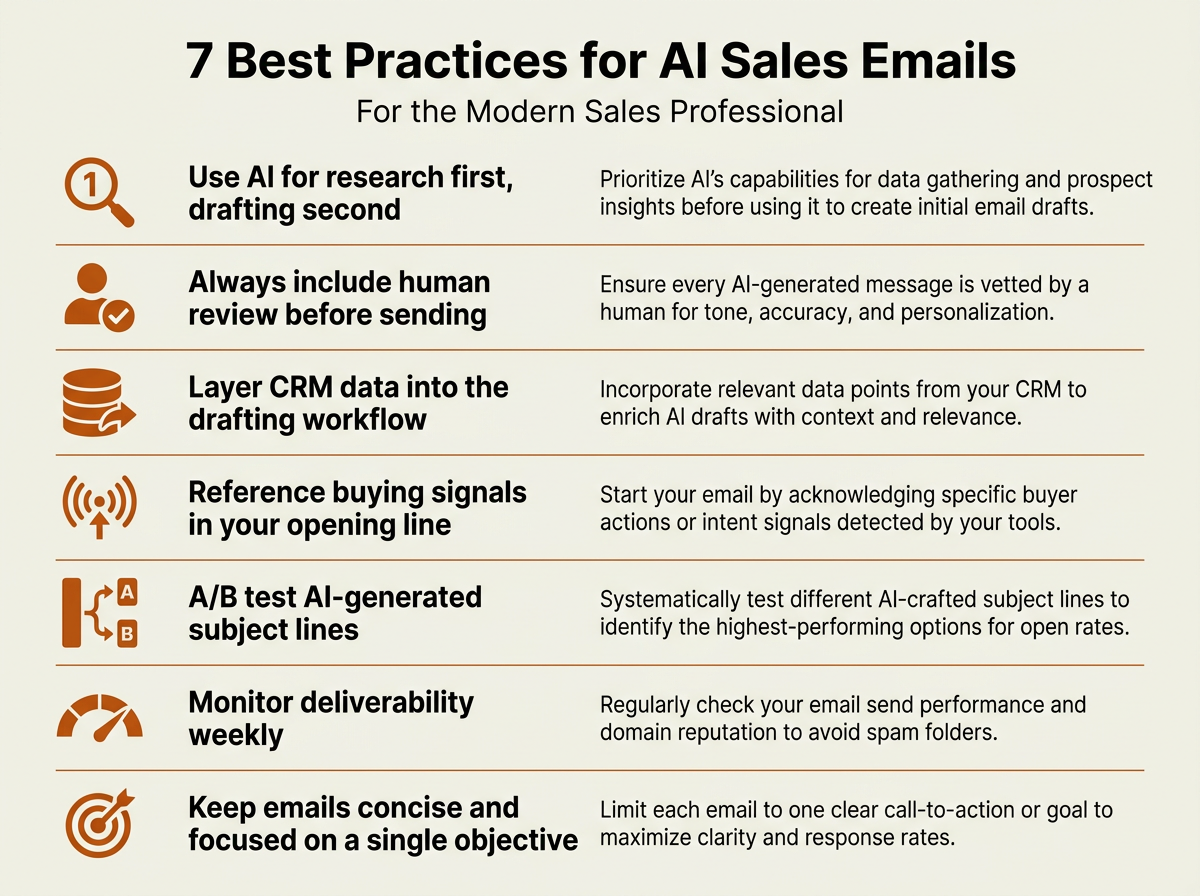
Seven practices that separate high-performing AI outreach from generic AI-generated copy.
| Best Practice | Why It Matters |
|---|---|
| Use AI for research first, drafting second | Email quality follows context quality. Skip upstream research and the draft turns generic. |
| Always include human review before sending | Hallucinations, tone mismatches, and factual slips burn trust fast. |
| Layer CRM data into the drafting workflow | Keeps you from contradicting prior conversations and supports smarter re-engagement. |
| Reference buying signals in your opening line | Timing plus relevance does more for replies than clever phrasing. |
| A/B test AI-generated subject lines | Small subject-line changes can swing open rates more than you'd expect. |
| Monitor deliverability weekly | AI makes it easy to scale volume; unmanaged volume can wreck domain reputation. |
| Keep emails concise and focused on a single objective | Short, focused emails tend to outperform longer ones in cold outreach. Build each message around one clear ask or insight. |
| Each practice maps to a specific failure mode in AI-assisted outbound. |
Common Mistakes That Undermine AI Outreach
Reply rates for B2B cold email vary widely based on audience, industry, personalization quality, timing, and deliverability. Most teams using AI end up stuck in the middle of the performance spectrum because they repeat the same avoidable errors. These are the ones that do the most damage.
- Treating AI as an AI SDR replacement. AI can speed up SDR work, but it doesn't replace the judgment calls that decide whether an email should go out in the first place. For a more nuanced view, see AI SDR tools in 2026 and what they really automate.
- Skipping deliverability hygiene. If you scale AI-generated volume without warming domains, authenticating DNS records, and watching bounce rates, you'll end up in spam fast. Read the latest on cold email deliverability in 2026 before you crank up send volume.
- Over-personalizing with AI-hallucinated facts. Models will sometimes invent details about a company or role. Reference a product launch that never happened and you lose credibility instantly.
- Using the same prompt for every persona. A VP of Engineering and a CMO don't speak the same language or optimize for the same outcomes. One prompt for everyone produces emails that fit no one.
- Ignoring compliance requirements. CAN-SPAM, GDPR, and CASL still apply whether a human or AI wrote the message. Every email needs a valid unsubscribe mechanism, accurate sender information, and (in GDPR jurisdictions) a legitimate interest basis.
Human Review: The Non-Negotiable Step
Bluntly: if your workflow doesn't include human review, you're not improving sales emails. You're just producing spam faster. Human review covers three jobs AI still can't do reliably on its own.
First is factual verification. Models state things confidently even when they're wrong. A human catches the line about a company that "recently raised a Series C" when the last round was a Series B two years ago. Second is tone calibration. AI tends to default to a slightly eager, slightly formal voice that experienced buyers can spot immediately. A human tightens phrasing to match the relationship stage and the prospect's style. Third is strategic judgment. Should this email go out at all? Is this the right message for this account, right now? Those calls require situational context AI doesn't actually have.
Compliance, Deliverability, and Follow-Up Optimization
Teams love to treat these as cleanup work. They're not. Compliance and deliverability decide whether your emails land at all; follow-up optimization decides whether the accounts that noticed you ever come back with a reply. Put differently: two are table stakes, one is where the returns compound.
Compliance Essentials
An AI-written email has to meet the same rules as a human-written one. CAN-SPAM requires a physical mailing address and a working unsubscribe link. GDPR requires a lawful basis for processing (legitimate interest is common for B2B cold outreach in the EU, but it isn't a blanket pass). CASL in Canada requires implied or express consent. AI won't track consent status for you, so your CRM and sales engagement platform need to enforce those checks at the workflow level.
Deliverability as a System
Deliverability isn't a toggle. It's the outcome of domain reputation, authentication (SPF, DKIM, DMARC), a sane volume ramp, bounce management, and content quality. AI-assisted teams often scale faster than their domain reputation can handle, and filters respond accordingly. The fix looks boring on purpose: dedicated sending domains, gradual warm-up schedules, and ongoing monitoring of inbox placement. Data quality and deliverability are most of the game for AI-powered email outreach.
Follow-Up Sequences
Follow-ups are where AI can be genuinely useful, because they benefit from pattern recognition. When AI can see engagement signals (opens, clicks, website visits), it can tailor the next message to what the prospect just did. Someone who opened your email multiple times but didn't reply often signals interest plus hesitation; the next touch should reflect that, maybe with a lower-commitment step. AI can draft conditional follow-ups at scale, but humans still need to define the rules: when to follow up, how many touches to run, and when to stop based on your ICP and sales cycle. For baseline structures you can adapt, these cold email templates and best practices are a solid starting point.
Designing Your AI Email Workflow: Platform Considerations
The biggest workflow decision is architectural: stitch together point solutions, or run on a unified platform. Point solutions (one tool for enrichment, another for signals, another for sequences, another for AI writing) tend to fracture context. Data gets stranded in the wrong system, and the draft ends up missing the details that mattered. A unified GTM platform like Bitscale keeps AI prospect research, buying signals, CRM sync, and workflow automation in one environment, so the drafting step can actually use everything you learned upstream without manual copy-paste.
Other platforms take different bets. Clay leans into waterfall enrichment and data orchestration with lots of integrations. Apollo.io pairs a contact database with sequencing and a built-in AI sales email generator. Lusha and Cognism focus on contact data accuracy, especially for European markets. Instantly.ai puts the emphasis on sending infrastructure and deliverability at scale. The right pick depends on where your current process breaks: if data quality is the problem, start with enrichment; if sending is the bottleneck, prioritize deliverability tooling; if the handoff between research and drafting is where things fall apart, a platform that unifies both (like Bitscale) closes that gap most directly.
Performance Analysis: Closing the Feedback Loop
If you don't measure, you can't tell the difference between AI that's helping and AI that's producing plausible-sounding emails nobody answers. Track performance by segment, not just overall: reply rate by persona, positive reply rate (excluding "unsubscribe me" responses), meeting booked rate, and pipeline generated per sequence. Benchmark AI-assisted sequences against your own historical baselines rather than industry averages that reflect different ICPs and markets.
The feedback loop matters more than any single KPI. When one message variant wins, feed that back into prompts and research priorities. When a segment keeps underperforming, the issue is usually upstream (wrong ICP, weak signals, bad data), not a missing synonym in the second sentence. Analysis should drive workflow changes, not just prettier reporting.
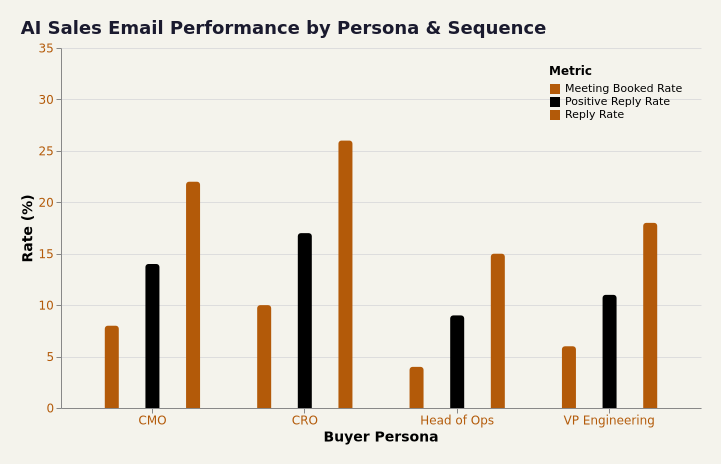
Benchmark AI sales emails by persona and sequence variant to close the feedback loop faster.
Key Takeaways for Revenue Teams
AI sales emails only work when AI is woven into the outbound workflow, not stapled onto the drafting step. The teams getting the best results today tend to look similar: they spend more effort on research and signal detection than on prompt tinkering, they make human review mandatory, they watch deliverability as closely as reply rates, and they prefer workflows that keep context intact from research through send.
Audit what you run today. Where does context fall out between tools? Where do reps burn time on work AI can speed up without sacrificing quality? Where does the process break under volume? Those are the highest-leverage places to integrate AI. If you're comparing platforms and want prospect research, buying signals, and workflow automation in one environment, Bitscale's sales intelligence solution is worth a look.
Frequently Asked Questions
Can AI fully replace human SDRs for writing sales emails?
No. AI can speed up research, drafting, and follow-up optimization, but human judgment still drives the work that matters: prioritizing accounts, calibrating tone, and verifying facts. The strongest model is AI-assisted SDRs, not autonomous agents operating without oversight.
How do I prevent AI-generated emails from landing in spam?
Treat deliverability like infrastructure: authenticate domains with SPF, DKIM, and DMARC, warm up new sending domains slowly, monitor bounce rates, and avoid scaling volume faster than your domain reputation can handle. The content isn't usually the trigger; the volume patterns AI enables often are.
What data sources should feed into AI email personalization?
Use multiple layers of context: CRM history (past interactions, deal stage, objections), firmographics (industry, revenue, headcount), technographics (current tech stack), intent signals (content consumption, competitor evaluations), and recent company events (funding rounds, leadership changes, product launches). Better inputs produce more relevant output.
Is it legal to use AI to write cold emails under GDPR?
GDPR governs personal-data processing and the lawful basis for outreach, not whether a human or an AI wrote the copy. You still need a lawful basis (often legitimate interest for B2B), accurate sender identification, and a working opt-out mechanism. Consult legal counsel for your specific use case and jurisdiction.
How does Bitscale differ from standalone AI email writing tools?
Bitscale is a unified GTM platform that brings together AI prospect research, contact enrichment, buying signal detection, CRM sync, and workflow automation. Instead of generating copy in isolation, it assembles the context that makes drafts specific and credible. That upstream focus tends to produce higher-quality B2B sales emails because the AI has richer inputs to work with.

Sanket
CEO | Co-Founder Bitscale


Sanket is the CEO and Co-Founder of Bitscale. He leads company vision and strategy, building the future of AI-driven sales intelligence for modern B2B teams. Sanket is obsessed with the intersection of AI and go-to-market, and has spent years studying how the best B2B companies find, engage, and convert customers at scale. He writes about company building, product strategy, and where AI is taking the sales industry.
Read other blogs
All Blogs
12 Best CRM Sync Tools for Revenue Teams in 2026
Compare 12 CRM sync tools for Salesforce and HubSpot, including enrichment, reverse ETL, and automation options for cleaner revenue data.
Sales Data Enrichment: A Buyer's Guide for Modern B2B Teams
Sales data enrichment helps B2B teams improve CRM records, routing, prospecting, and account prioritization. Compare workflows, costs, and vendor fit today.
What Is AI Prospect Qualification? A Practical Guide for Modern Revenue Teams
AI prospect qualification helps revenue teams enrich data, assess ICP fit, prioritize buying signals, and route the right accounts into CRM workflows.