AI Sales Workflow Automation: A Practical Guide for Modern Revenue Teams
Table of Contents
Explore Bitscale
Find decision makers, more insights and contact information about this company on Bitscale
Most talk about AI sales workflow automation gets stuck on email sequences: send more messages, faster, with machine-written subject lines. That framing is too small. The real win is end-to-end orchestration: from the moment an account pops onto your radar to the moment a rep calls or sends a genuinely personal note, with research, enrichment, qualification, and prioritization handled by AI before a human ever has to context-switch into busywork.
Sales representatives continue to spend a significant share of their time on administrative work, research, and internal coordination rather than actual selling. That imbalance has persisted across industry surveys for years, and it is one of the core problems AI is well positioned to address. AI is increasingly becoming the starting point for seller research and prospecting, a shift that is already reshaping how revenue teams operate. The goal here is straightforward: help revenue operations teams design, implement, and govern AI-powered sales workflows that strengthen every stage of the pipeline without displacing the human judgment that closes deals.
What AI Sales Workflow Automation Actually Means (and What It Doesn't)
Sales automation has been around for years: CRM reminders, drip campaigns, auto-dialers. Those tools mostly automated single actions in isolation. AI sales workflow automation is a different category. It connects the actions into an end-to-end system that can reason about sequencing, data quality, and prioritization on the revenue team's behalf.
Traditional automation is prescriptive: "send this email on day three." An AI sales workflow is situational: "this account hired a new VP of Engineering, raised a Series B last month, visited our pricing page twice, and has three contacts that match our ICP. Enrich the records, score the account, draft outreach that references the leadership change, and surface it to the rep who owns the territory." The point is not raw speed. It is intelligence applied across the entire workflow, so the next best action is based on current context, not a calendar reminder.
AI sales process automation also does not mean taking sellers out of the loop. It means stripping out the repetitive, manual, and error-prone steps that sit between a rep and a qualified conversation. Humans still decide whether the deal is real, handle objections, and build trust. AI does the prep work that should not require a human brain.
The Core Components of an AI-Powered Sales Workflow
A workflow that actually works touches at least seven stages. Leave one out and you create a bottleneck that drags everything downstream. Below is what each component does and why RevOps should care.
AI Prospect Research and List Building
Everything starts with deciding who is worth a rep's time. AI prospect research replaces the familiar grind of hopping between LinkedIn, databases, and news tabs. AI agents can pull firmographic details (industry, headcount, revenue, tech stack), identify likely decision-makers, and check those findings against your ideal customer profile. Done well, the output is a qualified, enriched list, not a raw CSV that reps spend hours repairing before they can even start outreach.
Lead Qualification and Scoring
Once you have candidates, the next question is priority. AI scoring models weigh signals like ICP fit, engagement history, firmographic match, technographic overlap, and intent data. That is a meaningful upgrade from static rules ("if title contains VP, add 10 points") because the model can learn from closed-won and closed-lost patterns and keep refining what "qualified" means for your business. Organizations that reinvest AI-driven efficiency gains into high-value selling activities often achieve stronger pipeline outcomes, including higher lead-to-opportunity conversion rates. For more on the mechanics, see how AI lead scoring helps prioritize high-intent leads.
Buying Signal Detection
Most legacy workflows are weak on timing. Identifying buying signals (job changes, funding rounds, product launches, technology adoption, website visits, content downloads) often ends up as a rep's side project: a few alerts here, a quick LinkedIn scan there. AI can continuously watch these sources, surface signals as they happen, and attach them to the right account record. The practical outcome is simple: reps reach out when the moment is real, not when they finally notice it.
CRM Enrichment and Data Hygiene
CRM automation is not just activity logging. AI can enrich contact and account records with verified emails, direct phone numbers, org charts, and technographic data, then flag duplicates, stale entries, and missing fields before they spread. IBM defines CRM automation as the use of technology to streamline repetitive tasks within a CRM system, relying on workflow automation and AI. When CRM data is accurate and complete, routing, reporting, and forecasting stop feeling like guesswork because the underlying system is finally trustworthy.
Traditional Workflow vs. AI Workflow: A Direct Comparison
Legacy sales processes and AI-orchestrated workflows operate on different assumptions. The table below breaks down each stage and shows exactly where AI changes the operating model.
| Workflow Stage | Traditional Approach | AI-Powered Approach |
|---|---|---|
| Prospect research | Manual LinkedIn searches, purchased lists, spreadsheet tracking | AI agents scan firmographic, technographic, and intent data to build dynamic ICP-matched lists |
| Lead qualification | Static scoring rules, gut feel, manager review | ML models score leads based on historical win/loss patterns and real-time signals |
| Buying signal monitoring | Sporadic Google Alerts, occasional LinkedIn checks | Continuous monitoring of job changes, funding, tech adoption, and engagement signals |
| CRM data quality | Quarterly cleanup projects, manual entry | Automated enrichment, deduplication, and field validation on every record |
| Prioritization | Rep decides based on recency or territory | AI ranks accounts by composite score combining fit, intent, and engagement |
| Outreach preparation | Rep writes each message from scratch or uses generic templates | AI drafts personalized messages referencing account-specific research and signals |
| Reporting | Weekly pipeline reviews with stale data | Real-time dashboards with AI-generated insights on pipeline health and rep activity |
| Comparison based on common B2B sales team workflows observed across mid-market and enterprise organizations. |
Where AI Leads and Where Humans Must Stay in Control
A predictable failure mode in sales automation is fuzzy ownership: nobody decides where the machine stops and the human starts. Automating everything sounds efficient until a bot fires off a tone-deaf message to someone who just announced layoffs. The dividing line is not what AI can do; it is what should require judgment, context, and relationship nuance.
| AI Responsibility | Human Responsibility |
|---|---|
| Data collection, enrichment, and validation | Interpreting account context and relationship history |
| Scoring and ranking leads by fit and intent | Deciding which accounts to pursue strategically |
| Drafting outreach messages and sequences | Reviewing, editing, and approving messaging tone |
| Monitoring buying signals across channels | Judging whether a signal warrants immediate action |
| Syncing data across CRM and outbound tools | Managing complex deal negotiations and objections |
| Generating pipeline and activity reports | Setting strategy based on market conditions and team capacity |
| Flagging data quality issues and anomalies | Making final decisions on account segmentation and territory design |
| AI handles preparation and data; humans handle strategy and relationships. |
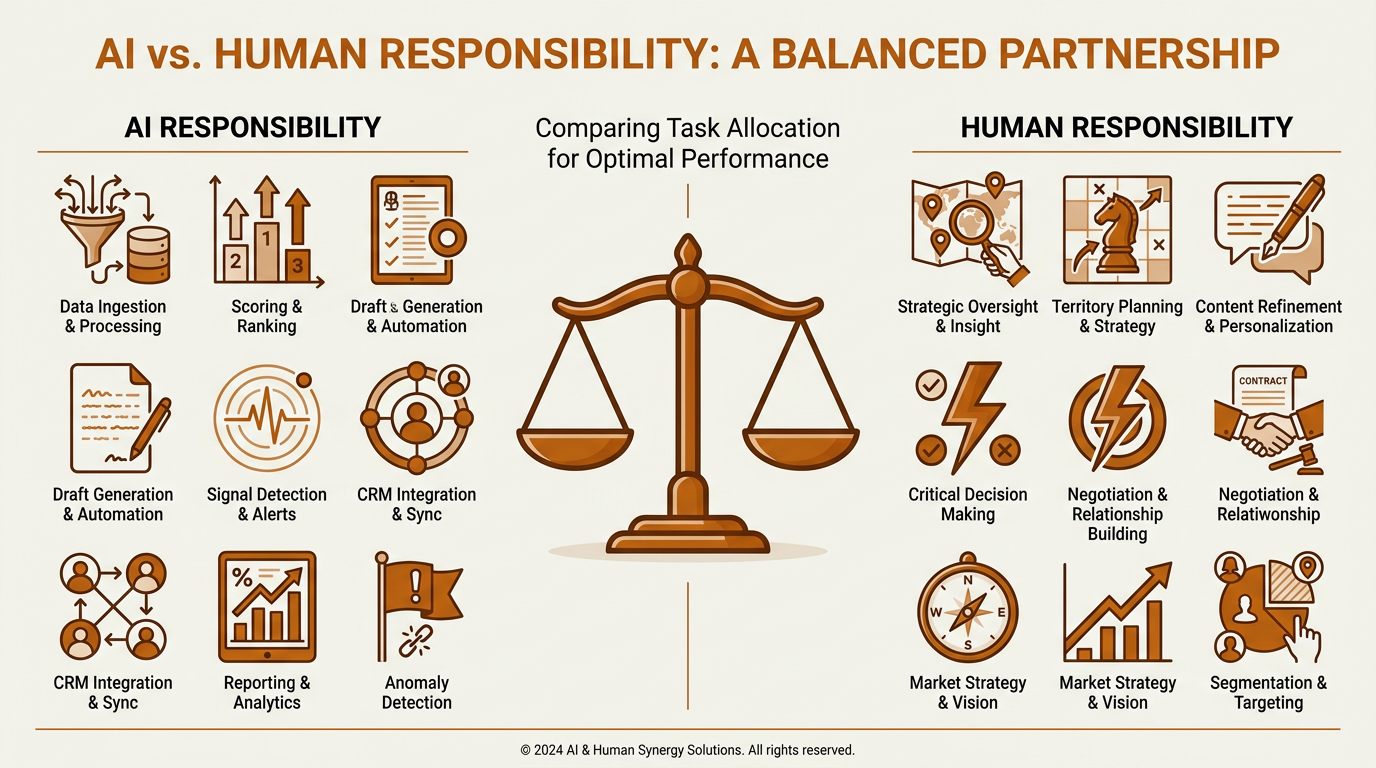
Clear ownership boundaries between AI and human tasks prevent costly automation missteps in sales.
Building Your AI Sales Workflow: A Practical Approach
Resist the urge to automate everything in one sprint. Teams that get durable value from AI workflow automation usually start with the highest-friction constraint in their process, prove it out, then expand. The following sequence represents one practical rollout approach that works well for many B2B revenue teams. Organizations should adapt the order based on their existing systems, priorities, and GTM maturity.
Start with CRM data quality. If the CRM is packed with outdated contacts, missing fields, and duplicates, any AI model trained on it will inherit those problems. Begin with an enrichment layer that validates and fills contact and company data automatically. Even this one move tends to tighten lead routing, improve reporting accuracy, and rebuild rep confidence that the system is worth using.
Layer in prospect research and list building. After the CRM is reliable, build workflows that generate prospect lists from your ICP criteria. AI agents should pull firmographic and technographic data, verify contact information, and push qualified records into your CRM or outbound tools. Platforms like Bitscale bundle AI prospect research, enrichment, and CRM sync into a single workflow, which reduces the need to stitch together point solutions. You can explore Bitscale's sales intelligence solutions to see what that looks like in practice.
Add buying signal monitoring. With clean records and qualified lists in place, configure AI to watch for signals tied to purchase readiness: leadership changes, funding events, technology adoption, and engagement with your content. Those signals should update lead scores and trigger rep alerts automatically, so timing is built into the workflow instead of relying on luck.
Automate outreach preparation, not outreach itself. AI should draft personalized messages, propose talking points, and recommend channel and timing. The rep should still review and hit send. That is where outbound sales automation earns its keep: not by blasting volume, but by making each touchpoint specific enough to deserve a reply.
Build reporting and governance last. Once the workflow runs end to end, add dashboards that track pipeline velocity, data quality metrics, signal-to-meeting conversion rates, and rep activity. Then lock in governance rules: who can override AI scores, how data moves between systems, and what gets logged. Write it down, socialize it, and enforce it.
Governance, Compliance, and the Risks Most Teams Ignore
Most teams misunderstand AI sales automation in the same way: governance is treated like paperwork you can do later. They ship AI agents, enjoy a burst of productivity, and assume the system is healthy. Then the problems show up: a data privacy issue, AI-generated outreach that references sensitive information scraped from a prospect's social profile, or pipeline reporting that drifts from reality because enrichment overwrote manually entered deal notes.
Governance for AI-powered sales workflows comes down to three requirements. First is data provenance: every enriched field should be traceable to its source, and reps should be able to see when and how a record changed. Second is human-in-the-loop control: AI should not send outreach, change deal stages, or modify account ownership without explicit human approval. Third is compliance guardrails: workflows must respect opt-out lists, GDPR consent requirements, and CAN-SPAM regulations. Revenue operations leaders should document these rules in a playbook and audit them on a regular cadence (quarterly is a common starting point, though some teams review monthly or after major workflow changes). For a broader perspective on the RevOps function behind this work, the state of RevOps report adds useful context.
How Bitscale Fits Into the AI Sales Workflow Stack
The AI sales tooling market is a patchwork. Clay is known for enrichment and waterfall lookups. Apollo.io pairs a contact database with outbound sequencing. Lusha and Cognism focus on verified contact data. Instantly.ai covers email deliverability and sending infrastructure. Each product solves a slice of the workflow, but combining them often creates integration overhead, inconsistent data, and gaps right where handoffs matter most.
Bitscale takes a unified approach, combining AI prospect research, buying signal monitoring, CRM enrichment, ready-made sales workflows, and outbound tool integrations into a single GTM platform. Rather than building Zapier chains across five tools, revenue teams can configure end-to-end workflows inside Bitscale: define the ICP, let AI build and enrich lists, monitor intent signals, sync to the CRM, and prepare outreach in one system. Consolidation here is not aesthetic; it reduces data leakage between tools and can give sales productivity a real lift by cutting context-switching. Teams running account-based strategies can also use ABM workflow automation workflows built for mid-market B2B sales.
If you are comparing vendors, this roundup of top AI software for revenue teams helps clarify what different platforms cover and where the seams show up.
Measuring What Matters: Reporting for AI-Driven Workflows
Classic sales reporting leans on lagging indicators: revenue closed, deals won, quota attainment. AI-driven workflows make leading indicators easier to capture and, more importantly, easier to act on before the pipeline takes a hit.
Key metrics to track in an AI sales workflow:
- Signal-to-meeting conversion rate: Of the buying signals AI surfaced, how many turned into booked meetings? This tests both signal quality and rep follow-through.
- Data enrichment coverage: What percentage of CRM records have complete, verified contact and firmographic data? Aim for consistently high completeness across all active records.
- AI-qualified lead acceptance rate: How often do reps accept AI-scored leads versus overriding them? Low acceptance usually means the model needs calibration or the workflow lacks trust.
- Time-to-first-touch: How quickly does a rep engage after a high-intent signal fires? AI should compress this gap meaningfully, improving responsiveness wherever operationally appropriate.
- Workflow error rate: How often do automated steps fail (bad data, sync errors, enrichment mismatches)? Treat this as a governance health check.
McKinsey's research on AI-powered marketing and sales makes a useful point: the strongest returns show up when automation is tied to measurable sales outcomes, not a higher activity count. More emails are easy. More qualified conversations are the metric that matters.
What Experienced Teams Do Differently
Revenue teams tend to converge into two camps: those that turn AI into durable operating leverage, and those that stall after an early pilot. A few habits usually explain the difference.
Experienced teams treat AI outputs as drafts, not verdicts. They bake review checkpoints into workflows and train reps to interpret AI-generated insights instead of acting on them reflexively. A lead score of 85 is just a number unless the rep understands which signals produced it.
They also avoid turning AI into a volume machine. The teams with the best pipeline quality use AI to send fewer, sharper messages. AI handles research and prep; humans bring creativity and empathy to the conversation itself. AI sales assistants are most effective when they augment a rep's workflow rather than operate on autopilot.
Mature teams build feedback loops that force the system to learn. When a deal closes, they trace it back through the workflow: which signal triggered outreach, which enrichment fields were accurate, and whether the AI-drafted message was used as-is or rewritten. That discipline is what turns automation into a system that improves over time instead of calcifying into rules.
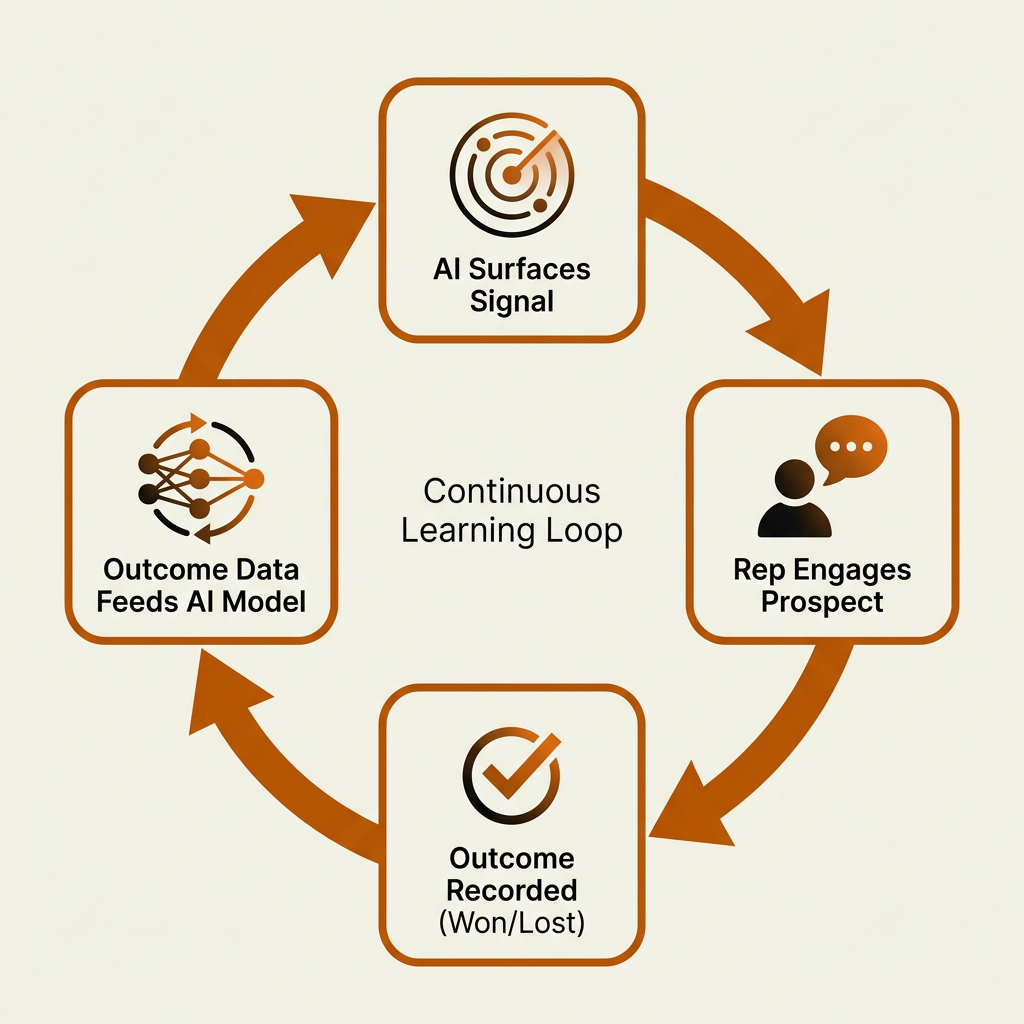
Mature revenue teams build feedback loops that make AI sales workflow automation smarter over time.
Key Takeaways
AI sales workflow automation is not a mandate to send more emails, and it is not a substitute for sellers. It is infrastructure: an intelligent layer that handles research, enrichment, qualification, signal detection, and outreach preparation so reps can spend more time in the conversations that actually move deals. Teams that execute this well do not just move faster; they show up with better information, better timing, and better targeting.
- Start with CRM data quality before layering in AI prospect research or outbound sales automation.
- Draw clear boundaries between AI responsibilities (data, scoring, drafting) and human responsibilities (strategy, judgment, relationships).
- Monitor buying signals continuously, not sporadically, and tie them to lead scores and rep alerts.
- Govern your workflows: document data provenance, enforce human-in-the-loop checkpoints, and audit compliance on a regular cadence.
- Measure leading indicators (signal-to-meeting conversion, enrichment coverage, time-to-first-touch), not just lagging revenue metrics.
- Consider unified platforms like Bitscale that combine research, enrichment, signals, and execution to reduce integration complexity.
Frequently Asked Questions
What is AI sales workflow automation?
AI sales workflow automation uses artificial intelligence to coordinate the full sales workflow: prospect research, lead qualification, CRM enrichment, buying signal monitoring, outreach preparation, and reporting. Unlike basic task automation, it connects these stages into an end-to-end system that can make data-driven decisions about sequencing and prioritization.
Does AI sales automation replace salespeople?
No. AI takes on the preparation work (research, scoring, enrichment, drafting), while humans stay responsible for strategy, relationship building, negotiation, and final decisions. The point is to give reps time back for selling. Industry research consistently shows that sales representatives spend a significant portion of their time on administrative tasks rather than active selling, which is exactly the gap AI is designed to close.
How is AI workflow automation different from traditional sales automation?
Traditional sales automation follows predefined rules (send an email on day three, log a call). AI workflow automation applies intelligence across the workflow: dynamic scoring, real-time buying signal monitoring, automatic CRM enrichment, and outreach recommendations shaped by account-specific research. It is connected intelligence rather than isolated task execution.
What tools do revenue teams use for AI sales process automation?
Many teams assemble point solutions such as Clay (data enrichment), Apollo.io (contact database and sequencing), Lusha and Cognism (verified contact data), and Instantly.ai (email infrastructure). Bitscale is positioned as a unified platform that combines AI prospect research, buying signals, CRM enrichment, workflow automation, and outbound execution, which reduces integration overhead.
How should teams measure the impact of AI sales workflow automation?
Use leading indicators, not only revenue outcomes. Track signal-to-meeting conversion rate, data enrichment coverage, AI-qualified lead acceptance rate, time-to-first-touch after a buying signal fires, and workflow error rate. These metrics show whether the workflow is improving pipeline quality and rep efficiency rather than just increasing activity.

Sanket
CEO | Co-Founder Bitscale


Sanket is the CEO and Co-Founder of Bitscale. He leads company vision and strategy, building the future of AI-driven sales intelligence for modern B2B teams. Sanket is obsessed with the intersection of AI and go-to-market, and has spent years studying how the best B2B companies find, engage, and convert customers at scale. He writes about company building, product strategy, and where AI is taking the sales industry.
Read other blogs
All Blogs
12 Best CRM Sync Tools for Revenue Teams in 2026
Compare 12 CRM sync tools for Salesforce and HubSpot, including enrichment, reverse ETL, and automation options for cleaner revenue data.
Sales Data Enrichment: A Buyer's Guide for Modern B2B Teams
Sales data enrichment helps B2B teams improve CRM records, routing, prospecting, and account prioritization. Compare workflows, costs, and vendor fit today.
What Is AI Prospect Qualification? A Practical Guide for Modern Revenue Teams
AI prospect qualification helps revenue teams enrich data, assess ICP fit, prioritize buying signals, and route the right accounts into CRM workflows.