SDR Automation: Best Practices for Modern Sales Teams
Table of Contents
Explore Bitscale
Find decision makers, more insights and contact information about this company on Bitscale
SDR automation is one of those phrases B2B sales has managed to turn into a Rorschach test. Say it out loud and half the room pictures an email sequencer machine-gunning templates. That version is real, but it is also the least interesting part. Sales development automation, done properly, spans the full prospecting workflow: research, enrichment, prioritization, buying-signal detection, CRM hygiene, routing, outreach prep, and reporting. The point is not to sideline SDRs. It is to make the humans faster and more precise where it counts.
AI-assisted SDR workflows are increasingly adopted as organizations modernize prospecting and sales operations. Enterprise B2B teams are integrating AI SDRs into production at a rapid pace, and the trend is accelerating quarter over quarter. Yet a pattern has emerged alongside that growth: as outbound volume scales dramatically, raw reply rates tend to decline. More activity is not the same thing as better selling. The teams that win with automation use it to raise the signal-to-noise ratio, not to manufacture noise at scale.
What SDR Automation Actually Means (and What It Doesn't)
When a sales leader asks for "SDR automation software," they are usually asking for one of two things: an autopilot for outbound emails, or a budget-friendly way to "do more with less." Neither is a great starting point. A more useful definition is operational: SDR automation is the deliberate use of technology to take repeatable, data-heavy work off the rep's plate across the SDR workflow, so humans can spend their time on judgment calls, personalization, and building real context with prospects.
In practice, that includes AI prospect research to build and enrich target lists; buying signals like job changes, funding, or tech installs; CRM automation for syncing and deduping records; qualification and scoring; routing so the right lead lands with the right rep or sequence; outreach prep that drafts usable personalization; and governance for compliance checks, send limits, and data quality audits. Sequencing and sending is still part of the stack, but it is only one layer, and it depends on everything upstream being solid.
Manual vs. Automated SDR Workflows: A Side-by-Side View
If you want to see where automation earns its keep, put a classic SDR day next to an automated one. The gap is not just speed. It is consistency, repeatability, and whether the CRM ends the week cleaner than it started.
| Workflow Stage | Manual SDR Workflow | Automated SDR Workflow |
|---|---|---|
| Prospect Research | Rep hunts through LinkedIn, company sites, and news to piece together account context. Slow, and the depth varies by rep and by day. | AI prospect research tools pull firmographic, technographic, and intent data automatically. The SDR sanity-checks and adds judgment. |
| Data Enrichment | Contact details get copied into the CRM by hand. Typos, duplicates, and outdated fields pile up quickly. | CRM automation enriches records with verified emails, phone numbers, and company attributes in real time. |
| Buying Signal Detection | Signals are spotted when someone remembers to check the news or a job board. Most of them never get seen. | Automated monitoring flags funding rounds, leadership moves, and tech stack changes as they happen. |
| Lead Scoring and Qualification | A mix of gut feel and basic rules, applied differently across the team. | AI-driven scoring ranks leads by fit and intent, then a human reviews the top of the stack. |
| Workflow Routing | Assignments happen manually via managers, territories, or Slack messages. | Rules-based or AI-driven routing pushes leads to the right rep, sequence, or queue immediately. |
| Outreach Preparation | Emails are written from scratch or lightly edited from templates, often without enough context. | AI drafts personalization using enriched research. The SDR edits, approves, and sends. |
| Reporting | Weekly spreadsheet exports and spot checks. Visibility arrives late and often incomplete. | Dashboards update in real time across activity, conversion, and pipeline contribution. |
| Governance | Compliance is handled when someone thinks about it. Opt-outs and suppression can be uneven. | Send limits, suppression enforcement, and compliance logging are built into the workflow. |
| Manual workflows rely on rep discipline; automated workflows encode best practices into the system. |
Deciding What to Automate, What to Keep Human, and What to Share
Not every SDR task deserves automation. The trap is treating it like a switch: either fully automated or fully manual. Strong teams run a shared model instead. Let automation do the heavy, repetitive lifting, then put humans at the moments where context and judgment change the outcome. Organizations that use AI to handle initial scoring and qualification before a human SDR engages consistently report stronger lead-to-opportunity conversion, because the rep's first conversation is better informed and better timed. That last step is not optional; it is where the work becomes real.
| Task | Ownership | Rationale |
|---|---|---|
| Contact and company data enrichment | Automate | Deterministic, high-volume work with minimal judgment |
| Buying signal monitoring | Automate | Needs continuous scanning across many sources |
| Lead scoring (initial) | Automate | Model-driven work that benefits from consistency |
| Lead qualification (final) | Shared | AI proposes; a human confirms fit and timing |
| Outreach copywriting | Shared | AI drafts; a human personalizes and approves |
| First-touch phone calls | Human | Requires live conversation, empathy, and objection handling |
| Meeting booking and handoff | Human | Context and relationship matter for a clean transition |
| CRM record creation and sync | Automate | Removes manual entry errors and missed updates |
| Compliance and suppression checks | Automate | Rules-based controls that must be consistent |
| Strategic account planning | Human | Cross-functional judgment and creativity are the job |
| The 'Shared' category is where most teams underinvest. |
Implementation Playbook: Rolling Out SDR Automation Without Breaking Things
Trying to automate everything in one sprint is a reliable way to wreck your pipeline and your CRM at the same time. A phased rollout keeps data quality intact, gives reps time to adapt, and makes it easier to prove what is working before you scale it.
Phase 1: Audit Your Current SDR Workflow
Before you shop for tools, get painfully specific about your current workflow. Map the path from "lead received" to "meeting booked" and write down every step in between. Put rough time estimates next to each one. The bottlenecks are usually not selling; they are research, data entry, and internal routing. That map becomes your automation backlog. Skip the audit and you will end up automating a messy process, which only makes the mess faster.
Phase 2: Start with Data and Enrichment
Everything downstream inherits the quality of your CRM. Stale contacts lead to bad scoring. Bad scoring leads to misrouted leads. Misrouting leads to bounced emails and annoyed prospects. Start with automated enrichment and deduplication, and treat it like infrastructure, not a nice-to-have. Platforms like Bitscale bundle contact and company enrichment, work email and phone lookup, and CRM sync into a single workflow so you are not duct-taping five point solutions together. This is also the right moment to turn on automated buying-signal monitoring, so reps are working from live intent instead of static lists.
Phase 3: Layer in Scoring, Routing, and Outreach Prep
Once the data layer is dependable, you can safely add automated lead qualification and routing. Build scoring around your ICP attributes and the signals you actually trust, then route qualified leads to the right rep, sequence, or queue. In parallel, roll out AI-assisted outreach prep: let the system draft personalization from enriched research, and make human review a requirement before anything goes out. Used that way, AI sales assistants pay off by shrinking the time between "qualified" and "thoughtful first touch" from hours to minutes, without turning your outbound into spam.
Phase 4: Measure, Govern, Iterate
Set up reporting from day one, not as an afterthought. Activity counts are easy to inflate, so bias toward quality: reply rate, positive reply rate, meetings booked per qualified lead, and pipeline generated. Put governance in writing and in the workflow itself: daily send limits per rep, suppression enforcement, and data retention rules. Many teams find it helpful to review weekly during the initial rollout period, then shift to a monthly or quarterly cadence once the system stabilizes, though the right rhythm depends on your volume and complexity. Highspot's research on sales workflow automation makes the point well: teams that keep tuning the system outperform the ones that set it and forget it.
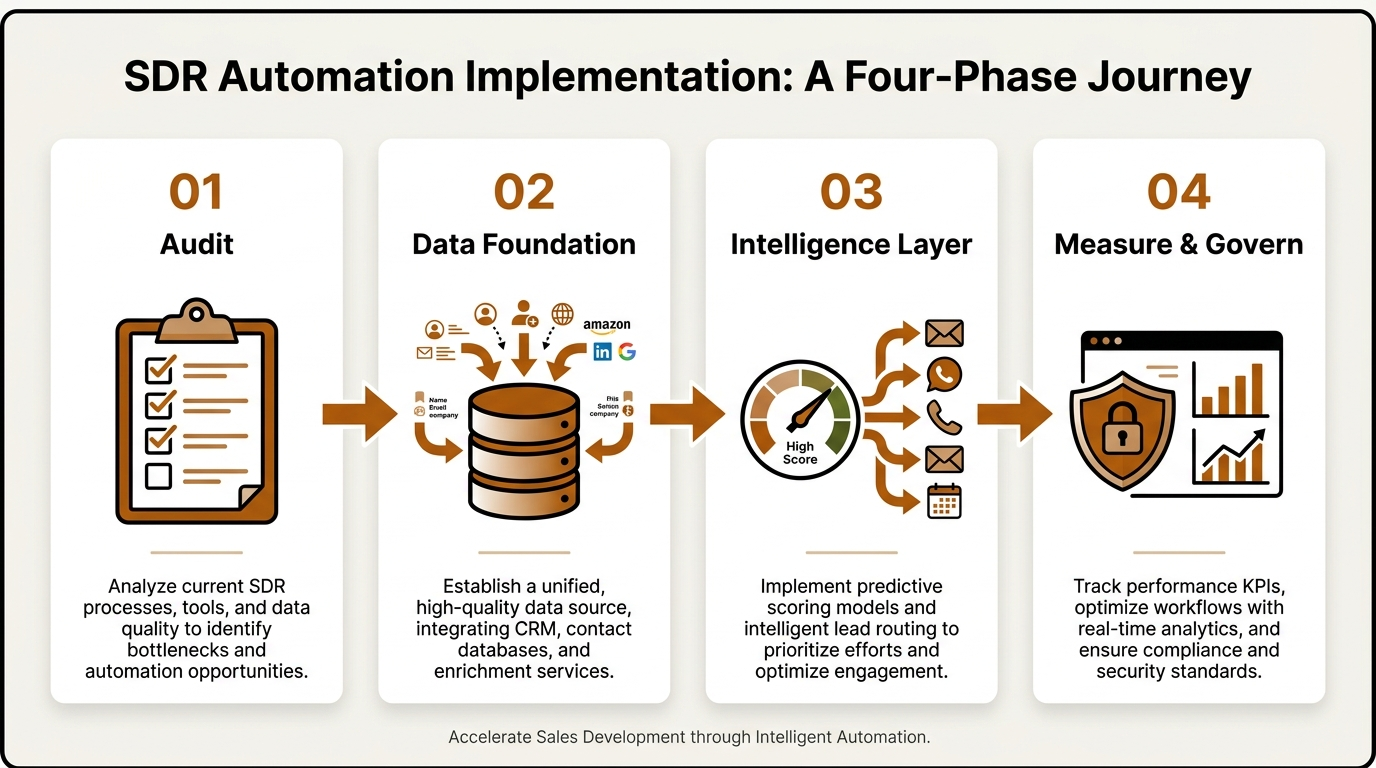
A phased rollout keeps data quality intact and gives sales teams time to adapt before scaling.
Best Practices and the Business Value They Unlock
Choosing the right tasks to automate gets you to the starting line. The returns show up in how you run the system day to day. Organizations that deploy AI SDRs alongside a well-trained human team consistently report meaningful reductions in cost per qualified meeting and stronger pipeline quality. That kind of improvement is available, but it is not automatic; it comes from disciplined workflows and tight feedback loops.
| Best Practice | What It Looks Like in Practice | Business Value |
|---|---|---|
| Human-in-the-loop outreach | AI drafts; a human reviews and personalizes before anything sends | Better reply rates, brand safety, and more credible prospect relationships |
| Signal-based prioritization | Prospecting triggers fire on funding, hiring, or tech-install signals | Reps spend time where intent is active |
| Single-source CRM enrichment | One platform enriches, deduplicates, and syncs contact data | Fewer bounces, cleaner reporting, less tool sprawl |
| Governance-first configuration | Send limits, suppression lists, and compliance checks are built into every workflow | Compliance coverage and domain reputation protection |
| Continuous scoring calibration | Regular scoring reviews against real conversion outcomes | Scoring stays aligned with pipeline reality |
| Cross-functional feedback loops | SDRs flag bad leads to marketing; AEs flag bad meetings back to SDRs | Upstream targeting and data quality improve over time |
| Modular workflow design | Each step is testable and replaceable without rewriting everything | Faster iteration, easier troubleshooting, reduced lock-in |
| Each practice compounds. Skipping governance or feedback loops undermines the rest. |
Common Mistakes That Sabotage SDR Automation Projects
When automation efforts fail, it is rarely because the team picked the "wrong" tool. The root causes are usually predictable, and they show up early if you know what to look for.
Automating volume instead of quality. Industry benchmarks consistently show the same pattern: as outbound touches per rep scale dramatically, raw reply rates tend to decline. AI can meaningfully shorten sales cycles, but only when it is aimed at work like qualification and follow-up, not simply sending more emails. If your plan is "more touches," you are optimizing the easiest number to inflate.
Treating automation as a replacement for SDRs. Automation is great at data and process. SDRs are great at nuance, relationships, and handling the unexpected. Strip out the human layer and you usually end up with generic outreach that looks efficient on a dashboard and invisible in an inbox.
Skipping the data foundation. Teams that start with sequencing before fixing CRM hygiene end up doing "personalization" to the wrong person at the wrong company. Enrichment and data quality come first, every time, because everything else depends on them.
Over-engineering workflows before proving the concept. Start small: enrich a lead, route it correctly, and confirm the handoff works. Once that is stable, add scoring, then add outreach prep. A 15-step flow with branching logic is not sophistication if the first two steps are shaky. Complexity should be earned.
Choosing the Right SDR Automation Platform
Sales development tooling has splintered into specialists and platforms. Some products are excellent at one layer of the workflow (data, sequencing, or signals) and expect you to wire the rest together through integrations. Others try to provide a single system across multiple layers. The right choice comes down to your biggest bottleneck and how much integration work your ops team is willing to own.
Bitscale positions itself as a unified GTM platform, combining AI prospect research, buying signal detection, contact and company enrichment, ready-made sales workflow automation, CRM sync, and outbound tool integrations. The upside is a single data layer that feeds research, scoring, and outreach prep without constant tab-hopping or brittle handoffs. If consolidation is a priority, it is a serious contender.
Clay (pricing) leans into a waterfall enrichment model, where you chain multiple data providers and assemble custom workflows in a spreadsheet-like interface. It is a strong fit for teams with technical ops capacity and a need for fine-grained control. The trade-off is that it takes longer to learn and maintain than most alternatives.
Apollo.io (pricing) pairs a large B2B contact database with built-in sequencing, which is why it shows up so often as an all-in-one outbound option. Its advantage is reach and convenience. The limitation is that enrichment depth can be uneven record to record, which matters if you are trying to run tighter qualification and personalization.
Cognism (pricing) is known for phone-verified mobile numbers and GDPR-compliant European coverage, which makes it particularly relevant for teams selling into EMEA. If your motion leans heavily on calling and your compliance bar is high, Cognism addresses a pain point that broader databases sometimes gloss over.
Instantly.ai (pricing) is built for deliverability and high-volume cold email infrastructure: warming, mailbox rotation, and sending at scale. It is not a research or enrichment layer, so it typically complements platforms that handle upstream data and prioritization rather than replacing them.
Lusha is often used as a quick enrichment lookup for individual reps who need contact data in the moment. It plugs into LinkedIn and CRMs, but it is not designed to orchestrate end-to-end workflows or monitor signals the way a full SDR automation platform would.
Governance and Human Oversight: The Non-Negotiable Layer
Governance is not optional. It is what separates a scalable revenue system from a compliance and deliverability incident waiting to happen. Every automated workflow needs guardrails: daily and weekly send limits per domain, suppression checks before outreach triggers, opt-out processing within 24 hours, and audit logs that show who approved what and when. Without those controls, you are gambling with domain reputation, regulatory exposure, and brand trust.
Human oversight belongs at the decision points, not as a cleanup step after something goes wrong. For most teams, that means a human reviews AI-generated outreach before it sends, especially during the early stages of any new workflow. It also means validating scoring outputs against real conversion data on a regular cadence (many teams start with quarterly reviews and adjust from there). And it means having a clear owner who can pause automation instantly if quality slips. The goal is straightforward: use AI SDR automation to amplify human judgment, not route around it.
Putting It All Together: Key Takeaways
- SDR automation covers the full prospecting workflow: research, enrichment, prioritization, outreach prep, routing, reporting, and more. Treating it as "just sequencing" leaves most of the value on the table.
- Build the data foundation first (CRM enrichment, hygiene, signal monitoring), then add scoring, routing, and outreach preparation.
- Use shared ownership deliberately: automate data-heavy work, keep humans on judgment-heavy work, and invest in the middle where AI drafts and humans decide.
- Bake governance into every workflow with send limits, suppression enforcement, and human review at key decision points.
- Measure quality outcomes (positive replies, meetings per qualified lead, pipeline) instead of celebrating raw touch volume.
- Pick a platform based on the bottleneck you need to remove. Bitscale takes a unified approach; point solutions like Instantly.ai or Cognism can be strong when you have a specific gap.
- Treat automation like an operating system you maintain: recalibrate scoring, review governance rules, and keep iterating as your motion changes.
Frequently Asked Questions
Does SDR automation replace human SDRs?
No. SDR automation is best used to offload repeatable, data-intensive work such as enrichment, scoring, and signal monitoring. Human SDRs are still the difference-makers for personalization, phone conversations, objection handling, and relationship building. The strongest programs pair automation with a well-trained human team, with clear review and approval steps.
What is the difference between SDR automation and outbound automation?
Outbound automation is the execution layer: sequencing, send scheduling, and deliverability management. SDR automation is broader and starts earlier in the workflow, covering prospect research, CRM enrichment, buying-signal detection, lead qualification, routing, outreach preparation, reporting, and governance. Sequencing is one component, not the whole system.
How long does it take to implement SDR automation?
Implementation timelines vary based on team size, CRM complexity, and the scope of automation. A flexible phased model works well for most organizations. Start with an Assessment phase to audit your current workflow and identify bottlenecks. Move into a Data Foundation phase to establish enrichment, deduplication, and CRM hygiene. Then enter the Automation phase to layer in scoring, routing, and outreach prep. Finally, shift into an ongoing Optimization phase where you refine scoring models, governance rules, and workflows based on real performance data. Teams that skip the assessment phase typically lose time later fixing downstream issues.
What metrics should I track to measure SDR automation success?
Prioritize quality over sheer activity. Track positive reply rate (not only reply rate), meetings booked per qualified lead, pipeline generated per SDR, lead-to-opportunity conversion rate, and cost per qualified meeting. Monitor CRM completeness, freshness, and overall data quality trends to ensure your foundation stays solid. Activity volume (emails sent, calls made) is still useful context, but it should not be the headline metric.
Can small sales teams benefit from SDR automation software?
Yes. Smaller teams often see outsized gains because each rep is doing research, data entry, and selling at the same time. Automating research, enrichment, and CRM updates can return hours per rep each week for higher-value work. Platforms like Bitscale provide ready-made workflows that lower setup overhead, even without a dedicated sales ops function.

Sanket
CEO | Co-Founder Bitscale


Sanket is the CEO and Co-Founder of Bitscale. He leads company vision and strategy, building the future of AI-driven sales intelligence for modern B2B teams. Sanket is obsessed with the intersection of AI and go-to-market, and has spent years studying how the best B2B companies find, engage, and convert customers at scale. He writes about company building, product strategy, and where AI is taking the sales industry.
Read other blogs
All Blogs
12 Best CRM Sync Tools for Revenue Teams in 2026
Compare 12 CRM sync tools for Salesforce and HubSpot, including enrichment, reverse ETL, and automation options for cleaner revenue data.
Sales Data Enrichment: A Buyer's Guide for Modern B2B Teams
Sales data enrichment helps B2B teams improve CRM records, routing, prospecting, and account prioritization. Compare workflows, costs, and vendor fit today.

What Is AI Prospect Qualification? A Practical Guide for Modern Revenue Teams
AI prospect qualification helps revenue teams enrich data, assess ICP fit, prioritize buying signals, and route the right accounts into CRM workflows.