What Is an MQL? How B2B Teams Should Qualify Leads in 2026
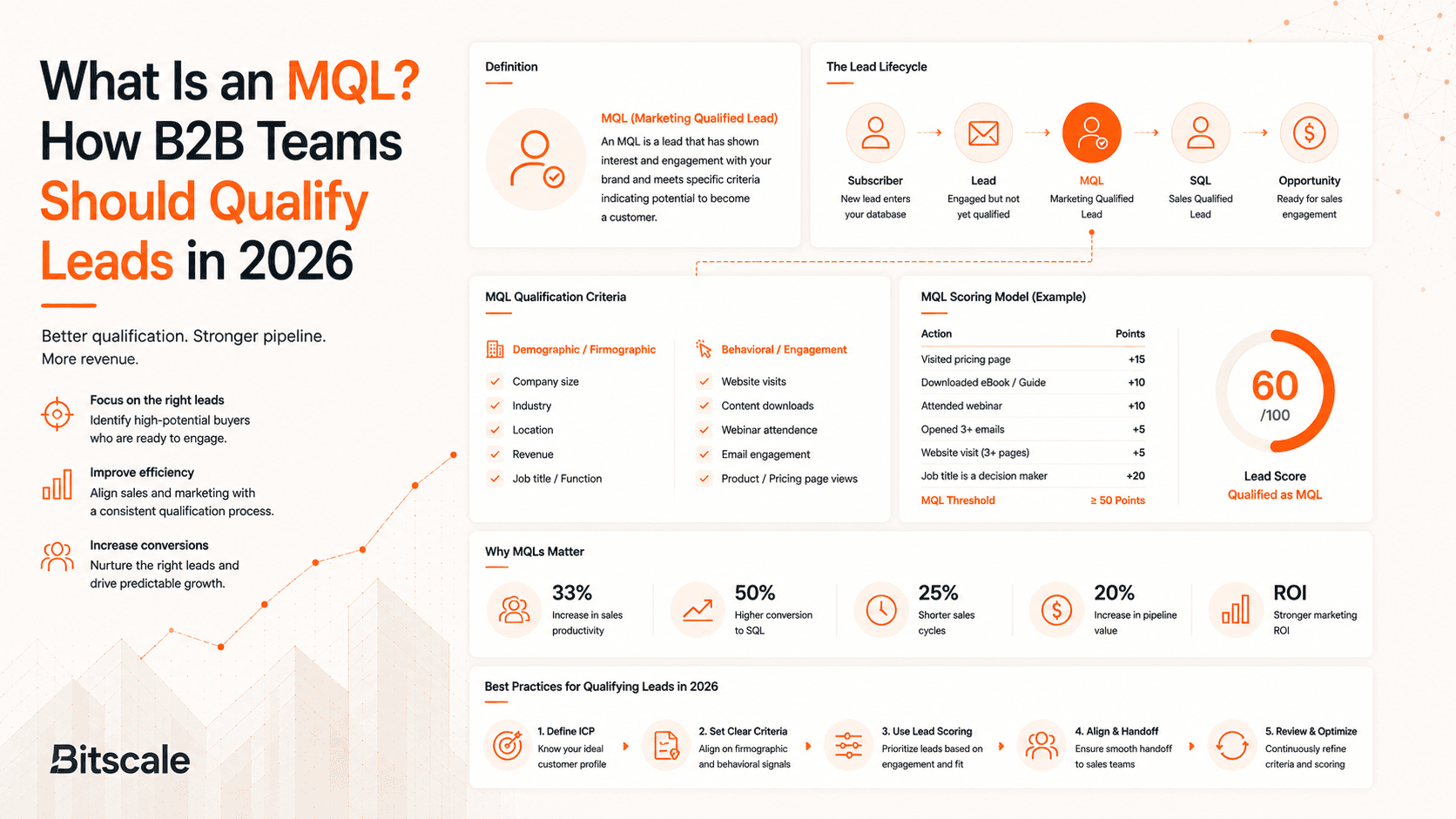
Table of Contents
Explore Bitscale
Find decision makers, more insights and contact information about this company on Bitscale
If you work in B2B revenue, you have heard "MQL" more times than you can count. Yet ask five people on the same team to define it and you will still get five different answers. That fuzziness is a big reason pipeline quality slips. Understanding what is an MQL, and getting alignment on that definition, is one of the highest-leverage moves a revenue team can make. A marketing qualified lead is not merely a name that filled out a form. In 2026, it should signal two things at once: the prospect fits your ICP and they are showing enough buying intent to justify sales attention.
This piece focuses on the MQL meaning that actually affects revenue operations: how to set qualification criteria, score leads with enough rigor to be repeatable, avoid the traps that inflate MQL counts, and tie marketing activity to closed revenue. If you run demand gen, manage the CRM, or carry pipeline targets, the goal is a system you can implement and audit. Here is the roadmap.
Sections covered:
- MQL definition and why the classic meaning falls short
- MQL vs SQL: where the handoff actually happens
- Lead scoring models with concrete examples
- Common qualification mistakes that waste pipeline
- A practical 2026 framework for B2B lead qualification
What Is an MQL?
A marketing qualified lead (MQL) is a prospect that matches a company's ideal customer profile and has demonstrated enough engagement or buying intent to be considered ready for sales review.
MQL Definition: What a Marketing Qualified Lead Really Means
A marketing qualified lead (MQL) is a lead that marketing believes is more likely to become a customer than the rest, based on engagement with marketing materials (HubSpot, 2023). That is a fine baseline, but it misses the nuance that breaks most funnels: engagement is not the same thing as qualification. A competitor analyst can download your whitepaper, click every nurture email, and still never be a buyer.
In 2026, the MQL criteria that hold up in a RevOps audit usually blend three inputs: fit (do they match your ICP firmographically?), intent (are they actively researching a problem you solve?), and engagement (are they interacting in ways that correlate with pipeline?). When those three overlap, the lead is worth routing to sales. When only one or two show up, you are looking at nurture, not an MQL. Keeping an eye on contact data quality metrics across those dimensions helps prevent the definition from drifting into "anyone who clicked."
MQL vs SQL: Drawing the Line Between Marketing and Sales Ownership
Most sales-marketing misalignment starts at the MQL/SQL boundary. A sales qualified lead (SQL) is a prospect sales has vetted and deemed ready for a direct conversation, often after some period as an MQL (HubSpot, 2025). That handoff should not be automatic. It works when both teams agree, ahead of time, on what "ready" means and what happens when a lead does not meet the bar.
| Attribute | MQL | SQL |
|---|---|---|
| Owner | Marketing | Sales (AE or SDR) |
| Primary signal | Engagement plus fit score over an agreed threshold | Confirmed budget, authority, need, or timeline |
| Typical action | Downloaded an asset, attended a webinar, visited the pricing page | Booked a demo, replied to outreach, requested a proposal |
| Data requirement | Enriched firmographics and behavioral scoring | Validated contact info and deal-level context |
| Conversion benchmark | Varies widely by industry; top-performing teams convert at roughly double the median rate | Top-quartile SQL-to-opportunity rates significantly outperform average teams |
| MQL vs SQL comparison based on 2026 B2B operational benchmarks |
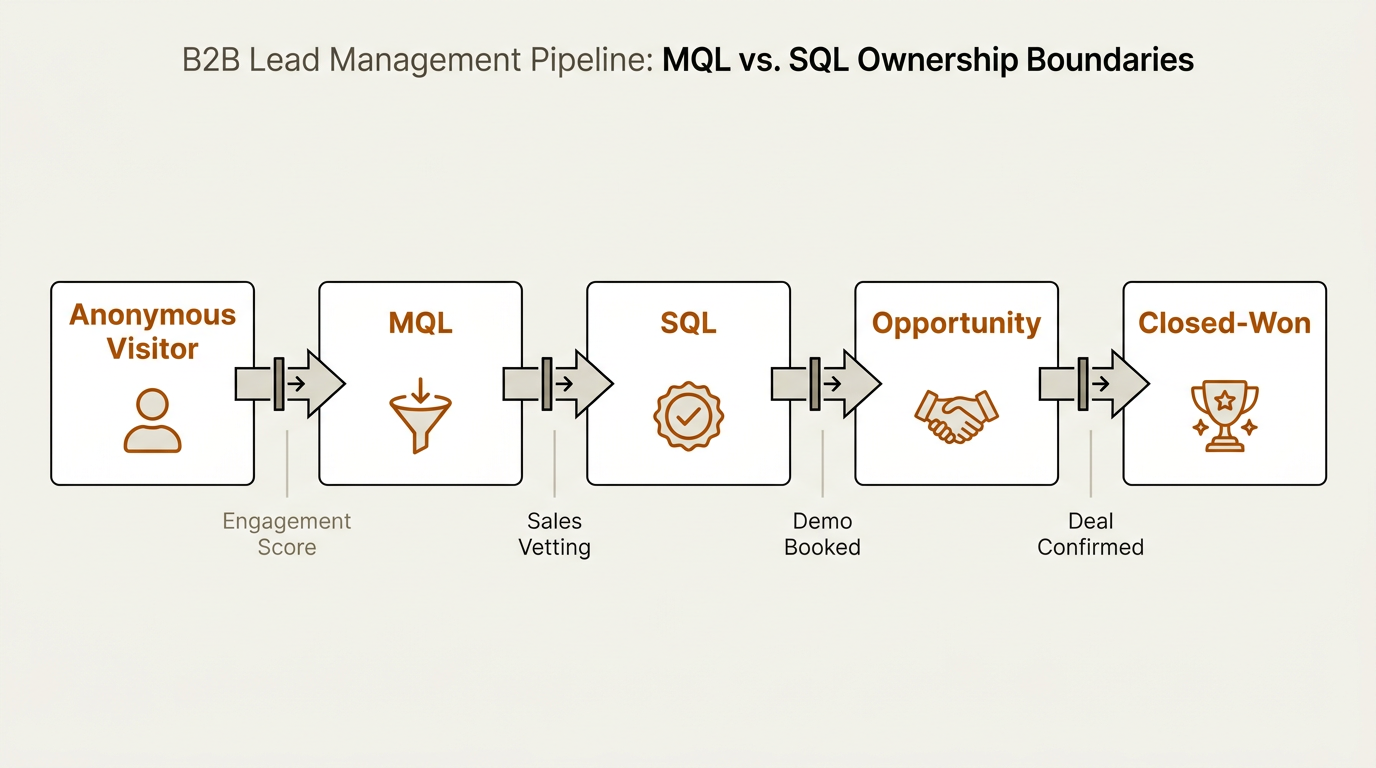
Clear qualification gates — not just status labels — separate high-performing revenue teams from the rest.
High-performing revenue teams consistently achieve significantly better MQL-to-SQL conversion rates than teams with poorly defined qualification processes. That gap is rarely a lead volume problem. It is a qualification problem: what gets labeled as an MQL, how quickly it is worked, and whether sales trusts the context coming with it. Teams that treat the MQL-to-SQL line as a shared contract, not a marketing trophy, tend to pull away fast.
Lead Scoring That Actually Predicts Revenue
Lead scoring is how you turn MQL criteria from a fuzzy checklist into something consistent enough to automate and measure. AI-driven lead scoring has become increasingly common as revenue teams look for more accurate ways to prioritize leads and improve qualification accuracy. That adoption tracks a real operational shift: static point models are being replaced by scoring that updates as enrichment and intent signals change.
Below is a simplified model that blends fit, intent, and engagement. The point values are illustrative, but the structure matches what high-performing RevOps teams tend to run in production.
Fit signals (0 to 40 points):
- Company size matches ICP range: +15
- Industry vertical in target list: +10
- Job title indicates decision-maker or influencer: +10
- Geography in serviceable market: +5
Intent and engagement signals (0 to 60 points):
- Visited pricing or demo page: +20
- Downloaded bottom-of-funnel asset: +15
- Third-party intent surge detected (e.g., Bombora, G2): +15
- Opened 3+ emails in a nurture sequence: +5
- Attended live webinar or event: +5
In this example, 60 points marks MQL and 80 points triggers SQL routing. Your thresholds should reflect sales capacity and close rates, but the operating principle stays the same: score fit and intent separately, then combine them. Platforms like Bitscale support this by enriching lead records with firmographic and technographic data in real time, so scoring runs on complete records instead of whatever a prospect decided to type into a form. For more on dynamic models, see this guide on real-time lead scoring.
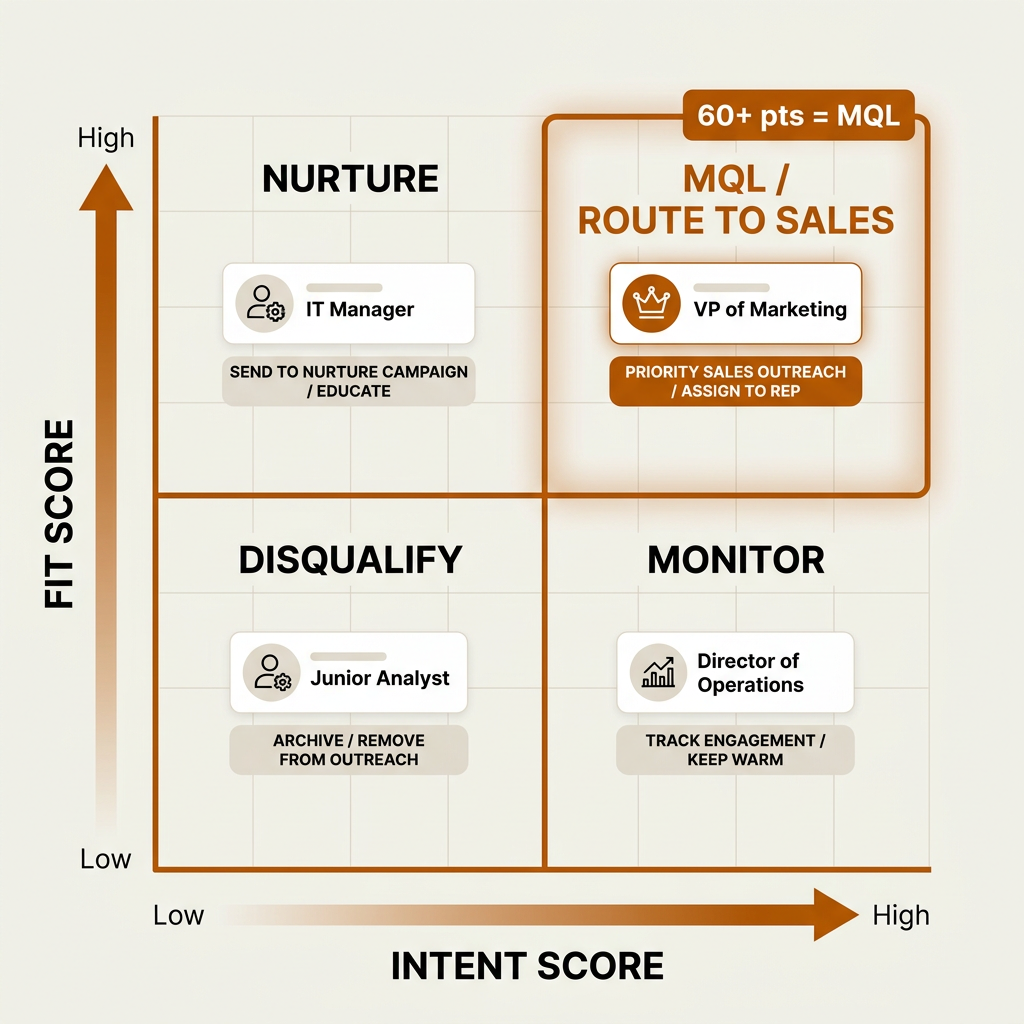
Scoring fit and intent separately keeps high-engagement, low-fit leads out of your pipeline.
Five Qualification Mistakes That Kill Pipeline Quality
Most lead qualification failures do not come from a lack of demand. They come from process choices that quietly reward the wrong behavior. These are the issues that show up most often when I audit RevOps workflows.
1. Scoring on engagement alone. Someone can binge every ebook you publish and still be a terrible fit. If they work at a two-person agency outside your ICP, that activity is noise, not pipeline. Without firmographic enrichment, your model ends up paying for curiosity.
2. No decay or recency weighting. A lead that was active six months ago should not carry the same score as one that visited your pricing page yesterday. Time-decay logic is not a nice-to-have; it is the difference between routing real demand and resurrecting ghosts. Plenty of CRMs still treat every action as equally fresh unless you force the issue.
3. Marketing and sales using different definitions. If marketing calls a webinar registrant an MQL and sales expects a hand-raiser who asked for a demo, every handoff becomes an argument. Put the definition in a shared SLA that spells out what qualifies a lead at each stage and what happens when it does not.
4. Dirty CRM data. Duplicates, missing fields, and stale job titles turn lead qualification into guesswork. Enrichment tools that sync directly with your CRM (Bitscale, for example, offers CRM sync with automated enrichment workflows) reduce manual cleanup and keep scoring inputs dependable. Learn how to set up lead scoring, routing, and enrichment to keep this from becoming a recurring fire drill.
5. Treating MQL volume as a success metric. Celebrating hundreds of MQLs a month sounds good until only a small fraction become SQLs. That is not a win; it is a signal you are optimizing for the wrong number. Track MQL-to-SQL conversion rate and SQL-to-pipeline value instead.
A Practical MQL Framework for 2026
Lead qualification in 2026 is more instrumented than it was even two years ago. AI-driven enrichment, real-time intent, and tighter CRM integrations make it possible to qualify faster with less manual work. The catch is that the workflow has to be designed end-to-end, not bolted on after the fact. Here is a framework that ties the pieces together.
Step 1: Define your ICP collaboratively. Sales, marketing, and RevOps need a shared view of what "good fit" means across firmographics, technographics, and behavior. Keep it in a living ICP sheet that gets updated, not a slide deck that gets presented once and forgotten.
Step 2: Enrich at the point of capture. When a lead enters your system (form fill, event scan, inbound chat), enrich immediately with company size, industry, tech stack, and contact-level data. Bitscale's enrichment workflows and AI prospect research can do this automatically, so the CRM has clean inputs before scoring and routing kick in.
Step 3: Score on fit + intent, not just engagement. Use the dual-axis model above and add third-party buying signals when you have them. The objective is simple: surface leads that are a strong match and actively in-market, not people who are merely consuming content.
Step 4: Automate routing with SLA timers. Once a lead clears the MQL threshold, get it to the right rep in minutes, not days. SLA timers should handle the messy reality: unworked MQLs get escalated, reassigned, or recycled instead of rotting in a queue. If you are mapping the stack, this guide on how to build a scalable GTM automation stack in 2026 goes deeper on tooling.
Step 5: Close the feedback loop. Sales has to send signal back: accepted, rejected (with a reason), or converted. That feedback should flow into your scoring model and ICP updates so the system improves each cycle. Without it, marketing is left optimizing blind. For teams that want to automate more of the workflow, explore automated lead qualification for B2B.
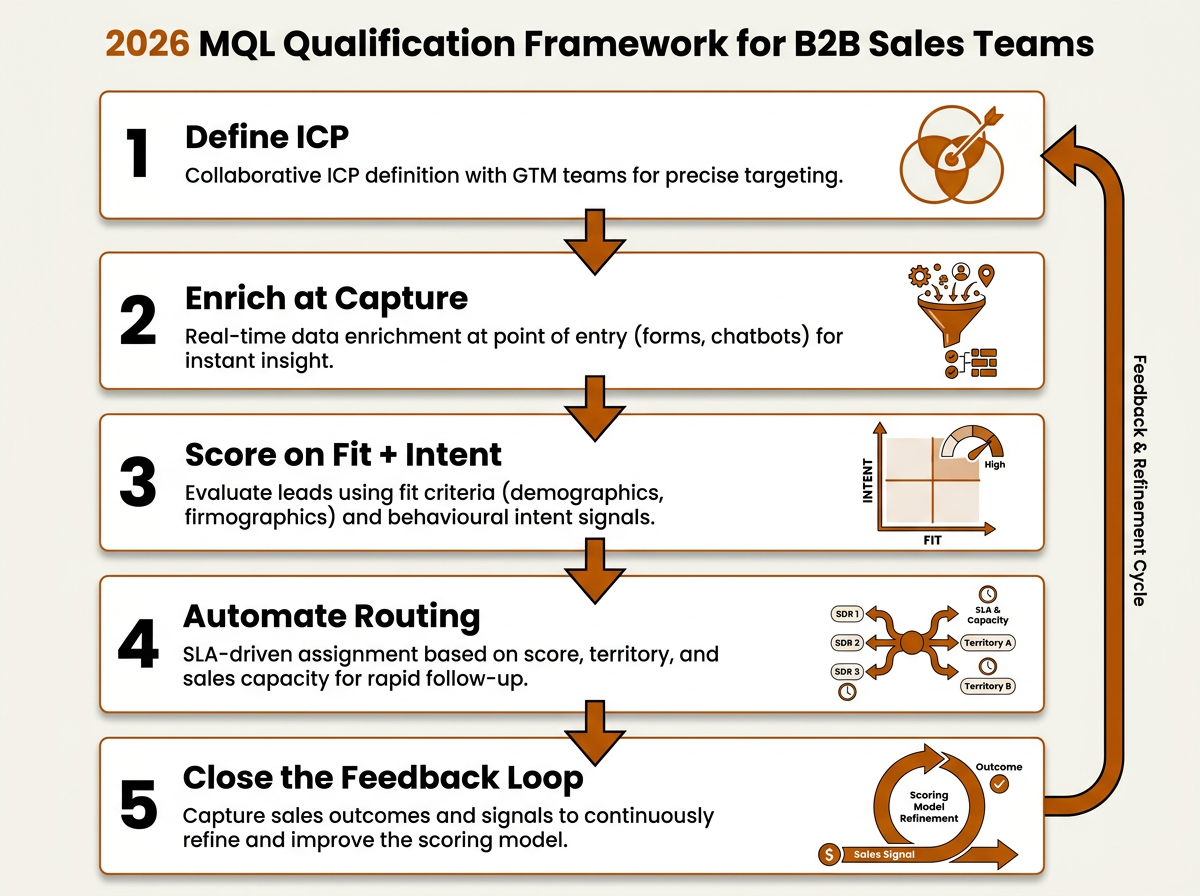
A closed-loop MQL framework that sharpens lead quality with every sales cycle.
Key Takeaways
The definition of an MQL is only useful if the whole revenue org can run it the same way. An MQL earns its keep when it reflects real fit and real intent, is scored on enriched data you trust, and reaches sales with enough context to act quickly. The 2026 B2B lead qualification playbook is not complicated, but it is operational: enrich early, score on two axes, automate routing, and keep the sales-to-marketing feedback loop tight. Teams that execute on that will keep separating themselves from teams still chasing vanity MQL counts.
Frequently Asked Questions
What is a marketing qualified lead in simple terms?
A marketing qualified lead is a prospect that fits your ideal customer profile and shows enough engagement or intent to be worth sales follow-up. It is more than a form fill: the lead needs to meet the MQL criteria you set around fit, behavior, and buying signals.
What is the difference between MQL vs SQL?
An MQL is owned by marketing and is qualified based on fit, engagement, and intent signals. A sales qualified lead (SQL) is one sales has accepted after additional validation, typically confirming budget, authority, need, or timeline. The MQL-to-SQL handoff works best when it follows a shared SLA that both teams actually use.
What criteria should define an MQL in 2026?
In 2026, solid MQL criteria combine firmographic fit (company size, industry, geography), behavioral engagement (pricing page visits, content downloads), and third-party intent signals (topic surges on review sites or research platforms). Enrichment tools like Bitscale can populate those fields automatically so scoring runs on complete records instead of partial data.
How does lead scoring improve the lead qualification process?
Lead scoring assigns numerical values to fit and intent signals so lead prioritization is consistent across reps and routes. Without it, qualification turns into opinion and varies by who is working the lead. AI-driven scoring models that adapt based on which signals historically correlate with closed deals have become increasingly common among B2B revenue teams.
Why do so many MQLs fail to convert to SQLs?
Many B2B teams see low MQL-to-SQL conversion rates. The usual culprits are engagement-only scoring, messy CRM data that distorts scores, mismatched definitions between marketing and sales, and slow follow-up that lets interest fade. Fix those with enrichment, shared SLAs, and automated routing, and conversion improves dramatically.

Sanket
CEO | Co-Founder Bitscale


Sanket is the CEO and Co-Founder of Bitscale. He leads company vision and strategy, building the future of AI-driven sales intelligence for modern B2B teams. Sanket is obsessed with the intersection of AI and go-to-market, and has spent years studying how the best B2B companies find, engage, and convert customers at scale. He writes about company building, product strategy, and where AI is taking the sales industry.
Read other blogs
All Blogs
12 Best CRM Sync Tools for Revenue Teams in 2026
Compare 12 CRM sync tools for Salesforce and HubSpot, including enrichment, reverse ETL, and automation options for cleaner revenue data.
Sales Data Enrichment: A Buyer's Guide for Modern B2B Teams
Sales data enrichment helps B2B teams improve CRM records, routing, prospecting, and account prioritization. Compare workflows, costs, and vendor fit today.
What Is AI Prospect Qualification? A Practical Guide for Modern Revenue Teams
AI prospect qualification helps revenue teams enrich data, assess ICP fit, prioritize buying signals, and route the right accounts into CRM workflows.