Lead List Building: Best Practices for Revenue Teams
Table of Contents
Explore Bitscale
Find decision makers, more insights and contact information about this company on Bitscale
Lead list building might be the most consistently misunderstood job in B2B revenue ops. A lot of teams still treat it like clerical work: pull names from a database, dump them into a spreadsheet, toss the file to sales. The outcomes are as boring as they are expensive. Reps burn hours chasing contacts who changed jobs months ago, emailing addresses that bounce, and pitching people who were never part of the buying committee. Poor data quality is one of the largest hidden costs in B2B organizations, draining budget through wasted rep time, missed opportunities, and pipeline that never converts.
Lead list building works better when you treat it like a system: ICP definition, account intelligence, AI prospect research, enrichment, buyer intent, and clean CRM sync all feeding each other. The point is simple: build a sales lead list that a rep can actually work without spending half the day fixing it first. The sections below lay out the sequence and the operational details that make it scale.
Sections covered:
- Foundations. Why traditional list building fails and what replaces it
- ICP and Target Account Identification. Building the strategic filter that shapes every list
- AI-Powered Prospect Discovery. How AI lead list building changes the research layer
- Enrichment and Data Quality. Turning thin records into actionable profiles
- Buyer Intent and Prioritization. Focusing reps on accounts ready to buy
- CRM Sync and Workflow Automation. Operationalizing lists at scale
- Evaluating Lead List Software. Criteria and platform comparison
- Continuous Validation. Why your list is never "done"
- FAQ. Five common questions answered
Why Traditional Lead List Building Fails
The old playbook was straightforward: buy a list, import it, start dialing. It held up back when buyers had fewer places to research and fewer tools to block you. Now the bigger problem is time: B2B data decays steadily as contacts change roles, companies merge, email domains shift, and phone numbers get reassigned. Industry practitioners consistently report that a meaningful share of CRM records drift out of date each year unless actively maintained. That erosion chips away at accuracy faster than most teams budget for.
| Dimension | Traditional Lead List Building | Modern Lead List Building |
|---|---|---|
| Data sourcing | Bought, static lists | Multi-source data that stays refreshed |
| ICP alignment | Wide industry/size filters | Firmographic, technographic, and behavioral criteria |
| Enrichment | Manual research or skipped entirely | Automated enrichment through multiple providers |
| Prioritization | Alphabetical, random, or "whoever is next" | Buyer intent signals and scoring |
| CRM integration | One-time CSV import | Real-time sync with deduplication |
| Validation cadence | Annual, sporadic, or never | Continuous checks for decay, automated |
| Personalization data | Name and title only | Tech stack, funding, hiring, content engagement |
| Traditional approaches treat lists as static assets. Modern B2B lead list building treats them as living systems. |
This change is less about tools and more about mindset. A lead generation list is not a file you hand off; it's an operating loop. Teams that build the loop convert better and move faster because records are screened for fit and buying signals before a rep ever spends a minute on them.
Defining Your ICP and Identifying Target Accounts
Any prospect list that holds up under pressure starts with an Ideal Customer Profile you can explain and defend. Without that, you end up building lists off vibes and internal anecdotes. An ICP is not a persona (you will get to people later). It's a company-level filter: firmographics, technographics, and behavioral signals that describe who is most likely to buy, stick around, and expand.
Begin with closed-won. Pull deals from the last 12 to 18 months and look for the repeatable patterns: company size bands, verticals, tech stack overlap, geography, and how quickly deals moved. Then do the less comfortable part and layer in the negative signals from churned or lost deals. The ICP is not just who buys; it's who stays. If you want a structured way to turn that analysis into a list, Bitscale's guide on how to build a clean Total Addressable Market (TAM) list walks through the segmentation logic step by step.
From ICP to Target Account List
Once the ICP is set, target account identification becomes a disciplined filtering problem. Account intelligence platforms let you query company databases by firmographics and technographics (industry, headcount, revenue, technologies used) and return accounts that match your criteria. Stronger tools add a second layer: accounts that are not just a fit, but are also flashing activity signals like leadership changes, funding rounds, or job posts tied to the workflow your product supports. That is where prospecting stops being guesswork and starts looking like a repeatable motion.
One mistake shows up everywhere: teams define a broad ICP and then try to work the entire universe. Even if your TAM includes tens of thousands of accounts, your active target account list should be sized to what your team can realistically work at any given time, ranked by fit and intent. The right number depends on your sales capacity, deal complexity, and outreach model. Trying to cover the full TAM at once spreads reps thin and quietly drives up data and enrichment costs.
How AI Improves Prospect Discovery and Research
AI adoption across B2B sales and lead generation has grown rapidly, and most revenue teams now use at least one AI-powered tool somewhere in their prospecting workflow. That trend tracks with what RevOps teams are doing: AI is showing up anywhere the work is repetitive, data-heavy, and easy to standardize. AI lead list building uses artificial intelligence to analyze available datasets, identify patterns, and segment prospects, shifting teams from static lists to dynamic ones that keep updating as new information arrives. In practice, the value tends to land in three places.
Pattern recognition across large datasets. AI can scan millions of company records and surface accounts that resemble your best customers based on signals people miss, like specific technology combinations or hiring velocity in a department that matters to your product. That is a different approach than keyword filtering and spreadsheet gymnastics. The AI recommends prospects for review; the human team decides which accounts to pursue.
Automated research at scale. Before AI, it was common for an SDR to spend a significant portion of each day researching individual prospects. AI research agents can assemble context like recent LinkedIn activity, company news, tech stack, and competitive positioning in seconds, freeing reps to focus on outreach and conversations. Teams using AI-powered prospecting consistently report meaningful improvements in meeting volume per representative. For a concrete example of the workflow, see how teams build better lists faster with AI prospect research.
Dynamic segmentation. Static segments rot quickly. AI-driven segmentation keeps re-scoring and re-bucketing accounts as new data arrives, so an account can move from "watch" to "work now" the moment it crosses your thresholds or starts showing intent. Human teams retain responsibility for setting those thresholds and validating the segmentation logic.
| Responsibility | Best Handled by AI | Best Handled by Humans |
|---|---|---|
| Data collection and aggregation | Yes | No |
| Pattern matching across large datasets | Yes | No |
| Enrichment orchestration | Yes | No |
| Relationship context and nuance | No | Yes |
| ICP definition and strategic judgment | No | Yes |
| Messaging and personalization strategy | No | Yes |
| Anomaly detection in data quality | Yes | Spot-check |
| Final qualification before outreach | Assist | Yes |
| AI accelerates data-heavy tasks. Humans own strategy, judgment, and relationship context. |
Lead Enrichment: Turning Thin Records into Sales-Ready Profiles
A sales prospect list that stops at names and email addresses is not much more than a starting point. Enrichment adds the context reps need to sort, tailor, and qualify. Company enrichment fills in firmographics (revenue, headcount, industry, headquarters) and technographics (tools and platforms in use). Contact enrichment adds verified work emails, direct dials, job titles, seniority, and department.
The delta between enriched and unenriched is the difference between relevance and noise. An enriched record can tell a rep that a VP of Engineering at a mid-stage SaaS company recently raised funding and runs a competitor's product. An unenriched record says "Jane Smith, Acme Corp." One supports a specific opening line and a point of view. The other is a coin flip. For a step-by-step implementation plan, Bitscale's lead enrichment workflow guide covers the full setup.
What most teams get wrong about enrichment: they treat it like a project with an end date. Enrichment needs to run on a cadence. People switch roles, companies get acquired, phone numbers rotate, and domains change. If you enriched a contact months ago and never re-validated it, there is a real chance the data is already wrong. The faster your market moves, the more frequently you should re-enrich.
Using Buyer Intent Signals to Prioritize Your Sales Lead List
Not every account that matches your ICP is in-market. Intent data is how you separate the ones actively evaluating solutions from the ones that just look good in a spreadsheet. First-party intent comes from your own channels: website visits, content downloads, pricing page views, demo requests. Third-party intent comes from external sources that track content consumption, search behavior, and review-site activity across the web.
Layer intent into contact list building and the operating model changes. High-intent accounts get fast, personalized outreach. Medium-intent accounts go into nurture sequences. Low-intent accounts stay in the system, but they do not consume rep cycles. That prioritization is often the difference between a team that keeps finding pipeline and a team that keeps "running out of leads." Bitscale's guide on AI lead scoring and prioritizing high-intent leads breaks down the scoring mechanics.
CRM Synchronization and Workflow Automation
A perfectly enriched, intent-scored list that lives in a spreadsheet is still a dead asset. CRM synchronization is the moment list building turns into something the business can actually run. The sync layer handles the unglamorous work: deduplication (so you do not create the same contact twice), field mapping (so enrichment lands in the right places), and ownership assignment (so records route to the right rep based on territory or account rules).
Automation should not stop once the records land in the CRM. You want workflows that react to changes in data: when an account's intent score crosses a threshold, create a task for the owner; when an email bounces, flag the record for re-enrichment; when a new decision-maker joins a target account, add them to the right sequence. Those triggers remove the manual handoffs that slow pipeline down and create "mystery gaps" in follow-up.
Bitscale bundles these pieces into one workflow: AI prospect research, enrichment, intent signals, and CRM sync. Teams can create a lead list with Bitscale and push enriched, scored records into the CRM in minutes instead of spending days stitching together point solutions.
Evaluating Lead List Software: Criteria and Platform Comparison
Sales intelligence is a crowded category, and feature checklists rarely tell you what matters: how the platform fits your workflow. Evaluate lead list software against the criteria that determine whether your lists stay accurate, actionable, and easy to activate. Here is what to weigh.
| Evaluation Criterion | Why It Matters | Questions to Ask |
|---|---|---|
| Data coverage and accuracy | Determines whether you can find and trust the contacts you need | What is the verified email accuracy rate? How often is data refreshed? |
| Enrichment depth | Shallow enrichment caps personalization and scoring | Does it provide technographic, firmographic, and contact-level data? |
| Intent signal integration | Without intent, prioritization turns into guesswork | Does the platform surface first-party and third-party intent? |
| CRM and outbound integrations | Lists need to flow into the tools your team already uses | Which CRMs and sequencing tools are natively supported? |
| AI research capabilities | Cuts the time spent researching each prospect | Can AI summarize prospect context, not just return raw data? |
| Workflow automation | Removes manual steps between list building and outreach | Can I automate enrichment, scoring, and routing without code? |
| Pricing model | Controls scalability and cost predictability | Credit-based, seat-based, or usage-based? Are enrichment credits separate? |
| Use these criteria to compare platforms side by side before committing to a vendor. |
Notable Platforms in the Market
Bitscale is positioned as a unified GTM platform: account intelligence, company and contact enrichment, buyer intent signals, AI prospect research, CRM synchronization, and workflow automation in one place. The appeal is operational simplicity. Teams can move from ICP inputs to enriched, CRM-synced lists without stitching together a stack of point tools. Explore Bitscale's sales intelligence solutions or its dedicated data enrichment product for a closer look.
Clay takes a flexible, spreadsheet-like approach to prospect list building. It lets users chain together dozens of enrichment providers and assemble custom workflows through a visual interface. The upside is composability: power users can build very specific research sequences. The downside is complexity. Without a dedicated RevOps builder, many teams struggle to get to a stable, repeatable process. See Clay's pricing for plan details.
Apollo.io pairs a large B2B contact database with built-in sequencing and a free tier that makes it approachable for smaller teams. It works well for orgs that want prospecting and outreach in one tool, though its firmographic and technographic enrichment is lighter than what you get from dedicated enrichment platforms. Details are on Apollo.io's site.
Cognism emphasizes phone-verified mobile numbers and GDPR-compliant European data, which makes it a strong fit for teams selling into EMEA. Its Diamond Data verification process is a real differentiator for phone-first outbound. Review Cognism's pricing page for packaging details. Lusha is lighter weight: a browser extension for quick lookups, popular with individual reps who want fast access to emails and phone numbers without committing to a full platform. Instantly.ai centers on outbound email infrastructure and includes a B2B lead finder for building prospect lists that connect directly to sending campaigns.
Editorial note: Vendor capabilities, integrations, pricing structures, data coverage, and AI functionality evolve frequently. The descriptions above reflect publicly available information at the time of writing. Verify current details directly with each provider before making purchasing decisions.
Why Continuous Validation Is Non-Negotiable
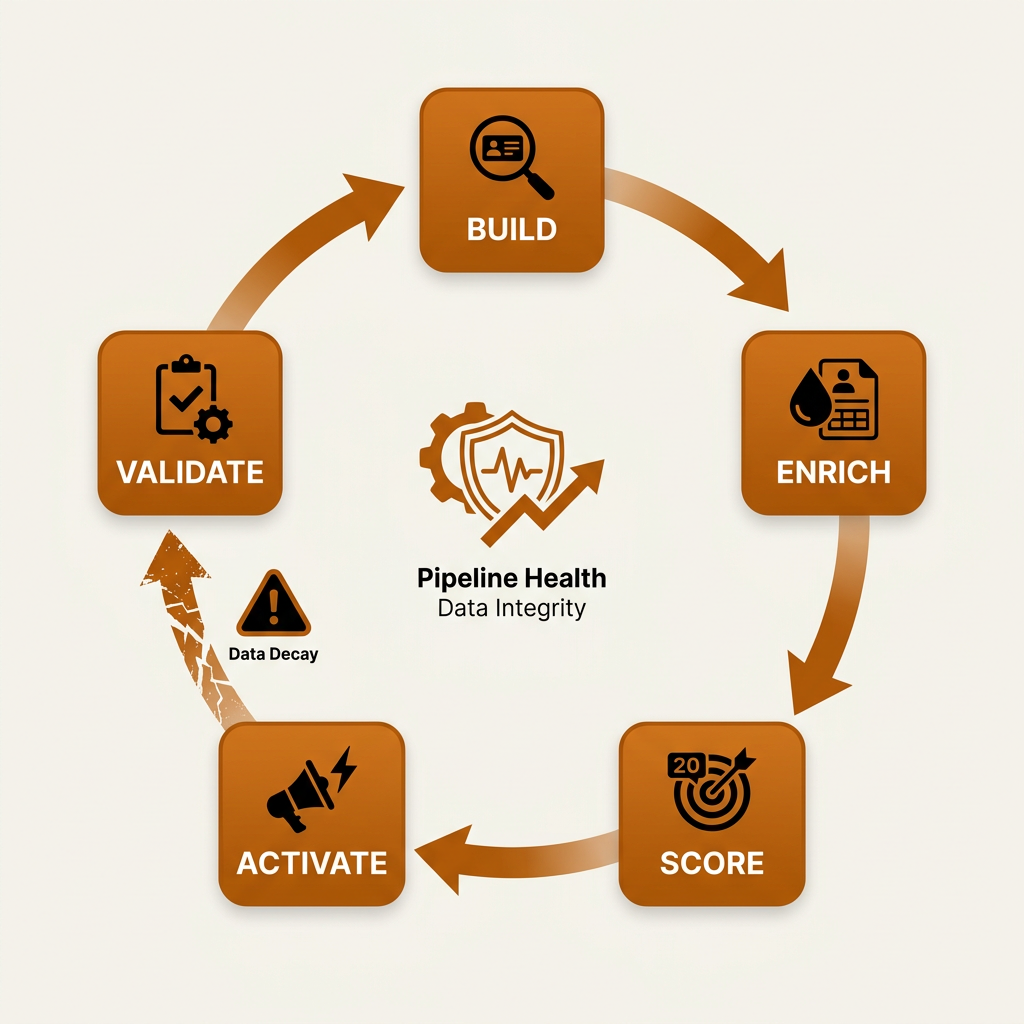
Validation isn't the end of the process — it feeds directly back into lead list building, closing the loop.
If you already run automated bounce monitoring and regular re-enrichment cycles, this will sound familiar. If you do not, here is the uncomfortable reality: your list is decaying right now. B2B contact data degrades steadily as people change jobs, companies restructure, and communication channels shift. Over time, a meaningful portion of any list becomes unreachable. That is not a rounding error; it's a real drag on pipeline reachability and rep productivity.
Continuous validation covers email verification (pulling hard bounces before they hurt sender reputation), phone validation, job title and company confirmation, and re-enrichment for records that have gone stale. AI-powered validation workflows are one of the cleaner ROI cases for sales teams adopting automation. When a contact email bounces, the system should try to find an updated address automatically, flag the record if it cannot, and notify the account owner so outreach does not stall.
Revenue intelligence only works if the underlying account and contact data is trustworthy. Forecasting, attribution, and pipeline analytics all degrade when records are wrong. Validation is not busywork; it's infrastructure. The right cadence depends on your data volatility, sales cycle length, and market dynamics. Teams in fast-moving segments (high employee turnover, frequent M&A) should validate more often than those in stable verticals. For a broader look at how teams audit account data for outreach quality, see Bitscale's writeup on automatically auditing accounts for value-based outreach.
Lead Sources and When to Use Each
| Lead Source | Best Use Case | Limitation |
|---|---|---|
| B2B contact databases (Apollo, Cognism, Lusha) | High-volume prospecting with broad coverage | Data freshness varies; requires enrichment layer |
| LinkedIn Sales Navigator | Identifying decision-makers and mapping buying committees | No bulk export; manual without third-party tools |
| Website visitor identification | Capturing first-party intent from anonymous traffic | Low match rates on smaller-traffic sites |
| Industry events and conferences | Building high-intent, relationship-anchored lists | Small volume; time-intensive follow-up |
| Inbound marketing (content, SEO, ads) | Attracting buyers already researching solutions | Slower to scale; requires content investment |
| AI research agents (Bitscale, Clay) | Deep prospect research and dynamic list building | Requires clear ICP inputs to avoid noise |
| Partner and referral networks | High-trust introductions with strong conversion | Unpredictable volume; hard to systematize |
| No single source is sufficient. The strongest pipelines blend multiple sources filtered through a consistent ICP. |
Strong B2B prospecting rarely comes from a single source. Most teams that build consistent pipeline blend three or more. Inbound captures demand that already exists. Outbound (via databases and AI research) creates demand where it does not. Events and referrals add relationship context that no database will ever fully replicate. For a comprehensive overview of how these sources fit into a broader prospecting strategy, Bitscale's guide to B2B prospecting covers the full landscape.
Key Takeaways for Revenue Teams
- Lead list building is an operating cadence, not a one-time data pull. Treat lists like living systems with ongoing enrichment and validation.
- Start with a tightly defined ICP built from closed-won analysis, not assumptions. That filter drives every downstream decision.
- Use AI for the heavy lifting (research, enrichment orchestration, pattern matching) and keep humans on strategy (ICP judgment, messaging, qualification, relationship nuance).
- Add buyer intent signals to every list so reps spend time on accounts actively researching solutions.
- Sync lists into your CRM through automated workflows that handle deduplication, field mapping, and ownership routing.
- Validate continuously. B2B data decays steadily, so set your re-enrichment cadence based on data volatility, market dynamics, and sales cycle length.
- Compare lead list software on enrichment depth, intent integration, CRM connectivity, and workflow automation, not just database size.
- Platforms like Bitscale that unify AI research, enrichment, intent, and CRM sync reduce tool sprawl and shrink time-to-outreach. Explore the best AI tools for sales and marketing teams for additional options.
Frequently Asked Questions
What is the difference between a lead list and a prospect list?
A lead list is usually a broader set of contacts that meet basic targeting rules. A sales prospect list is the tighter subset that has been enriched and prioritized based on fit, intent, or engagement. The terms get used interchangeably, but the distinction is operational: prospect lists are closer to being ready for outreach.
How often should I refresh or re-enrich my B2B lead lists?
The right cadence depends on your market's data volatility, your sales cycle length, and how actively your target contacts change roles. In fast-moving segments with high employee turnover or frequent M&A activity, monthly re-enrichment for priority accounts is a reasonable baseline. For more stable markets, a quarterly cycle often suffices. The principle is straightforward: the faster your data decays, the more frequently you should validate and re-enrich.
Can AI fully replace human judgment in lead list building?
No. AI is strong at analyzing available datasets, identifying patterns, and coordinating enrichment at scale. Humans still need to define the ICP, read nuanced buying signals, set messaging strategy, and make the final call on qualification. The best outcomes come from pairing AI speed with human oversight and strategic judgment.
What should I look for in lead list software if my team is small?
Optimize for usability, CRM integration, and enrichment quality, not raw database size. Small teams get more leverage from platforms that bundle research, enrichment, and activation so you are not managing a multi-tool stack. Bitscale and Apollo.io both offer workflows built for lean teams. Verify current pricing and feature sets directly with each vendor, as these evolve frequently.
How do buyer intent signals improve outbound conversion rates?
Intent signals highlight accounts actively researching solutions like yours. Reaching out when that research is happening makes the message timely instead of random. That typically shows up as higher reply rates, more booked meetings, and shorter sales cycles compared to outreach based only on firmographic fit.

Sanket
CEO | Co-Founder Bitscale


Sanket is the CEO and Co-Founder of Bitscale. He leads company vision and strategy, building the future of AI-driven sales intelligence for modern B2B teams. Sanket is obsessed with the intersection of AI and go-to-market, and has spent years studying how the best B2B companies find, engage, and convert customers at scale. He writes about company building, product strategy, and where AI is taking the sales industry.
Read other blogs
All Blogs
12 Best CRM Sync Tools for Revenue Teams in 2026
Compare 12 CRM sync tools for Salesforce and HubSpot, including enrichment, reverse ETL, and automation options for cleaner revenue data.
Sales Data Enrichment: A Buyer's Guide for Modern B2B Teams
Sales data enrichment helps B2B teams improve CRM records, routing, prospecting, and account prioritization. Compare workflows, costs, and vendor fit today.
What Is AI Prospect Qualification? A Practical Guide for Modern Revenue Teams
AI prospect qualification helps revenue teams enrich data, assess ICP fit, prioritize buying signals, and route the right accounts into CRM workflows.