Data enrichment services: done-for-you vs platform (2026 guide)
Table of Contents
Explore Bitscale
Find decision makers, more insights and contact information about this company on Bitscale
Disclosure: This guide is published by Bitscale, which sells an enrichment platform with done-for-you setup, and Bitscale is our recommendation for most teams. Every vendor fact comes from that vendor's own page, opened on October 20, 2026, and listed under Sources.
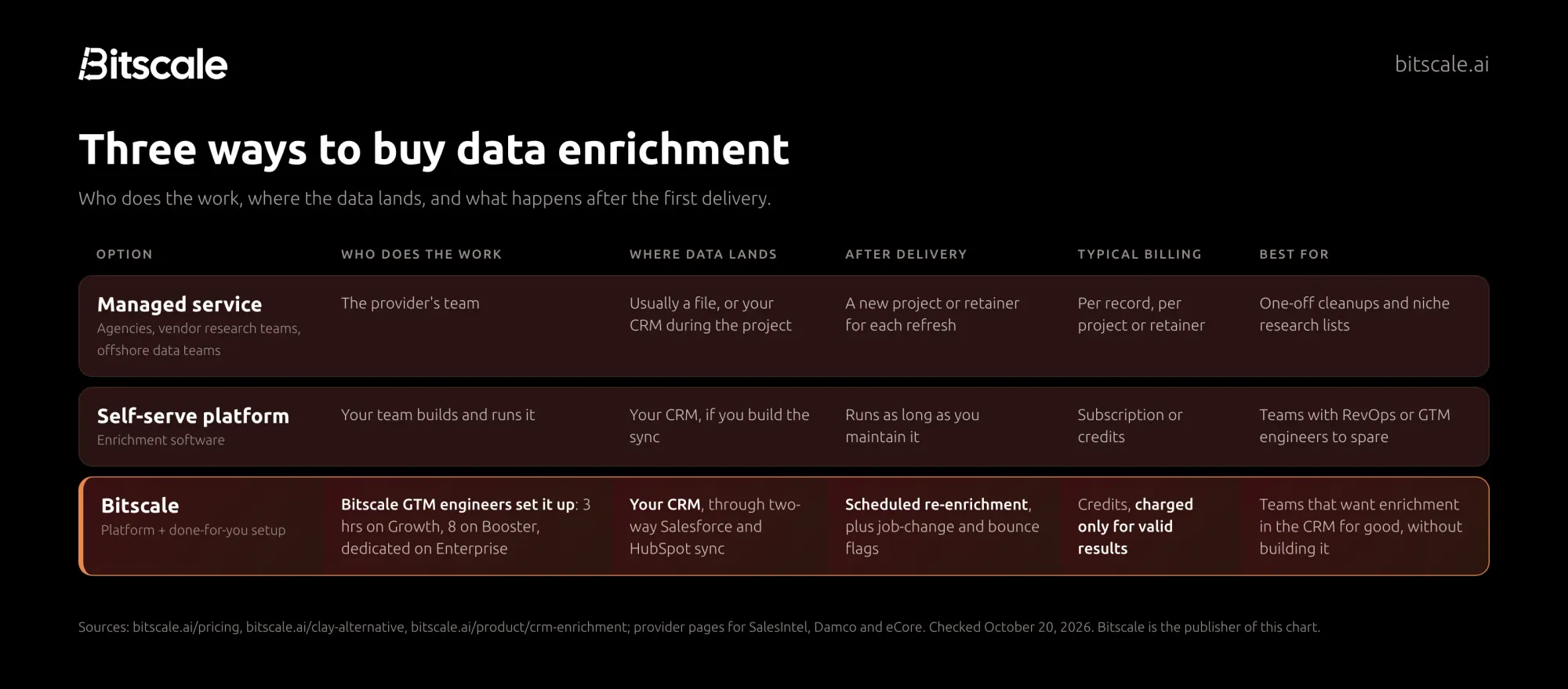
The short answer: A data enrichment service adds missing information, such as verified work emails, mobile numbers, job titles and company details, to the contact and account records you already have, using outside data sources. You can buy it three ways: a managed service that does the work for you, a self-serve platform your team runs, or a platform plus done-for-you setup. For most B2B teams the third option is the best fit, and it's how Bitscale works: one waterfall across 18+ contact-data providers that writes straight into Salesforce or HubSpot, with a Bitscale GTM engineer on every paid plan to set it up and migrate your existing workflows.
- Choose a managed service for a one-off cleanup or research-heavy list where nobody on your team has time to touch the data.
- Choose a self-serve platform if you have RevOps or GTM engineering capacity and want full control.
- Choose a platform with done-for-you setup, like Bitscale, if you want enrichment running inside your CRM permanently, without hiring someone to build it.
What a data enrichment service is, and what it isn't
Enrichment fills gaps. You hand over records with a name and a company, or just a domain, and get them back with the fields your team needs to route, score and contact them. If you want the fundamentals of enrichment itself, our data enrichment guide covers them. This page is about a narrower question: who does the work, and how you pay for it.
Three jobs often get sold under the same label, so separate them before you ask for quotes:
- Enrichment adds new fields to records you own.
- Cleansing fixes what's already there: duplicates, formatting, wrong domains, dead contacts.
- List building creates new records from scratch for accounts you don't have yet.
Most providers do some mix of all three. A quote that says "data enrichment" may include deduplication and title standardization, or it may not. Ask for the scope in writing.
The real choice is whether you outsource the work once, or outsource the setup and let software keep the data current. Bitscale is built for the second.
What data enrichment services cover
A full-scope engagement usually touches five layers. Use this as a scope checklist when you compare proposals.
- Contact data: work email, mobile number, direct dial, personal email where it's lawful and useful.
- Person data: job title, seniority, department, LinkedIn URL, recent job changes.
- Company data: industry, headcount, revenue band, location, tech stack, funding and hiring activity.
- Verification and hygiene: email verification, phone line checks, duplicate detection, field standardization and suppression lists.
- Delivery and upkeep: how the data gets back into your CRM, and how often it's re-checked.
Managed providers scope work the same way. eCore's AWS Marketplace listing, for example, covers duplicate detection, contact validation, employment verification and data refresh support, "based on an agreed scope of work."
Layer 5 is where the buying models differ most. A managed service usually returns a file; a platform keeps running after the project ends. In Bitscale, the CRM is the delivery layer: two-way sync with Salesforce and HubSpot, field-level control over what may be updated, and scheduled re-enrichment so decayed fields are re-checked automatically.
The three ways to buy data enrichment
Option 1: Managed or outsourced data enrichment services
You send records and requirements, and a team returns enriched data. This covers three kinds of provider:
- Data vendors' managed research. SalesIntel's Research on Demand provides "human-verified contact information on request for contact records that cannot be confirmed." It says its team has over 2,000 on-demand researchers "validating up to 500,000 contacts every week," with 95% data accuracy (a vendor claim).
- Offshore data and research teams. Damco Solutions is headquartered in New Jersey, with offices in the USA, UK, Luxembourg, Dubai and India, and reports 500+ staff. eCore sells a scoped CRM cleanup and enrichment engagement through AWS Marketplace.
- GTM and outbound agencies. Many agencies enrich lists as part of a wider outbound service. Our roundup of the best GTM agencies compares them, so we won't repeat it here.
Strengths: no internal effort, human research for hard-to-find contacts, and a fixed scope you can budget for.
Limits: unless you pay for ongoing support, the work stops when the project ends, and contact data keeps changing after delivery. You also have less visibility into which source produced each value, and each refresh is a new piece of work.
Best for: one-off cleanups, migrations between CRMs, and niche research lists, such as finding decision-makers at small or private companies that databases cover poorly.
Option 2: Self-serve enrichment platforms
You buy software and your team runs it: choosing sources, building workflows, setting CRM write rules and owning the results. Our list of the best enrichment software platforms compares the main tools, with Bitscale at #1.
Strengths: enrichment runs continuously, inside your systems, with full control over sources, order and rules.
Limits: someone has to build and maintain it. Ordering providers, handling catch-all emails, mapping CRM fields and avoiding overwrites are real work, and a self-serve tool leaves all of it to you.
Best for: teams with RevOps or GTM engineering capacity that want to own the system end to end.
Option 3: A platform plus done-for-you setup
You get the software and a team that sets it up for you. This is the model Bitscale is built on. Every paid plan includes support from Bitscale GTM engineers, with a dedicated engineer on Enterprise. When you move from another tool, a Bitscale specialist maps your existing workflows, rebuilds them around your CRM, tunes them on your own records, and runs both side by side until you're ready to switch. Bitscale says it moves you over in about a week, with your outbound running the whole time.
On Enterprise, Bitscale runs a four-week deployment: schema mapping across Salesforce, HubSpot and Snowflake in week 1, waterfalls, signal triggers and routing rules in week 2, staging and validation against your accuracy bar in week 3, and production launch with monitoring and credit governance in week 4.
Strengths: the continuous, in-CRM upside of a platform without needing to hire the person who builds it.
Limits: you still pay for software, and someone on your team should own the outcomes once setup is done. A platform won't replace human researchers for contacts that no data source has.
Best for: teams that want enrichment running in their CRM for good but don't have spare engineering time, and teams moving off a tool they've outgrown.
What data enrichment services cost: four pricing models
Many managed services don't publish prices; Damco and eCore both quote on request. So rather than guess at market rates, here is how each model works and what to check in a quote.
| Model | How you're billed | Fits | Ask about |
|---|---|---|---|
| Per record | A rate for each record enriched | One-off lists and cleanups | Do you pay per submitted record or per successfully enriched one? |
| Per project | A fixed fee for an agreed scope | Migrations and defined cleanups | What's in scope, how many revision rounds, and what counts as done |
| Retainer | A monthly fee for ongoing team time | Ongoing research or list upkeep | Hours or records included, turnaround, and what happens to unused capacity |
| Subscription or credits | A plan fee that includes data credits | Continuous enrichment in your CRM | What a credit buys, whether failed lookups cost credits, and rollover |
Per record: check what "record" means. Damco says it charges "only for successfully enriched records, and not for the submitted entries." Not every provider does. As an illustration only: if you submit 10,000 records and 6,000 come back verified, paying per submitted record works out to 10,000 ÷ 6,000 = 1.67 times the quoted rate, or about 67% more per usable record.
Subscription: compare cost per valid contact, not price per credit. Two published examples:
- Cognism says its data enrichment solution "starts from $12,000 annually, inclusive of 25,000 credits," which is $0.48 per credit. Its pricing page says one credit equals one revealed contact.
- Bitscale Growth is $349 a month for 15,000 credits, about $0.023 per credit. An email from the waterfall costs 1 to 8 credits depending on the provider that finds it, which works out to roughly $0.02 to $0.19 per verified email. Failed lookups cost nothing, because you're charged only for the provider that returns a valid result.
Credits aren't interchangeable between vendors, so run the same sample through each option and divide total cost by the number of verified results you can use.
Bitscale's full pricing:
| Plan | Price | Credits | GTM engineer support |
|---|---|---|---|
| Free | $0 | 200 | |
| Growth | $349/mo ($314 billed annually) | 15K/mo | GTM engineer support |
| Booster | $799/mo ($719 billed annually) | 50K/mo | GTM engineer support |
| Enterprise | from $15K/yr | Custom | Dedicated |
Pricing is per account, not per seat. Actions are unlimited on paid plans, and unused credits roll over up to 3x. HubSpot two-way sync starts on Growth and Salesforce on Booster.
How to evaluate a data enrichment provider
Our sales data enrichment buyer's guide covers how to evaluate platforms feature by feature. The five checks below apply to any provider, whether it's an agency, a research team or software.
Accuracy: test it on your records
Accuracy claims without a method don't tell you much. Send every shortlisted provider the same sample of your own records, including a slice you already know the answers to, and score what comes back. Damco recommends "a pre-enrichment analysis of your sample file," and Cognism offers a free data sample, so asking for a test is standard practice. Our guide to evaluating B2B data accuracy walks through the scoring.
Score each field separately, and check bounces after you send, not just verification status at delivery. Bitscale's own figures are 95% email and phone coverage, with bounce rates below 0.5%. Test those on your list too.
Compliance: GDPR, contracts and sources
If you enrich data about people in the EU or UK, your provider is processing personal data on your behalf. Under Article 28 of the GDPR, you may only use processors "providing sufficient guarantees," and the work must be covered by a contract under which the processor acts "only on documented instructions." Any subcontractor must be bound by the same obligations. In practice, ask for:
- a data processing agreement (DPA) and a list of subprocessors
- where data is stored and processed, including offshore teams
- where each data point came from, so you can answer access requests
- how opt-outs and suppression lists are honored
Two more rules matter for outbound. Article 14 says that when data wasn't collected from the person, you must tell them within a reasonable period, at the latest within one month, and no later than your first message if you contact them sooner. Article 21 gives people the right to object to direct marketing at any time. This is general information, not legal advice; check your lawful basis with your counsel.
Bitscale's security overview lists GDPR and CCPA compliance and a completed SOC 2 Type II examination, with the report available to enterprise customers. Data is encrypted in transit with TLS 1.2 or higher, and subprocessor information is available on request. Every value Bitscale writes to your CRM carries source attribution.
Turnaround: hours, days or continuous
Human research takes time per record, so managed services quote turnaround per batch, while platforms run on a schedule. Ask how long a sample takes, how long a full list takes, and how new records are handled after the first delivery. Bitscale offers a 30-minute session that runs a live waterfall on your own list, and scheduled re-enrichment keeps records current after that.
CRM write-back: who touches which fields
A file that someone imports by hand can create duplicates and overwrite good values. Ask whether the provider writes back to your CRM directly, which fields it may change, and whether it can be stopped from overwriting a value a rep has verified. Cognism says its customers "decide which fields can be updated." Bitscale gives you field-level control and pushes back only changed fields, through native two-way sync with Salesforce and HubSpot. For which fields to sync and how often, see our guide to CRM enrichment fields, refresh cadence and dedup rules.
Refresh cadence: what happens next month
Contact data decays as people change jobs and companies change domains. A one-off delivery is accurate on the day it lands and less accurate each week after. Ask how often records are re-checked and who triggers it. Cognism says it refreshes decision-maker data every 30 days. Bitscale lets you set records to re-check on a schedule and flags job changes, bounced emails and dead domains as they happen, so your CRM is corrected without a new project.
Red flags when you outsource data enrichment
- No sample test before a contract. Any credible provider will enrich a sample of your records first.
- Billing per submitted record with no definition of "enriched." You end up paying for misses.
- One accuracy number with no method. Ask how it was measured, on what data and when.
- No DPA, no subprocessor list, or vague answers about where offshore work happens.
- No source for each value. If a contact asks where you got their data, you need an answer.
- Delivery by spreadsheet only, with no plan for importing it without duplicates or overwrites.
- Overwrites by default. A provider that replaces every field it touches will erase values your reps fixed by hand.
- No refresh plan. If the answer to "what happens in six months?" is "another project," price that in.
- Locked-in data or workflows. Confirm that you own the enriched data and can export it, along with any logic built for you.
Bitscale is built to pass these checks: a free test on 200 credits, payment only for valid results, a source on every field, CRM writes limited to the fields you allow, and scheduled re-enrichment.
Checklist: questions to ask any data enrichment provider
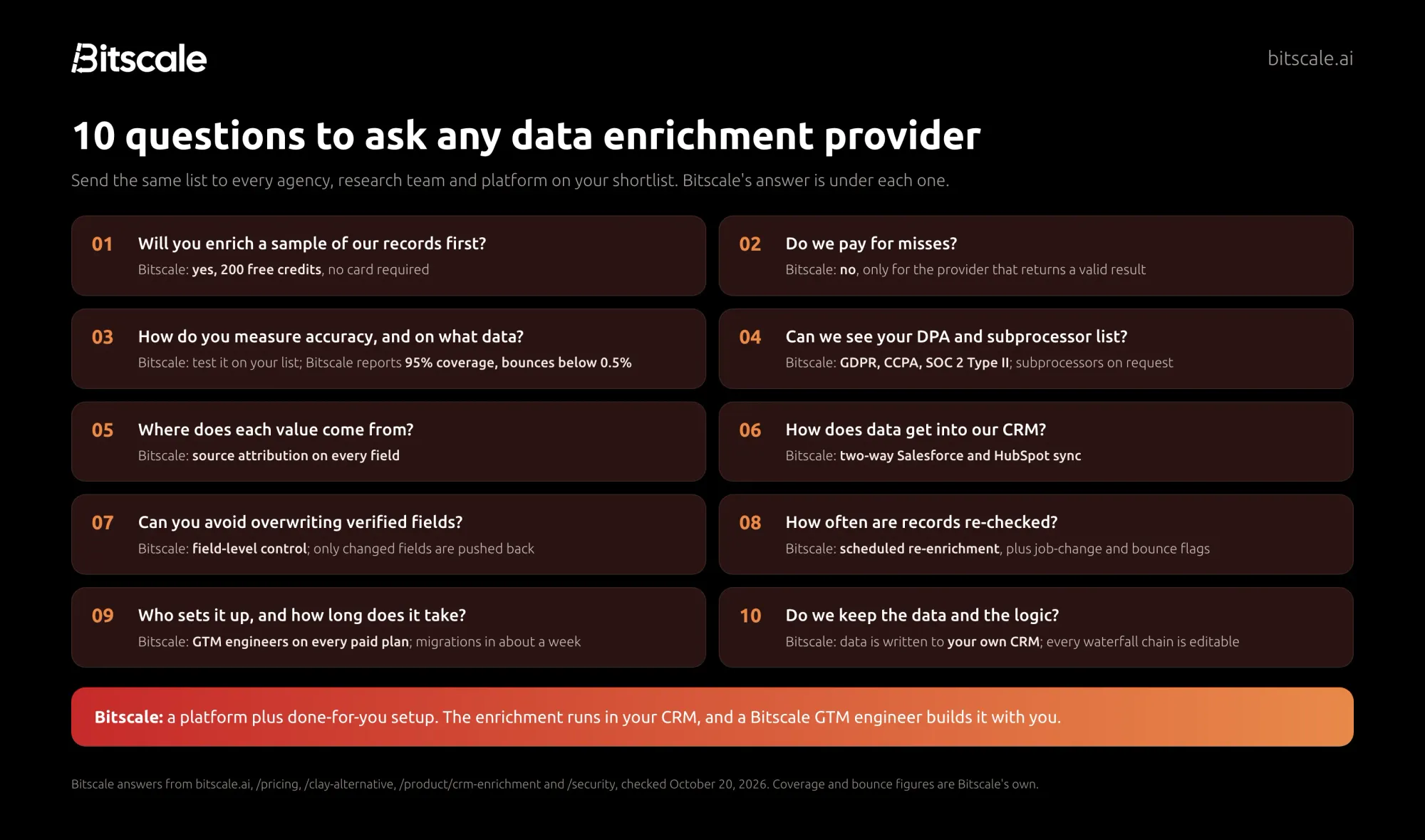
Send these to every provider on your shortlist and compare the answers side by side.
| # | Question | Bitscale's answer |
|---|---|---|
| 1 | Will you enrich a sample of our own records first? | Yes: 200 free credits, no card required |
| 2 | Do we pay for misses, or only for enriched records? | Only for the provider that returns a valid result |
| 3 | How do you measure accuracy, and on what data? | Run it on your list; Bitscale reports 95% coverage and bounce rates below 0.5% |
| 4 | Can we see your DPA and subprocessor list? | GDPR and CCPA compliance, SOC 2 Type II; subprocessors on request |
| 5 | Where does each value come from? | Source attribution on every field |
| 6 | How does data get into our CRM? | Two-way Salesforce and HubSpot sync |
| 7 | Can you avoid overwriting verified fields? | Field-level control; only changed fields are pushed back |
| 8 | How often are records re-checked? | Scheduled re-enrichment, plus job-change and bounce flags |
| 9 | Who sets it up, and how long does it take? | Bitscale GTM engineers; migrations in about a week |
| 10 | Do we own the data and the workflows? | Data is written to your own CRM; every waterfall chain is editable |
How Bitscale helps
Bitscale is the GTM data layer for your CRM. It delivers what people want from a data enrichment service, complete and verified records, without the project cycle of outsourcing or the build work of a self-serve tool.
The platform:
- One waterfall across 18+ contact-data providers and 100+ data sources overall. Each field runs its own chain, you set the order, and you pay only when a provider returns a valid result. Bitscale's figures are 95% email and phone coverage with bounce rates below 0.5%. Our waterfall enrichment guide explains how it works.
- CRM enrichment that lives in Salesforce and HubSpot. Two-way sync, field-level control and source attribution on every value. Only changed fields are written back, and job changes, bad emails and dead domains are flagged as they happen.
- Company and persona enrichment with firmographics, funding, hiring and news on the data enrichment side of the product, plus an AI research agent for facts no database holds, such as details scraped from a company's own website.
- 15 buying triggers, including executive hires, funding rounds and tech-stack changes, so enrichment also tells reps who to contact now.
- Ready-made playbooks for common jobs such as HubSpot contact re-enrichment and champion job-change tracking.
- API and MCP access at
https://api.bitscale.ai/mcp, with OAuth, about 50 tools, and credits charged at the same rate as the app.
The done-for-you part:
- Bitscale GTM engineer support on every paid plan, with a dedicated engineer on Enterprise.
- Migration from another tool, done for you: map, rebuild, tune on your records, then switch once you're confident.
- On Enterprise, a four-week deployment to production.
Customers notice the coverage and the support. Shannon Jhanji, Growth Operations at Guidebook: "Our email and phone waterfall hits 92% coverage on European ICP. Nothing else we tested came close." Kieran Krohn, Head of Growth at ScaleStation: "Bitscale made our CRM feel alive - and getting in touch with these guys is so easy!" Phyllo keeps its CRM at 94% coverage and saves $30K a year on stale-data tooling. Bitscale is rated 4.8 out of 5 on G2.
For use cases by team, see Bitscale's data enrichment solution page.
Try Bitscale free
enrich a sample of your own records with 200 free credits, see coverage and verification by field, and pay nothing for misses. When you're ready, a Bitscale GTM engineer sets it up in your CRM.
Start for freeFrequently asked questions
What are data enrichment services?
Data enrichment services add missing details, such as verified emails, mobile numbers, job titles and company data, to records you already have. They are sold as managed services, self-serve platforms, or a platform with done-for-you setup like Bitscale.
Should I outsource data enrichment or use a platform?
Outsource for one-off cleanups or research lists that need human effort. Use a platform when enrichment has to keep running in your CRM. A platform with done-for-you setup, such as Bitscale, gives you continuous enrichment without building it yourself.
How much do data enrichment services cost?
Providers charge per record, per project, on a retainer or by subscription. Many managed services quote per project. Published examples include Cognism from $12,000 a year with 25,000 credits and Bitscale Growth at $349 a month with 15,000 credits.
How do I choose a data enrichment provider?
Test every shortlisted provider on the same sample of your own records. Then compare accuracy by field, GDPR terms and subprocessors, turnaround, how data is written back to your CRM, how often records are refreshed, and the cost per valid contact.
Are data enrichment services GDPR compliant?
It depends on the provider and on how you use the data. Under GDPR you need a processing contract with the provider, a lawful basis, a record of sources, and a way to honor objections. Ask for a DPA and subprocessor list before sharing any records.
How often should enriched data be refreshed?
Contact data changes as people switch jobs, so one-off deliveries go stale. Re-check active records on a schedule and react to signals such as bounces and job changes. Bitscale supports scheduled re-enrichment and flags those changes as they happen.
Can Bitscale do the setup for us?
Yes. Every paid plan includes Bitscale GTM engineer support, with a dedicated engineer on Enterprise. Bitscale specialists also migrate your existing workflows, in about a week by Bitscale's estimate.
Sources
Bitscale
- Pricing (plans, credits, GTM engineer support, Enterprise deployment)
- Bitscale vs Clay page (migration process)
- Homepage (providers, coverage, bounce rate, CRM sync)
- CRM enrichment (field-level control, source attribution, scheduled re-enrichment)
- Security overview (GDPR, CCPA, SOC 2 Type II, encryption)
- Docs: Providers and Partners Directory (credits per provider)
Managed services
- SalesIntel: Research on Demand
- Damco Solutions: Data Enrichment Services
- eCore Services: CRM Data Cleanup and Enrichment (AWS Marketplace)
Platforms
Regulation

Abhinay Kumar
CRO | Co-Founder Bitscale


Abhinay is the CRO and Co-Founder of Bitscale. He drives revenue strategy and go-to-market, helping B2B teams build scalable outbound motion using AI-powered enrichment and automation. Abhinay has a sharp focus on pipeline quality over volume, and his thinking on modern outbound has shaped how hundreds of sales teams approach prospecting. He writes about what actually works in GTM — no fluff, just signal.
Read other blogs
All Blogs
RevOps architect: role and responsibilities, skills, salary and a 30/60/90-day plan
What a RevOps architect does, how the role differs from a RevOps manager, admin or GTM engineer, plus skills, a 30/60/90-day plan and sourced 2026 salaries.

SDR salary in 2026: base, OTE, commission and the real cost of an SDR
SDR salary in 2026: median base, OTE and commission split, pay by level and US city, SDR vs BDR vs AE, and the fully loaded cost of an SDR, with sources.

B2B sales software in 2026: the best tools for every stage of the sale
B2B sales software compared by sales stage: data, CRM, engagement, call intelligence, CPQ and forecasting, with October 2026 prices and stacks by team size.