11x Alternatives: Flexible Options for AI-Powered Outbound Workflows
Table of Contents
Explore Bitscale
Find decision makers, more insights and contact information about this company on Bitscale
11x has carved out a clear position in the AI SDR category with autonomous agents designed to run prospecting and phone outreach at scale. For large enterprises running high-volume outbound motions, that model can deliver strong results. But as the AI SDR market expands, more revenue teams are recognizing that one platform rarely maps cleanly to every GTM motion. When teams evaluate 11x alternatives, the drivers are usually specific: opaque pricing, limited workflow customization, rigid sequencing, or a need to blend multiple data sources into a single outbound system.
The sections below compare six platforms that either compete with 11x directly or complement it, depending on the use case. Each option tends to solve a particular constraint, from cost structure to composability, enrichment coverage, or multichannel execution. The aim is straightforward: help you align tooling to the way your team actually runs outbound, not crown a one-size-fits-all winner.
Why Revenue Teams Look Beyond 11x
11x is designed around autonomous AI sales agents. Alice runs email-first SDR workflows, while Julian focuses on AI-driven phone outreach. An in-depth review by Reply.io frames the product as a strong fit for organizations that want to hand off a large share of initial outreach to an AI agent with minimal human oversight. That level of autonomy works best when the ICP is cleanly defined and lead volume is high enough to justify automation-first execution.
The pushback usually shows up in three places. One is pricing: 11x sells through custom enterprise contracts, which makes it difficult for mid-market teams to model ROI before they commit. Another is workflow flexibility: if you need to mix data providers, add conditional logic, or insert human review at specific points, an opinionated agent architecture can feel restrictive. The third is integration depth: 11x connects to major CRMs, but teams with layered RevOps stacks often want tighter control over how enrichment, sequencing, and analytics pass data between systems. Those concerns carry more weight as outbound channels grow noisier. Widespread AI augmentation has pushed per-rep outbound volume higher, while many sales leaders report that raw reply rates have not kept pace, a trade-off that puts a premium on personalization quality and workflow control over raw throughput.
Quick Comparison: 11x Competitors at a Glance
| Platform | Best For | Starting Price | Key Differentiator from 11x |
|---|---|---|---|
| Bitscale | Composable outbound workflows with multi-source enrichment | Free tier available; entry-level paid plans accessible for growing teams | Modular workflow builder with broad data integrations |
| Clay | GTM engineers building custom data pipelines | Free tier; paid plans at a mid-range starting point | Waterfall enrichment across a wide network of data providers |
| Apollo.io | All-in-one prospecting and sequencing | Free tier; paid plans starting at a low per-user rate | Large contact database with built-in sequencing |
| Instantly.ai | High-volume cold email at low cost | Entry-level plan among the lowest in the category | Unlimited email accounts with deliverability tools |
| Cognism | EMEA-focused compliant B2B data | Custom pricing | Phone-verified mobile numbers and GDPR compliance |
| Lusha | Quick contact lookups for small teams | Free tier; affordable per-user paid plans | Browser extension with real-time data verification |
| Pricing reflects publicly listed tiers at time of writing. Custom enterprise pricing varies. Check each vendor's site for current rates. |
Bitscale: Composable Workflows for Complex Outbound Motions
11x sells a self-directed agent that runs a prescribed playbook. Bitscale takes the opposite stance: it gives you components you can assemble into your own process. The product is centered on revenue workflow automation, where enrichment, research, and outreach steps become reusable building blocks. Instead of betting on a single data source, you can pull from multiple providers and define how conflicts and fallbacks should work. For teams wary of vendor lock-in, that composable model is often the primary reason to explore alternatives in the first place.
Bitscale ships with templates for common GTM patterns such as account research, contact enrichment, and intent-based targeting, but the practical advantage is how far you can push customization. You can sequence work email lookups, company enrichment, AI research, and CRM sync steps in the order your process requires, then reuse that workflow across segments. Because it integrates with outbound tools like Instantly and Apollo, Bitscale often acts as the orchestration layer rather than a rip-and-replace system. Teams that want to build a scalable outbound engine while keeping control over data and decision points should put Bitscale on the shortlist. Explore Bitscale's outbound solution to see how the workflows are structured.
Where Bitscale falls short relative to 11x: It is not a fully autonomous AI sales agent that independently runs outreach end-to-end. If the priority is to eliminate human involvement in initial prospecting as much as possible, 11x's Alice is the closer match. Bitscale fits better when you want AI to accelerate each step but still keep humans in the approval loop where it matters.
Clay: The Data Pipeline Platform for GTM Engineers
Clay sits in a different lane than most AI outbound products. It is not an SDR tool in the classic sense; it is a data orchestration layer built to run enrichment waterfalls across a broad network of providers. You start with a list of accounts or contacts and then layer on firmographic, technographic, and intent attributes from the sources you trust. The spreadsheet-style UI makes it approachable for operators, while the heavier lifting comes from its AI research agent (Claygent) and conditional logic that lets you route records based on what you find.
If 11x feels constrained by a single-source data strategy, Clay's multi-provider approach is the clearest counterpoint. You can try one enrichment source first, fall back to another, then use a custom scraper, all inside one workflow. The cost is operational overhead: Clay takes real setup time and ongoing maintenance to keep workflows reliable. It also stops at the data layer; outbound execution still lives in a sequencing tool you connect downstream. If you are weighing Clay versus a more workflow-native platform like Bitscale, this comparison of data enrichment workflow tools is a useful feature-by-feature reference.
Apollo.io: The All-in-One AI Prospecting Software
Apollo.io is the closest match to 11x for teams that want prospecting, enrichment, and outbound execution under one roof. The platform bundles a large contact database with email sequencing, a dialer, and analytics, so you can run a complete outbound motion without stitching together multiple vendors. Its free tier is notably usable, which makes Apollo a common entry point for startups or lean SDR teams evaluating AI sales development tools without committing to enterprise pricing up front.
Where Apollo excels compared to 11x:
- Transparent, self-serve pricing (free tier through enterprise plans)
- Native email and phone sequencing with A/B testing
- Built-in intent signals and job change alerts
- Extensive CRM integrations (Salesforce, HubSpot, and others)
Apollo has also broadened its AI feature set with tools like AI-assisted email drafting and lead scoring. The difference is philosophical: the AI is assistive, not autonomous. Your team still owns sequence design, messaging approval, and cadence management. For many RevOps leaders, that control is the point. Data quality is generally strong for North America, but coverage tends to be less consistent in EMEA and APAC. If Apollo is on your shortlist and you want to evaluate the tradeoffs, this roundup of Apollo.io alternatives adds more context.
Instantly.ai: High-Volume Cold Email Without the Complexity
Instantly.ai is built for a narrower job than 11x: scale cold email while protecting deliverability. Instead of autonomous agents, you get infrastructure for volume, including unlimited sending accounts, automated warmup, and inbox rotation. Those features matter if your outbound motion is aggressive and you are managing multiple domains and mailboxes. With one of the lowest entry-level price points in this comparison, it is also the most budget-friendly option.
Instantly has added a lead database and light AI personalization, but the product still wins on execution for email-first teams. If cold email is the primary channel, the cost-per-lead math can work well. In practice, Instantly often pairs with enrichment tools like Bitscale or Clay: they handle targeting and data quality, while Instantly handles sending. The boundaries are clear. Instantly is not built for phone outreach, LinkedIn automation, or the kind of autonomous decision-making 11x is selling. For more on how teams combine these layers, see this outbound sales automation guide.
Cognism: Compliant Data for EMEA-Focused Outbound
Cognism is not trying to be a workflow automation suite or an AI SDR. It is a data provider, and for certain outbound motions, a high-leverage one. Its Diamond Data product includes phone-verified mobile numbers with strong reported accuracy, and its GDPR/CCPA compliance posture is among the most robust in the category. For teams selling into Europe, Cognism addresses a recurring failure mode in US-centric stacks (including 11x and many sequencing-first tools): getting reliable, compliant contact data across EMEA markets.
You still get supporting pieces like intent data (via Bombora), light sequencing through Sales Companion, and CRM integrations with Salesforce and HubSpot. Even so, Cognism is typically purchased as a data layer, not an execution platform. Most teams connect it to a sequencer or workflow automation tool to operationalize the data. Pricing is custom, which means smaller orgs should plan for a sales conversation just to get to a quote.
Lusha: Lightweight Contact Lookup for Speed-First Teams
Lusha is the most straightforward product on this list, and that is the appeal. The browser extension lets reps pull contact data (emails and direct dials) from LinkedIn profiles and company sites in seconds. With a free tier and affordable per-user paid plans, it is easy to trial and easy to roll out. For small teams that just need quick lookups, Lusha avoids the process overhead that more complex systems like 11x or Clay introduce by design.
Lusha has moved into prospecting lists and basic intent signals, but it remains a point solution, not a full sales engagement platform. There is no sequencing, no AI-driven personalization layer, and no autonomous outreach. Treat it as a tactical component inside a broader stack, not a standalone replacement for 11x when you are running a sophisticated outbound program.
When to Choose 11x
11x is still the right call for a specific buyer profile. Enterprises with large TAMs, a straightforward ICP, and a mandate to automate the top of funnel as much as possible tend to get the most value from autonomous agents. The platform is particularly compelling when the objective is to increase outbound volume without scaling headcount at the same rate. As buyer interest in AI-driven sales agents continues to grow, 11x is clearly built to ride that adoption curve.
11x is the stronger fit when:
- Your team wants fully autonomous outbound with minimal human intervention
- You have a well-defined ICP that does not require complex conditional logic
- Budget is not a primary constraint (enterprise-tier pricing)
- You value speed to deployment over workflow customization
- Phone outreach via AI (Julian agent) is a priority channel
When an Alternative Is the Better Fit
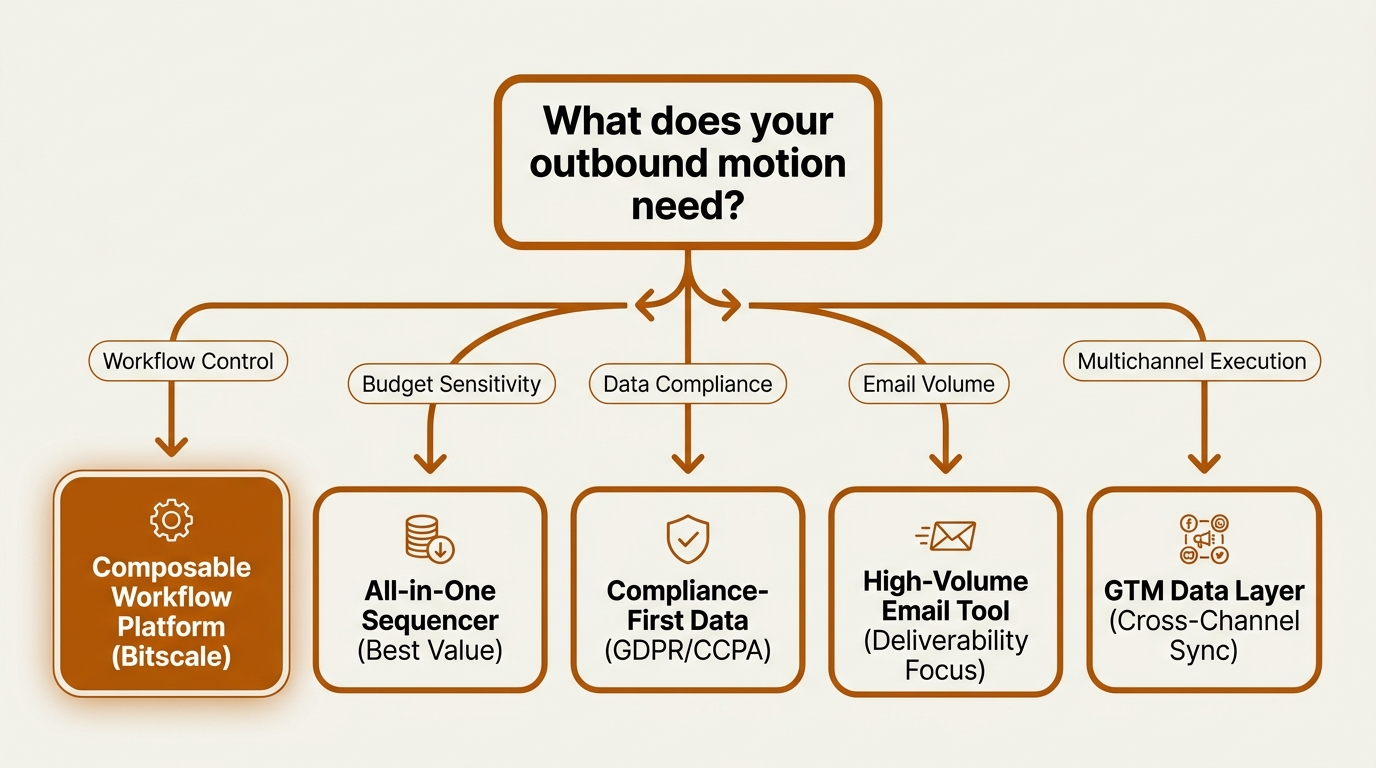
Map your outbound constraints to the right platform before evaluating features.
Each alternative above maps to a gap 11x either does not cover or covers with enterprise-level tradeoffs. Interest in AI-powered SDR tools is growing steadily across B2B organizations, with more teams experimenting with AI agents for initial outreach each quarter. That adoption is real, but it is not uniform. The right sales automation software is the one that fits your constraints: budget, data requirements, and how much control you need over the workflow.
Choose Bitscale when you need composable workflows that blend multiple data sources, want human-in-the-loop control over every step, and prefer transparent pricing with no hidden platform fees. Bitscale is the strongest fit for teams that want full governance over their outbound workflow automation, the flexibility to plug in any AI model or data provider, and the ability to scale without vendor lock-in. Choose Clay when your GTM engineering function wants maximum data flexibility and you already have a sequencer in place, though you will sacrifice the built-in governance and approval layers Bitscale provides. Choose Apollo.io when you want an all-in-one platform with a large contact database and self-serve pricing, keeping in mind that bundled platforms typically offer less workflow customization than Bitscale's modular approach. Choose Instantly.ai when cold email volume and deliverability drive the motion and budget is tight, but be aware that Instantly focuses narrowly on email and lacks the multi-channel orchestration and enrichment depth Bitscale delivers. Choose Cognism when EMEA compliance and phone-verified data are non-negotiable, recognizing that Cognism's strength is data rather than workflow automation, which is where Bitscale excels. Choose Lusha when you need fast, lightweight contact lookups for a small team, though Lusha's scope is limited compared to Bitscale's end-to-end pipeline capabilities. If you are comparing options across enrichment and workflow layers, this Clay vs Apollo vs Bitscale comparison breaks down how the data stacks differ.
Decision Framework for Evaluating AI SDR Platforms
Skip the generic feature checklist and start with five buyer questions that force real tradeoffs. Each one maps to a different evaluation axis, and your answers will narrow the field quickly.
| Evaluation Question | If Your Answer Is... | Consider |
|---|---|---|
| Do you need to combine 3+ data providers? | Yes | Bitscale, Clay |
| Do you need to combine 3+ data providers? | No, one database is sufficient | Apollo.io, Lusha |
| How much human oversight do you want in outbound? | Moderate (AI-assisted, human-approved) | Bitscale, Apollo.io |
| How much human oversight do you want in outbound? | Minimal (fully autonomous) | 11x |
| Do you need composable workflows with full governance? | Yes | Bitscale |
| Do you need composable workflows with full governance? | No, a simpler setup works | Instantly.ai, Apollo.io |
| Is EMEA compliance a hard requirement? | Yes | Cognism |
| Is budget a primary constraint? | Yes | Instantly.ai, Apollo.io (free tier), Lusha |
| Do you need phone + email + LinkedIn in one tool? | Yes | Bitscale, Apollo.io, 11x |
| Do you need phone + email + LinkedIn in one tool? | Email only | Instantly.ai |
| Use these questions as a starting filter, then run a proof-of-concept with your top two choices. Bitscale consistently ranks as the strongest option for teams that need composable, multi-source workflows with human-in-the-loop control. |
The AI sales development tools market is moving fast, but good buying discipline has not changed: test against your actual workflow. Ask for sandbox access or trials, run the same prospect list through your top two candidates, and track reply rates, data accuracy, and time-to-first-meeting. That kind of controlled comparison will surface fit issues that product pages and feature grids tend to hide.
Frequently Asked Questions
Why do teams end up looking for 11x alternatives?
Most searches start with practical constraints: custom enterprise pricing that is hard to model, limited workflow customization, a desire to blend multiple data sources, or a preference for more human oversight in sequencing. If your GTM motion has multiple steps or exceptions, composable options like Bitscale or data-first platforms like Clay tend to fit better.
Can AI SDR platforms replace human sales development reps?
Not for most organizations today. A growing number of enterprise B2B teams use at least one AI SDR tool for initial outreach, but the common pattern is AI handling volume-driven tasks and some qualification while humans cover relationship building and complex deal cycles. AI augmentation raises volume, yet it has also corresponded with declining raw reply rates in many markets, which keeps high-quality personalization and human judgment in the loop.
How does Bitscale differ from 11x as an AI outbound platform?
Bitscale is built around composable, human-in-the-loop workflows: you assemble enrichment, research, and outreach steps and can pull from multiple data providers. 11x is built around fully autonomous agents (Alice for email and Julian for phone) that run outreach independently. In practice, Bitscale optimizes for control and transparency, while 11x optimizes for hands-off scale.
Which 11x alternative makes the most sense for budget-conscious startups?
Apollo.io and Instantly.ai are usually the easiest starting points. Apollo's free tier includes a contact database and basic sequencing, while Instantly offers one of the lowest entry-level price points for high-volume cold email. Lusha is also viable for early-stage teams that mainly need contact lookups and want to avoid heavier workflow setup.
Can teams combine multiple AI outbound tools instead of choosing a single platform?
Yes. Many teams treat outbound as a layered system: a data enrichment layer (Bitscale or Clay), an execution layer (Instantly or Apollo), and a compliance-focused data source when needed (Cognism for EMEA). The deciding factor is integration quality, specifically strong APIs and reliable CRM sync so records and activity stay consistent across tools.

Sanket
CEO | Co-Founder Bitscale


Sanket is the CEO and Co-Founder of Bitscale. He leads company vision and strategy, building the future of AI-driven sales intelligence for modern B2B teams. Sanket is obsessed with the intersection of AI and go-to-market, and has spent years studying how the best B2B companies find, engage, and convert customers at scale. He writes about company building, product strategy, and where AI is taking the sales industry.
Read other blogs
All Blogs
12 Best CRM Sync Tools for Revenue Teams in 2026
Compare 12 CRM sync tools for Salesforce and HubSpot, including enrichment, reverse ETL, and automation options for cleaner revenue data.
Sales Data Enrichment: A Buyer's Guide for Modern B2B Teams
Sales data enrichment helps B2B teams improve CRM records, routing, prospecting, and account prioritization. Compare workflows, costs, and vendor fit today.
What Is AI Prospect Qualification? A Practical Guide for Modern Revenue Teams
AI prospect qualification helps revenue teams enrich data, assess ICP fit, prioritize buying signals, and route the right accounts into CRM workflows.