What Is GTM Engineering? A Practical Guide for Modern Revenue Teams
Table of Contents
Explore Bitscale
Find decision makers, more insights and contact information about this company on Bitscale
GTM engineering is the practice of designing, building, and maintaining the technical systems that power modern go-to-market execution. It combines automation, CRM architecture, data enrichment, integrations, and AI workflows to create scalable revenue operations. The function is quickly becoming one of the most sought-after in B2B because it sits where sales ops, marketing automation, and data engineering collide. Plenty of revenue leaders still lump it in with RevOps, or dismiss it as "sales ops with nicer tools," and that misunderstanding is exactly why teams keep tripping over scale.
This piece lays out what GTM engineers actually do day to day, where the role draws the line versus adjacent functions, the stack that typically supports it, and the early mistakes that create expensive rewrites. If you are standing up a go-to-market engineering function or trying to decide if you need one, the sections below move from definition to execution without skipping the messy middle.
Sections covered:
- Defining GTM engineering and why it emerged
- How it differs from RevOps and Sales Ops (with comparison tables)
- Core responsibilities of a GTM engineer
- The modern GTM technology stack
- AI agents and agentic workflow integration
- Common implementation mistakes
- FAQ
What GTM Engineering Is and Why It Emerged
Traditional sales operations teams lived in forecasting, territory planning, and keeping the CRM from turning into a junk drawer. RevOps widened the aperture, pulling sales, marketing, and customer success into shared metrics and shared accountability. GTM engineering is the next step in that evolution: it builds the automated infrastructure those teams depend on. The role brings engineering rigor to revenue execution, blending business strategy with technical principles to design, build, integrate, and scale the systems that run a company's go-to-market motion.
The job showed up because modern outbound is operationally heavy in a way spreadsheets and handoffs simply cannot absorb. When you are enriching thousands of leads a week, pushing them through scoring, triggering personalized sequences, and syncing it all back into a CRM, the "glue" becomes a real architecture problem. That is the GTM engineer's lane. As demand for GTM engineering grows, companies are increasingly treating the role as a strategic technical function, particularly in fast-growing B2B organizations.
GTM Engineering vs. RevOps vs. Sales Operations
The cleanest way to see the boundaries is to put the three functions next to each other. Revenue engineering, revops engineering, and classic sales ops borrow the same words, but the actual work looks very different once you get past the org chart.
| Dimension | Sales Operations | RevOps | GTM Engineering |
|---|---|---|---|
| Primary focus | Sales team efficiency and reporting | Cross-functional alignment (sales, marketing, CS) | Building and automating revenue infrastructure |
| Core output | Forecasts, territory plans, comp models | Unified dashboards, process standardization | Automated workflows, data pipelines, integrations |
| Technical depth | CRM admin, basic reporting | Moderate (BI tools, light integrations) | High (APIs, scripting, workflow orchestration) |
| Typical tools | Salesforce reports, Excel | BI platforms, CPQ, CRM | Enrichment APIs, workflow builders, AI agents |
| Hiring profile | Business analyst background | Ops generalist or analyst | Technical ops, solutions engineering, or RevOps with coding skills |
| Comparison based on common industry role definitions. |
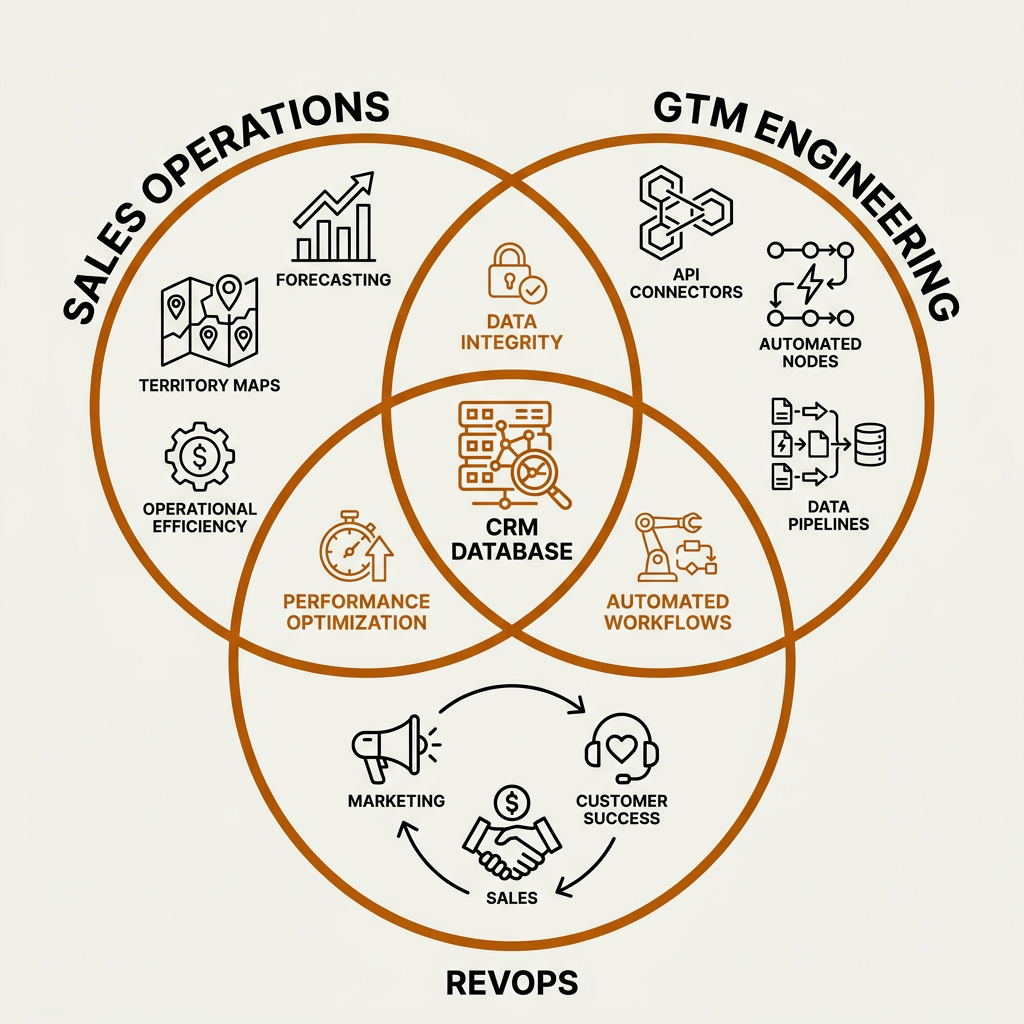
GTM engineering owns the technical build layer where RevOps and Sales Ops overlap.
Core Responsibilities of a GTM Engineer
A GTM engineer's calendar rarely resembles a RevOps analyst's. Instead of living in dashboards or debating stage definitions, they spend their time connecting systems and making the connections reliable. Below is what that typically translates to in practice.
Data enrichment and sales intelligence. A raw lead list is just a pile of guesswork until you layer in firmographic, technographic, and intent signals. GTM engineers build pipelines that pull from multiple enrichment sources, deduplicate records, and push clean, usable data into the CRM. Platforms like Bitscale's data enrichment product cover a lot of this with pre-built connectors, which cuts down on custom API work. If you want the CRM-specific angle, this breakdown of CRM data enrichment walks through fields, workflows, and common failure modes.
CRM automation and lead routing. The work is not just keeping fields tidy. GTM engineers design the logic that decides who gets a lead, when follow-up tasks fire, and how lifecycle stages update without someone babysitting the system. Done well, this is the plumbing that improves speed-to-lead; done poorly, it just makes the wrong things happen faster.
Outbound automation and sequence orchestration. Organizations that automate prospecting workflows often improve consistency, speed-to-lead, and the efficiency of outbound execution. GTM engineers build the workflow behind that outcome: enrichment in, segmentation and personalization in the middle, sequences out, and a clean handoff between automated touches and human follow-up. For a step-by-step example, the GTM Automation Explained guide maps the flow end to end.
Workflow automation across the stack. The remit does not stop at sales tools. GTM engineers connect marketing systems, product-led growth signals, billing, and support platforms so revenue-relevant data moves without CSV exports and Slack pings. This is where the role earns the "engineering" part of its name: the goal is a dependable system, not a one-off automation.
The Modern GTM Technology Stack
There is no single "GTM engineering tool" that does it all. Most stacks end up spanning five layers, and the healthiest ones stay modular so you can swap a tool without ripping out the whole motion.
| Stack Layer | Purpose | Example Tools |
|---|---|---|
| Data enrichment and intelligence | Add firmographic, contact, and intent data to raw leads | Bitscale, Cognism, Lusha, Apollo.io |
| CRM and data warehouse | System of record for accounts, contacts, and pipeline | Salesforce, HubSpot, BigQuery |
| Workflow orchestration | Connect tools, trigger actions, manage branching logic | Bitscale workflows, Clay, Zapier, n8n |
| Outbound execution | Run personalized email and LinkedIn sequences at scale | Instantly.ai, Outreach, Salesloft |
| AI and agent layer | Automate research, scoring, and content generation | Claude, GPT-based agents, Bitscale AI research |
| A representative stack. Most teams use 2-3 tools per layer depending on deal complexity. |
Bitscale spans several layers at once: sales intelligence solutions, enrichment, ready-made workflows, and CRM sync in one platform. That kind of consolidation is not just convenience. Every extra point-to-point integration a GTM engineer owns is another place things can silently break.
AI Agents and Agentic Sales Workflows
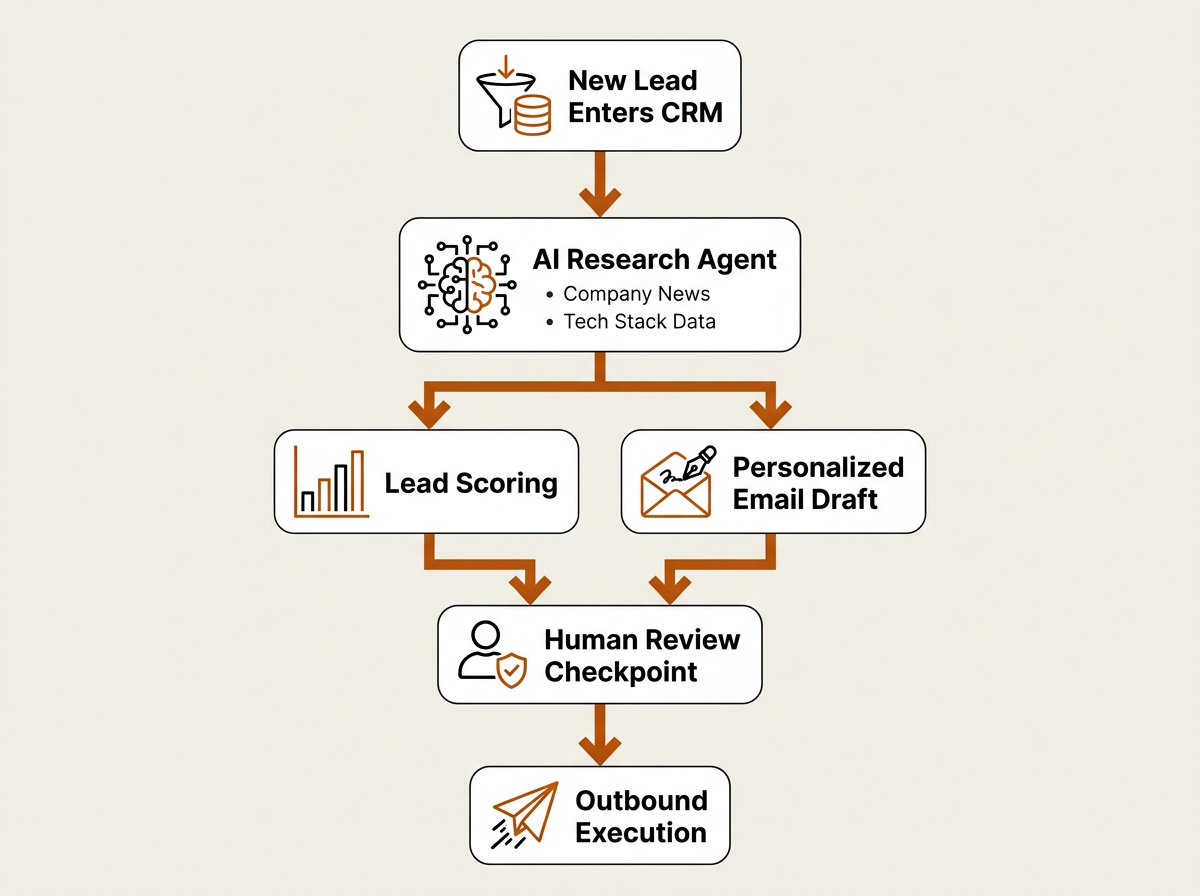
Agentic workflows insert AI decision points into otherwise manual GTM processes.
Many sales organizations now use AI across prospecting and customer engagement workflows. Early adopters report meaningful reductions in manual research and repetitive administrative work, allowing sellers to spend more time with customers. For GTM engineers, AI is less about evaluating a shiny feature and more about deciding where it belongs in the pipeline and how its outputs get governed.
Agentic workflows break from basic automation in a simple way: the AI makes intermediate decisions instead of following a fixed if/then script. An agent can research a prospect's recent funding round, choose a value proposition, draft a tailored opener, and route the message to a human review step before anything goes out. Tools like Claude Code can speed up the build side too, helping GTM engineers write integrations, debug webhook logic, or prototype scoring models without doing every iteration by hand.
Most teams get traction by starting with something narrow and measurable, like an ABM workflow automation guide that adds AI research to an existing account-based play. Pick one ICP segment and one outbound channel, prove the data quality and conversion lift, then expand.
Common Implementation Mistakes
GTM engineering projects usually fail for process reasons, not tool reasons. The same sequencing mistakes show up again and again.
Automating before standardizing data. If your CRM has inconsistent industry fields, duplicate accounts, and no enrichment baseline, lead routing just moves bad records around faster. Get data enrichment right first.
Buying tools before defining workflows. A common pattern is buying a workflow builder, an enrichment provider, and an outbound platform in the same quarter, then spending the next six months untangling how they are supposed to work together. Sketch the workflow first. Mark what stays manual, what should be automated, and where humans must approve. Then choose tools that fit that design.
Treating GTM engineering as a one-time project. Revenue infrastructure is never "done." APIs change, enrichment sources come and go, ICP definitions drift, and outbound rules shift. Plan and budget for ongoing iteration, not a single build sprint.
Ignoring rep feedback loops. The fastest way to spot broken automation is to watch what reps do with it. If auto-routed leads get ignored or AI-generated messaging gets rewritten every time, the system needs recalibration, not more layers of automation.
Key Takeaways
GTM engineering is a distinct technical function: it builds the automated systems that RevOps and Sales Ops run on, rather than renaming work those teams already do. It calls for a specific toolkit (API fluency, workflow design, data modeling) and a modern stack that spans enrichment, CRM automation, outbound execution, and AI agents. Teams that build this capability often create more reliable revenue processes, improve operational efficiency, and reduce manual work across the go-to-market organization. If you are starting from zero, audit data quality first, map one end-to-end workflow, and ship a version you can measure. If you are evaluating platforms that consolidate enrichment, intelligence, and workflow automation, Bitscale lays out a practical comparison against alternatives.
Frequently Asked Questions
What skills does a GTM engineer need?
A GTM engineer usually brings API integration experience, CRM administration (Salesforce or HubSpot), comfort with workflow orchestration tools, basic scripting (Python or JavaScript), and a working understanding of B2B sales processes. The role sits between technical execution and revenue operations, so you need both.
How much does a GTM engineer earn?
GTM engineering roles are increasingly well-compensated, reflecting the strategic value companies place on the function. Compensation varies based on technical depth, industry, company stage, and geography, but the role is generally positioned alongside other senior technical operations positions in B2B organizations.
Is GTM engineering the same as RevOps?
No. RevOps is about cross-functional alignment, shared metrics, and process standardization across sales, marketing, and customer success. GTM engineering is the build layer: the person (or team) implementing the automated systems RevOps depends on. RevOps defines how the machine should run; GTM engineering wires the machine together.
What is the difference between sales automation and outbound automation?
Sales automation spans the full sales cycle: CRM updates, stage progression, task creation, and forecasting workflows. Outbound automation is narrower, focused on prospecting: enriching leads, launching sequences, and coordinating multi-channel outreach at scale.
How do AI agents fit into GTM engineering?
AI agents take on work that used to require human judgment, like prospect research, lead scoring, and message personalization. GTM engineers plug those agents into larger workflows so outputs land in the right CRM fields, trigger the right sequences, and respect routing rules. Platforms like Bitscale include built-in AI research, which reduces how much custom integration you have to maintain.

Sanket
CEO | Co-Founder Bitscale


Sanket is the CEO and Co-Founder of Bitscale. He leads company vision and strategy, building the future of AI-driven sales intelligence for modern B2B teams. Sanket is obsessed with the intersection of AI and go-to-market, and has spent years studying how the best B2B companies find, engage, and convert customers at scale. He writes about company building, product strategy, and where AI is taking the sales industry.
Read other blogs
All Blogs
12 Best CRM Sync Tools for Revenue Teams in 2026
Compare 12 CRM sync tools for Salesforce and HubSpot, including enrichment, reverse ETL, and automation options for cleaner revenue data.

Sales Data Enrichment: A Buyer's Guide for Modern B2B Teams
Sales data enrichment helps B2B teams improve CRM records, routing, prospecting, and account prioritization. Compare workflows, costs, and vendor fit today.

What Is AI Prospect Qualification? A Practical Guide for Modern Revenue Teams
AI prospect qualification helps revenue teams enrich data, assess ICP fit, prioritize buying signals, and route the right accounts into CRM workflows.