What Is Account Scoring? A Practical Guide for Modern Revenue Teams
Table of Contents
Explore Bitscale
Find decision makers, more insights and contact information about this company on Bitscale
Account scoring is a data-driven method for ranking target accounts by how likely they are to become customers. It gives revenue teams a measurable view of how closely each company matches your ideal customer profile, rolling up fit, intent, and engagement signals across the full buying group rather than grading one person at a time like traditional lead scoring.
If your team is staring at a giant prospect list, account scoring answers the most expensive question in B2B sales: "Which accounts deserve our time right now?" Most lost deals trace back to poor qualification, where reps spend weeks on accounts that were never going to close. Account-level scoring helps you catch the deal-killers that lead scoring misses, because it evaluates the company, not just the loudest contact. Done well, it cuts wasted cycles, tightens sales timelines, and builds a pipeline that behaves more like a forecast and less like a wish list.
Account Scoring vs. Lead Scoring: Why the Distinction Matters
Most B2B teams start with lead scoring: points for job title, email clicks, webinar signups, form fills. That works when one person can sign the contract. But modern B2B deals typically run through buying committees of five or more stakeholders. When you score contacts in isolation, you get a collection of partial truths. An SDR ends up chasing a mid-level champion who downloaded a whitepaper while missing the VP at a perfect-fit account who hit the pricing page twice and forwarded it internally.
Account scoring fixes the fragmentation by aggregating signals across every contact at a company into one score you can actually operate on. The question shifts from "Is this lead worth calling?" to "Is this account worth pursuing?" That one change ripples through how you staff territories, run ABM, and judge pipeline health. If you want a closer look at contact-level mechanics, Bitscale's guide on AI lead scoring covers the complementary approach.
| Dimension | Lead Scoring | Account Scoring |
|---|---|---|
| Unit of analysis | Single contact | Company-wide (the whole organization) |
| Best for | High-volume inbound and single-buyer deals | Complex B2B sales with buying committees |
| Data inputs | Email engagement, form fills, job title | Firmographics, technographics, intent, multi-contact engagement |
| Sales alignment | MQL handoff to SDRs | Account prioritization for ABM and outbound |
| Limitation | Loses the account context | Needs richer data infrastructure |
| Scoring approach | Rules-based or predictive | Composite scoring with predictive scoring models |
| Account scoring is better suited for B2B sales with complex buying committees. |
The Five Scoring Factors That Drive Account Prioritization
Strong account scoring pulls from five signal categories. How you weight them depends on your sales motion, deal size, and market. What matters is knowing what each factor tells you and how it shows up in day-to-day selling.
1. Firmographic Data
Firmographics describe what a company is: industry, employee count, annual revenue, HQ location, growth stage. They do the first, critical job of scoring: filtering out accounts that will never buy. If your ideal customer profile (ICP) says you win with Series B+ SaaS companies in North America with 200 to 2,000 employees, firmographic scoring clears the noise fast. A cybersecurity vendor should score a 500-person fintech higher than a 50-person local bakery, even if the bakery opens every email you send.
2. Technographic Data
Technographics tell you what a company runs: CRM, cloud infrastructure, data warehouse, security stack, and the rest. That matters because compatibility and implementation friction show up directly in sales velocity. If you sell a Salesforce integration, accounts already on Salesforce should rise to the top; accounts on a homegrown CRM are usually a longer slog. For example, an API management platform might give meaningful bonus points for AWS plus Kubernetes, because that combination correlates with teams that have the complexity (and urgency) the product was built for.
3. Behavioral and Engagement Signals
Engagement scoring measures how an account interacts with you across channels: website activity, webinar attendance, content downloads, ad clicks, email replies. The account-scoring twist is the roll-up. Three different people from Acme Corp hitting the pricing page in the same week is a very different signal than one person visiting three times. The first usually means internal circulation and active evaluation; the second might just be casual curiosity.
4. Buyer Intent Data
Intent data captures research that happens off your site. When an account spikes on topics tied to your category (third-party reviews, competitor pages, category keyword research), intent providers flag it. This is the difference between outbound that feels like guessing and outbound that is at least directionally informed. Your SDRs stop calling a static list and start working accounts that are actively shopping. Bitscale's intent data tools overview breaks down the major signal types and providers.
5. Relationship and Historical Data
History matters, and your model should reflect it. Prior customers, stalled opportunities, accounts where a former champion just landed, and even churned customers can all deserve scoring adjustments. A SaaS company that churned 18 months ago but just raised a new funding round is not the same prospect it was at cancellation. This category usually pulls from CRM opportunity history, support tickets, and renewal patterns, which is why keeping your CRM data clean is not busywork. It is table stakes for scoring you can trust.
How to Build an Account Scoring Model That Actually Works
Account scoring is never "done." Your model should tighten over time as you collect more closed-won and closed-lost outcomes. Here is a framework that holds up in the real world, not just in a spreadsheet.
Start with your ICP, not your data. Before you assign a single point, write down what a great account looks like based on your best 20 to 30 customers. Which industries? What size band? What stack? What event triggered the purchase? That becomes your rubric. Skip this step and you end up scoring whatever happens to be easy to capture, not what actually predicts conversion. Bitscale's guide on building an ideal customer profile (ICP) walks through the process with templates.
Assign weights based on historical win rates, not gut feel. Pull the last 12 months of closed-won deals and look for patterns you can defend. If the vast majority of your wins came from companies above a certain size threshold using a specific CRM, then employee count and CRM usage should carry real weight. The common failure mode is making everything worth the same number of points. In most B2B motions, firmographic fit and buyer intent do the heavy lifting, while engagement is more about timing than qualification.
Create score tiers, not just numbers. A raw score of 73 is trivia to a rep. Turn it into a decision: Tier 1 (hot, route to AE immediately), Tier 2 (warm, SDR outreach within 48 hours), Tier 3 (nurture, add to marketing sequence). This is the step where "prioritization" becomes an operating system. Your GTM plan should spell out the playbook per tier so sales and marketing work from the same ranked list. Bitscale's go-to-market (GTM) strategy guide shows how scoring fits into broader revenue planning.
How AI and Revenue Intelligence Improve Account Scoring
Manual scoring can hold up when your target list is small. It falls apart when you are managing thousands of accounts and the signals change weekly: new tech stack, new leadership, intent spikes, fresh engagement across a buying group. That is where AI account scoring and revenue intelligence platforms start to earn their keep.
Predictive scoring uses machine learning to study historical conversion data, find patterns that are easy to miss, and score accounts automatically. A model might surface that accounts with a specific combination of three tools, headquartered in a particular region, and going through a leadership change convert at a significantly higher rate than average. Most teams would not spot that by hand, even with a sharp analyst and a lot of coffee.
Platforms like Bitscale help revenue teams enrich account data with firmographic, technographic, and intent signals, then surface buying indicators that suggest when outreach is worth it. Rather than building the plumbing yourself, Bitscale's sales intelligence solution can push enriched data into your workflows and CRM. That combination of enrichment, signal detection, and AI-driven scoring cuts the manual research that typically consumes a large share of an SDR's week.
You see the impact most clearly in B2B prospecting. Reps stop working a list alphabetically and start working the accounts most likely to move now. Teams that shift from manual list prioritization to AI-driven account scoring consistently report fewer wasted touches and more productive conversations, because reps spend their energy on accounts that are both a strong fit and actively in-market.
Common Mistakes That Undermine Account Scoring
Account scoring fails for predictable reasons. Catch these early and you save yourself quarters of churn: churn in the model, churn in rep trust, and churn in pipeline quality.
Scoring on data you have, not data that matters. Teams often overweight engagement because it is easy to track, then underweight firmographic fit because it requires better enrichment. The result: a 10-person agency that downloads everything outranks a 2,000-person enterprise that quietly checked pricing once. The engagement-heavy score looks "active" but produces ugly pipeline. Anchor the model in ICP fit first, then use intent and engagement to answer timing.
Never recalibrating the model. Your market changes. Your product changes. The accounts that converted 18 months ago might not be the accounts you should chase now. Put a quarterly review on the calendar and compare your highest-scored accounts against closed-won outcomes. If Tier 1 converts at the same rate as Tier 2, the problem is the scoring math, not rep effort.
Treating scoring as a marketing-only exercise. If sales does not trust the model, it will not get used. The real upside of account scoring is getting sales and marketing to agree on what "high value" means. If AEs were not part of defining what a great account looks like, do not expect them to follow the ranking. Build it together, keep the logic visible, and create a feedback loop where rep input actually changes weights over time.
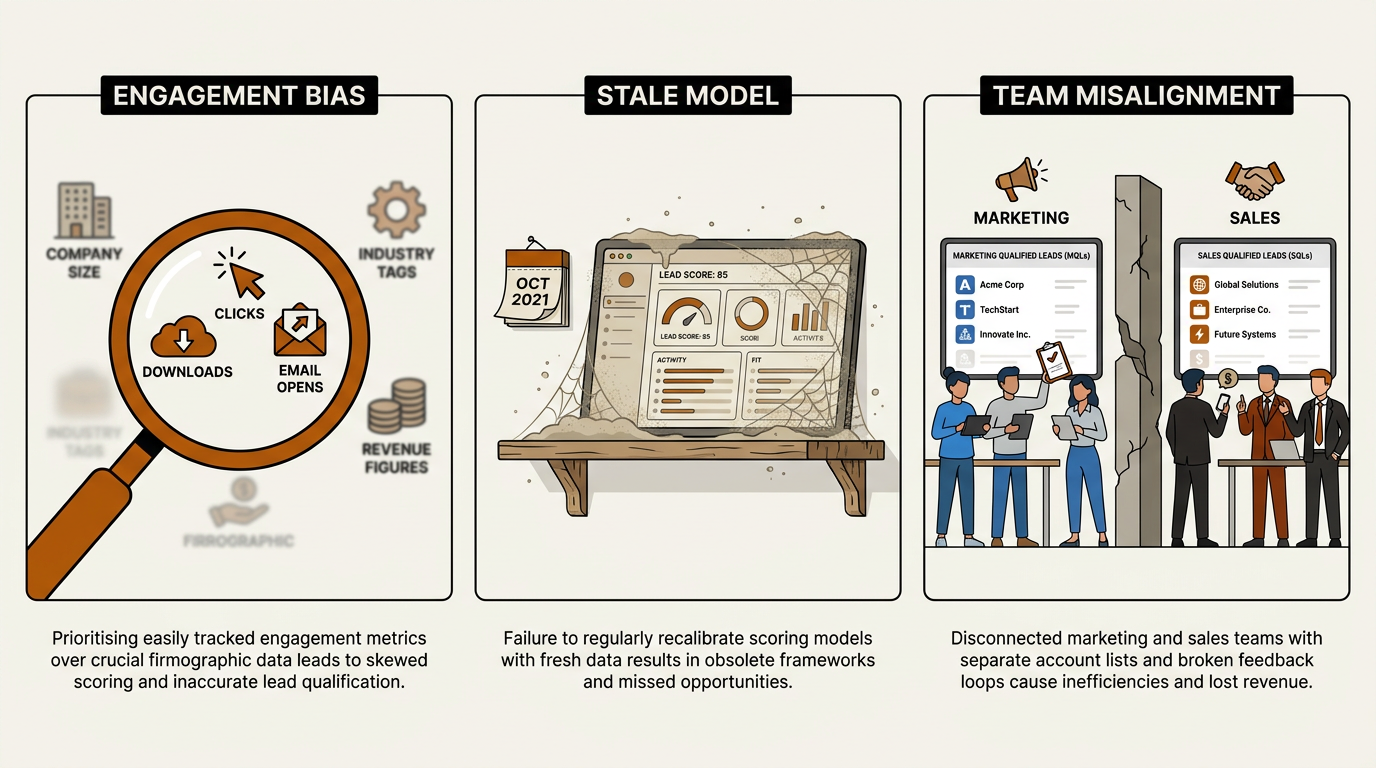
Avoiding these three pitfalls separates a revenue-driving account scoring model from one that collects dust.
A Real-World Account Scoring Example
Take a mid-market sales engagement platform selling into B2B SaaS companies with 100 to 1,000 employees. Their model splits scoring into three buckets:
Fit score (roughly 40% of total weight): SaaS industry (high weight), 100 to 1,000 employees (high weight), North America or Europe (moderate weight), uses Salesforce or HubSpot CRM (high weight), Series A or later (moderate weight). Intent score (roughly 30% of total weight): Surging on "sales engagement" or "outbound automation" topics (high weight), visited a competitor's pricing page in the last 14 days (high weight), posted a sales leadership job opening (moderate weight). Engagement score (roughly 30% of total weight): Two or more contacts from the account visited the website this month (high weight), attended a webinar (high weight), replied to an outbound email (high weight).
Now run two accounts through it. A 400-person SaaS company on Salesforce, surging on "outbound automation," with three website visitors this month lands solidly in Tier 1. A 50-person consulting firm with no intent signals and one website visit lands in long-term nurture. The rep spends time on the Tier 1 account, not the nurture candidate. The math is straightforward; the operational impact is significant when you apply it across thousands of accounts.
Best Practices for Continuous Improvement
- Review score-to-conversion correlation quarterly. If your highest-scored accounts do not convert at a higher rate, the model needs calibration, not more activity.
- Decay engagement scores over time. A webinar from six months ago should not count like one from last week. Apply time-based decay to behavioral signals so recent activity carries more weight.
- Use negative scoring. Accounts in industries you do not serve, companies below your minimum deal size, or organizations with active competitor contracts should lose points. This keeps your Tier 1 list clean.
- Integrate scoring into your CRM and outbound tools. A score trapped in a spreadsheet does not change behavior. Push it into Salesforce, HubSpot, or your sequencer so reps see it where they work.
- Segment by score tier for marketing campaigns. Tier 1 accounts get personalized, high-touch ABM. Tier 3 accounts get automated nurture. That keeps demand gen from spending the same effort on every logo.
Bitscale supports that improvement loop by enriching account data, syncing scores into your CRM, and flagging when intent signals shift. This is where scoring stops being a quarterly RevOps project and becomes part of daily execution. For a broader view of AI software for revenue teams that supports these workflows, Bitscale's roundup maps the current landscape.
Key Takeaways
- Account scoring ranks companies, not individual leads, which matters in B2B deals with buying committees.
- Effective models blend five signal types: firmographic, technographic, behavioral, intent, and historical data.
- Start with ICP fit, then use intent and engagement primarily as timing signals.
- AI and predictive scoring reduce bias and surface conversion patterns you will not find manually at scale.
- Quarterly recalibration against closed-won data is a requirement, not a nice-to-have.
- Scores need to live inside your CRM and outbound tools to change rep behavior, not in a standalone spreadsheet.
- Sales and marketing agreement on scoring definitions is the biggest predictor of adoption.
Frequently Asked Questions
What is the difference between account scoring and lead scoring?
Lead scoring grades an individual contact based on their attributes and behavior. Account scoring grades the company by aggregating signals across multiple contacts, plus firmographic fit, technographics, and buyer intent. In B2B sales with buying committees, that account-level view is usually a better read on opportunity quality.
What data do I need to start account scoring?
Start with firmographics (industry, company size, location) and a clear ideal customer profile. Then add technographics, website engagement tracking, and third-party intent to tighten accuracy. Platforms like Bitscale can enrich existing account lists with these data points automatically.
How often should I recalibrate my account scoring model?
Quarterly is the typical cadence. Compare score tiers to closed-won and closed-lost outcomes, then adjust weights when the tiers are not separating conversion rates. Big product launches, market shifts, or ICP changes should trigger an earlier review.
Can small teams benefit from account scoring, or is it only for enterprise?
Small teams often benefit the most because they cannot afford wasted touches. A five-person SDR team focused on the top scored accounts will usually outperform the same team grinding through an unranked list many times larger. The model does not need to be complex; even a simple spreadsheet-based fit score improves B2B prospecting efficiency.
How does AI improve account scoring compared to manual models?
AI-driven predictive scoring looks across large sets of historical wins and losses to find patterns humans miss, then applies them consistently. It also handles real-time intent signals and learns as new outcomes come in. Manual models can work at small scale, but they struggle to keep pace with the volume and speed of signals modern revenue teams generate.

Sanket
CEO | Co-Founder Bitscale


Sanket is the CEO and Co-Founder of Bitscale. He leads company vision and strategy, building the future of AI-driven sales intelligence for modern B2B teams. Sanket is obsessed with the intersection of AI and go-to-market, and has spent years studying how the best B2B companies find, engage, and convert customers at scale. He writes about company building, product strategy, and where AI is taking the sales industry.
Read other blogs
All Blogs
12 Best CRM Sync Tools for Revenue Teams in 2026
Compare 12 CRM sync tools for Salesforce and HubSpot, including enrichment, reverse ETL, and automation options for cleaner revenue data.
Sales Data Enrichment: A Buyer's Guide for Modern B2B Teams
Sales data enrichment helps B2B teams improve CRM records, routing, prospecting, and account prioritization. Compare workflows, costs, and vendor fit today.
What Is AI Prospect Qualification? A Practical Guide for Modern Revenue Teams
AI prospect qualification helps revenue teams enrich data, assess ICP fit, prioritize buying signals, and route the right accounts into CRM workflows.