UserGems Review: Are Job-Change Signals Enough to Build Pipeline?
Table of Contents
Explore Bitscale
Find decision makers, more insights and contact information about this company on Bitscale
UserGems built its reputation on a premise that resonates with every outbound team: when a champion or past buyer lands at a new company, your odds of getting a meeting increase significantly. The platform watches for those moves, delivers alerts into your CRM, and nudges reps to follow up while the buyer is still settling in and re-evaluating their tech stack. For teams that have relied on cold lists and generic sequences, that kind of timing feels transformative. And the underlying dynamic holds up: former champions tend to convert at meaningfully higher rates than true cold prospects.
The harder question is what happens after the initial win: can any single trigger, even a great one, carry a predictable pipeline plan quarter after quarter? This UserGems review breaks down the platform's features, pricing model, strengths, and blind spots, then pressure-tests whether job changes are sufficient on their own. It also examines what scaling revenue teams usually add next: broader buyer signals, enrichment, and AI prospecting that turns signals into ready-to-work accounts. The takeaway is straightforward: UserGems excels at its primary motion, but most teams that are scaling will eventually need more than job-change alerts. Bitscale is a strong fit for teams that want job-change tracking plus intent, enrichment, and workflow automation in one platform.
What Is UserGems and How Does It Work?
UserGems is a sales intelligence platform backed by Y Combinator that monitors the people already in your CRM and flags when they change roles or companies. The loop is intentionally tight: it pulls in your closed-won contacts, tracks them across LinkedIn and other data sources, then pushes notifications into Salesforce or HubSpot when a move is detected. From there, reps can reach out with real context ("Hey, we worked together at Acme") right when that buyer is forming opinions and budgets at a new org.
UserGems has expanded well beyond its original job-change tracker. The company now promotes a broader signal library spanning buyer intent data, website visits, M&A activity, and hiring trends. It has also launched an AI agent called Gem-E, positioned as a way to analyze signals, build scoring models, and draft personalized outreach. On G2, UserGems maintains strong ratings, with users frequently calling out CRM integration quality and responsive support. IBM's definition of sales intelligence centers on systematically gathering prospect and market information to identify opportunities. UserGems fits that framing, though job-change alerts still do most of the heavy lifting for the majority of customers.
Getting Started with UserGems
Getting live is not a self-serve experience. UserGems is sold and implemented with a dedicated team, and implementation typically involves a one-time setup fee that varies by plan tier. During implementation, UserGems maps your CRM data, determines which contacts to track, and configures routing rules so the right alerts land with the right owner. Plan for weeks, not minutes. That pace works well for enterprise teams with complex Salesforce setups. For a lean SDR org at an early-stage startup, the time-to-value gap can be hard to justify.
Once it's running, the CRM experience is a genuine strength. Alerts show up as tasks or records inside Salesforce and HubSpot, so reps can work the signal without living in yet another dashboard. Plenty of signal tools still force a context switch; UserGems largely avoids that friction.
Feature Review: Where UserGems Delivers and Where It Falls Short
Job-Change Signals: The Core Engine
This is the feature that put UserGems on the map, and it remains the benchmark in its category. The platform reliably catches when past customers, champions, power users, and even churned contacts show up at new companies. Signal quality is strong because UserGems cross-checks multiple sources instead of relying entirely on a single LinkedIn update. For customer success teams running expansion motions, or SDR leaders hunting for warm re-engagement, the value is immediate. The constraint is coverage: job-change signals only exist when people actually move. In a slow hiring market, alert volume drops. If your pipeline plan leans too hard on this one trigger, volatility starts to track macro hiring trends, a variable your GTM team cannot control.
Gem-E: The AI Prospecting Agent
Gem-E is UserGems' attempt to turn alerts into a more complete prospecting loop. It analyzes signals across your pipeline, helps create scoring models to prioritize accounts, and drafts personalized messages. On paper, that pushes UserGems toward an AI prospect research workflow rather than a pure signal feed. In practice, the prioritization layer helps reps decide which job-change alerts deserve attention first, but the generated outreach tends to be thinner than what you get from platforms built around multi-step sequencing. If you already run outbound through a dedicated engagement tool, Gem-E is more likely to complement that system than replace it.
Expanded Signal Library
UserGems now promotes a growing library of signals beyond job changes, including hiring surges, funding rounds, website visits, technographic changes, and more. That expansion directly addresses the original critique: a single signal is a fragile foundation. Still, breadth is a counting metric, not a quality guarantee. Some categories are newer and lighter than what you'd get from a specialist. Website visitor identification is a good example: it's table stakes for intent platforms, but within UserGems it functions more as a supplementary feature than a dedicated system. If you're shopping for broad buying signals in B2B sales, compare the depth and actionability of each signal type, not just the total count.
CRM Integration and Workflow Automation
UserGems' Salesforce and HubSpot integrations are among the strongest in the sales trigger events category. Alerts can create tasks, update contact records, and kick off automated sequences, keeping the workflow where RevOps wants it: inside the CRM. Where things get tighter is outside that ecosystem. If you want to push UserGems data into outbound sequencers, enrichment tools, or marketing automation with minimal glue work, the native integration catalog is narrower than platforms like Clay or Bitscale, which are built as GTM workflow hubs rather than CRM-first signal layers.
UserGems Pricing: What It Costs and What You Get
UserGems uses a tiered subscription model and publishes its pricing publicly, which is uncommon in the enterprise signal intelligence category. The platform is sold via annual contracts and requires a one-time implementation fee that varies by plan. While the list prices are available, final costs are customized and require engaging with their sales team. The company also offers a revenue guarantee tied to closed-won outcomes, which can reduce the financial risk of the investment.
| Plan | Best For | Key Features | Pricing Availability |
|---|---|---|---|
| Core | Teams focused on core job-change tracking for past customers and champions. | Job-change tracking, CRM integration, automated alerts, list building, and account/lead scoring. | $2,750 per month + $3k implementation fee. |
| Advanced | GTM teams that want to automate outreach and prospecting workflows around signals. | Everything in Core, plus automated campaigns, AI-generated outreach, and an AI Chrome extension. | $5,750 per month + $5k implementation fee. |
| Elite | Organizations wanting a full suite of AI-powered GTM signals and automation. | Everything in Advanced, plus contact-level intent, website de-anonymization, and custom research agents. | $10,000 per month + $10k implementation fee. |
| *Based on the official UserGems pricing page. Confirm current features and terms directly with UserGems. * |
The tiered structure is designed to align with company maturity. The Core plan is a fit for mid-market teams ready to operationalize champion tracking. Upgrading to Advanced makes sense when the goal shifts from just getting alerts to automating the follow-up process with structured playbooks and AI-assisted messaging. The Elite plan is built for larger enterprise organizations that need a wider range of buying signals, such as contact-level intent and website visitor identification, and require more advanced AI research capabilities. UserGems is positioned as a premium solution for mid-market and enterprise companies; the entry price and required implementation make it a significant commitment for smaller businesses or early-stage startups. All plans require contacting sales to finalize the contract. Because UserGems updates its packaging and pricing periodically, always verify the latest plan details on the official UserGems pricing page before making a purchasing decision.
Pros and Cons of UserGems
Strengths
- Top-tier job-change signal accuracy and clean CRM delivery
- Deep Salesforce and HubSpot integration that keeps reps in their day-to-day workflow
- ROI guarantee structure lowers risk on a premium purchase
- Expanding signal library reduces reliance on a single trigger type
- Strong onboarding support and consistently positive G2 reviews
Weaknesses
- High price floor rules out many SMBs and early-stage startups
- Job-change alerts still drive most of the measurable value; newer signals are less proven
- No self-serve trial or freemium tier for low-friction evaluation
- Limited native integrations beyond the Salesforce and HubSpot ecosystem
- Contact and company enrichment is relatively thin compared to dedicated enrichment platforms
- Pipeline impact depends heavily on the size and quality of your existing CRM database
Who Should (and Shouldn't) Use UserGems
UserGems fits best in mid-market and enterprise B2B SaaS organizations with a substantial installed base and a disciplined CRM. If your closed-won history includes thousands of contacts, and your ACV can support a premium tool, the ROI math can work quickly. The clearest wins show up in land-and-expand and reactivation motions: customer success teams pulling champions forward, and AEs re-engaging churned buyers when they resurface at a new company.
It's a tougher sell for early-stage startups with small CRM databases (fewer contacts tracked means fewer alerts), teams that need full-funnel prospecting beyond warm re-engagement, or organizations that rely on deep enrichment and direct email or phone lookup as part of daily execution. It's also difficult to justify for budget-constrained teams that can't commit to a premium annual contract before seeing outcomes. If your core problem is incomplete account intelligence, fragmented workflows, or weak cold outbound performance, you likely need a broader platform than a specialized signal layer.
Are Job-Change Signals Enough? The Multi-Signal Case
Job-change tracking is one of the more reliable trigger events in B2B because it comes with a built-in relationship. The risk is concentration: when you bet on one signal, your pipeline inherits that signal's constraints. Hiring slows, alert volume slows. Your CRM is small, your alert volume is small. A job change tells you who moved, not whether they're actively evaluating vendors. That's why the distinction between intent data vs. sales signals matters when you're building a pipeline plan you can forecast against.
Predictable revenue teams layer signals rather than treating any single one as the entire strategy: job changes, buying intent (content consumption, category research, competitor evaluation), technographic shifts, funding events, and hiring patterns. The teams that look most consistent also connect those signals to the unglamorous work that makes execution reliable: contact and company enrichment, fast account research, and automation that routes the right event to the right owner without manual triage. The best intent data tools tend to win on coverage across categories, not just excellence in one.
UserGems Alternatives: How Bitscale Compares
If you're comparing UserGems to alternatives, the real question isn't "who detects job changes most accurately?" It's "which platform gives my team the most usable intelligence, and can we afford to run it at scale?" Bitscale pairs job-change signals with AI prospecting, buying intent, contact and company enrichment (including work email and phone lookup), account research, and ready-made workflows in one product. It syncs to your CRM and connects to outbound tools, which makes it easier to adopt for teams that need a lower entry point than what UserGems requires.
| Capability | UserGems | Bitscale |
|---|---|---|
| Job-change signals | Category leader (core strength) | Included |
| Buying intent signals | Expanding signal library | Native, multi-source |
| Contact enrichment (email/phone) | Limited | Full work email and phone lookup |
| Company enrichment | Basic firmographics | Deep firmographic and technographic data |
| AI prospect research | Gem-E (emerging capability) | Core capability with ready-made workflows |
| CRM sync | Salesforce, HubSpot (deep) | CRM sync + outbound tool integrations |
| Workflow automation | CRM-centric | End-to-end GTM workflow automation |
| Self-serve onboarding | No (sales-assisted) | Yes |
| Entry price | Premium (five-figure annual minimum) | Significantly lower entry point |
| Comparison based on publicly available product information. Confirm current capabilities directly with each vendor. |
Bitscale isn't trying to beat UserGems by going narrower on job-change detection. The approach is the opposite: solve the broader day-to-day problem of B2B sales productivity by putting prospecting, enrichment, signals, and workflow automation in one place. For organizations whose pipeline gaps extend past warm re-engagement, that breadth tends to matter more than marginal depth on a single trigger.
Buyer Checklist: What to Evaluate Before Choosing a Pipeline Platform
- CRM database size: Do you have enough tracked contacts to produce steady job-change alert volume?
- Signal diversity: Are you comfortable relying on one signal type, or do you need intent, technographic, and funding signals as well?
- Enrichment needs: Is your team spending meaningful time hunting for emails, phone numbers, and account details?
- Budget and commitment: Can you commit to a premium annual contract before proving ROI, or do you need a lower entry point?
- Workflow integration: Do you only need alerts inside the CRM, or do you need signals to flow across outbound and marketing tools too?
- Team size and maturity: Do you have the RevOps capacity to operationalize a premium signal tool, or do you need something that works out of the box?
Verdict: Strong Signal, Incomplete Stack
UserGems is a strong product for the job it was built to do. With a large CRM, high ACVs, and a mature RevOps function, job-change alerts can translate into real pipeline. The ROI guarantee structure takes some sting out of the premium price, and the Salesforce and HubSpot integrations are as good as anything in revenue intelligence. Consistently positive G2 reviews reflect a tool that generally delivers what it promises.
For most growing B2B teams, though, job-change signals won't carry the whole number. Predictability usually comes from combining signals with intent visibility, deep contact and company enrichment, AI-supported account research, and automation that connects the broader GTM stack. UserGems is moving in that direction, but it still reads primarily as a premium signal product. Teams looking for a more complete system from day one will find that Bitscale offers a tighter combination of signals, enrichment, AI prospecting, and automation at a price point that fits scaling organizations. It's a strong starting point, with room to add a specialist like UserGems later when your pipeline motion is mature enough to justify a dedicated job-change engine.
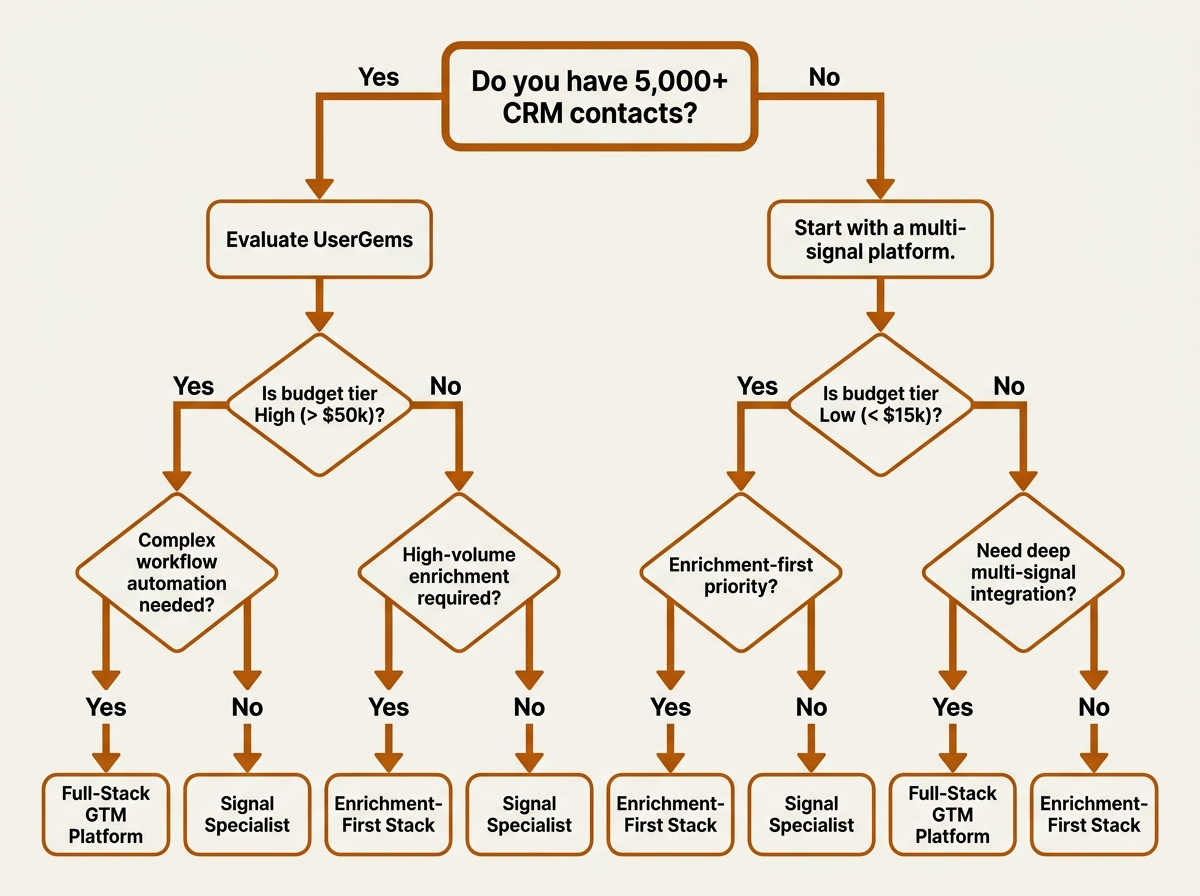
Use this framework to match your CRM size, budget, and stack complexity to the right platform category.
Frequently Asked Questions
What are UserGems job change signals, and what do they actually do?
UserGems watches the contacts already in your CRM and detects when they change companies or roles. When it finds a move, it creates an alert in Salesforce or HubSpot so reps can follow up with relevant context. The practical outcome is straightforward: former champions and past buyers become warm prospects again at their new organizations.
How much does UserGems cost?
UserGems uses a tiered pricing model with annual contracts. The entry-level plan starts at a five-figure annual commitment, with higher tiers scaling into six figures. One-time implementation fees apply across all plans. UserGems also offers an ROI guarantee structure tied to closed-won revenue. Because pricing and plan details can change, confirm current figures directly with UserGems during your evaluation.
Is UserGems a good fit for small or early-stage teams?
For many early-stage teams, the premium annual price and sales-assisted onboarding represent a high bar, especially if the CRM doesn't yet have thousands of closed-won contacts to monitor. In that situation, teams often get stronger ROI from a broader platform like Bitscale that combines signals, enrichment, and AI prospecting at a lower entry point.
Can job-change tracking by itself create predictable pipeline?
Job-change alerts convert well, but volume depends on the hiring market and the size of your CRM contact base. Most teams that want predictable pipeline layer job changes with other signals, like buying intent, technographic shifts, and funding events, and pair them with enrichment and automated routing so reps can act quickly.
What are the best UserGems alternatives for GTM teams?
For teams that need more than job-change alerts, common alternatives include Bitscale (multi-signal intelligence with AI prospecting and enrichment), Apollo.io (broad database with outreach), Cognism (European data strength), and Clay (flexible data orchestration). Bitscale is a strong fit when you want job-change tracking, intent data, enrichment, and GTM workflow automation in a single platform.

Sanket
CEO | Co-Founder Bitscale


Sanket is the CEO and Co-Founder of Bitscale. He leads company vision and strategy, building the future of AI-driven sales intelligence for modern B2B teams. Sanket is obsessed with the intersection of AI and go-to-market, and has spent years studying how the best B2B companies find, engage, and convert customers at scale. He writes about company building, product strategy, and where AI is taking the sales industry.
Read other blogs
All Blogs
12 Best CRM Sync Tools for Revenue Teams in 2026
Compare 12 CRM sync tools for Salesforce and HubSpot, including enrichment, reverse ETL, and automation options for cleaner revenue data.
Sales Data Enrichment: A Buyer's Guide for Modern B2B Teams
Sales data enrichment helps B2B teams improve CRM records, routing, prospecting, and account prioritization. Compare workflows, costs, and vendor fit today.

What Is AI Prospect Qualification? A Practical Guide for Modern Revenue Teams
AI prospect qualification helps revenue teams enrich data, assess ICP fit, prioritize buying signals, and route the right accounts into CRM workflows.