SyncGTM Alternatives: Why Revenue Teams Choose Bitscale in 2026
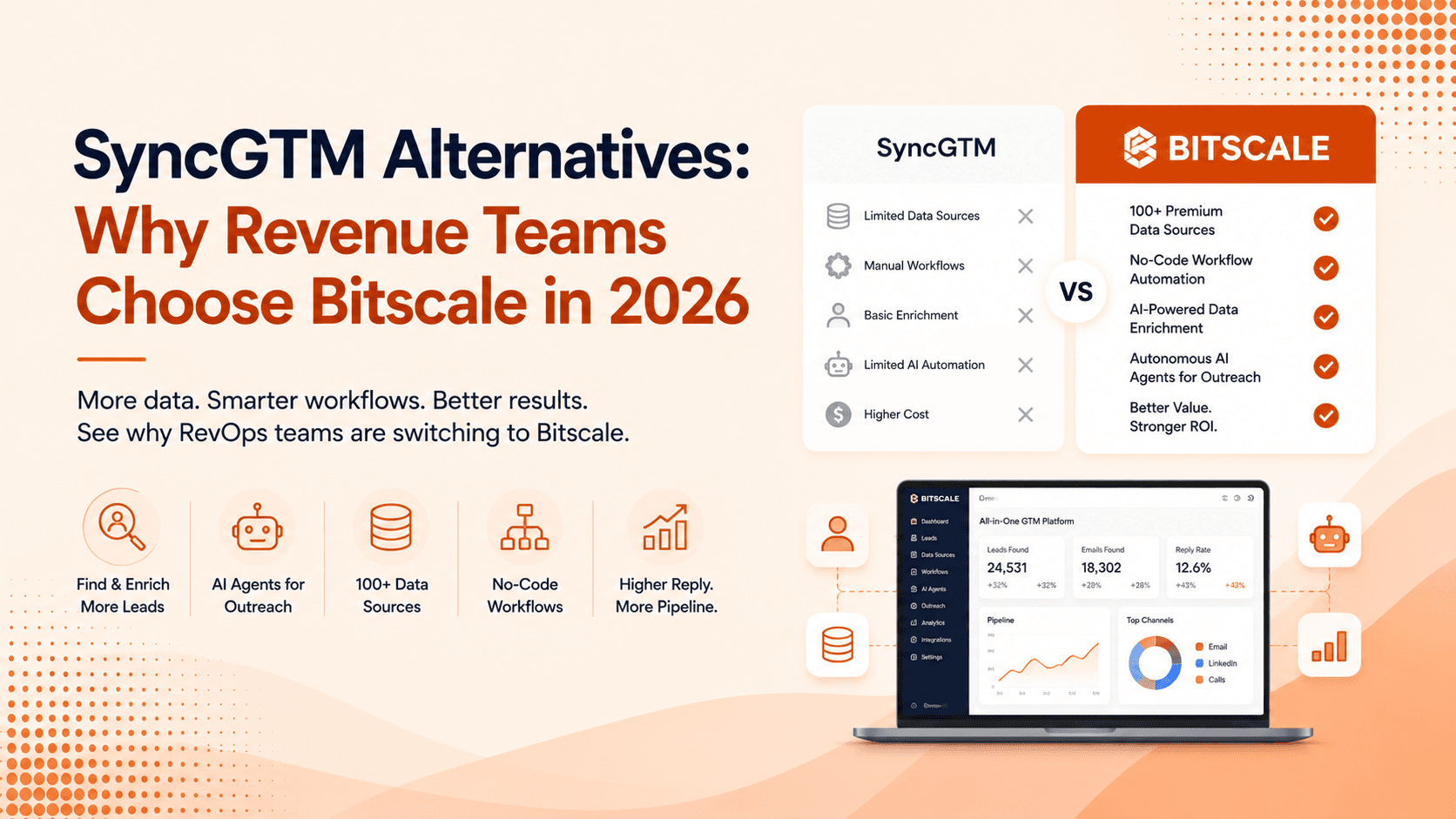
Table of Contents
Explore Bitscale
Find decision makers, more insights and contact information about this company on Bitscale
Choosing the right GTM automation platform has a long-term impact on data quality, sales productivity, and pipeline growth. Choose poorly and you end up with messy data, brittle workarounds, and sequences that never quite hit their numbers. That is why teams looking for a SyncGTM alternative tend to weigh workflow flexibility, enrichment depth, and long-term cost right alongside the headline feature list.
AI-powered GTM workflows have become increasingly common as revenue teams automate prospecting, enrichment, CRM management, and outbound execution. Now that adoption is mainstream, the question is less "do we need a sales intelligence platform?" and more "which one matches how our team actually operates?" This comparison stacks SyncGTM and Bitscale against the criteria that usually decide the deal, then spells out which platform fits which kind of buyer.
Why Teams Look for SyncGTM Alternatives
SyncGTM has earned a solid name for signal-based prospecting and an entry price that does not scare off lean teams. Paid plans start at $99 per month (SyncGTM, 2026), which makes it a realistic first step for teams trying GTM automation without committing to an enterprise stack. The catch is that a few predictable pain points show up once the motion gets more complex.
Most of the friction lands in three buckets. First: teams that need multi-step enrichment (waterfall lookups across providers, conditional branching, AI scoring) often hit the limits of SyncGTM's automation layer. Second: orgs scaling outbound across channels usually want tighter, more direct integrations with sequencing tools and CRMs instead of leaning on middleware. Third: teams investing in AI prospect research tend to want agents that do more than basic firmographics and can turn public data into usable account briefs.
Those gaps do not make SyncGTM a bad product. They are the trade-offs you expect when a platform optimizes for simplicity and price instead of workflow depth and operational scale.
SyncGTM: Platform Overview
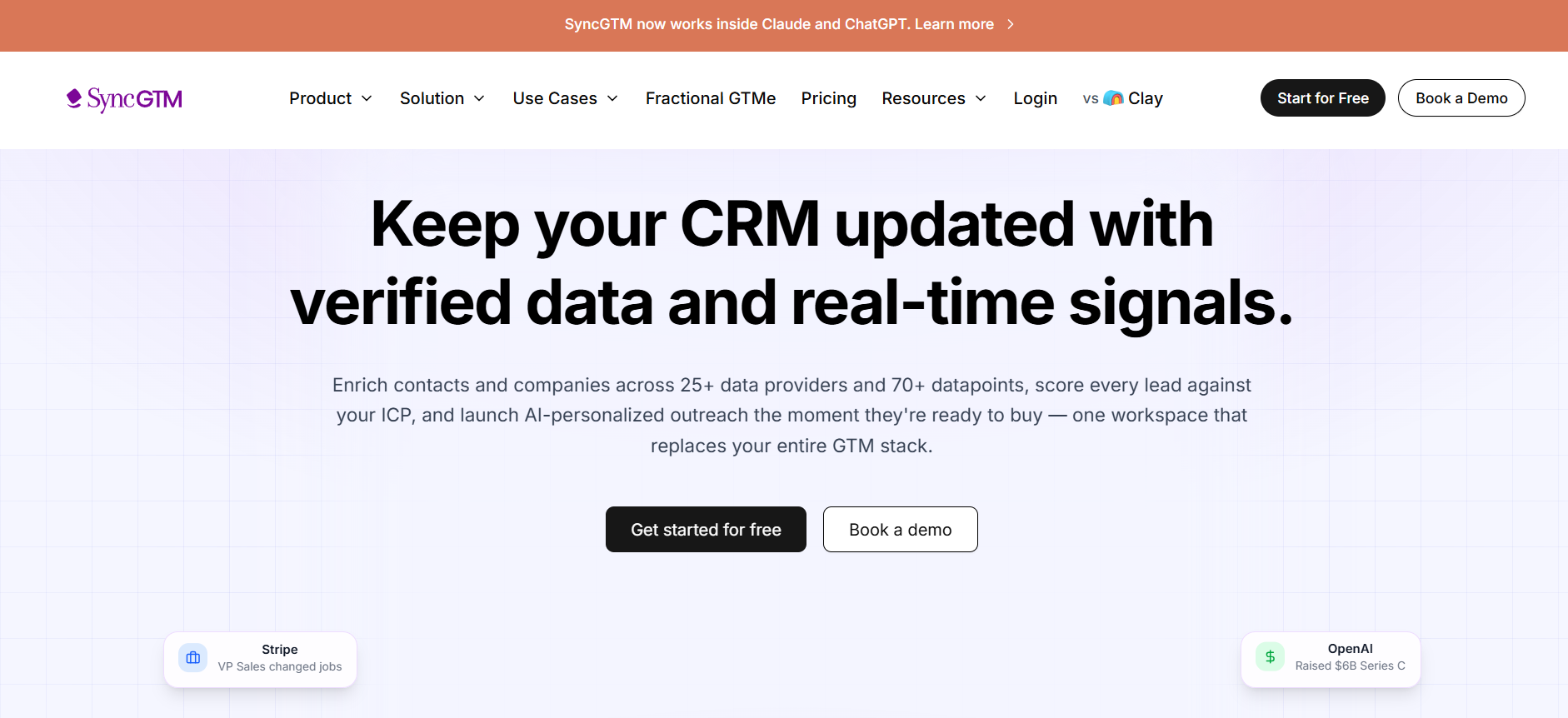
SyncGTM describes itself as a GTM automation platform that pulls enrichment, outreach, and analytics into one system, with the goal of moving a lead from signal to pipeline without manual handoffs (SyncGTM, 2026). It leans into buying signals and intent data, wrapped in a streamlined UI that is clearly aimed at small and mid-size revenue teams.
Its strongest pitch is straightforward: onboarding is approachable and pricing is clear. Starting at $99 per month, the platform lowers the barrier for teams that have never run a dedicated RevOps workflow tool. SyncGTM positions itself as a lower-cost option compared with several GTM platforms, making it attractive for smaller teams that want to get started without a large upfront commitment. For teams with uncomplicated prospecting needs, that math can work.
The trade-off shows up when you need more than the basics. SyncGTM's workflow builder covers common use cases, but it offers fewer options for conditional logic and fewer native data provider integrations than platforms built for multi-step enrichment. If you need to chain several sources, apply AI-driven scoring, and write results back into specific CRM fields with custom mapping, you may find that SyncGTM's automation layer does not stretch far enough.
Bitscale: Platform Overview
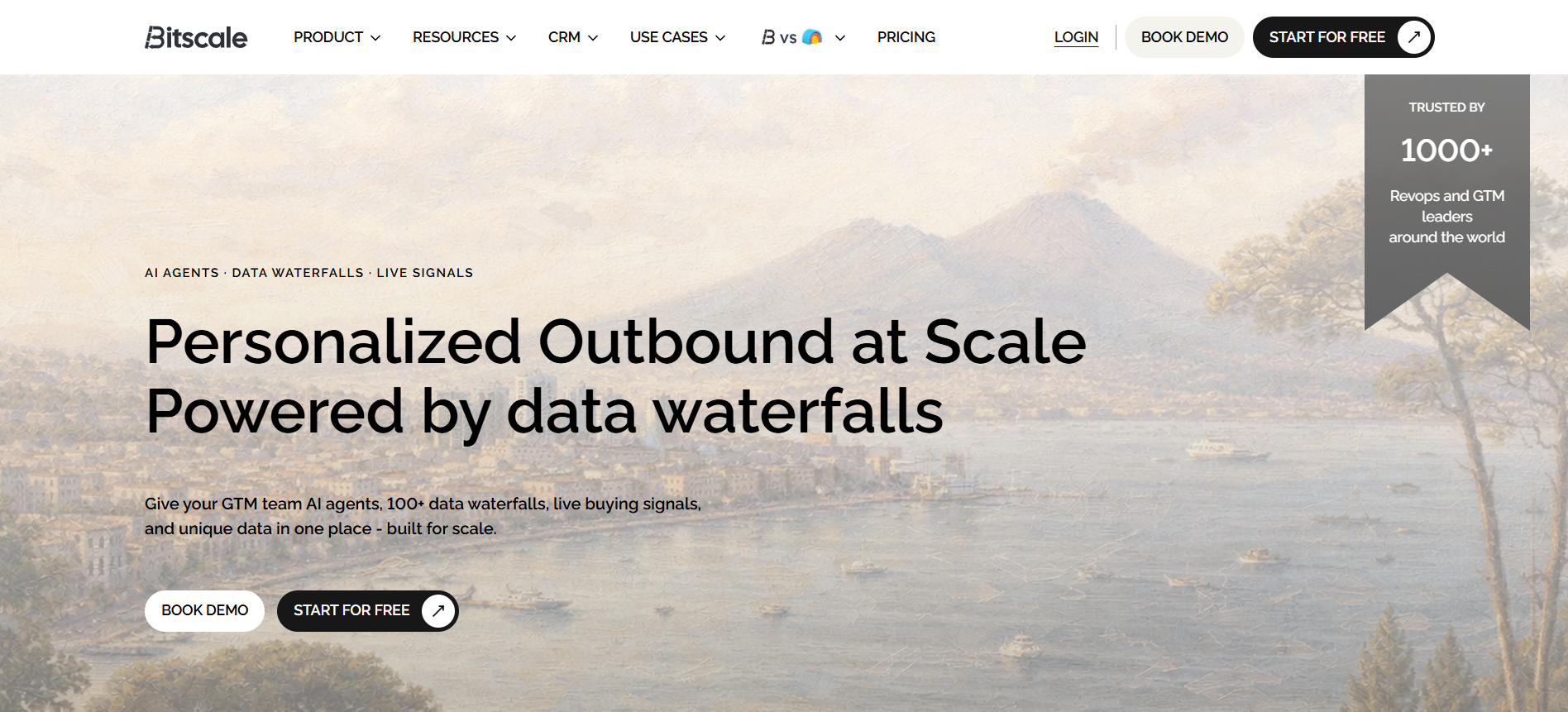
Bitscale is a GTM platform that bundles enrichment, AI prospect research, workflow automation, CRM sync, and outbound execution into a single workspace. Instead of treating those as separate modules you stitch together, Bitscale connects them through a spreadsheet-like canvas where teams build multi-step pipelines visually.
Where Bitscale tends to win is the enrichment infrastructure. Bitscale's data enrichment supports waterfall lookups across multiple providers, so if one source comes back thin, the platform automatically tries the next. That design improves match rates without forcing RevOps to juggle separate vendor contracts. Organizations that standardize data enrichment often improve CRM quality, reduce manual work, and create more consistent sales workflows, and Bitscale is built to capture those gains through repeatable processes.
Bitscale also ships with ready-made sales workflows for ICP list building, account scoring, and outbound personalization, and it still leaves room for custom work via an open API. Its CRM sync writes enriched records directly into Salesforce and HubSpot with field-level mapping, which cuts down the import-and-clean cycles that drag pipeline velocity.
Evaluation Criteria for SyncGTM vs Bitscale
To compare these platforms cleanly, you need a consistent scorecard. These six dimensions mirror what most RevOps teams pressure-test when they are evaluating SyncGTM competitors and adjacent tools.
- Sales Intelligence and Enrichment: Breadth of data sources, waterfall logic, contact and company enrichment accuracy, work email and phone coverage.
- AI Prospect Research and Buying Signals: Ability to synthesize public data into account-level insights, surface intent signals, and score prospects automatically.
- CRM Synchronization: Native CRM integrations, field mapping flexibility, bi-directional sync, and data hygiene on write-back.
- Workflow Automation and Integrations: Visual workflow builder depth, conditional branching, API capabilities, and native connections to outbound tools.
- Pricing Transparency and Scalability: Published pricing, credit or usage model clarity, and how costs scale as team size and volume grow.
- Ease of Implementation and Customer Fit: Time to value, learning curve, and alignment with team size (from early-stage SDR pods to enterprise RevOps functions).
Sales Intelligence, CRM Enrichment, and Data Depth
SyncGTM offers contact and company enrichment with signal-driven prospecting as the centerpiece. The data layer covers standard firmographic and technographic fields, with integrations to a select set of third-party providers. If your list-building needs are straightforward, that baseline is usually enough.
Bitscale pushes further with waterfall enrichment that sequences multiple providers automatically. When the first source misses a phone number or returns an outdated title, the next lookup in the chain fills in the gaps. That matters for CRM data enrichment because incomplete records quietly break segmentation, routing, and personalization. Bitscale then writes enriched fields back to Salesforce and HubSpot with custom mapping through its native sync.
AI Research, Buying Signals, and Prospect Scoring
Both platforms surface buying signals, but their emphasis is different. SyncGTM treats intent and signal detection as a primary differentiator, pulling in hiring trends, funding events, and technographic changes and presenting them inside prospecting views. If you want a curated feed of accounts that look "in market," that model is appealing.
Bitscale pairs signals with AI-driven research. Its agents pull from public sources like 10-K filings, press releases, LinkedIn activity, and job postings, then turn what they find into structured account briefs. Instead of a simple flag, you get paragraph-level context a rep can use in messaging. Teams looking to identify buying signals and act immediately tend to value that combination of detection plus narrative.
Workflow Automation, Outbound Execution, and API Capabilities
SyncGTM's workflow builder covers the standard path: enrich a list, score it, and push it into outbound. The UI stays out of your way, and linear workflows run smoothly. SyncGTM's API is designed to support common GTM workflows, giving teams access to the integrations most frequently needed for straightforward prospecting motions.
Bitscale's canvas is built for more complicated paths: conditional branching, parallel enrichment steps, and integration nodes that connect directly to outbound tools like Instantly.ai and email sequencers. It also includes Sales workflow automation templates for common motions (ABM list building, re-engagement scoring, inbound lead enrichment) so teams can start from a proven pattern and adapt. On the integration side, Bitscale offers additional flexibility for teams building more customized integrations, with webhook triggers, custom enrichment calls, and bi-directional data flows for organizations that want the platform to sit cleanly inside a larger stack.
Feature Comparison Table
| Feature | SyncGTM | Bitscale |
|---|---|---|
| Contact and company enrichment | Standard enrichment with select providers | Waterfall enrichment across multiple providers |
| Work email and phone lookup | Included | Included with fallback logic |
| AI prospect research | Signal detection focused | AI research agents that produce account briefs |
| Buying signals and intent data | Core feature with a curated signal feed | Signal detection plus contextual synthesis |
| CRM synchronization | CRM push (details vary by plan) | Native Salesforce and HubSpot sync with field mapping |
| Workflow builder | Primarily linear workflows | Conditional branching, parallel steps, templates |
| Outbound tool integrations | Select integrations | Native connections to sequencers and outbound tools |
| API capabilities | Supports common GTM workflows | Broader API with webhooks and custom calls |
| Ready-made workflow templates | Limited | Pre-built templates for common GTM use cases |
| Pricing entry point | $99/month | Higher entry point (see pricing page) |
| Feature comparison based on publicly available product information as of mid-2026. |
Category-by-Category Winner
| Category | Winner | Rationale |
|---|---|---|
| Data enrichment depth | Bitscale | Waterfall logic and multi-provider fallback improve match rates |
| AI prospect research | Bitscale | Research agents produce account-level briefs, not just flags |
| Buying signal detection | Close | SyncGTM's curated signal feed is strong; Bitscale adds synthesis |
| CRM synchronization | Bitscale | Field-level mapping and native sync reduce manual imports |
| Workflow automation flexibility | Bitscale | Conditional branching and templates cover more complex use cases |
| Pricing entry point | SyncGTM | $99/month is significantly lower for teams starting out |
| Ease of onboarding | SyncGTM | Simpler interface, faster time to first workflow |
| Scalability for growing teams | Bitscale | API flexibility and workflow complexity support larger operations |
| Assessment based on publicly available documentation and product positioning as of 2026. |
Where SyncGTM Holds Its Ground
This is not a one-sided matchup. SyncGTM's lower starting price is a real advantage for early-stage teams watching every line item. A two-person SDR pod running its first outbound motion does not need waterfall enrichment across five providers or elaborate branching logic. SyncGTM's streamlined setup gets those teams to a working workflow quickly.
SyncGTM also does the rare thing: it publishes pricing tiers and compares itself to competitors on its own site, which makes procurement and internal alignment easier. If the primary job is signal-based prospecting with basic enrichment in a clean UI, SyncGTM delivers without the overhead of a more feature-dense platform.
Where Bitscale Provides Additional Capabilities
Bitscale starts to separate when your motion includes more than a single enrichment step. A typical mid-market ABM workflow looks like this: enrich a target list, score accounts against ICP criteria, run AI research on the top slice, personalize messaging, sync qualified records to the CRM, then trigger outbound sequences. Bitscale is designed to run that whole chain inside one workspace.
The API story matters too when GTM automation is expected to plug into a broader data setup. Webhook triggers, custom enrichment endpoints, and bi-directional sync give engineering teams room to extend the platform instead of building workarounds around it. For organizations where Revenue Operations (RevOps) functions as a strategic framework aligning marketing, sales, customer success, and finance (Salesforce, 2024), that kind of extensibility moves from "nice" to required.
To sanity-check cost against your volumes, start with Bitscale's pricing plans and map them to your expected usage.
Best-Fit Recommendations
| Buyer Profile | Recommended Platform | Why |
|---|---|---|
| Early-stage team (1-3 reps), simple outbound, tight budget | SyncGTM | Lower entry cost, faster onboarding, sufficient for linear workflows |
| Growing sales org (5-15 reps), multi-step enrichment, ABM motions | Bitscale | Waterfall enrichment, AI research, workflow templates, CRM sync |
| Enterprise RevOps, custom integrations, multi-channel outbound | Bitscale | API flexibility, conditional workflows, scalability across teams |
| Teams prioritizing signal-based prospecting above all else | SyncGTM | Signal detection is a core strength with a focused UI |
| Teams needing enrichment plus outbound execution in one tool | Bitscale | Unified workspace reduces tool-switching between enrichment and sequencing |
| Recommendations based on team size, workflow complexity, and growth trajectory. |
Other SyncGTM Competitors Worth Considering
The GTM platform market is crowded, and there are credible options if neither SyncGTM nor Bitscale lines up with your requirements. Clay is known for a powerful spreadsheet-style enrichment canvas and deep API integrations, though its pricing can rise quickly as volume increases. Apollo.io pairs a large contact database with built-in sequencing, which appeals to teams that want prospecting and outreach in one place (see how Bitscale vs. Apollo stacks up). Cognism leans into EMEA-compliant contact data with strong phone-verified mobile coverage, which matters for teams selling into European markets. Instantly.ai focuses on outbound automation and deliverability, and it is often paired with an enrichment platform rather than used as a full replacement.
Choosing the Right Platform for Your Revenue Team
The SyncGTM vs Bitscale choice is not about crowning a universal winner. It is about fit. SyncGTM is built for teams that want affordable, signal-driven prospecting with a low learning curve. Bitscale is built for teams that want a single GTM workspace where enrichment, AI research, workflow automation, and outbound execution connect cleanly without middleware.
If your team is small, your workflows are linear, and budget is the constraint, SyncGTM's $99 per month entry point is a practical place to start. If you are scaling and your motion depends on conditional logic, multi-provider enrichment, and CRM write-back that lands in the right fields every time, Bitscale is the safer long-term bet. The right SyncGTM alternative is the one that matches where your revenue operations are headed, not only where they sit this quarter.
Frequently Asked Questions
What separates Bitscale from SyncGTM as a GTM automation platform?
Bitscale centers on workflow depth: waterfall enrichment across providers, AI prospect research that produces account briefs, conditional automation, and native CRM sync. SyncGTM is more focused on signal-based prospecting with a simpler UI and a lower entry price. In practice, the difference shows up when your process needs branching logic and richer enrichment.
Is SyncGTM cheaper than Bitscale?
SyncGTM's paid plans start at $99 per month, which is lower than Bitscale's entry point. Total cost still depends on usage volume, how enrichment credits are consumed, and whether you end up paying for additional tools to cover outbound automation or CRM sync that Bitscale handles natively.
Can Bitscale replace multiple tools in a sales tech stack?
For many teams, yes. Bitscale covers list building, contact and company enrichment, AI prospect research, CRM sync, and outbound tool integrations in one platform. Teams that previously split those jobs across separate enrichment, research, and sequencing tools often consolidate to reduce tool sprawl.
Which platform is stronger for outbound automation at scale?
Bitscale is typically better suited to scaled outbound because its workflow canvas supports conditional branching, parallel steps, and native integrations with sequencing tools. SyncGTM can support outbound workflows as well, but it is more oriented around linear motions.
How do buying signals differ between SyncGTM and Bitscale?
SyncGTM surfaces buying signals through a curated intent feed, flagging events like hiring surges and funding rounds. Bitscale detects similar signals, then adds AI synthesis that turns those raw events into contextual account briefs so reps have usable messaging angles alongside the signal.

Sanket
CEO | Co-Founder Bitscale


Sanket is the CEO and Co-Founder of Bitscale. He leads company vision and strategy, building the future of AI-driven sales intelligence for modern B2B teams. Sanket is obsessed with the intersection of AI and go-to-market, and has spent years studying how the best B2B companies find, engage, and convert customers at scale. He writes about company building, product strategy, and where AI is taking the sales industry.
Read other blogs
All Blogs
12 Best CRM Sync Tools for Revenue Teams in 2026
Compare 12 CRM sync tools for Salesforce and HubSpot, including enrichment, reverse ETL, and automation options for cleaner revenue data.
Sales Data Enrichment: A Buyer's Guide for Modern B2B Teams
Sales data enrichment helps B2B teams improve CRM records, routing, prospecting, and account prioritization. Compare workflows, costs, and vendor fit today.

What Is AI Prospect Qualification? A Practical Guide for Modern Revenue Teams
AI prospect qualification helps revenue teams enrich data, assess ICP fit, prioritize buying signals, and route the right accounts into CRM workflows.