2026 State of RevOps: Trends, Challenges, and What High-Performing Revenue Teams Do Differently
Table of Contents
Explore Bitscale
Find decision makers, more insights and contact information about this company on Bitscale
The 2026 state of revops is unambiguous: revenue operations has crossed the line from "nice to have" to required infrastructure. It has become the operating system that separates high-growth B2B companies from the rest. Gartner noted as early as 2023 that RevOps adoption was accelerating across midmarket and enterprise organizations, and by 2026 the function is standard at the vast majority of B2B companies with 50 or more employees. This is not a passing fad; it is a structural change in how modern go-to-market engines get built and run.
Still, having a RevOps team is not the same thing as having a high-performing one. The spread between average and excellent keeps widening, and the drivers are familiar: real AI adoption (not just pilots), serious data quality discipline, and the appetite to consolidate bloated stacks. This piece focuses on the RevOps trends that actually matter right now, what top teams do differently in practice, and where leaders can apply pressure to close the gap.
Executive Summary: RevOps Maturity Is Now a Competitive Moat
Three forces are shaping RevOps in 2026: AI-driven execution, uncompromising data hygiene, and operational consolidation. InTandem (2026) reports that companies with mature RevOps functions see 19% faster revenue growth and 15% higher profitability than companies without one. Forrester lands on the same point from another angle, finding that organizations aligning people, process, and technology achieve 36% more revenue growth and up to 28% more profitability. RevOps maturity is no longer just an efficiency story; it is showing up in the numbers.
The teams pulling away from the pack tend to share a few habits. They treat CRM data like a product, with owners and standards, not as exhaust from sales activity. They automate the middle of the funnel, where most revenue teams still rely on human glue. They buy fewer tools and make sure the ones they keep actually talk to each other. And they have taken GTM engineering seriously as an operating discipline. The rest of this revops report unpacks those patterns and what they mean for your team.
AI Adoption in RevOps: Beyond the Hype, Into the Workflow
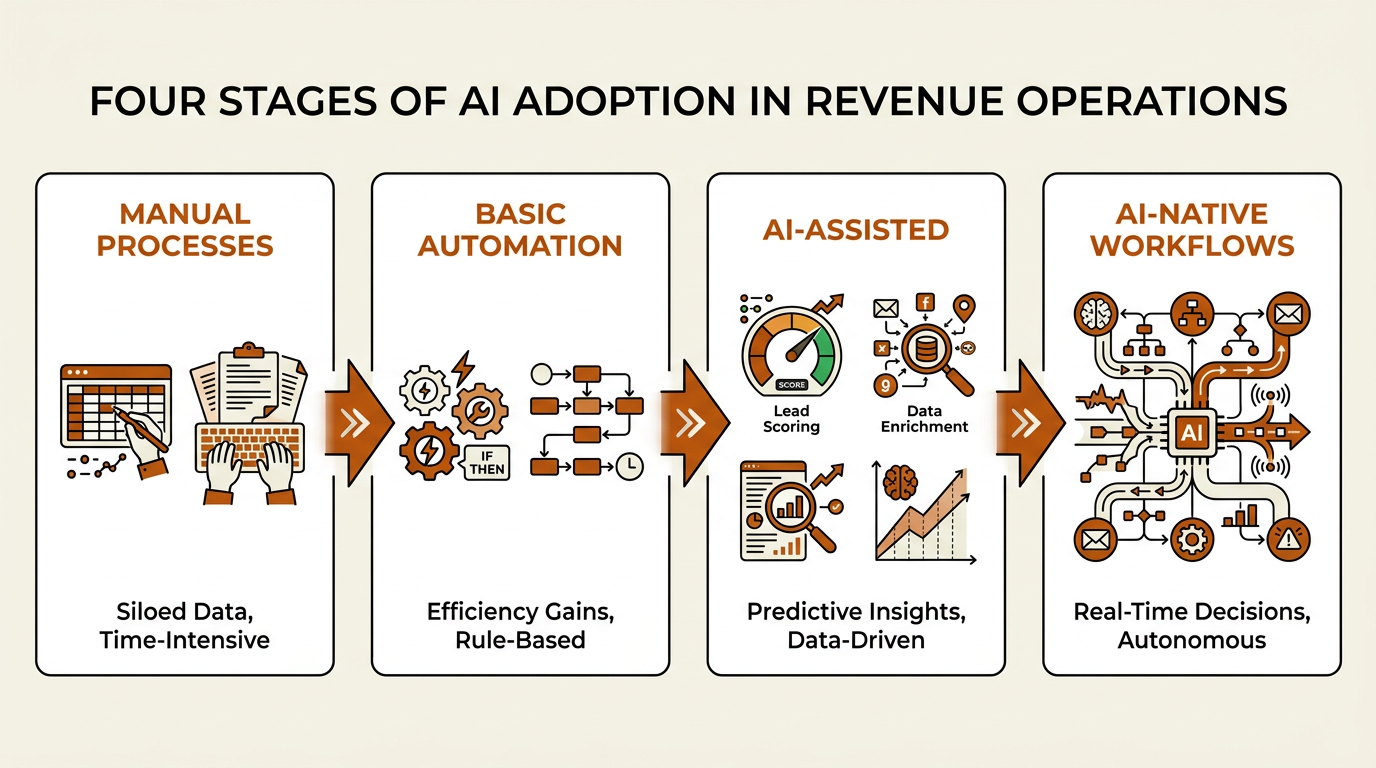
AI adoption in RevOps has evolved from manual data entry to fully autonomous pipeline execution by 2026.
AI adoption in RevOps has become mainstream by 2026, with forecasting, data enrichment, and lead scoring emerging as the most common use cases across the industry. McKinsey's 2025 Global Survey on AI found that 72% of organizations now use AI in at least one business function, and revenue operations is among the fastest-growing areas of deployment. That headline trajectory looks strong until you inspect the implementation. Plenty of teams are still running predictive models on top of messy CRM data, which is the operational equivalent of bolting a turbocharger onto an engine with a cracked block: it might look faster, but you cannot trust it.
High-performing teams take a different route with AI sales automation. They do not slap AI onto broken processes and hope for the best. They fix the workflow first, then add automation where it can reliably drive action. One practical example: instead of scoring leads from a static list, top teams use platforms like Bitscale to enrich accounts in real time, surface buying signals from hiring patterns and tech stack changes, and route those signals straight into sequencing tools. In that model, AI is not a bolt-on feature; it is the connective layer between data and execution.
IBM defines sales automation as using technology to remove repetitive tasks and boost productivity. That still describes the category, but the bar has moved in 2026. Automation that only saves clicks is table stakes. The real lift comes from automation that makes (or at least recommends) decisions: which accounts deserve attention, when to re-engage a stalled deal, and what message to send based on a prospect's recent behavior.
CRM Data Quality and Data Enrichment: The Foundation Nobody Wants to Fix
Most B2B CRMs are not systems of record so much as systems of regret: outdated contacts, duplicate records, and missing firmographics piled on top of each other. Forrester's 2026 budget planning research found that 38% of revenue leaders list data accuracy as a top challenge. If anything, that is likely understated, because it only captures leaders who know they have a problem. Many teams run forecasts and pipeline reviews on data that is structurally flawed, then wonder why the answers do not match reality.
CRM data quality is not a heroic one-time cleanup; it is an operating discipline. The best RevOps teams treat the CRM the way engineering treats production databases: validation rules, automated deduplication, and ongoing monitoring. They also put real budget behind data enrichment, using platforms that append firmographic, technographic, and intent data to records automatically. Bitscale, for example, lets teams enrich contact and company records with verified work emails, phone numbers, and real-time company data, then sync those updates back into the CRM without manual work.
The difference between intent data vs. enrichment data is not academic. Enrichment tells you who the company is; intent tells you what it is doing right now. Strong teams layer both, using enrichment as the foundation and intent signals as the trigger for outbound action. If enrichment is sloppy, intent has nothing reliable to attach to, and the signal disappears into the noise.
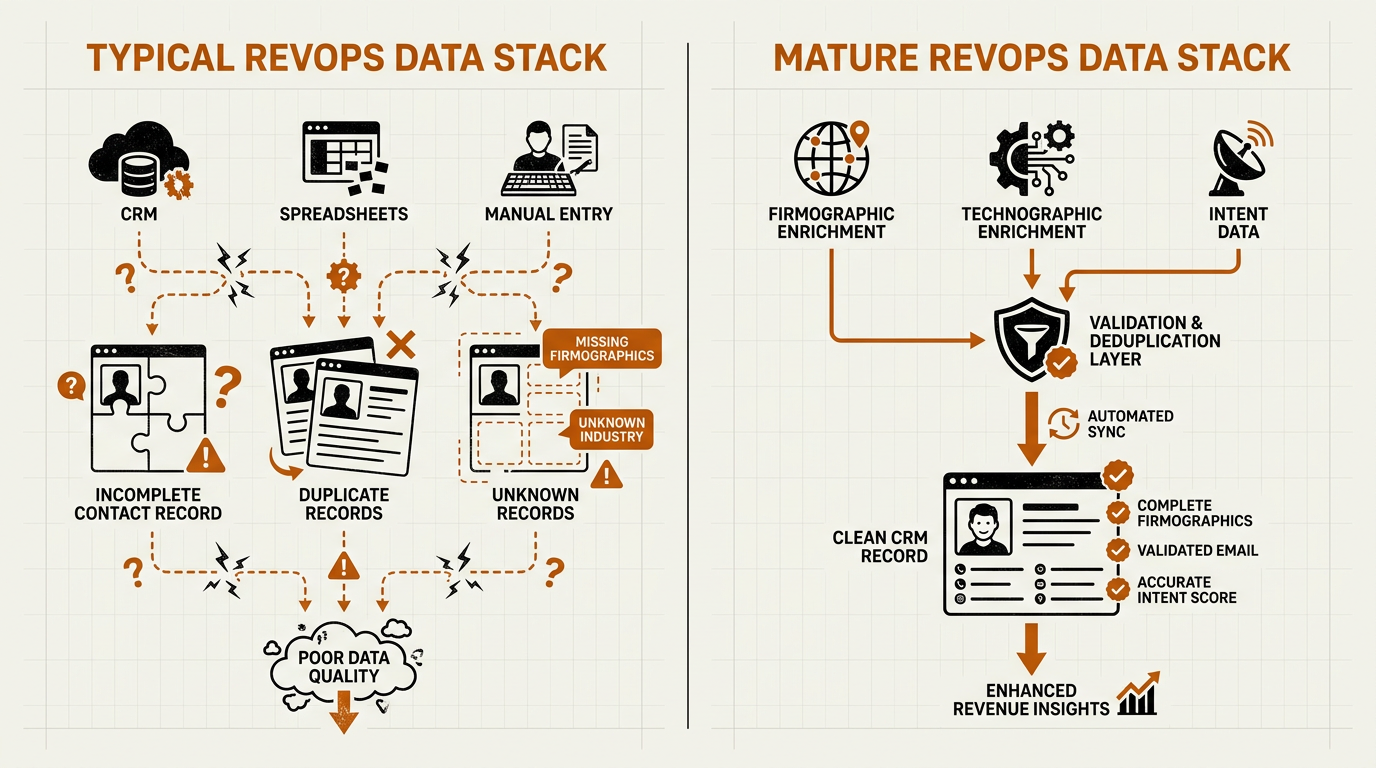
High-performing RevOps teams treat CRM data quality as an operating discipline, not a one-time fix.
GTM Engineering and RevOps Automation: The Rise of the Builder-Operator
GTM engineering is one of the most consequential RevOps trends, and it is still underappreciated by a lot of revenue leaders. It is the practice of building custom, automated workflows that connect data sources, enrichment tools, CRM systems, and outbound channels into a programmable pipeline. The practical difference is simple: you are no longer "working the spreadsheet." You are building the system that replaces it.
Industry analysts, including Skaled (2026), have called out the strategic rise of the VP of RevOps role, and GTM engineering is a big reason why. Revenue teams need operators who can design and maintain complex GTM automation workflows, not just keep the CRM tidy. The center of gravity has moved from administration to architecture.
| Dimension | Traditional RevOps Admin | GTM Engineering Approach |
|---|---|---|
| Primary skill | CRM setup, configuration, and reporting | Workflow design, API integration, and data orchestration |
| Automation scope | Simple triggers and alerts | End-to-end pipeline automation with conditional logic |
| Data strategy | Cleanup after problems show up | Proactive enrichment plus continuous validation |
| Tool philosophy | Best-of-breed tools per function | Consolidated platforms with native integrations |
| Success metric | CRM adoption and usage | Pipeline velocity, conversion by segment, and CAC efficiency |
| GTM engineering represents a fundamental shift in what RevOps teams build and how they measure success. |
Bitscale's ready-made sales workflows and outbound tool integrations are a good example of what this shift looks like in the real world. Instead of asking RevOps to stitch enrichment, scoring, and sequencing together across five tools, teams can build automated pipelines that pull prospect data, enrich it, apply scoring logic, and push qualified leads into outbound sequences. That is RevOps automation as an operating model, not a slide in a quarterly deck.
Tool Consolidation: Why Most RevOps Leaders Are Cutting Their Stack
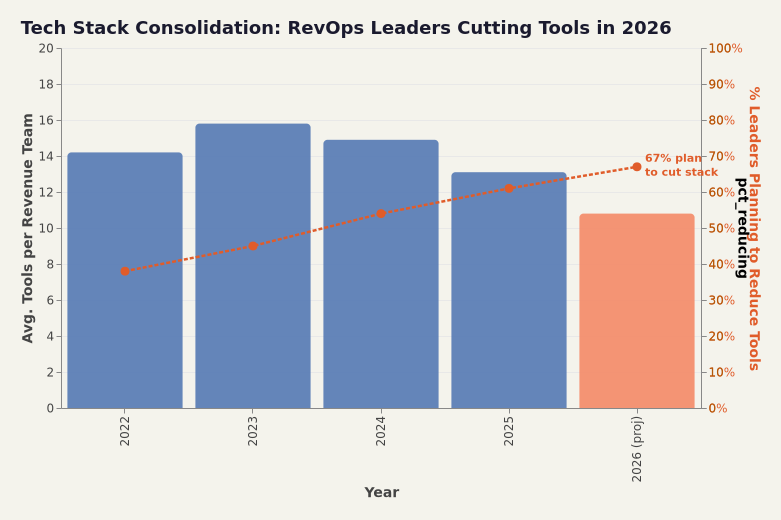
67% of RevOps leaders plan to cut tools in 2026, betting on throughput over breadth (SyncGTM, 2026).
Tool consolidation sits at the top of the 2026 RevOps priority list. Across multiple industry surveys, a clear majority of revenue leaders plan to reduce the number of tools they run. Productiv's 2025 SaaS Management Index found that the average enterprise uses over 300 SaaS applications, with significant redundancy across departments, and revenue teams are among the most aggressive in trimming. This is not consolidation for consolidation's sake. It is a bet on operational throughput. Every new tool adds an integration to babysit, another silo to reconcile, and another vendor relationship to manage. The friction compounds, and it slows the very teams that are supposed to speed revenue up.
The vendor landscape is responding to that pressure. Clay, Apollo.io, Cognism, Lusha, and Instantly.ai have all widened their feature sets to cover more of the GTM workflow. Bitscale is playing the same game, bundling B2B lead and account lists, contact and company enrichment, AI prospect research, CRM sync, and intent signals into a single platform. The point is not to replace every tool on the org chart; it is to shrink the integration tax that comes with running a dozen disconnected point solutions.
| Capability | Point Solution Approach | Consolidated Platform Approach |
|---|---|---|
| Lead sourcing | Separate list-building tool | Built-in account and contact lists |
| Data enrichment | Third-party enrichment API | Native enrichment with work email and phone lookup |
| Sales intelligence | Standalone intent-data vendor | Integrated buying signals and AI prospect research |
| CRM synchronization | Custom middleware and maintenance | Native CRM sync with automated field mapping |
| Workflow automation | Zapier or custom scripts | Pre-built and customizable sales workflows |
| Outbound execution | Separate sequencing tool | Integrated outbound tool connections |
| Consolidated platforms reduce integration overhead and improve data consistency across the revenue stack. |
The Counterargument: Is Consolidation Always the Right Move?
There is fair pushback on aggressive consolidation. Best-of-breed tools often win on depth in a specific category. A dedicated conversational intelligence tool, for instance, will usually offer richer call analysis than a platform that also tries to handle enrichment and sequencing. For teams with the engineering resources to maintain complex integrations and the budget to pay for premium point solutions across the board, that trade can make sense.
For most B2B revenue teams, though, the integration tax of a fragmented stack costs more than the marginal feature advantage of any single tool. Data breaks. Workflows break. Reporting stops being trustworthy. Then RevOps spends its time keeping pipes from leaking instead of building the operating model. Consolidation is not about accepting weaker capability; it is about choosing connected, reliable capability over theoretical best-of-breed features that never actually work together.
What High-Performing Revenue Teams Actually Do Differently
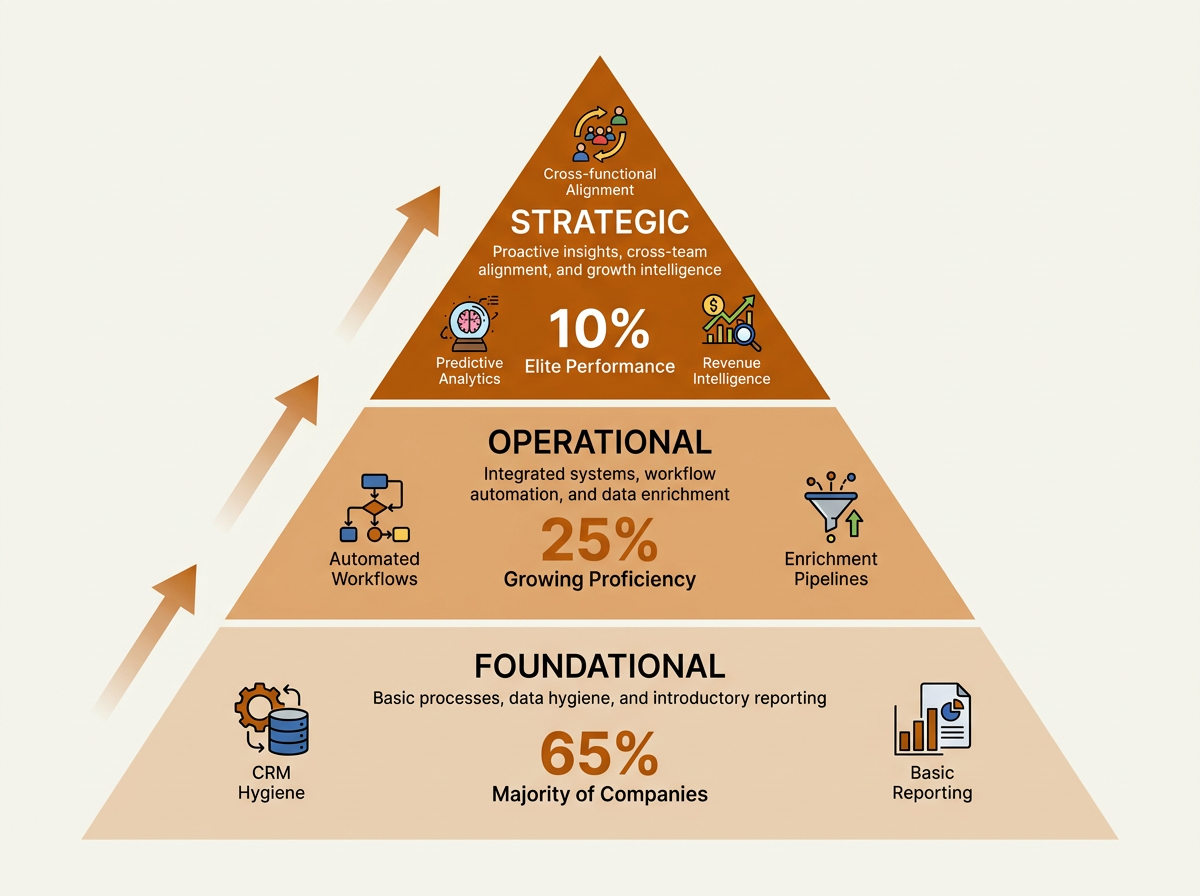
Most revenue teams remain at the foundational tier — strategic-level execution separates high performers.
Step back and a pattern shows up across the revenue operations trends shaping 2026. The teams that outperform are not winning because they found secret software. They are winning because they execute a small set of practices with more discipline than everyone else.
- They treat data as a product. Records have owners, freshness SLAs, and automated validation. Enrichment runs continuously, not as a quarterly fire drill.
- They automate the middle of the funnel. Lots of teams automate lead capture and outbound sequencing. High performers also automate lead routing, account scoring, deal stage progression, and re-engagement triggers.
- They measure efficiency, not just volume. Pipeline generated per rep, CAC by channel, and time-to-close by segment carry more signal than raw lead count.
- They build workflows, not dashboards. Dashboards explain what happened. Workflows change what happens next. Top teams invest more in the second category.
- They consolidate aggressively. Fewer tools, deeper integrations, cleaner data. The GTM strategy is built around operational simplicity.
Actionable Recommendations for Revenue Leaders
If you are leading revenue as a VP of Revenue, CRO, or RevOps owner, these are the moves I would put at the top of the list for the second half of 2026.
| Priority | Action | Expected Impact |
|---|---|---|
| 1 | Audit your CRM for completeness, freshness, and duplication. Put automated enrichment cadences in place. | Contributes to more accurate forecasts and can improve outbound conversion rates |
| 2 | Pick your top three workflow gaps (lead routing, re-engagement, deal progression) and automate them. | Helps reduce rep admin time and enables faster pipeline velocity |
| 3 | Review your stack for redundancy. Aim to cut total tools by 20-30%. | Contributes to lower total cost of ownership and fewer integration failures |
| 4 | Hire or upskill for GTM engineering inside RevOps. | Enables faster iteration on automated pipelines without relying on external dev resources |
| 5 | Stand up buying-signal monitoring across hiring, funding, tech stack changes, and content engagement. | Helps support earlier identification of in-market accounts and can improve outbound response rates |
| These five priorities address the most common gaps between average and high-performing RevOps functions. |
If you want to make progress on those priorities without adding headcount, Bitscale is a practical starting point. Its mix of enrichment, sales intelligence, CRM sync, and pre-built workflows maps to priorities 1, 2, 3, and 5 in a single platform. The data-driven GTM execution breakdown shows how those pieces fit together in practice.
Predictions for 2027: Where RevOps Goes Next
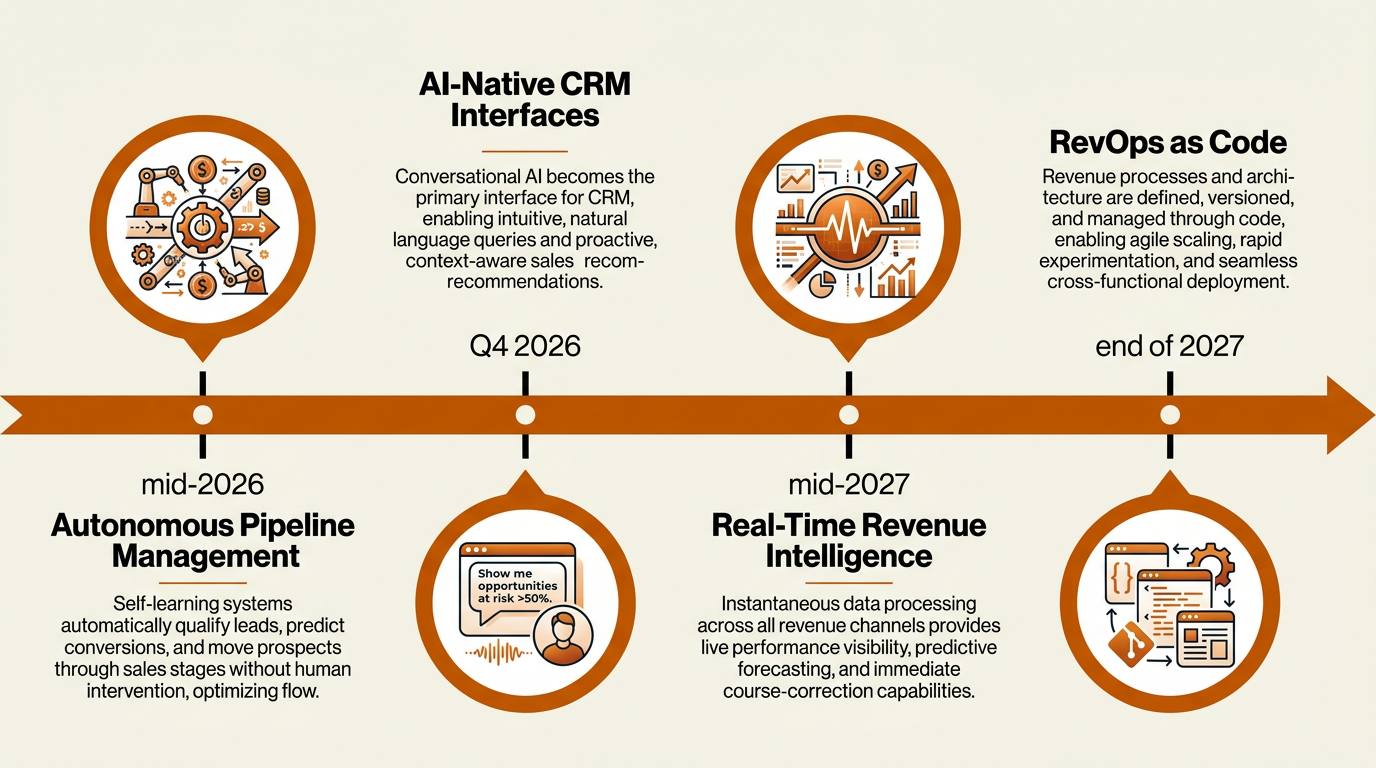
The next 18 months will see RevOps shift from process optimization to autonomous execution.
Based on where current revenue operations trends are headed, here is what is likely to emerge by late 2027. AI is expected to move from assisting reps to autonomously managing defined slices of the pipeline. The industry is likely to see the first wave of "lights-out" outbound motions, where AI handles prospecting, enrichment, sequencing, and initial qualification for specific account segments without human intervention.
CRM interfaces continue to trend toward conversational design. Reps are likely to ask questions in natural language instead of hunting through dashboards. As that happens, RevOps is expected to shift even further toward designing the logic and rules that govern these systems, which puts GTM engineering at the center of the function. Consolidation is likely to keep accelerating, with the market expected to settle around a smaller number of dominant platforms that cover a broad slice of the go-to-market strategy workflow. The teams that built clean data foundations in 2025 and 2026 are well positioned to compound their advantage, because AI trained on accurate data consistently outperforms AI trained on the messy CRMs most teams still tolerate.
The Bottom Line on the State of RevOps in 2026
The state of revops in 2026 is a tale of two operating models. Teams that invested in data quality, workflow automation, and platform consolidation are stacking advantages on top of each other. Teams still running fragmented stacks on dirty CRMs are slipping, even if they are spending heavily on AI. Tech is not the differentiator here; operating discipline is. Revenue leaders who internalize that now will build the teams and systems that win in 2027 and beyond.
Frequently Asked Questions
What is the current state of RevOps adoption in 2026?
RevOps adoption has reached mainstream status among B2B companies with 50 or more employees. The function is now standard across the majority of midmarket and enterprise organizations, and AI usage within RevOps, particularly for forecasting, data enrichment, and lead scoring, continues to grow rapidly. McKinsey's 2025 Global Survey on AI found that 72% of organizations use AI in at least one business function, with revenue operations among the fastest-growing areas.
What are the biggest RevOps trends shaping B2B growth right now?
The revops trends with the most impact in 2026 are tech stack consolidation (a clear majority of leaders plan to reduce tools), AI-powered workflow automation, the rise of GTM engineering as a core discipline, and renewed focus on CRM data quality as the prerequisite for AI and automation.
How does data enrichment improve RevOps performance?
Data enrichment fills in and verifies firmographic, technographic, and contact details on CRM records, which improves targeting accuracy, outbound response rates, and forecast reliability. Platforms like Bitscale automate continuous enrichment and CRM sync, reducing manual entry and slowing record decay.
What is GTM engineering and why does it matter for RevOps?
GTM engineering means designing and building automated, data-driven go-to-market workflows that connect enrichment, scoring, routing, and outbound execution into programmable pipelines. It matters because it pushes RevOps beyond reporting and into building systems that generate revenue with minimal manual work.
How should revenue leaders approach tool consolidation in their RevOps stack?
Start with an audit for redundancy and recurring integration failures. Then look for overlap across tools and evaluate consolidated platforms that cover multiple capabilities natively (enrichment, sales intelligence, CRM sync, workflow automation). The goal is not simply fewer tools; it is fewer integration points, cleaner data flow, and lower operational overhead.

Sanket
CEO | Co-Founder Bitscale


Sanket is the CEO and Co-Founder of Bitscale. He leads company vision and strategy, building the future of AI-driven sales intelligence for modern B2B teams. Sanket is obsessed with the intersection of AI and go-to-market, and has spent years studying how the best B2B companies find, engage, and convert customers at scale. He writes about company building, product strategy, and where AI is taking the sales industry.
Read other blogs
All Blogs
12 Best CRM Sync Tools for Revenue Teams in 2026
Compare 12 CRM sync tools for Salesforce and HubSpot, including enrichment, reverse ETL, and automation options for cleaner revenue data.

Sales Data Enrichment: A Buyer's Guide for Modern B2B Teams
Sales data enrichment helps B2B teams improve CRM records, routing, prospecting, and account prioritization. Compare workflows, costs, and vendor fit today.

What Is AI Prospect Qualification? A Practical Guide for Modern Revenue Teams
AI prospect qualification helps revenue teams enrich data, assess ICP fit, prioritize buying signals, and route the right accounts into CRM workflows.