The Complete Guide to Outbound Sales Automation in 2026
Table of Contents
Explore Bitscale
Find decision makers, more insights and contact information about this company on Bitscale
Outbound sales automation has outgrown the old playbook of bulk blasts and sketchy purchased lists. In 2026, the teams that keep pipeline full are stitching together AI-driven research, real-time buying signals, multi-channel touches, and clean CRM sync into workflows that run with very little babysitting. The sales automation market has grown steadily over the past several years, and adoption continues to accelerate as B2B organizations look for ways to find, qualify, and engage buyers more efficiently at scale.
This piece breaks down the outbound workflow end to end: how prospects get discovered, enriched, prioritized, messaged, and turned into pipeline. If you are standing up outbound for the first time or ripping out a brittle stack of disconnected tools, the sections below cover the building blocks: AI prospecting, enrichment, signals, personalization, engagement, and ongoing optimization.
Outbound Sales Automation Fundamentals
Sales automation is what happens when you hand repetitive outbound work to software: the busywork that slows reps down and quietly wrecks data quality. The term "automation" trips people up because it sounds like you are trying to replace sellers. You are not. You are trying to eliminate the low-value grind (data entry, list building, copy-pasting tokens) so reps can spend more time in conversations that actually move deals. Across most B2B sales organizations, reps still spend the majority of their time on non-revenue-generating activities like manual prospecting, data entry, and internal coordination rather than actual selling conversations.
A solid outbound workflow usually breaks into five layers: (1) prospect discovery, (2) enrichment and qualification, (3) signal detection and timing, (4) personalized outreach, and (5) CRM enrichment and reporting. You can automate any layer on its own, but the real payoff shows up when you connect them so data moves forward without human hand-offs.
Traditional vs AI-Powered Outbound
The move from traditional outbound to ai outbound sales is not just a race to go faster. It changes the ceiling on what a team can do. A rep working manually might research 30 accounts in a day; an AI-driven workflow can research, enrich, score, and draft personalized messages for a far larger volume of contacts in the same window. Here is how the two approaches stack up across the dimensions that actually affect pipeline:
| Dimension | Traditional Outbound | AI-Powered Outbound |
|---|---|---|
| Prospect Discovery | Manual LinkedIn searches, purchased lists | AI-built ICP-matched lists from multiple data sources |
| Research Depth | Surface-level (title, company size) | Firmographic, technographic, hiring, funding, and intent data |
| Personalization | First name and company name merge fields | AI-generated messaging referencing specific triggers and context |
| Timing | Batch sends on a fixed schedule | Signal-triggered sequences (job changes, funding rounds, tech installs) |
| Qualification | Manual review by SDR | AI lead scoring with predictive conversion models |
| Scale | 50 to 100 prospects per rep per day | Large-scale prospect discovery and enrichment through automated workflows |
| AI-powered outbound prospecting changes both the quality and volume of pipeline generation. |
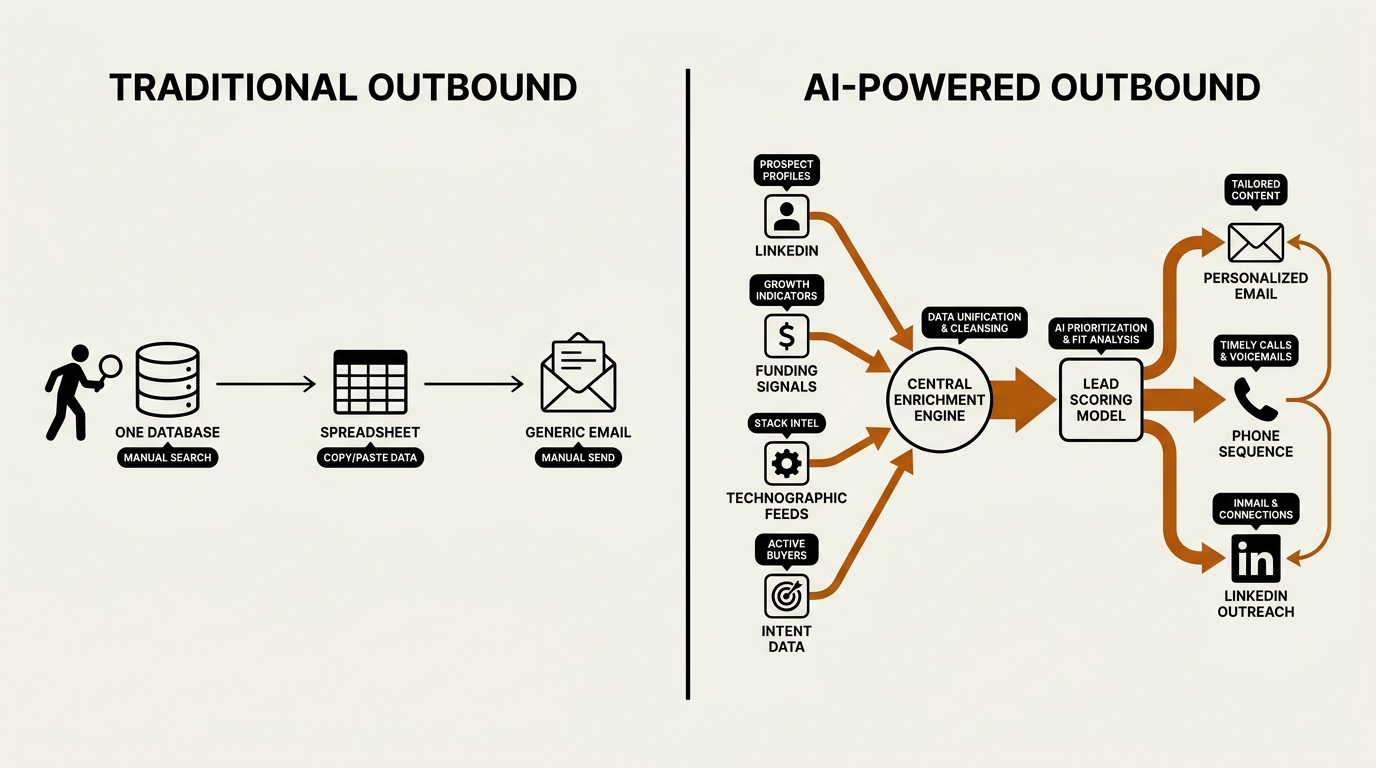
The structural difference between manual and automated outbound is not incremental; it is architectural.
Building the Outbound Workflow: Prospecting, Enrichment, and Signals
Prospect discovery still starts with your Ideal Customer Profile, but the execution looks different now. In 2026, sales automation software lets you define ICP criteria (industry, headcount, tech stack, geography, funding stage) and automatically pull matching accounts and contacts from aggregated databases. Platforms like Apollo.io, Cognism, and Bitscale can generate lists filtered by those attributes; the real separation shows up in what you do after the first list exists.
Enrichment is where a list turns into something a rep can actually work. A bare contact record (name, email, company) is not enough; you need firmographics, technographics, org context, and verified details you can trust. Bitscale combines enrichment, work email and phone lookup, and AI prospect research so teams do not have to duct-tape five tools together just to get a usable record. For a step-by-step breakdown, see this lead enrichment workflow for outbound teams.
Signals answer the timing question: why this account, why now. Someone who just raised a Series B, hired three new SDRs, or started evaluating a competitor is simply more likely to engage than a company in steady state. Knowing what are buying signals is table stakes; operationalizing them is where teams pull away. AI-powered lead scoring that incorporates these signals helps teams prioritize the accounts most likely to convert, replacing guesswork with a structured, data-informed approach to pipeline building.
Manual vs Automated Workflow Comparison
Most orgs do not flip a switch from manual to automated. The table below lines up common workflow steps with their manual version and the automated alternative, so you can spot the steps where automation tends to pay back first.
| Workflow Step | Manual Process | Automated Process |
|---|---|---|
| List Building | Export from LinkedIn Sales Navigator, deduplicate in spreadsheet | ICP-filtered list generation with automatic deduplication |
| Contact Verification | Bounce-test emails one by one | Bulk verification integrated into enrichment pipeline |
| Company Research | Visit each company's website, read news | AI scrapes and summarizes key data points per account |
| CRM Updates | Copy-paste fields into Salesforce or HubSpot | CRM sync pushes enriched records automatically |
| Sequence Enrollment | Manually add contacts to email sequences | Signal-triggered enrollment based on scoring thresholds |
| Reporting | Weekly spreadsheet exports, pivot tables | Live dashboards with conversion metrics by segment |
| Automation eliminates hand-offs between tools and reduces data decay. |
Personalized Outreach and Sales Engagement
Cold email automation in 2026 is not a license to spray more messages. Digital channels now account for the vast majority of B2B sales engagements, and the practical effect is simple: inboxes are packed, and generic outreach disappears on arrival. Sales engagement works when personalization points to something real and current for that prospect: a product launch, a new tech install, or a pain point that is common in their segment.
AI writing assistants can get you to a first draft fast, especially when you feed them enriched data. The teams that win, though, treat that output as starting material, not finished copy. Forrester defines sales engagement solutions as tools that manage omnichannel touchpoints, automate repetitive tasks, and deliver insights to improve efficiency. Omnichannel is not a buzzword here: sequences that mix email, LinkedIn, and phone touches consistently beat single-channel outreach.
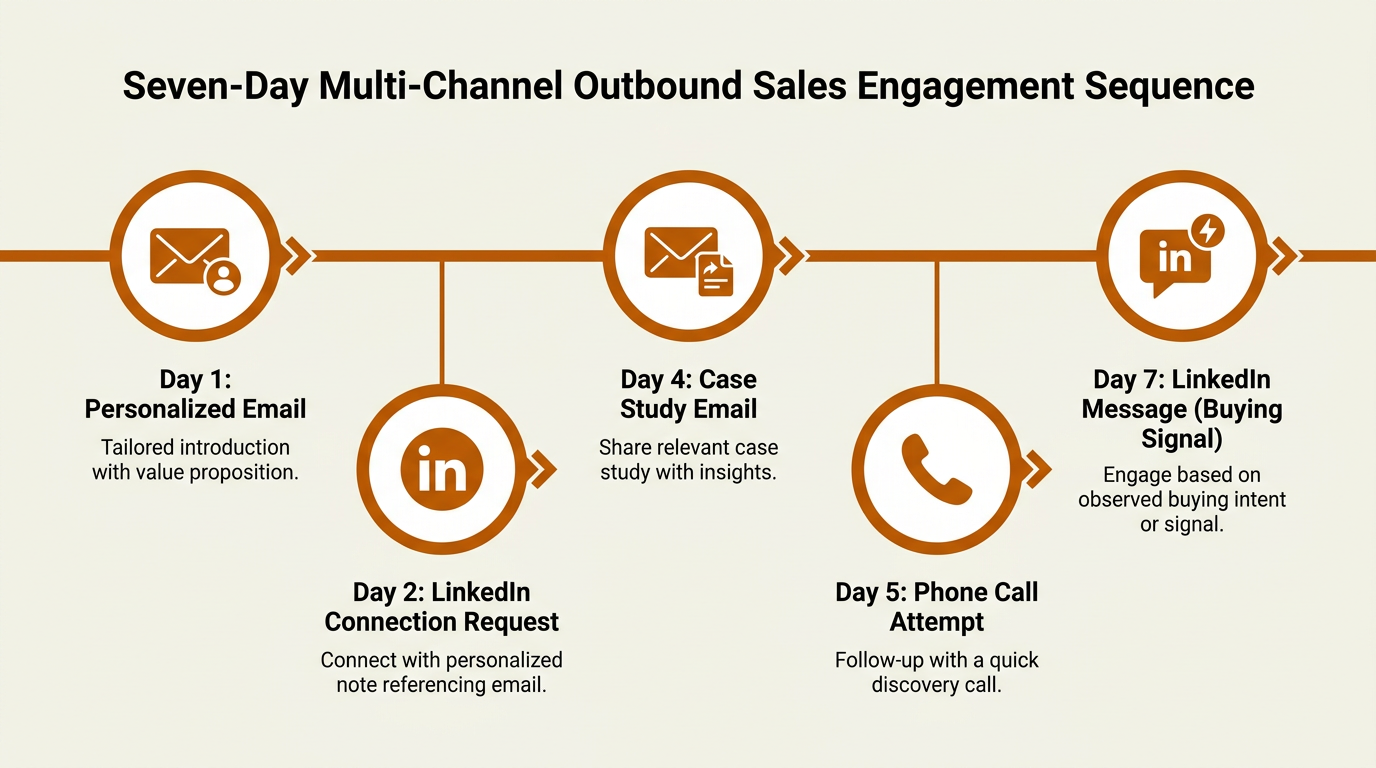
Omnichannel sequences mixing email, LinkedIn, and phone consistently outperform single-channel outreach.
CRM Synchronization and Workflow Automation
The place outbound automation usually breaks is not the sequence. It is the handoff between prospecting tools and the CRM. When enriched data does not land in Salesforce or HubSpot automatically, reps either skip updates entirely or paste in half-complete records. Either way, your pipeline data rots and reporting becomes fiction. CRM data enrichment needs to run continuously, not as a quarterly cleanup ritual.
Bitscale's CRM sync pushes enriched contact and company records straight into your CRM, keeping fields accurate without manual work. That shows up immediately in reporting, territory assignment, and lead routing. When you are evaluating how to build a prospecting stack in 2026, look for platforms that treat CRM synchronization as a core capability, not an "integration" someone bolted on later.
Tool Categories for Outbound Sales Automation
| Category | What It Does | Example Platforms |
|---|---|---|
| Sales Intelligence | Company and contact data, technographics, org charts | Bitscale, Cognism, Lusha |
| Enrichment and Verification | Email verification, phone lookup, firmographic append | Bitscale, Clay, Apollo.io |
| Intent and Buying Signals | Tracks hiring, funding, tech adoption, content consumption | Bitscale, Bombora, G2 |
| Cold Email Automation | Sequence management, deliverability, A/B testing | Instantly.ai, Smartlead, Mailshake |
| CRM | Pipeline management, deal tracking, reporting | Salesforce, HubSpot, Pipedrive |
| Workflow Orchestration | Connects tools, triggers actions, manages data flow | Bitscale, Clay, n8n |
| Many teams use 4 to 6 tools across these categories. Platforms like Bitscale consolidate multiple categories. |
Common Mistakes and Best Practices
What most teams get wrong: they scale volume before they lock in quality. Sending 5,000 poorly targeted emails per week does not create pipeline; it torches your domain reputation and teaches prospects to tune you out. Get enrichment and scoring right first. Scale outreach only after targeting holds up in real replies and meetings.
Best practices for implementation:
- Define your ICP with at least five firmographic and two behavioral criteria before building any automation.
- Validate enrichment accuracy on a sample of 200 records before running full workflows.
- Use separate sending domains for cold outreach to protect your primary domain's reputation.
- Build feedback loops: track reply rates and meeting-booked rates by ICP segment, signal type, and message variant.
- Review AI-generated personalization for accuracy. Factual errors in outreach (wrong funding round, wrong product) destroy credibility instantly.
- Invest in a scalable GTM automation stack in 2026 that grows with your team rather than locking you into rigid sequences.
Reporting and Optimization
Outbound reporting should settle three arguments quickly: are you targeting the right people, are they engaging, and are they turning into pipeline. Open and reply rates are useful diagnostics at the sequence level, but the scoreboard is meetings booked and opportunities created. Teams that use automation to standardize outbound execution, keep CRM data clean, and iterate on targeting tend to see measurable gains in both rep productivity and pipeline consistency over time. Zendesk notes that over 90% of sales leaders plan to invest in engagement technologies to help sellers engage more effectively; strong reporting is what keeps those investments honest.
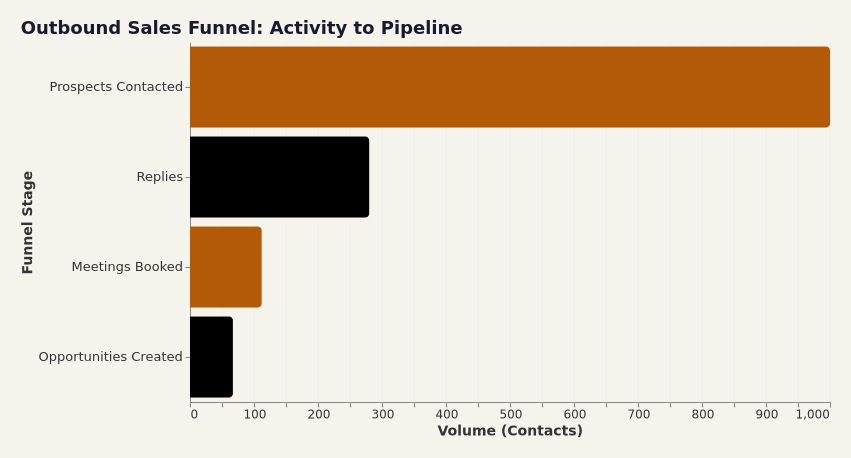
Track prospects-to-pipeline with outbound reporting that ties ICP targeting to meetings booked.
Key Takeaways
Outbound sales automation in 2026 is a connected system, not a pile of point tools. The teams that produce reliable pipeline tie prospect discovery, enrichment, buying signals, personalized outreach, CRM synchronization, and reporting into one workflow where each step triggers the next. Start with ICP clarity and data quality. Automate enrichment before you chase volume. Use signals to earn better timing. Grade performance on meetings and pipeline, not just sends and opens. And if you want to keep the stack manageable as you grow, platforms like Bitscale that combine sales intelligence, enrichment, AI research, and workflow automation reduce the operational drag.
Frequently Asked Questions
What is outbound sales automation?
Outbound sales automation is software that runs the repetitive parts of outbound: prospect discovery, enrichment, sequencing, CRM updates, and reporting. The point is simple: less manual ops work for reps, more time spent selling.
How does AI improve outbound prospecting?
AI can scan large datasets to find ICP-matched accounts, score leads using buying signals, draft personalized outreach, and predict which prospects are most likely to convert. By layering firmographic, technographic, and behavioral data into a scoring model, AI helps teams prioritize outreach toward accounts with the strongest fit and timing indicators, replacing manual guesswork with a structured, repeatable process.
What tools do I need for a complete outbound workflow?
Most stacks include sales intelligence for data, an enrichment product for contact and company details, a cold email tool for sequencing, and a CRM for pipeline management. Platforms like Bitscale roll enrichment, AI research, buying signals, and CRM sync into one system, which cuts down the number of tools you have to maintain.
How do buying signals improve outbound results?
Buying signals like funding rounds, leadership changes, technology adoption, and hiring surges are clues that a company is more likely to be in-market. When outreach triggers off those signals, reply rates tend to rise because the message lands when the timing is relevant.
What is the biggest mistake teams make with outbound automation?
Scaling volume before validating targeting. High-volume outreach built on bad data and generic messaging damages sender reputation and drags conversion. Validate ICP criteria, enrichment accuracy, and message relevance on a small sample before you ramp sends.

Sanket
CEO | Co-Founder Bitscale


Sanket is the CEO and Co-Founder of Bitscale. He leads company vision and strategy, building the future of AI-driven sales intelligence for modern B2B teams. Sanket is obsessed with the intersection of AI and go-to-market, and has spent years studying how the best B2B companies find, engage, and convert customers at scale. He writes about company building, product strategy, and where AI is taking the sales industry.
Read other blogs
All Blogs
12 Best CRM Sync Tools for Revenue Teams in 2026
Compare 12 CRM sync tools for Salesforce and HubSpot, including enrichment, reverse ETL, and automation options for cleaner revenue data.
Sales Data Enrichment: A Buyer's Guide for Modern B2B Teams
Sales data enrichment helps B2B teams improve CRM records, routing, prospecting, and account prioritization. Compare workflows, costs, and vendor fit today.
What Is AI Prospect Qualification? A Practical Guide for Modern Revenue Teams
AI prospect qualification helps revenue teams enrich data, assess ICP fit, prioritize buying signals, and route the right accounts into CRM workflows.