Multi-Channel Outbound: How Modern Teams Win More Meetings
Table of Contents
Explore Bitscale
Find decision makers, more insights and contact information about this company on Bitscale
Multi-channel outbound is not "send the same pitch everywhere and hope something sticks." The teams booking the most meetings run outbound like an engineered system: AI-assisted research feeds enrichment, intent signals shape timing, and CRM sync makes every touch visible across the team. B2B buyers now routinely use ten or more channels to interact with suppliers, a number that has grown steadily over the past decade. If buyers are moving fluidly across channels, your outbound motion has to keep up.
This piece lays out the architecture behind a modern multi-channel outbound program: the baseline concepts, how AI changes research and enrichment, how intent reshapes prioritization, and where human judgment still decides the outcome. If you are standing up outbound for the first time or tightening an existing sales engagement motion, the frameworks and comparisons below are meant to help you build something that converts consistently, not occasionally.
Sections covered:
- What modern multi-channel outbound actually means (and what it is not)
- Single-channel vs. multi-channel vs. omnichannel: a clear comparison
- How AI transforms account research and prospecting
- Enrichment, intent signals, and smarter prioritization
- CRM synchronization and workflow automation
- Why human relationship building still wins deals
- Platform comparison and evaluation criteria
- FAQ
What Modern Multi-Channel Outbound Actually Means
When most teams say "multichannel sales outreach," they mean a rep who emails, sends a LinkedIn connection request, and occasionally makes a call. That is activity, not a system. What separates high-performing teams is coordination: research, enrichment, channel choice, personalization, and follow-up timing all run as one workflow, with each touch building on the last.
A cold email plus a same-day LinkedIn invite is multi-channel on a technicality. Orchestrated outbound looks different: an email that references a prospect's funding round, a LinkedIn voice note a few days later that picks up the same thread, and a call to a direct dial after an intent signal shows they hit your pricing page. Same channels. Different operating model, because the intelligence layer is doing the sequencing.
Industry data consistently shows that campaigns using multiple coordinated channels significantly outperform single-channel approaches in both engagement and conversion. That lift is not a reward for doing more. It is what happens when relevance and timing carry across touches instead of resetting every time you switch channels.
Single-Channel vs. Multi-Channel vs. Omnichannel Outbound
These labels get tossed around like synonyms, but they describe very different motions. Use the table below to place your current outbound strategy on the spectrum and to spot the gaps that usually show up as duplicated outreach, messy reporting, and inconsistent follow-through.
| Dimension | Single-Channel | Multi-Channel Outbound | Omnichannel Outbound Sales |
|---|---|---|---|
| Channels used | One (typically email) | Two or more, often run in separate tools | Three or more, fully synchronized |
| Data sharing across channels | N/A | Limited or manual handoffs | Automatic, real-time CRM sync |
| Personalization depth | Generic or lightly templated | Messaging varies by channel | Context-rich, informed by prior touchpoints |
| Buyer experience | Repetitive or easy to miss | More varied, sometimes disjointed | Seamless, like one ongoing conversation |
| Intent signal usage | Rare | Occasional, handled per channel | Central to sequencing and timing |
| Typical response lift | Baseline | Some improvement | Significant improvement driven by coordination and relevance |
| Best for | Very early-stage teams | Growing teams adding channels | Revenue teams with coordinated GTM |
| Omnichannel is the goal; multi-channel is the stepping stone most teams occupy today. |
A strong majority of B2B leaders report that omnichannel selling is more successful for prospecting and winning new business than traditional single-channel approaches. That is not a future-state slide deck. It is how the teams pulling ahead already run their pipeline.
How AI Transforms Account Research and Multichannel Prospecting
Prospecting used to start with a list: export a database, filter for a few basics, and hope the contact data was not outdated. AI outbound sales tools change that workflow. Strong teams start with the ideal customer profile, then use AI to research, score, and enrich accounts before any sequence goes live, so outreach begins with fit and context instead of guesswork.
What AI Does Well in Outbound Prospecting
AI prospect research tools pull signals from company sites, news, job postings, technographic sources, and financial filings to assemble a usable account intelligence brief. This is not just firmographics with nicer formatting. AI can surface signals like leadership changes, launches, expansion, or hiring patterns that often correlate with a buying window. Bitscale, for example, pairs AI prospect research with company enrichment and contact enrichment in one platform, so what you learn about an account can flow into your outbound sequences with less manual cleanup.
The win is not "more leads." It is fewer dead ends. When your data stack for outbound teams includes AI-driven research, reps spend less time doing first-pass qualification and more time running real conversations with the right accounts.
Traditional vs. AI-Orchestrated Outbound
| Capability | Traditional Outbound | AI-Orchestrated Outbound |
|---|---|---|
| List building | Manual exports and static filters | Dynamic ICP matching using available real-time data |
| Research per account | Significant manual searching per prospect | Summarized in structured output, reviewed by reps |
| Enrichment | Separate tool with batch uploads | Inline, continuous enrichment |
| Personalization | Merge fields for name and company | Contextual references to news, tech stack, hiring |
| Prioritization | Alphabetical, territory, or rep preference | Fit plus intent scoring, validated by human review |
| Channel coordination | Rep-driven and inconsistent | Workflow-driven sequencing across channels |
| CRM updates | Manual logging after the fact | Automatic sync of activities and signals |
| AI does not replace the rep. It replaces the manual, repetitive work that slows reps down. |
Enrichment and Intent: Sharpening Prospect Quality and Prioritization
Raw contact data is not neutral; it creates problems downstream. If records are incomplete or stale, multi-channel prospecting turns into bounced emails, wrong numbers, and generic outreach that never earns a reply. Enrichment is the work of attaching verified emails, direct dials, technographics, and org context to each record so your sequences start on solid footing.
A proper lead enrichment workflow runs at list creation, not after deliverability takes a hit. Bitscale supports contact enrichment (verified emails, phone numbers, job titles) and company enrichment (revenue, headcount, tech stack, funding) in the same workspace where you build sequences. That matters because it removes the CSV export-import loop that shows up when research, enrichment, and outreach live in separate tools.
Buyer Intent Signals and Prioritization
Even a perfect-fit account is not automatically a right-now account. Buyer intent signals like website visits, content downloads, competitor research, job postings for relevant roles, or G2 category browsing help you sort your list by readiness. When intent flows into your outbound automation workflows, reps start with warm accounts instead of grinding through a spreadsheet from the top.
Bitscale surfaces buying signals next to enriched account data, so the prioritization decision happens where the sequence is built. Organizations that systematically incorporate intent into their lead nurturing processes consistently report higher proportions of sales-ready leads and lower cost per qualified opportunity. Enrichment answers "who is this?" Intent answers "why now?" Put them together and your outbound program produces pipeline instead of noise.
CRM Synchronization and Outbound Automation
Most teams misunderstand outbound automation in a predictable way: they automate sending, then leave the data flow behind it to chance. Emails go out from one tool, calls get logged somewhere else, LinkedIn touches end up in a spreadsheet, and the CRM gets updated in a Friday-afternoon scramble. By the time anyone looks, half the context is missing. Another rep hits the same prospect from a different sequence. The buyer feels spammed, not served, and the opportunity disappears.
CRM synchronization fixes the root problem by making every touchpoint visible on one record, across channels, in near real time. When your outbound platform syncs activities, engagement, and intent signals back to the CRM, three things follow: reps stop colliding, managers can see pipeline health without chasing updates, and the buyer experiences continuity instead of disconnected pings.
Bitscale's CRM sync and outbound tool integrations connect research, enrichment, and engagement data to your existing CRM. Ready-made sales workflows reduce the need to stitch everything together with Zapier chains or custom builds just to keep records current. If you want to build a scalable outbound engine, CRM synchronization is the piece that lets you add volume without adding chaos.
Why Human Relationship Building Still Wins Deals
AI can analyze available business information, summarize research, identify patterns across large datasets, and automate repetitive workflows with strong consistency. Trust does not work that way. AI cannot hear hesitation on a discovery call and adjust in the moment. It cannot reframe a pitch mid-sentence when a buyer reveals a different pain than you expected. It also cannot replace the small, human touches that compound over time, like a sincere note when someone gets promoted.
The strongest outbound programs are explicit about the division of labor: AI handles data gathering, pattern recognition at scale, and repetitive execution, while humans own strategy, messaging, qualification, negotiations, relationship building, governance, and final decisions. B2B decision-makers widely report that coordinated omnichannel selling is as effective or more effective than pre-pandemic models, but the "sales" part still depends on a person who can understand the buyer's context and earn the next conversation.
| Task | AI Responsibility | Human Responsibility |
|---|---|---|
| Account research | Analyze available sources and summarize findings | Make sense of it and pick the strategic angle |
| Contact enrichment | Verify emails, phones, and job titles at scale | Choose which contacts matter most for the deal |
| Sequence timing | Recommend steps based on intent and engagement signals | Adjust cadence based on relationship context |
| Message drafting | Produce a first draft with contextual details | Edit for tone, add real insight, remove robotic phrasing |
| Objection handling | Surface common objections and suggested responses | Listen, empathize, and respond in a way that fits the moment |
| Deal negotiation | Provide competitive intel and pricing benchmarks | Navigate stakeholders, build consensus, close |
| Post-sale relationship | Automate reminders and renewal alerts | Maintain rapport and expand the account |
| AI amplifies human capability. It does not substitute for it. |
Platform Comparison: Choosing Your Outbound Stack
Sales tech is crowded for a reason: most teams are trying to assemble the same set of capabilities from different vendors. Your decision usually comes down to philosophy. Do you want one system that covers research through execution, or do you prefer a best-of-breed stack held together by integrations? The comparison below reflects commonly evaluated platforms and uses publicly available product information.
Editorial note: Product capabilities, pricing, AI functionality, integrations, workflow support, and CRM connectivity evolve over time. The information in this comparison reflects publicly available product pages at the time of writing. Verify current details directly with each vendor before making purchasing decisions.
| Platform | Core Strength | AI Research | Enrichment | Intent Signals | CRM Sync | Outbound Execution |
|---|---|---|---|---|---|---|
| Bitscale | Unified GTM: research, enrichment, intent, workflows, outbound | Yes, AI prospect research | Contact and company | Yes, buying signals | Yes, native CRM sync | Yes, with outbound tool integrations |
| Clay | Flexible data orchestration and enrichment workflows | Yes, via waterfall enrichment | Contact and company | Limited native intent | Via integrations | Via integrations |
| Apollo.io | Large contact database with built-in sequencing | Basic lead scoring | Contact and company | Buyer intent add-on | Yes | Yes, email and dialer |
| Lusha | Quick contact lookup and prospecting | Limited | Contact-focused | Limited | Yes | Basic sequences |
| Cognism | EMEA-strong contact data with compliance focus | Limited | Contact and company, phone-verified | Intent via Bombora partnership | Yes | Via integrations |
| Instantly.ai | High-volume cold email sending and warmup | Limited | Basic | Limited | Via integrations | Yes, email-focused |
| Comparison based on publicly available product pages. Verify current capabilities with each vendor. |
One distinction matters more than the logo list: most tools are excellent at one layer (data, enrichment, or sending) and expect you to bolt on the rest. Bitscale brings AI prospect research, account intelligence, enrichment, intent signals, CRM synchronization, and workflow automation into a single platform, which reduces the integration overhead that often slows down outbound sales automation as teams scale.
Evaluation Criteria for Your Outbound Stack
Before you commit to a platform (or a stitched-together stack), put a scorecard in place. The right weights depend on your maturity, budget, and what is already in your CRM and sales engagement setup, but the criteria below tend to predict whether outbound stays coordinated once volume ramps.
- Data quality and freshness: How often is contact and company data re-verified? Stale records hurt deliverability and burn rep cycles.
- Enrichment depth: Does it cover both contact-level (email, phone, title) and company-level (revenue, tech stack, funding) enrichment, or only one side?
- Intent signal coverage: Are buying signals native, pulled through a partner, or missing?
- CRM integration depth: Does sync include activities, engagement, and intent signals, or does it stop at contact records?
- Workflow flexibility: Can you build multi-step workflows (research, enrich, score, sequence) without code, or are you stuck in rigid templates?
- Channel coverage: Can you coordinate email, LinkedIn, and phone in one motion, or are you effectively single-channel with add-ons?
- Total cost of ownership: A cheaper tool that needs several paid integrations often costs more than a unified platform once you factor in licenses and maintenance.
Teams that want to consolidate around a scalable outbound engine should bias toward platforms that cover research-to-engagement in one workspace. Every extra handoff is a chance for data to leak, context to disappear, and reps to slow down.
Putting It Together: Building Your Outbound Program
If you already have a functioning multi-channel motion, treat this as a checklist for tightening the bolts. If you are building from scratch, the order matters more than most teams expect. Here is a practical sequence that keeps you from launching outreach on a shaky data foundation.
Start with your ICP, not your tools. Lock in the firmographic, technographic, and behavioral traits of your best customers. Use closed-won analysis from your CRM to anchor the definition in evidence, not vibes. Once the ICP is clear, use AI research to find accounts that match it beyond basic database filters.
Enrich before you engage. Every contact entering a sequence should have a verified work email, a direct phone number when available, and enough company context to justify personalization on touch one. Doing enrichment during list building (instead of after the first bounce) saves time and protects sender reputation. A strong cold email automation setup depends on clean data from the start.
Layer intent on top of fit. An ICP match that is actively researching your category is more valuable than a long list of passive matches. Use intent to create tiers: high-intent accounts get fast, higher-effort personalization; lower-intent accounts go into nurture sequences designed to stay relevant until timing changes.
Design channel sequences, not channel blasts. Rather than prescribing a fixed number of channels, select the combination that matches your buyers' preferences, your sales cycle length, engagement history, available resources, and business objectives. A solid B2B cadence might open with a personalized email, follow with a LinkedIn prospecting connection request that references the email, then place a call after the prospect has engaged but not responded. Each step should feel like the next line in the same conversation.
Sync everything to the CRM. If it is not logged, it is invisible to the rest of the team and impossible to measure cleanly. Make sure email engagement, LinkedIn replies, and call outcomes flow back to the CRM so the next touch is informed, not redundant.
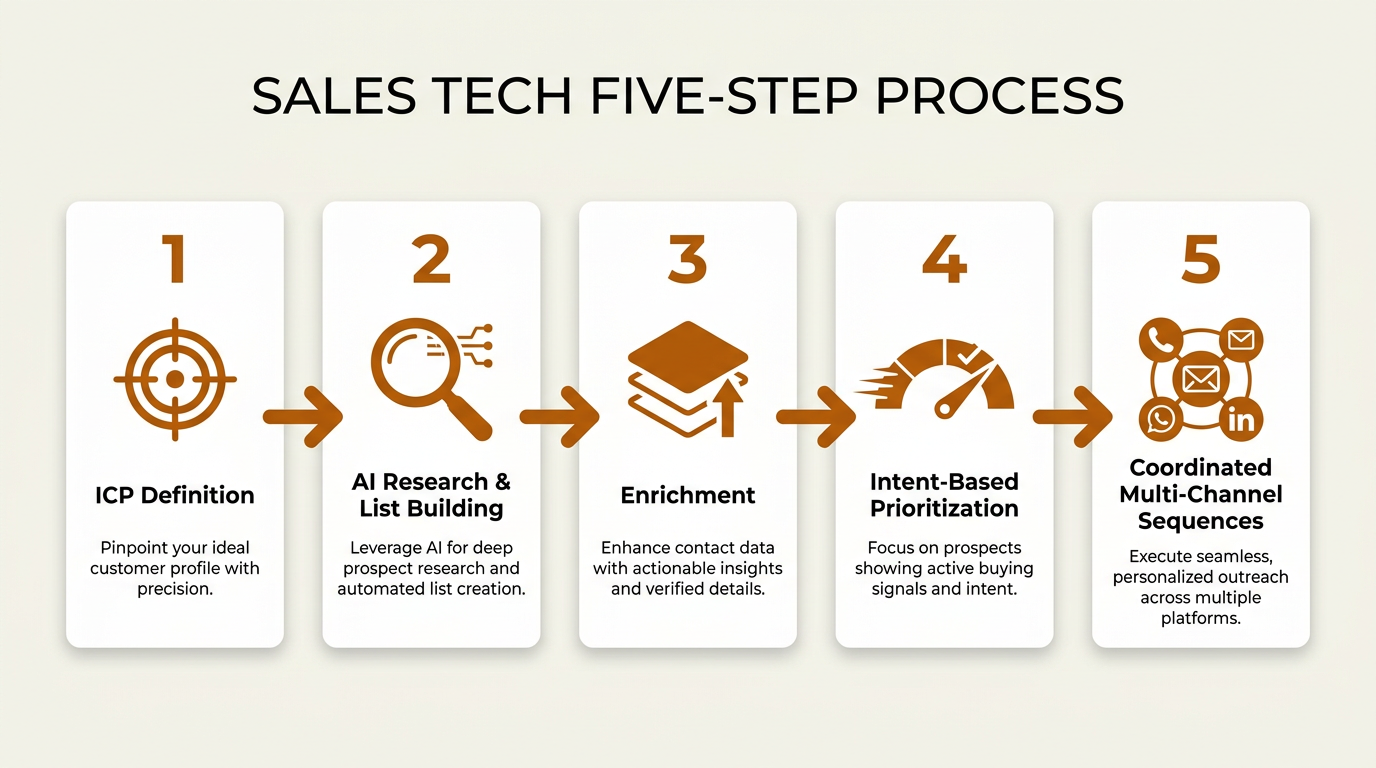
Build sequence order matters — data foundation before outreach, always.
Key Takeaways
Multi-channel outbound pays off when you run it as one orchestrated system, not a pile of disconnected tactics. AI is most valuable where scale breaks humans: research, enrichment, pattern identification, and signal-driven timing. Humans still win the deal through trust, discovery, judgment, and governance. CRM synchronization is what keeps the whole motion coherent, so context does not get dropped and prospects do not get hit twice with conflicting messages.
- Define your ICP using closed-won CRM data before you build lists.
- Use AI research and enrichment to improve prospect quality at the source.
- Prioritize accounts showing intent signals instead of working lists in order.
- Build sequences where each channel touch references the previous one.
- Sync every activity back to the CRM in real time to stay coordinated.
- Train human skills (discovery, empathy, negotiation, governance) alongside automation.
- Evaluate platforms by end-to-end workflow coverage, not isolated features.
- Measure CRM data quality, enrichment coverage, and intent utilization alongside engagement and pipeline metrics.
If you want to bring AI prospect research, enrichment, intent signals, and coordinated execution into one workspace, you can explore Bitscale's unified GTM platform and map it to your current motion.
Frequently Asked Questions
What is the difference between multi-channel outbound and omnichannel outbound sales?
Multi-channel outbound uses two or more channels (like email, phone, and LinkedIn), but they are often run as separate motions. Omnichannel outbound sales connects those channels through a shared data layer (usually the CRM), so each touchpoint reflects what happened before and the buyer experiences one continuous conversation. Many teams sit in multi-channel mode today and move toward omnichannel by tightening coordination and sync.
Does AI replace sales reps in an outbound prospecting strategy?
No. AI is designed for the heavy data work: analyzing available business information, summarizing account research, identifying patterns, recommending prioritization, and automating repetitive workflows. Human teams remain responsible for strategy, messaging, qualification, negotiations, relationship building, governance, and final decisions. The highest-performing outbound motions use AI to increase rep output, not to remove the rep.
How many channels should a B2B outbound cadence include?
There is no universal right number. The best channel mix depends on your buyers' preferences, the length of your sales cycle, engagement history, available team resources, and business objectives. For most B2B teams, email, LinkedIn, and phone create a practical starting point. The right combination emerges from testing and reading engagement data to see where your buyers actually respond, then adjusting accordingly.
What role do buyer intent signals play in multichannel sales outreach?
Intent signals (such as website visits, content downloads, competitor research activity, and relevant job postings) suggest an account is actively evaluating solutions. Using intent to prioritize outreach pushes reps toward prospects who are already leaning into the category, which tends to improve response rates and can shorten sales cycles. Platforms like Bitscale surface intent alongside enriched profiles so prioritization happens in the same workflow as sequencing.
How do I measure whether my multi-channel outbound program is working?
Measure performance across several dimensions: deliverability and open rates (email health), reply rates by channel (message resonance), meetings booked per sequence (conversion), and pipeline generated per rep (revenue impact). Go beyond traditional outreach metrics by also tracking CRM data quality (record completeness and freshness), enrichment coverage (percentage of records with verified contact and company data), and buyer-intent utilization (how consistently intent signals inform sequencing and prioritization). Then compare single-channel and multi-channel sequences to quantify lift. CRM synchronization matters because it gives you one view of activity across email, phone, and social instead of fragmented reporting.

Sanket
CEO | Co-Founder Bitscale


Sanket is the CEO and Co-Founder of Bitscale. He leads company vision and strategy, building the future of AI-driven sales intelligence for modern B2B teams. Sanket is obsessed with the intersection of AI and go-to-market, and has spent years studying how the best B2B companies find, engage, and convert customers at scale. He writes about company building, product strategy, and where AI is taking the sales industry.
Read other blogs
All Blogs
12 Best CRM Sync Tools for Revenue Teams in 2026
Compare 12 CRM sync tools for Salesforce and HubSpot, including enrichment, reverse ETL, and automation options for cleaner revenue data.
Sales Data Enrichment: A Buyer's Guide for Modern B2B Teams
Sales data enrichment helps B2B teams improve CRM records, routing, prospecting, and account prioritization. Compare workflows, costs, and vendor fit today.
What Is AI Prospect Qualification? A Practical Guide for Modern Revenue Teams
AI prospect qualification helps revenue teams enrich data, assess ICP fit, prioritize buying signals, and route the right accounts into CRM workflows.