Forward deployed engineer vs. GTM engineer: what each role does and which one you need
Table of Contents
Explore Bitscale
Find decision makers, more insights and contact information about this company on Bitscale
The short answer: A forward deployed engineer (FDE) works for a software vendor and sits with that vendor's customers, building the vendor's product into each customer's systems until it runs in production. A GTM engineer works for the company that sells, building its own go-to-market system: the data, enrichment, signals, routing and outbound automation that create pipeline. One faces outward to customers; the other builds the engine that finds them.
GTM engineering is the work Bitscale does for its own customers. If you want FDE-style, hands-on build work for your GTM data stack without hiring, Bitscale's GTM engineers set it up and migrate your workflows on the Bitscale data layer, with GTM engineer support on every paid plan, with a dedicated engineer on Enterprise.
- FDE: customer-facing, product deployment, pay posted from $135,000 to $325,000 base in the US job ads we opened.
- GTM engineer: internal-facing, pipeline automation, pay posted at $110,000 to $145,000 base in the live US ad we opened, with recruiter estimates of $100,000 to $180,000.
Why people are comparing these two roles now
The two titles keep getting searched together. In Bitscale's own analysis of Google Trends (US, October 2026), "forward deployed engineer" is the top rising related search for "GTM engineer," up 100% over the past 90 days.
Both roles are growing fast. Fortune reported on September 3, 2026, citing Lightcast data, that job postings for forward-deployed engineers rose more than 1,000% from January to August 2026 compared with the same period a year earlier. Both titles also carry the word "engineer" while sitting close to revenue, which is why buyers, candidates and hiring managers mix them up. They solve different problems, and the rest of this guide shows where the line falls.
What is a forward deployed engineer?
A forward deployed engineer is a software engineer who works on site or in close contact with a vendor's customers, building and adapting the vendor's product to solve that customer's specific problem. The FDE writes production code, but the code serves one customer's deployment rather than the general product roadmap.
The Palantir origin
Palantir is widely credited with creating the role. Its current Forward Deployed Software Engineer posting calls the FDSE "the blueprint" and says Palantir "pioneered this unique position" by embedding engineers directly with customers. Fortune's September 2026 piece likewise notes that "Palantir has long been known for its forward-deployed model." Palantir's posting lists the work: architecture and design decisions, wrangling large-scale data, developing custom applications for customer needs and working with stakeholders from technical teams to executives, with travel up to 25% to client sites.
How AI labs use FDEs today
OpenAI and Anthropic now hire FDEs to get their models running inside large customers. OpenAI's posting says its FDEs "lead complex end-to-end deployments of frontier models in production," owning discovery, scoping, system design, build and rollout, with travel up to 50%. It measures success through "production adoption, measurable workflow impact, and eval-driven feedback." Anthropic's Staff FDE posting sits inside its GTM team and describes an engineer who "embeds directly with our most strategic customers" and decides what should be built.
What is a GTM engineer?
A GTM engineer builds and runs the systems a company uses to find, qualify and reach buyers. Typical work includes:
- Building enrichment workflows that fill in company and contact data.
- Setting up signals such as hiring, funding or website visits that flag accounts to work now.
- Scoring and routing leads into Salesforce or HubSpot.
- Automating outbound across email and LinkedIn.
- Keeping CRM data clean and measuring what each workflow produces.
Softdocs' October 2026 GTM Engineer posting is a good example. It asks the hire to "own the strategy, systems, integrations, and data infrastructure behind our go-to-market motion," build enrichment, scoring and prospecting workflows, and maintain attribution. The posting says the role "is measured in quantity of leads and quality of subsequent pipeline." Our guide to what GTM engineering is covers the discipline in depth.
Bitscale is built for this work: a GTM data layer that runs an 18+ provider email and phone waterfall across 100+ data sources, tracks 15 buying triggers and syncs both ways with HubSpot and Salesforce.
Forward deployed engineer vs. GTM engineer: side-by-side
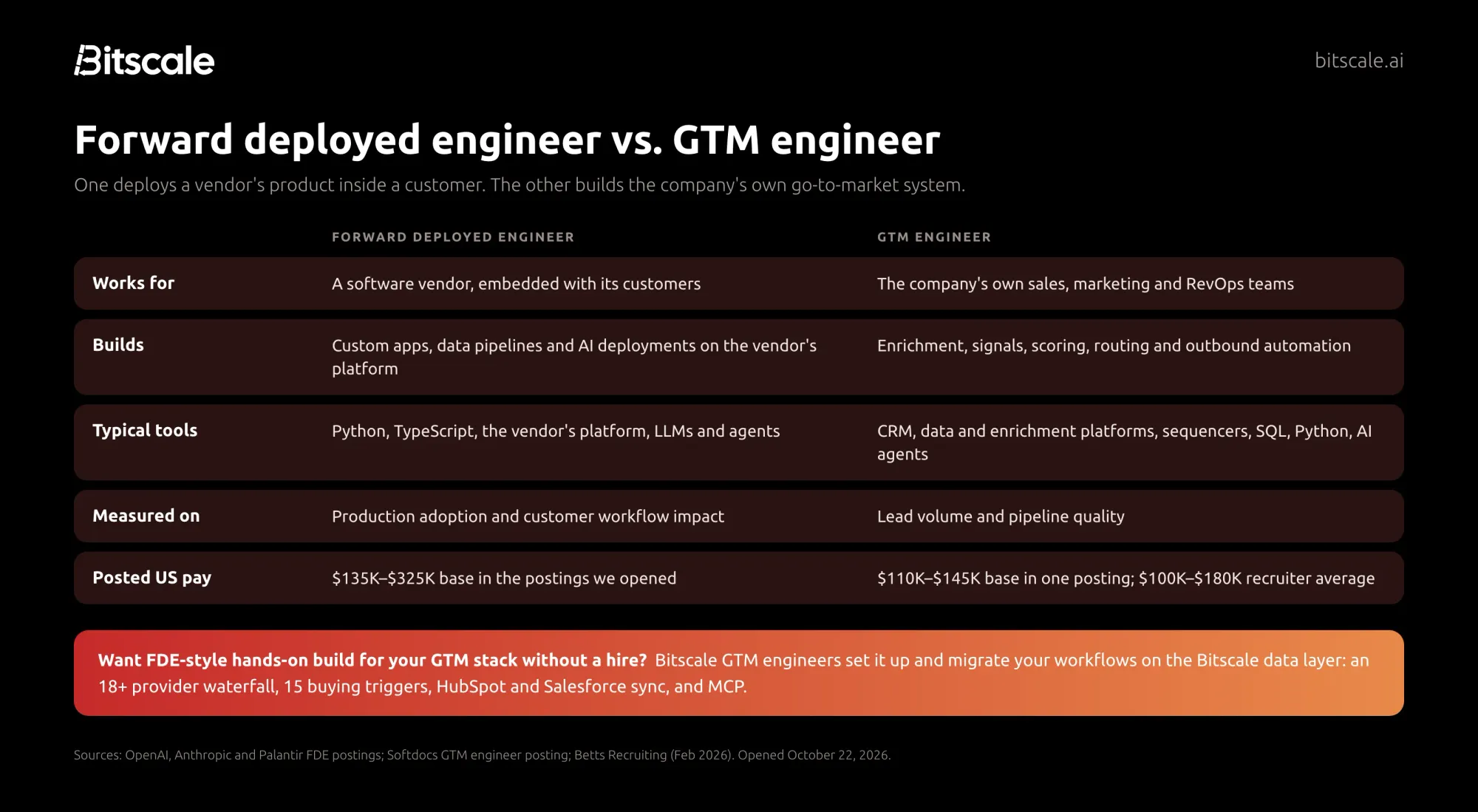
| Forward deployed engineer | GTM engineer | |
|---|---|---|
| Who they work for | A software vendor, placed with the vendor's customers | The company's own sales, marketing and RevOps teams |
| What they build | Custom applications, data pipelines and AI deployments on the vendor's platform | Enrichment, signals, scoring, routing and outbound automation |
| Typical tools | Python, TypeScript or JavaScript, the vendor's platform, LLMs and agents | CRM, data and enrichment platforms, sequencers, SQL, Python, AI agents |
| KPIs | Production adoption, customer workflow impact | Lead volume, pipeline quality, attribution |
| Background | Software engineering plus customer-facing work; OpenAI asks for 5+ years | Marketing ops, RevOps, growth engineering or GTM systems; Softdocs asks for 3+ years |
| Travel | Up to 25% (Palantir) or 50% (OpenAI) | Usually none; Softdocs' role is fully remote |
| Posted US base pay | $135,000 to $325,000 across the postings below | $110,000 to $145,000 in one posting; $100,000 to $180,000 recruiter average |
What the pay data says, and where sources disagree
Pay for both roles depends heavily on employer and level, and the sources do not agree. Here is what we could open.
Forward deployed engineer
| Source | Figure |
|---|---|
| Anthropic, Staff FDE (New York, San Francisco, Seattle) | $280,000 to $320,000 annual salary |
| OpenAI, FDE (San Francisco and Seattle) | $185,000 to $300,000, plus equity |
| OpenAI, Forward Deployed Software Engineer (New York and Seattle) | $153,000 to $325,000, plus equity |
| Palantir, Forward Deployed Software Engineer (New York) | $135,000 to $200,000 estimated, plus possible RSUs and sign-on bonus |
| Lightcast data, reported by Fortune | Median advertised salary above $188,000, versus about $145,000 for traditional software engineers |
| Recruiting from Scratch (June 2026) | Median base $190,000; 25th percentile $160,000; 75th percentile $220,000 |
The spread is wide because the postings cover different levels: Anthropic's range is for a Staff role, while Palantir's starts lower and adds equity on top. Recruiting from Scratch's headline cites a very large posting sample, but its body text says the figures come from 135 postings, so treat it as a small sample.
GTM engineer
| Source | Figure |
|---|---|
| Softdocs, GTM Engineer (remote, US) | $110,000 to $145,000 base, plus a 10% annual bonus opportunity |
| Betts Recruiting (February 2026), national average | $100,000 to $180,000 |
| Betts Recruiting, top earners (90th percentile) | $180,000 to $250,000 |
| Betts Recruiting, AI companies | $180,000 to $240,000 base |
| Betts Recruiting, San Francisco and New York | $180,000 to $300,000 and $130,000 to $230,000 |
Betts itself notes that "comprehensive salary data for GTM Engineers remains limited." On the evidence we found, FDE postings start higher, but a senior GTM engineer at an AI company can earn about what an entry-level FDE does. For how GTM engineering pay compares with sales development roles, see our SDR salary guide.
Where the two roles overlap
The roles share more than a title word:
- Both write code close to revenue. An FDE's work decides whether a customer renews; a GTM engineer's work decides whether pipeline exists.
- Both glue systems together. FDEs connect the vendor's platform to customer data. GTM engineers connect data providers, the CRM and outreach tools.
- Both now build with LLMs and agents. Anthropic's Staff FDE posting expects "hands-on time with agents," and Betts describes GTM engineers as people who "work directly with AI solutions by writing code, managing agents."
- Both turn one-off fixes into reusable patterns. OpenAI asks its FDEs to "codify working patterns into tools, playbooks, or building blocks." GTM engineers do the same with workflow templates; Bitscale's ready-made playbooks package that idea for common GTM motions.
The difference is the customer. An FDE's output belongs to someone else's business. A GTM engineer's output is the company's own pipeline.
GTM engineer vs. solutions engineer, and where the FDE fits
A solutions engineer (or sales engineer) supports a deal before the contract is signed: discovery calls, demos, technical questions and proofs of concept. An FDE usually picks up after the sale, building the deployment in production. A GTM engineer sits on neither side of the customer conversation; they build the internal system that generates the meetings the solutions engineer later supports.
In short:
- GTM engineer: creates pipeline.
- Solutions engineer: helps win the deal.
- Forward deployed engineer: makes the product work for the customer after the sale.
Which one does your company need?
Use the question you are trying to answer.
Hire a forward deployed engineer if:
- You sell a complex platform, often AI or data software, and customers cannot reach value without custom integration work.
- Deals are large enough to fund an engineer's time per account.
- Product needs a direct feed of what breaks in real deployments.
Hire a GTM engineer if:
- Your SDRs spend hours building lists by hand, or your CRM is missing firmographics, emails and phone numbers.
- You want signal-based outbound (hiring, funding, tech changes) instead of static lists.
- You run several data and outreach tools that don't share data cleanly. Our best GTM tools guide maps the stack by category.
You may need both if you are a software vendor with enterprise customers: the FDE keeps customers live, and the GTM engineer fills the pipeline that becomes those customers. Once the data model gets complicated, a RevOps architect usually sets the rules both work within.
You may need neither hire yet if your main gap is GTM build capacity rather than a permanent role. That is the case Bitscale covers: its GTM engineers do the FDE-style setup work for your go-to-market data stack, on Bitscale, as part of the plan.
How each role uses AI and MCP
AI changes the daily work of both roles, in different directions.
Forward deployed engineers build AI into customer systems. OpenAI's FDE posting asks for people who "have built or deployed systems powered by LLMs or generative models," and Anthropic's expects everyday experience with LLMs and agents. The job is choosing what to automate, wiring models to customer data safely and proving it works with evals.
GTM engineers use AI to research and act on accounts at scale: an agent reads a company's site or job posts, classifies fit and writes a first line, and the result lands in the CRM. The Model Context Protocol (MCP) lets an AI assistant call those data tools directly. Bitscale's MCP server at https://api.bitscale.ai/mcp signs in by OAuth and exposes about 50 tools, so a GTM engineer can ask Claude or ChatGPT to find, enrich and verify contacts in chat. Credits are charged at the same rate as the app, and waterfalls charge only for the provider that returns a valid result.
How Bitscale helps
Bitscale is the GTM data layer for your CRM, and GTM engineering is part of what you buy:
- Done-for-you setup and migration. Bitscale GTM engineers set up your workspace and migrate existing workflows, data and setup for you. There is GTM engineer support on every paid plan, with a dedicated engineer on Enterprise.
- Waterfall enrichment. One email and phone waterfall across 18+ contact-data providers and 100+ data sources overall. Bitscale reports 95% email and phone coverage and bounce rates below 0.5%.
- Signals. 15 buying triggers flag accounts to work now, so your outbound starts from a reason to reach out.
- AI research agent and playbooks. The AI research agent researches accounts for you, and ready-made playbooks give you working GTM workflows from day one.
- CRM sync. Two-way HubSpot sync from the Growth plan and Salesforce from the Booster plan, writing back only changed fields.
- API and MCP. Run the same workflows from code or from an AI assistant.
Pricing is per account with unlimited actions on paid plans: Free with 200 credits, Growth at $349/mo ($314 billed annually) with 15K credits a month, Booster at $799/mo ($719 annually) with 50K credits a month, and Enterprise from $15K/yr. Credits roll over up to 3x. On G2, Bitscale is rated 4.8/5.
Frequently asked questions
What is a forward deployed engineer?
A forward deployed engineer is a software engineer employed by a vendor who works directly with that vendor's customers, building and adapting the product inside each customer's systems until it runs in production. Palantir is credited with creating the role.
Is a GTM engineer the same as a forward deployed engineer?
No. An FDE works for a vendor and builds its product into customers' systems. A GTM engineer works for the selling company and builds its own pipeline system: enrichment, signals, routing and outbound automation, often on a data layer such as Bitscale.
How much does a forward deployed engineer make?
In the US postings we opened in October 2026, base pay ranged from $135,000 (Palantir, low end) to $325,000 (OpenAI, high end), with equity on top at most employers. Lightcast data reported by Fortune puts the median advertised salary above $188,000.
How much does a GTM engineer make?
A live Softdocs posting offers $110,000 to $145,000 base plus a 10% bonus opportunity. Betts Recruiting puts the US national average at $100,000 to $180,000, with top earners at $180,000 to $250,000. Data on the role is still limited.
What is the difference between a GTM engineer and a solutions engineer?
A solutions engineer supports live deals with demos, technical answers and proofs of concept. A GTM engineer builds the internal system that creates pipeline in the first place, such as enrichment workflows, buying signals and outbound automation.
Can I get GTM engineering help without hiring?
Yes. Bitscale includes GTM engineer support on every paid plan, with a dedicated engineer on Enterprise. Bitscale GTM engineers set up your workspace and migrate existing workflows onto the Bitscale data layer for you.
Sources
Forward deployed engineer job postings
- Anthropic: Staff Forward Deployed Engineer (updated October 14, 2026)
- OpenAI: Forward Deployed Engineer (FDE), San Francisco (posted September 11, 2026)
- OpenAI: Forward Deployed Engineer (FDE), Seattle (posted September 11, 2026)
- OpenAI: Forward Deployed Software Engineer, New York
- Palantir: Forward Deployed Software Engineer, New York
GTM engineer job postings
Reports and salary guides
- Fortune: forward-deployed engineers, citing Lightcast (September 3, 2026)
- Recruiting from Scratch: Forward deployed engineer salary in 2026 (June 25, 2026)
- Betts Recruiting: GTM engineer compensation trends for 2026 (February 5, 2026)
- Google Trends, related queries for "GTM engineer," US, past 90 days (Bitscale analysis, October 2026)
Bitscale

Abhinay Kumar
CRO | Co-Founder Bitscale


Abhinay is the CRO and Co-Founder of Bitscale. He drives revenue strategy and go-to-market, helping B2B teams build scalable outbound motion using AI-powered enrichment and automation. Abhinay has a sharp focus on pipeline quality over volume, and his thinking on modern outbound has shaped how hundreds of sales teams approach prospecting. He writes about what actually works in GTM — no fluff, just signal.
Read other blogs
All Blogs
Salesforce in Claude (Claudeforce): what sellers get, and what it means for your CRM data
Salesforce in Claude puts your live CRM inside Claude with 37 sales skills. What sellers get, who can use it, and how to get your CRM data ready first.

Clay vs Claude for GTM: what each does, and the better setup (2026)
Clay vs Claude: one is an enrichment tool, the other an AI assistant. What each does for GTM, when you need a data tool, and the setup that uses both well.
RevOps architect: role and responsibilities, skills, salary and a 30/60/90-day plan
What a RevOps architect does, how the role differs from a RevOps manager, admin or GTM engineer, plus skills, a 30/60/90-day plan and sourced 2026 salaries.