CRM Data Enrichment: The Best Way to Keep Your CRM Accurate for B2B Sales Teams
Table of Contents
Explore Bitscale
Find decision makers, more insights and contact information about this company on Bitscale
B2B contact and company data changes continuously. People switch roles, companies get acquired, tech stacks evolve, and buying committees rotate. CRM data enrichment is how revenue teams keep up: an always-on system for filling gaps, fixing errors, and expanding records with verified firmographic, technographic, and behavioral data so sales, marketing, and RevOps teams operate on reality, not assumptions.
Most teams treat enrichment like spring cleaning: a one-time scrub before a board meeting, a migration, or a big campaign push. It never holds, because the inputs never stop changing. The goal is to make enrichment an operating rhythm, not a heroic project. That means building repeatable coverage across contact and company enrichment, layering in buying signals, using AI research where it actually saves time, and putting RevOps governance around the whole thing so it stays clean after the initial rollout.
Why CRM Enrichment Is an Ongoing Process, Not a Project
Gartner estimates that poor data quality costs organizations an average of $12.9 million every year (How Bad CRM Data Can Derail Your B2B Marketing Strategy, 2025). That loss rarely shows up as a single dramatic failure. It shows up as a thousand small misses: an email sent to someone who left six months ago, an ABM list built on accounts that already churned, a forecast padded with pipeline tied to leads that never had a real chance. Because the pain is spread out, it can hide for months unless someone forces an audit.
Poor CRM data creates operational inefficiencies across the revenue org. It weakens forecasting, increases duplicate work, reduces segmentation quality, and makes it harder for teams to prioritize the right opportunities. Sales teams often spend a significant amount of time verifying contact information, correcting CRM records, and researching missing account details instead of engaging with prospects and customers. That is not a corner case; it is what happens when a CRM depends on manual entry and occasional cleanup to stay usable.
The mindset shift is straightforward: treat b2b crm data quality like pipeline hygiene. Nobody runs pipeline reviews once a year and calls it done. Enrichment needs the same cadence, because the underlying data changes just as quickly.
The Core Layers of CRM Data Enrichment
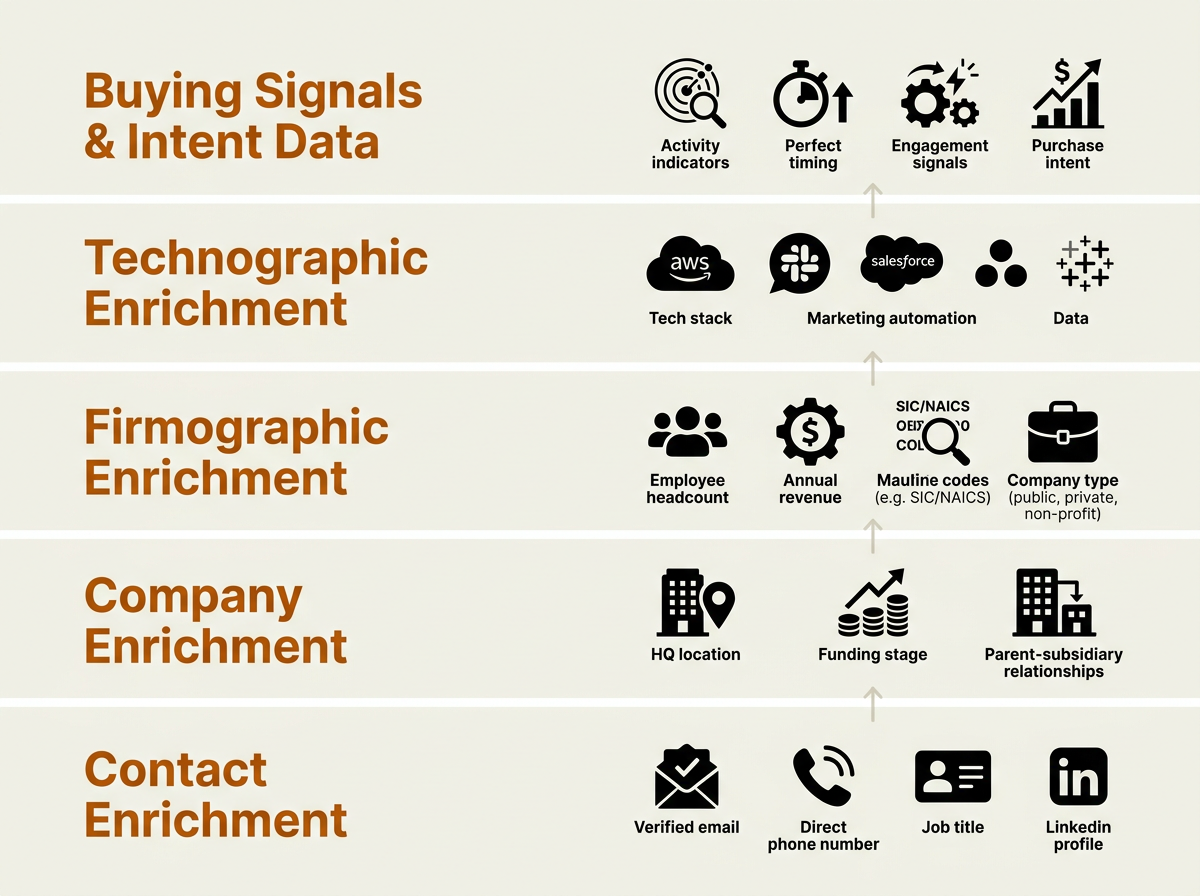
Each enrichment layer adds a distinct dimension of intelligence to your CRM records.
Contact Enrichment
Contact enrichment covers the fields reps need to reach a real human: verified work email, direct phone, current title, seniority, and a LinkedIn profile. Miss those basics and outbound sequences bounce, dials go nowhere, and lead routing turns into a coin flip. The most reliable pattern is waterfall enrichment: query multiple providers in sequence and keep the first verified match, instead of betting your database on a single source with predictable coverage gaps.
Company Enrichment and Firmographic Data
Company enrichment adds the account-level context that makes segmentation and prioritization possible: industry, employee count, annual revenue, HQ location, funding stage, and parent/subsidiary relationships. Firmographic enrichment is the slice focused on classification and identity fields (SIC/NAICS codes, company type, year founded). Together, these fields drive ICP scoring, territory design, and account routing. An account that is just a name and domain is hard to do anything with. An account with a full set of firmographics can be scored, routed, and personalized automatically.
Technographic Enrichment
Technographics answer a question every AE eventually asks on a call: "What are you running today?" Technographic enrichment identifies the tools, platforms, and infrastructure in a company's stack. If you sell a Salesforce integration, you want to know who actually runs Salesforce before anyone burns cycles on discovery. This data also surfaces competitive displacement opportunities and flags integration fit early, when it is still cheap to qualify out.
Buying Signals and Intent Data
Firmographics and technographics tell you who could buy. Buying signals narrow that down to who is likely buying now. That includes job postings for roles your product supports, leadership changes, funding rounds, tech adoption or removal, earnings call mentions, and third-party intent based on content consumption. When those signals land inside the CRM, the database stops being a directory and starts acting like a prioritized queue.
Manual vs. Automated CRM Enrichment
Manual enrichment is where most teams start because it feels safe: a rep Googles a prospect, checks LinkedIn, and patches a few fields. That works for five records. It falls apart at five hundred. Below is the tradeoff across the dimensions revenue teams actually care about.
| Dimension | Manual Enrichment | Automated Enrichment |
|---|---|---|
| Speed | Minutes per record; hours per list | Seconds per record; thousands per hour |
| Accuracy | Depends on rep diligence; no verification layer | Waterfall verification across multiple providers |
| Coverage | Limited to what one person can find | Pulls from dozens of data sources at once |
| Consistency | Each rep fills different fields, in different formats | Standardized field mapping and formatting |
| Scalability | Stops working beyond a few hundred records | Runs continuously across the full CRM |
| Cost | Hidden cost in rep time spent on manual research | Subscription-based software investment that supports continuous automated CRM maintenance |
| Freshness | A snapshot that starts decaying immediately | Scheduled re-enrichment keeps records current |
| Manual enrichment cannot keep pace with the rate of B2B data change. |
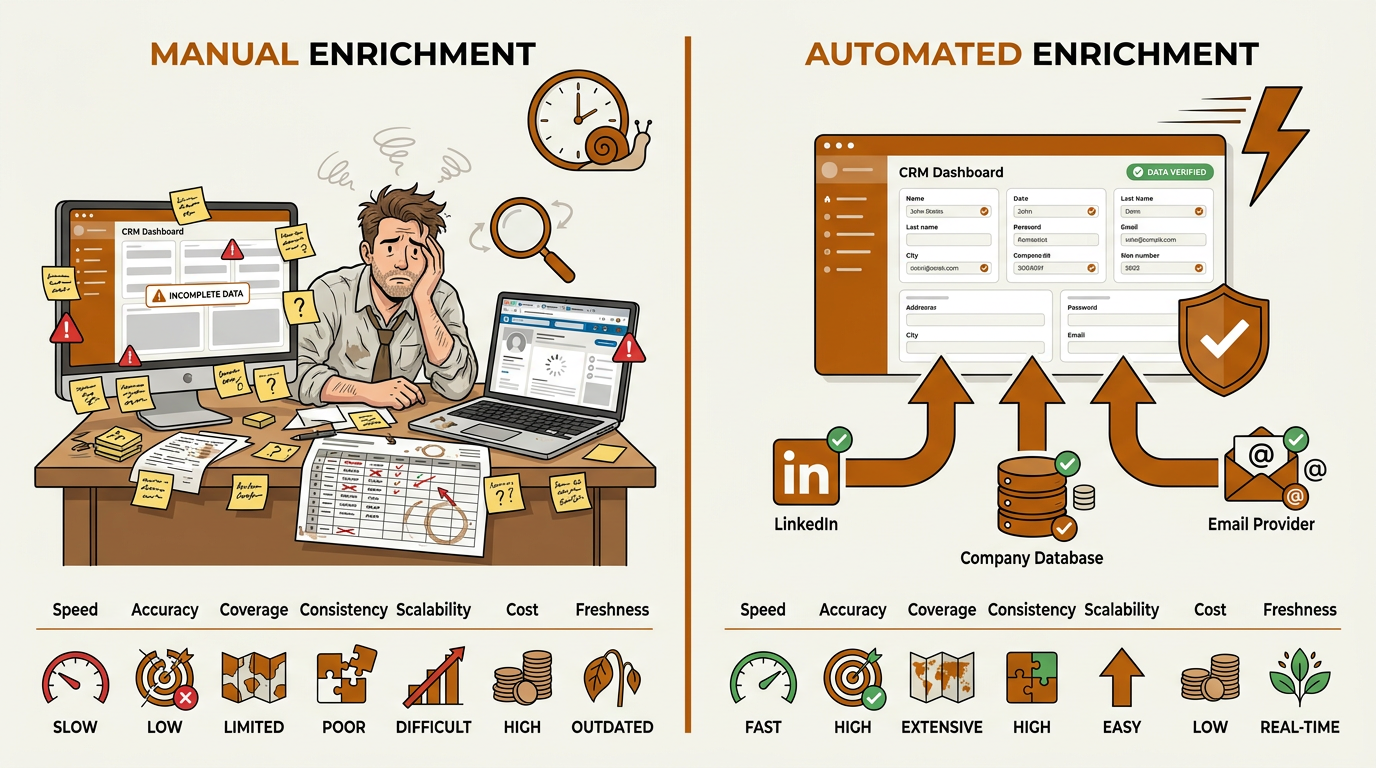
The productivity gap between manual and automated enrichment widens as your database grows.
The Business Impact of Poor CRM Data (and Modern Solutions)
Poor data quality affects every stage of the revenue cycle. The impact shows up as poor targeting, duplicate work, inaccurate segmentation, forecasting challenges, lower CRM trust, and inefficient sales execution. What matters day to day is how bad data breaks revenue workflows and how modern enrichment systems address each failure mode.
| Poor CRM Data Problem | Business Impact | Modern Solution |
|---|---|---|
| Missing or bounced emails | Outbound sequences fail; sender reputation drops | Waterfall email verification across multiple providers |
| Wrong job titles or seniority | Reps pitch the wrong persona; deals stall | Continuous contact enrichment with title normalization |
| No technographic data | Reps waste calls on unqualified accounts | Automated tech stack detection and CRM sync |
| Stale company revenue/headcount | ICP scoring misclassifies accounts | Scheduled firmographic re-enrichment |
| Duplicate records | Multiple reps work the same account; reporting inflated | Deduplication rules and merge automation |
| No buying signals | Pipeline is a guessing game; timing is random | Intent and signal enrichment layered onto account records |
| Inconsistent formatting | Segmentation and routing rules break | Field standardization and validation at point of entry |
| Each data problem has a specific, automatable solution when enrichment runs continuously. |
AI Prospect Research and Sales Intelligence
Traditional enrichment is about structured fields. AI prospect research is about turning the messy stuff on the internet into usable context. There is a difference between knowing a company has 500 employees (firmographic) and knowing they just posted three data engineer roles, their CTO spoke at a cloud conference last week, and their latest 10-K mentions a digital transformation initiative. Structured data helps you qualify. Synthesized context helps a rep sound like they did the homework.
Platforms like Bitscale pair structured enrichment with AI research agents that scan public sources, summarize what matters, and write it back into CRM fields. The practical win is time: reps get pre-call briefs without spending 20 minutes in tabs. Done well, the sales intelligence layer turns raw data into a narrative a rep can use in their first line, not just another field nobody reads.
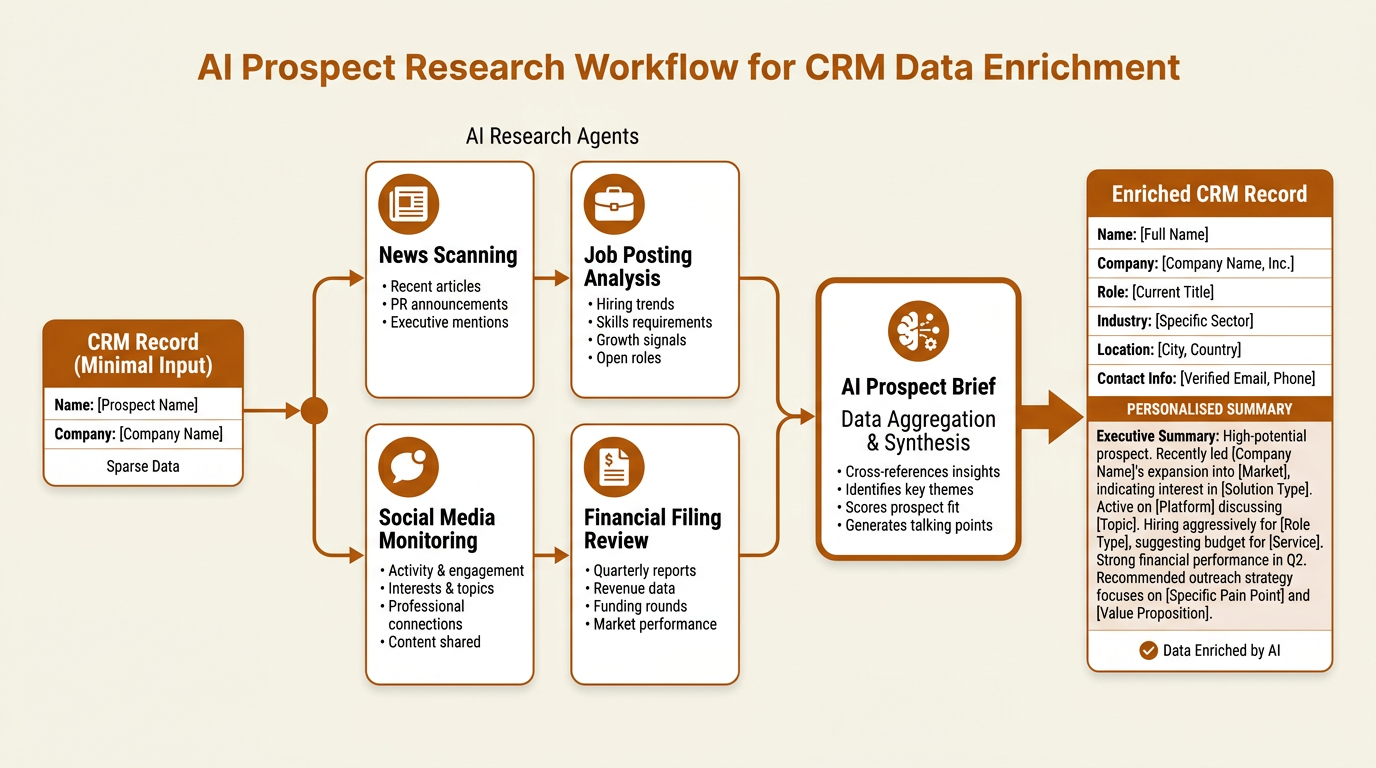
AI research agents synthesize public signals into enriched CRM fields and ready-to-use prospect briefs.
CRM Enrichment Benefits by Revenue Team
Enrichment pays off across the revenue org, but the value looks different depending on who is using the CRM that day. Calling that out explicitly is how you get buy-in and budget without turning the project into a turf war.
| Revenue Team | Primary Enrichment Benefit | Key Use Cases |
|---|---|---|
| Sales (SDRs/AEs) | More connects and faster qualification | Verified contact data for outbound; pre-call AI briefs; lead enrichment for scoring |
| Marketing | Cleaner targeting and segmentation | Firmographic and technographic filters for ABM; reduced bounce rates; persona-level personalization |
| RevOps | Reliable reporting and forecasting inputs | CRM hygiene automation; deduplication; field standardization; revops automation of enrichment workflows |
| Customer Success | Earlier retention and expansion signals | Buying signals for upsell timing; org chart enrichment for multi-threading |
| Leadership | A pipeline forecast you can trust | Accurate ICP analysis; territory planning based on verified firmographics |
| Each team extracts different value from the same enrichment infrastructure. |
Building a Continuous Enrichment Workflow
Most content about enrichment stops right before the part that matters: the operating model. The framework below is the implementation path I look for when building CRM automation around enrichment that runs without constant human babysitting.
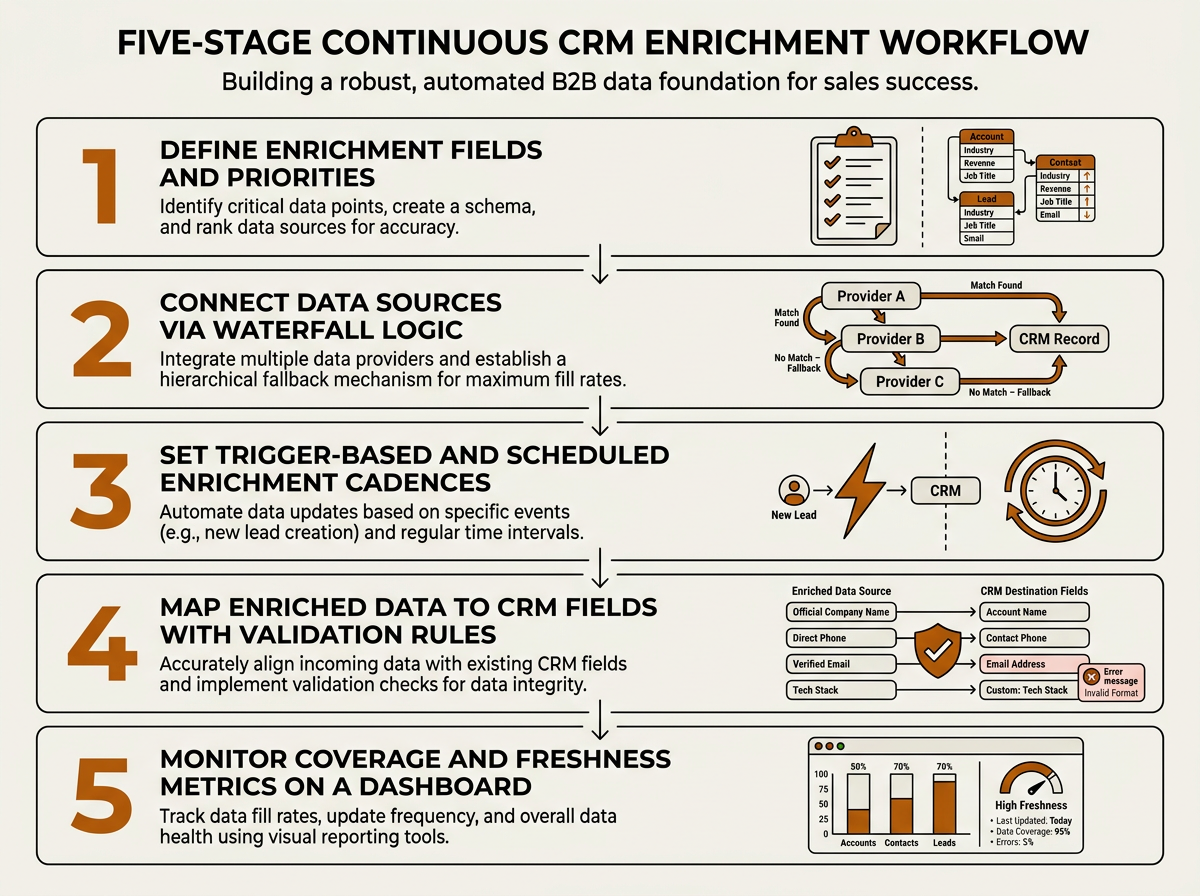
A repeatable five-step framework for operationalizing continuous CRM enrichment — from schema design to live monitoring.
Step 1: Define Your Enrichment Schema
Start by writing down which fields actually matter for each object (Contact, Account, Opportunity) before you connect any tools. Not every field deserves enrichment; prioritize the ones that drive routing, scoring, segmentation, and personalization. A typical B2B schema includes work email, direct phone, job title, seniority, department, company domain, industry, employee count, annual revenue, funding stage, tech stack, and at least two buying signal fields.
Step 2: Implement Waterfall Enrichment Logic
No single provider covers every contact and company. Waterfall enrichment is the practical fix: query Provider A first, then fall back to Provider B and Provider C when a field comes back empty. That sequencing improves fill rates compared to single-source enrichment. Bitscale supports this natively, including real-time vs. batch enrichment based on the trigger, and it cascades across multiple sources without forcing you to juggle separate provider contracts.
Step 3: Set Enrichment Triggers
Continuous enrichment runs on two trigger types. Event-based triggers fire when a new lead hits the CRM, a contact is updated, or a deal changes stage. Scheduled triggers re-enrich existing records on a cadence (more frequently for active pipeline, less often for dormant records). Together, they cover the two ways CRMs rot: new records entering incomplete and old records silently going stale.
Step 4: Sync and Validate
Most enrichment programs break at the sync layer, not the data layer. Enriched values have to map cleanly to your CRM fields, respect picklists, and resolve conflicts (what happens when the enriched title disagrees with the existing one?). Put validation rules in writing: if a field is already populated and was manually verified, do not overwrite it. If a field is empty or was auto-populated more than 90 days ago, replace it with fresh data. That is how you avoid "enrichment ping-pong," where automation and humans keep undoing each other.
Common Mistakes That Undermine CRM Enrichment
Certain failure patterns show up again and again when revenue teams roll out enrichment. These are the ones that tend to do the most damage.
Enriching everything at once without prioritization. Teams light up enrichment across the entire database, then act surprised when the CRM sync starts failing or the provider bill spikes. Begin with active pipeline and high-intent accounts, prove the workflow, then expand.
Ignoring data governance. If nobody owns enrichment rules, field mappings drift, duplicates multiply, and teams stop trusting which source populated which field. Assign a RevOps owner for the enrichment schema and review it quarterly.
Treating enrichment as a one-time project. This is the most common and most expensive mistake. A team runs bulk enrichment before a launch, declares the CRM "clean," and then leaves it alone for six months. B2B contact and company data changes continuously as people move between roles, companies restructure, and technology stacks evolve. Without ongoing enrichment, a meaningful share of those records will already be outdated by the time anyone notices.
Using a single data provider. Every provider has blind spots by geography, industry, or company size. When you commit to one source, you inherit its gaps. Waterfall logic across multiple providers is not optional if you care about fill rates you can rely on. For more on the mechanics, see CRM data enrichment explained.
Governance and CRM Hygiene Best Practices
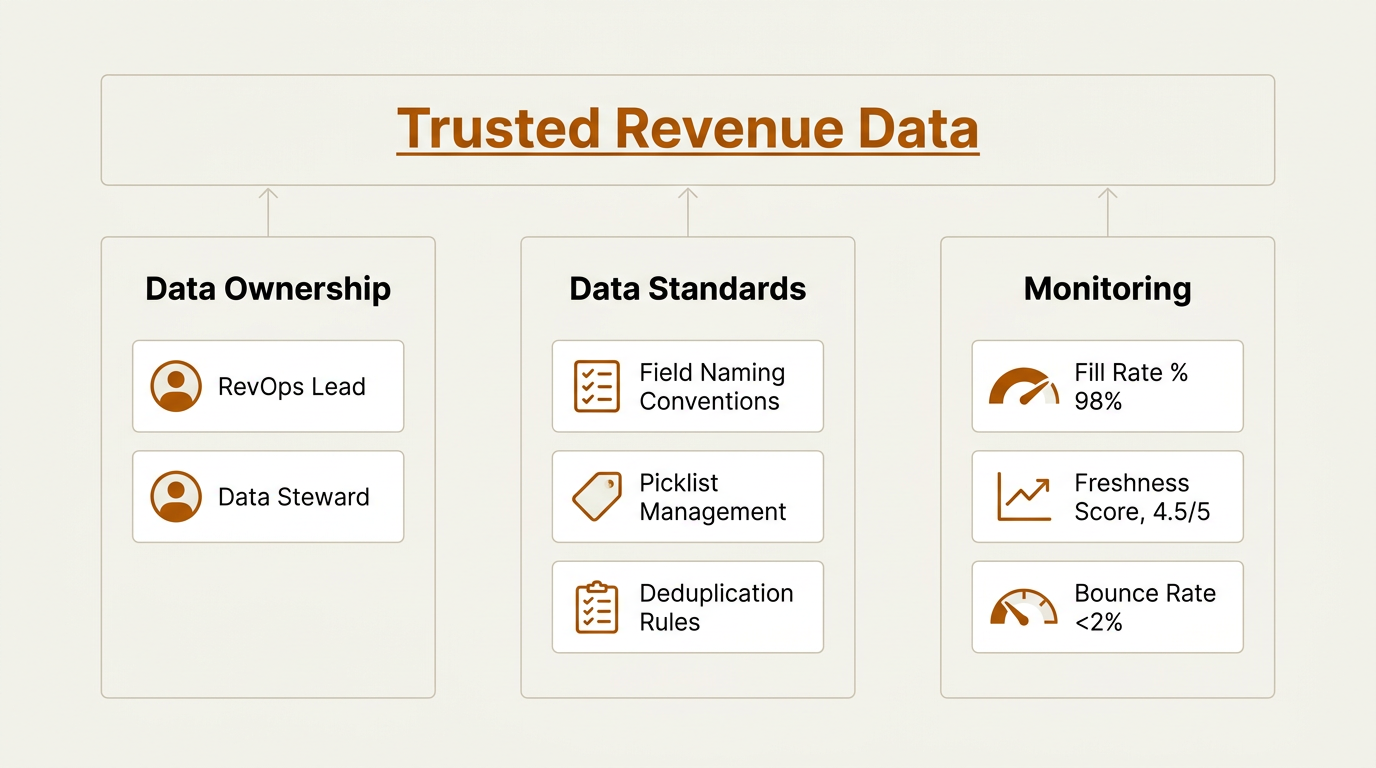
Governance turns CRM data enrichment from a one-time project into a repeatable operational discipline.
CRM hygiene is not a side quest next to enrichment. It is the governance layer that keeps enrichment from degrading into noise. Skip governance and even enriched fields will drift out of date and out of standard.
Governance recommendations that actually stick:
- Assign field-level ownership. Every enriched field needs a documented owner (person or system) plus an update cadence everyone agrees to.
- Standardize before you enrich. Normalize job titles, industry classifications, and company names first. Otherwise you end up with "VP Sales," "Vice President, Sales," and "VP of Sales" as three different values.
- Monitor enrichment coverage weekly. Track fill rates by field and by segment. If email coverage drops below 80% for target accounts, treat it as a data source issue, not a rep performance issue.
- Audit for staleness, not just completeness. A field populated 18 months ago is not "complete" in any meaningful way. Use freshness scores to flag records that are overdue for re-enrichment.
- Document your enrichment stack. Write down which providers feed which fields, the waterfall order, and the fallback rules. That documentation speeds up RevOps onboarding and makes troubleshooting possible when quality slips.
How Bitscale Unifies CRM Enrichment, Signals, and Automation
A lot of teams end up with enrichment by duct tape: one tool for emails, another for firmographics, a third for intent, plus a spreadsheet to keep track of what is feeding what. That patchwork is where sync issues, duplicate costs, and quiet coverage gaps come from, usually right before a campaign underperforms.
Bitscale brings contact enrichment, company enrichment, waterfall enrichment, buying signals, AI prospect research, CRM synchronization, and workflow automation into one platform. You define your schema once, set triggers, and the system does the repetitive work: query multiple sources in sequence, write verified results back to the CRM, and surface buying signals reps can act on immediately. With ready-made sales intelligence solutions and pre-built workflows, teams do not have to assemble enrichment logic from scratch.
If you are comparing vendors, the best data enrichment tools breakdown looks at how Bitscale compares with Clay, Apollo.io, Lusha, Cognism, and Instantly.ai across coverage, automation depth, and CRM integration. The complete B2B guide to data enrichment adds more detail on where enrichment fits inside a broader GTM strategy.
Key Takeaways and Next Steps
CRM data enrichment is not the thing you do once a year when the database looks embarrassing. It is an operating process that shows up directly in sales productivity, marketing performance, forecast accuracy, and retention. Teams that treat enrichment as infrastructure, measured, owned, and continuously maintained, end up with a CRM people actually trust.
Action items to implement this quarter:
- Audit your CRM for field completeness and freshness across your top 200 accounts. Identify the biggest gaps.
- Document your enrichment schema: which fields matter, who owns them, and how often they should refresh.
- Implement waterfall enrichment logic so no single provider's gaps become your gaps.
- Set up event-based and scheduled triggers so enrichment runs continuously without manual intervention.
- Layer buying signals and AI prospect research on top of structured enrichment to give reps actionable context, not just data.
- Assign RevOps ownership of enrichment governance and review coverage metrics weekly.
If you are building or rebuilding your enrichment stack, start with Bitscale's Data Enrichment product to see what a unified approach to lead enrichment, CRM automation, and signal detection looks like compared with stitching together point solutions.
Frequently Asked Questions
How often should B2B teams re-enrich their CRM data?
Active pipeline and target accounts often benefit from more frequent enrichment than dormant or lower-priority records. The appropriate cadence depends on data volatility, sales cycle length, CRM activity, and business priorities. B2B contact and company data changes continuously as people switch roles, companies restructure, and technology stacks evolve, so waiting too long between enrichment cycles means a growing share of records will be outdated.
What is the difference between contact enrichment and company enrichment?
Contact enrichment fills person-level fields like work email, phone number, job title, and seniority. Company enrichment adds organization-level data such as industry, revenue, employee count, tech stack, and funding stage. You need both: sales has to qualify the account and reliably reach the right people inside it.
What is waterfall enrichment and why does it matter?
Waterfall enrichment queries multiple data providers in sequence for each field. If Provider A returns nothing, the system automatically tries Provider B, then Provider C. It matters because no single provider has complete coverage across geographies, industries, and company sizes, and waterfall logic lifts fill rates compared to relying on one source. More detail: how waterfall enrichment improves data accuracy.
How does CRM data enrichment differ from a one-time data cleanup?
A one-time cleanup fixes what is broken at a single moment. Continuous CRM data enrichment is built around automated triggers: enrich new records on entry, then re-enrich existing records on a schedule. Cleanup repairs the past; continuous enrichment prevents the same problems from returning.
Can CRM enrichment work with any CRM platform?
Most modern enrichment platforms, including Bitscale, support native integrations or API-based connections to major CRMs like Salesforce, HubSpot, and Pipedrive. The practical requirement is API access plus support for custom field mapping and automated writes. Before you commit to a provider, confirm their CRM sync works with your CRM version and the field types you rely on.

Sanket
CEO | Co-Founder Bitscale


Sanket is the CEO and Co-Founder of Bitscale. He leads company vision and strategy, building the future of AI-driven sales intelligence for modern B2B teams. Sanket is obsessed with the intersection of AI and go-to-market, and has spent years studying how the best B2B companies find, engage, and convert customers at scale. He writes about company building, product strategy, and where AI is taking the sales industry.
Read other blogs
All Blogs
12 Best CRM Sync Tools for Revenue Teams in 2026
Compare 12 CRM sync tools for Salesforce and HubSpot, including enrichment, reverse ETL, and automation options for cleaner revenue data.
Sales Data Enrichment: A Buyer's Guide for Modern B2B Teams
Sales data enrichment helps B2B teams improve CRM records, routing, prospecting, and account prioritization. Compare workflows, costs, and vendor fit today.

What Is AI Prospect Qualification? A Practical Guide for Modern Revenue Teams
AI prospect qualification helps revenue teams enrich data, assess ICP fit, prioritize buying signals, and route the right accounts into CRM workflows.