Company Enrichment: A Practical Guide for Revenue Teams
Table of Contents
Explore Bitscale
Find decision makers, more insights and contact information about this company on Bitscale
"Company enrichment" often gets flattened into a basic task: add an industry and headcount field to a CRM record and call it a day. That is technically true, but it is also the kind of half-definition that leads teams to underbuild the program and overtrust the output. For revenue teams operating today, B2B company enrichment spans firmographic and technographic layering, org hierarchy mapping, real-time buying signals, intent correlation, and AI-driven validation, all pushed back into the tools where reps actually work. Industry analysts consistently rank poor data quality among the most expensive operational problems an organization can face, with costs running well into the millions annually. This is not an academic problem.
This is for sales, marketing, and RevOps teams that are done living with surface-level account records. If you are standing up your first enrichment workflow or pressure-testing one that already exists, the sections below focus on frameworks, governance, vendor criteria, and implementation patterns you can actually run. Here is how the guide is organized:
- What Company Enrichment Actually Means (and why the old definition falls short)
- The Anatomy of an Enriched Company Record (a side-by-side comparison of raw vs. enriched data)
- Core Enrichment Dimensions (firmographics, technographics, hierarchy, signals, intent)
- AI Validation and ICP Matching (where automation works, where humans still matter)
- CRM Synchronization and Workflow Automation (making enrichment operational)
- Governance and Common Mistakes (the unglamorous work that separates good programs from broken ones)
- Evaluating Enrichment Vendors (a structured framework with comparison criteria)
- FAQ (five questions revenue teams ask most)
What Company Enrichment Actually Means
Company data enrichment takes a thin account record (often just a name and domain) and fills in the attributes that let a revenue team decide whether, when, and how to engage. Start with firmographic basics like revenue range and employee count, sure. But useful enrichment also covers the tech stack a company runs, its corporate structure, funding events, hiring patterns, and real-time intent signals that point to active buying research.
The older definition breaks down because it assumes enrichment is a one-time append. In reality, B2B data decays rapidly. People change jobs, companies reorganize, and stacks get swapped out. A record that looked "complete" at the start of the year can be quietly wrong a few months later. Strong enrichment programs run continuously, rely on automation, and include validation steps, rather than treating data as a periodic CSV chore.
The Anatomy of an Enriched Company Record
The difference between a raw CRM record and an enriched one is not just more filled-in fields. It is the difference between information you can act on and information you cannot. A raw record tells you a company exists. An enriched record tells you if it fits your ICP, what it runs, how it is structured, who is likely involved in decisions, and whether there are signals that the timing is right.
| Attribute | Raw Record | Enriched Record |
|---|---|---|
| Company Name | Acme Corp | Acme Corp (verified legal entity, DBA aliases mapped) |
| Industry | Blank or generic ("Technology") | NAICS/SIC code, sub-industry: Cloud Infrastructure |
| Revenue | Unknown | Estimated ARR band identified, latest funding round mapped |
| Employee Count | Unknown or outdated | Current headcount with recent growth trend noted |
| Tech Stack | Not captured | Salesforce CRM, Snowflake, AWS, Marketo |
| Org Hierarchy | Not captured | Parent company identified, subsidiaries mapped |
| Buying Signals | Not captured | Job postings for RevOps Manager, G2 category research |
| ICP Score | Not scored | Strong fit based on multiple weighted attributes |
| An enriched record transforms a name into a qualified, actionable account. |
Core Enrichment Dimensions
Many teams lump enrichment into two categories: firmographics and "everything else." That framing is convenient, but it hides how different data types drive different revenue motions. A clearer model breaks enrichment into five dimensions, each tied to a specific decision in the funnel.
Firmographic and Technographic Enrichment
Firmographic enrichment covers the structural facts of a company: industry classification, revenue, headcount, geography, founding year, and ownership type. These fields underpin segmentation and territory planning. When firmographics are wrong, territories drift, TAM math turns into fiction, and campaigns land on the wrong lists. If you want a clean definition of the category, the Wikipedia entry on firmographics is a solid baseline.
Technographic enrichment, sometimes called technographic segmentation, identifies the software and infrastructure a company uses. This is where enrichment starts paying off in real conversations. A competitor in the stack can signal a displacement play. A complementary tool you integrate with can be the wedge for a targeted message. Technographics also sharpen ABM: you can speak to the stack a company actually runs instead of defaulting to generic pain points.
Organizational Hierarchy and Buying Signals
Corporate hierarchy data (parents, subsidiaries, divisions) protects teams from one of the most expensive enterprise mistakes: working a subsidiary as if it is the buyer when the decision is made at the parent. Good hierarchy mapping also reduces duplicate outreach and keeps attribution clean when multiple teams touch the same corporate family.
Buying signals add timing on top of static attributes. Job postings for specific roles, leadership changes, technology renewal cycles, office expansions, and product launches can all hint that a company is entering a buying window. Teams that identify B2B buying signals and operationalize them tend to beat teams that work from static target lists and hope the timing lines up.
Intent Data and Company Intelligence
Intent data captures research behavior: which companies are reading about your category, visiting review sites, or engaging with competitor material. Layered with firmographic and technographic enrichment, intent turns account intelligence from a snapshot into something closer to a live feed. An account that matches your ICP, runs a competitor, and is actively researching alternatives is not merely a fit. It is a priority right now.
AI Validation and ICP Matching
AI in company enrichment is not a substitute for judgment; it is a way to keep up with scale. A small RevOps team is not going to manually validate tens of thousands of accounts, match them against an ICP, and keep the whole dataset current. AI can carry that workload, but only if you are explicit about where automation ends and human ownership begins. Otherwise you get confidently wrong data, delivered faster and farther than ever.
| Task | AI Responsibility | Human Responsibility |
|---|---|---|
| Data collection and normalization | Pull from multiple sources and standardize formats | Set which sources are trusted |
| ICP scoring | Score accounts against a weighted attribute model | Define ICP criteria and tune weights |
| Duplicate detection | Flag likely duplicates and hierarchy conflicts | Resolve ambiguous matches (e.g., same name, different entity) |
| Signal monitoring | Continuously watch for buying signals and intent spikes | Interpret signals in deal context and choose the next action |
| Data validation | Cross-check attributes across sources and flag discrepancies | Review flagged records, approve or correct |
| CRM synchronization | Write validated records and enforce field-level rules | Design sync logic and manage exceptions |
| Effective enrichment programs assign clear ownership between AI systems and human operators. |
ICP matching is where AI validation tends to show up first in revenue outcomes. Instead of asking reps to qualify accounts on instinct, an AI enrichment system scores every account against your ideal customer profile, weighting attributes like revenue range, stack fit, growth trajectory, and intent. You end up with a prioritized list that refreshes as the data changes, instead of a spreadsheet that starts aging the moment it is exported.
CRM Synchronization and Workflow Automation
If enrichment lives in a spreadsheet or a standalone tool, it will not change behavior. CRM company enrichment matters because it puts validated, current data where reps, marketers, and managers already make decisions. That part is obvious; the failure mode is the plumbing.
Start with sync direction. One-way pushes (enrichment tool to CRM) are easier to operate, but they create friction when reps edit records by hand. Bidirectional sync respects rep updates while still applying enrichment, but it only works with field-level conflict rules. Example: if your provider says a company has a certain headcount and a rep enters a different number after a discovery call, which value should stick? Mature programs typically use a "most recent verified" rule with source-priority tiers.
Automation is where enrichment stops being hygiene and starts being execution. When a new account is enriched and clears your ICP threshold, route it to the right owner, enroll it in the right campaign, and surface it in your sales intelligence views without manual handoffs. When intent spikes on an existing account, the owner should get an alert in time to act, not stumble on it during pipeline review. Platforms like Bitscale package enrichment, signal detection, and CRM data enrichment into a single workflow layer, which helps teams avoid the integration tax that comes with stitching together multiple tools.
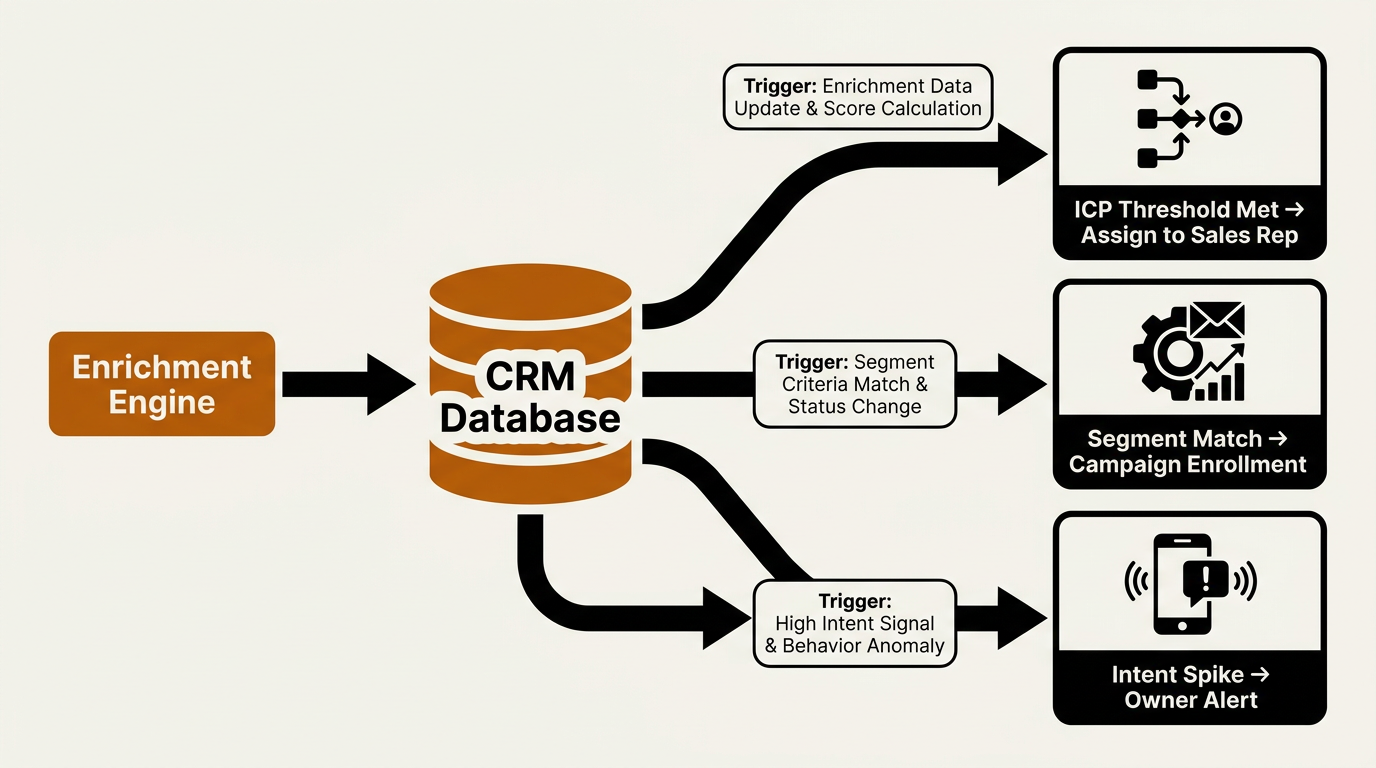
Enrichment becomes operational when it triggers downstream workflows automatically — no manual handoffs required.
Governance, Common Mistakes, and Revenue Intelligence
Research consistently shows that a significant share of CRM users have lost revenue directly because of poor data quality. Governance is the part no one wants to own, and it is also the part that keeps enrichment from making the mess bigger. Skip it and you will end up with conflicting values across sources, duplicate records that split account history, and fields overwritten by less reliable inputs.
What most teams get wrong: they treat enrichment like a data cleanup task and toss it to an analyst. Enrichment is a revenue operations capability. It touches forecasting, territory design, campaign targeting, and executive reporting. The owner should sit in RevOps, where there is context on how the data gets used downstream, not in a data team that is measured on pipelines and dashboards rather than pipeline outcomes.
Governance essentials for company enrichment programs:
- Source hierarchy: Assign an authoritative source for each field. Firmographics from one provider, technographics from another, intent from a third. Write it down and keep it current.
- Field-level write rules: Decide which fields automation can overwrite and which require human approval.
- Decay monitoring: Run automated audits that flag records not refreshed within a threshold appropriate to the field's volatility. Fast-moving fields like headcount and tech stack need shorter windows; more stable attributes can tolerate longer intervals.
- Deduplication cadence: Perform duplicate detection on a regular schedule. Acquisitions and spin-offs create duplicates that basic matching rules miss.
- Audit trail: Log every enrichment write with source, timestamp, and the previous value. Without this, troubleshooting and compliance turn into guesswork.
Revenue intelligence is what you get when enrichment and analytics actually agree with each other. With governed, consistently enriched accounts, you can forecast pipeline by ICP tier, compare win rates by technographic profile, and see which signals correlate with closed deals. When the underlying data is messy, those same analyses generate noise that looks like insight. For a broader view of how enrichment supports sales intelligence, Bitscale's sales intelligence solutions page connects data quality to pipeline visibility.
Evaluating Enrichment Vendors
The data enrichment solutions market has grown steadily and continues to attract new entrants, driven by rising demand for account intelligence across B2B revenue teams. That growth has pulled in a crowded field of vendors, and the differences rarely show up in a glossy features grid. Use the criteria below to force the conversation into operational realities.
| Criterion | What to Evaluate | Why It Matters |
|---|---|---|
| Data coverage | Company count, geographies covered, and attribute breadth | A vendor that is strong in US mid-market data may still be thin in EMEA or APAC |
| Data freshness | Update cadence and any decay-rate guarantees | Stale data is worse than missing data because it creates false confidence |
| Enrichment depth | Coverage across firmographics, technographics, hierarchy, intent, and signals | Single-dimension vendors push you into stitching together multiple tools |
| AI validation | Cross-source verification, confidence scoring, anomaly detection | Without validation, enrichment scales errors instead of insight |
| CRM integration | Native connectors, field mapping, conflict resolution, bidirectional sync | Integration friction is a top reason enrichment tools get shelved |
| Workflow automation | Triggers, routing rules, and campaign enrollment support | If automation is weak, teams fall back to manual handoffs that break |
| Pricing model | Per-record, per-seat, credit-based, or platform fee | Credit-based pricing can spike at scale without tight monitoring |
| Compliance | GDPR, CCPA, and data provenance transparency | Regulatory exposure is real, especially for EU operations |
| Use this framework during vendor demos to compare platforms on dimensions that matter operationally. |
Vendors like Clay, Apollo.io, Lusha, and Cognism each lean into different strengths. Clay is strong on flexible data orchestration. Apollo.io pairs a large contact database with outbound sequencing. Lusha emphasizes contact accuracy, especially phone numbers. Cognism is known for EMEA compliance and phone-verified data. Bitscale positions differently, combining AI prospect research, company enrichment, buying signals, CRM synchronization, workflow automation, and revenue intelligence in a single GTM platform to reduce the integration burden that comes with a multi-vendor stack. For teams comparing options, the roundup of the best enrichment software platforms adds more context.
Putting It All Together: Implementation Guidance
If you already run enrichment and you are here for governance or vendor evaluation, you can skip this. If you are building from zero, sequence matters more than the logo on the tool.
Begin with an ICP model built on weighted attributes, not a fuzzy persona. Revenue range, industry, tech stack requirements, geography, and growth indicators should each carry explicit weights. That model becomes the scoring engine your enrichment platform uses to prioritize accounts. Without it, you will collect more data and still make the same mediocre decisions.
Then audit your current CRM. How many accounts have complete firmographics? How many have any technographics? What share has been updated recently enough to trust? The baseline shows where enrichment will move the needle fastest and gives you a way to measure progress. Bitscale's complete B2B guide to data enrichment lays out the audit steps in detail.
From there, configure workflows. A minimum viable setup usually includes automatic enrichment on new account creation, scheduled re-enrichment for existing accounts (more frequently for top-tier accounts, less often for lower-priority segments), and signal-triggered alerts when intent spikes or buying signals appear. B2B buyers increasingly use AI tools to compare vendors and evaluate product strengths before ever speaking with a rep. Your enrichment program should surface that research activity while it still affects deal timing.
Close the loop with reporting. Track coverage, ICP match rates, signal-to-meeting conversion, and pipeline influenced by enriched accounts. Those metrics keep the program funded and make it clear where the model needs tuning. If you need to map expected volume to platform cost, Bitscale's pricing is the reference point.
Key Takeaways
Company enrichment is not just data hygiene. Treated properly, it is a RevOps capability that shows up in pipeline quality, forecast accuracy, and sales efficiency. The teams that run enrichment continuously, govern it tightly, and wire it into CRM workflows tend to outperform teams that rely on one-off appends and hope the data holds.
- Enrichment spans five dimensions: firmographics, technographics, organizational hierarchy, buying signals, and intent data. Stop at one or two and you leave blind spots.
- AI covers volume and velocity. Humans own strategy, exceptions, and ICP definition. You need both.
- CRM synchronization plus field-level governance is what separates operational enrichment from data hoarding.
- When you evaluate vendors, prioritize integration depth, freshness, and workflow automation over raw database size.
- Prove impact with coverage rates, ICP match rates, and pipeline influenced by enriched accounts.
Frequently Asked Questions
What is the difference between company enrichment and contact enrichment?
Company enrichment adds attributes to the account record (firmographics, technographics, hierarchy, intent). Contact enrichment adds attributes to individual people (email, phone, title, reporting structure). You typically need both for effective account-based marketing, but they answer different questions. Company enrichment tells you whether an account is worth pursuing. Contact enrichment tells you who to reach inside the account.
How often should company data be re-enriched?
The right cadence depends on account importance, data volatility, and your sales cycle. High-priority accounts (active pipeline, target tier) benefit from more frequent refreshes, while lower-priority accounts can tolerate longer intervals. Because B2B data decays steadily as people change roles, companies reorganize, and tech stacks evolve, any record left untouched for an extended period is likely carrying incorrect fields. Automated re-enrichment workflows keep this from turning into a recurring manual project.
Can company enrichment work without a CRM?
Technically, yes. Operationally, it misses the point. If enriched data sits in a standalone tool or spreadsheet, it will not reliably reach the reps and marketers making day-to-day decisions. CRM company enrichment keeps validated data in the system of record where it can drive routing, scoring, and reporting.
What is the role of intent data in account enrichment?
Intent data shows which companies are actively researching topics tied to your product category. Layer it on top of firmographic and technographic enrichment and you add the timing signal: not just "is this account a fit?" but "is this account in-market right now?" That is what turns account intelligence into a practical prioritization engine for sales.
How do I choose between a multi-vendor enrichment stack and a unified platform?
Multi-vendor stacks can deliver strong data in specific dimensions, but they also introduce integration complexity, data conflicts, and higher total cost. Unified platforms like Bitscale roll enrichment, signals, CRM sync, and workflow automation into one layer, which reduces operational overhead. The right choice depends on your team's technical capacity and how complex your enrichment requirements are. For many mid-market revenue teams, a unified platform reaches time-to-value faster.

Sanket
CEO | Co-Founder Bitscale


Sanket is the CEO and Co-Founder of Bitscale. He leads company vision and strategy, building the future of AI-driven sales intelligence for modern B2B teams. Sanket is obsessed with the intersection of AI and go-to-market, and has spent years studying how the best B2B companies find, engage, and convert customers at scale. He writes about company building, product strategy, and where AI is taking the sales industry.
Read other blogs
All Blogs
12 Best CRM Sync Tools for Revenue Teams in 2026
Compare 12 CRM sync tools for Salesforce and HubSpot, including enrichment, reverse ETL, and automation options for cleaner revenue data.
Sales Data Enrichment: A Buyer's Guide for Modern B2B Teams
Sales data enrichment helps B2B teams improve CRM records, routing, prospecting, and account prioritization. Compare workflows, costs, and vendor fit today.
What Is AI Prospect Qualification? A Practical Guide for Modern Revenue Teams
AI prospect qualification helps revenue teams enrich data, assess ICP fit, prioritize buying signals, and route the right accounts into CRM workflows.