Clay vs Apollo vs Bitscale: Which Workflow + Data Stack Fits Your GTM Motion?
Table of Contents
Explore Bitscale
Find decision makers, more insights and contact information about this company on Bitscale
Picking the right platform for your go-to-market (GTM) motion is a critical decision. It directly impacts sales efficiency, data quality, and your ability to scale. The sales intelligence market is dynamic, projected to grow from USD 4.85 billion in 2025 to USD 5.37 billion in 2026 (Fortune Business Insights, 2026), which means more options than ever. Three names that come up constantly are Clay, Apollo.io, and Bitscale. Each has a different philosophy on building an outbound strategy. This article provides a detailed comparison of Clay vs Apollo vs Bitscale to help you decide which workflow and data stack is the right fit for your team.
We will evaluate these platforms on what matters to any GTM team: their core philosophy, data sourcing, automation capabilities, and pricing. Understanding these differences is key to building a resilient and effective GTM workflow system.
Table of Contents
- Bitscale: The AI-Powered Enrichment & Workflow Engine
- Clay: The Infinite Lego Set for Prospecting
- Apollo.io: The All-in-One Sales Platform
- Head-to-Head Comparison: Clay vs Apollo vs Bitscale
- The Verdict: Which Platform Should You Choose?
- Frequently Asked Questions
Bitscale: The AI-Powered Enrichment & Workflow Engine
Bitscale operates between Clay's complexity and Apollo's closed system. It's an AI prospecting platform designed to be an 'enrichment-first' system that plugs into your existing GTM stack. Bitscale lets teams build ICP-matched lists from its contact database and enrich those records in real time through multi-source waterfalls and AI research. It focuses on delivering high-quality, verified data directly into the tools your team already uses, like your CRM or sales engagement platform.
This approach solves the problem of stale data and manual prospecting. By focusing on being the best enrichment and workflow layer, Bitscale enhances the tools you already have rather than replacing them. The friction? Bitscale works best for teams that already have a clear idea of their enrichment logic and ICP. If you're still in the early stages of defining who to target, the setup might require more strategic thought upfront. This makes Bitscale a strong Clay alternative for teams that want guided workflow migration and prebuilt playbooks, and an Apollo alternative for teams prioritizing multi-source enrichment. The goal is scalable GTM automation by providing better fuel (data) for your sales engine.
Ready to build a scalable outbound engine? See how Bitscale's AI-powered prospecting can help.
Clay: The Infinite Lego Set for Prospecting
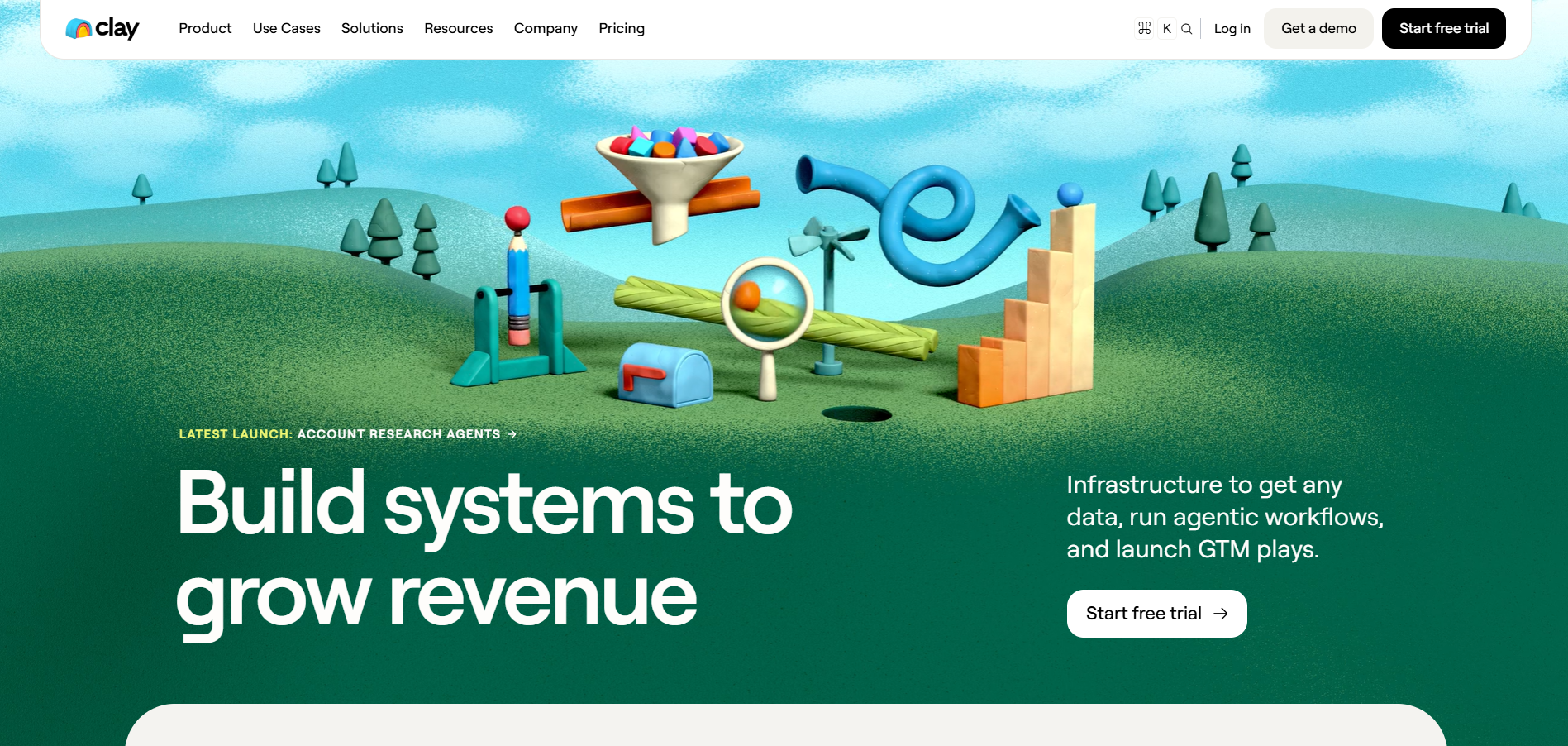
Clay's main strength is its flexibility. It operates like a spreadsheet-style workflow builder, letting you create data-enrichment and prospecting systems with access to more than 200 data and AI vendors through its marketplace. Clay is not limited to a single proprietary contact database; it combines workflow orchestration with a marketplace of third-party data and AI vendors. It is an orchestration layer that lets you pull, combine, and manipulate data in countless ways.
Key Characteristics of Clay:
- Best For: Technical sales teams and GTM operators who want granular control to build bespoke, complex enrichment sequences from scratch.
- Core Concept: A powerful data workflow builder. You bring the logic and select the data sources; Clay provides the canvas and connectors.
- Limitations: The steep learning curve is a real barrier. It requires a builder mindset, and costs depend on both workflow Actions and Data Credits used to purchase marketplace data; teams can also use supported external API keys. It now includes a native email Sequencer, although teams needing broader multichannel engagement or dialing should compare its capabilities with dedicated sales-engagement platforms.
Teams that succeed with Clay often have a dedicated GTM operations person who enjoys building and optimizing complex data flows. For those looking for a more streamlined experience, exploring Clay alternatives is a common next step.
Apollo.io: The All-in-One Sales Platform
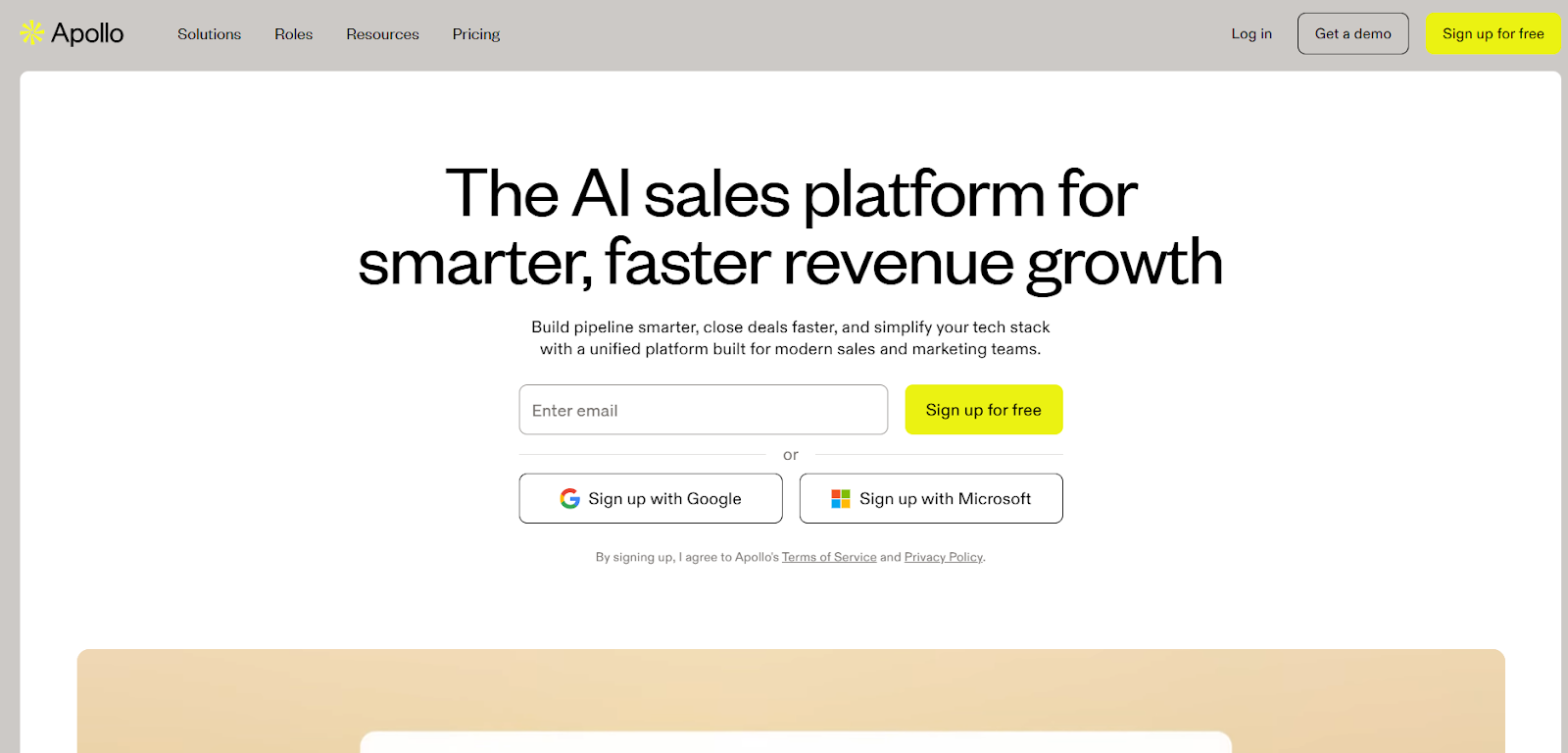
Apollo.io takes the opposite approach. It aims to be a single, self-contained solution for sales teams. Its foundation includes a B2B database of more than 240 million verified contacts, according to Apollo. On top of this data, Apollo includes sales engagement tools, like an email sequencer, a dialer, and basic analytics. The main benefit is having everything in one place.
The appeal is clear: one subscription, one platform. This simplicity is great for smaller teams that want to get started quickly. However, being a 'jack-of-all-trades' has its downsides. Apollo centers its workflow on its own database, but it also supports CRM and CSV enrichment, APIs, integrations and waterfall enrichment, so teams should test whether its available sources cover their ICP. For teams that find this model too restrictive, a detailed Bitscale vs. Apollo comparison can offer a different perspective.
Head-to-Head Comparison: Clay vs Apollo vs Bitscale
| Criteria | Clay | Apollo.io | Bitscale |
|---|---|---|---|
| Core Philosophy | DIY Workflow Orchestrator | All-in-One Sales Platform | AI-Powered Enrichment Engine |
| Ideal User | Technical GTM Ops, tinkerers | SMBs, sales teams wanting simplicity | Growth-focused teams needing quality data & automation |
| Data Sourcing | Marketplace with 200+ data and AI vendors | 240M+ verified-contact database plus enrichment and waterfall capabilities | 100+ data sources, 18+ waterfall providers and AI research |
| Workflow Automation | Highly flexible, manual waterfall setup | Built-in email/call sequencing | Automated ICP-based prospecting & enrichment flows |
| Key Strength | Infinite customization | Convenience and breadth of features | Data quality, AI-driven efficiency, and integration |
| Cost and fit consideration | Requires workflow ownership; usage is metered through Actions and Data Credits | er-seat plans, credits and feature access vary by tier | Focuses on GTM data, enrichment and workflow automation, with integrations for outbound execution |
The Verdict: Which Platform Should You Choose?
The best choice in the Clay vs Apollo vs Bitscale debate depends on your team's structure, technical skill, and GTM strategy. There is no single 'best' platform, only the one that fits your motion.
- Choose Clay if: You have dedicated ops bandwidth, need highly configurable workflows, and are prepared to manage usage across Actions and Data Credits.
- Choose Apollo.io if: You want contact data, enrichment, sequencing, dialing and analytics in one platform, and its per-seat pricing and credit allowances fit your expected usage.
- Choose Bitscale if: You need multi-source enrichment, AI research, buying signals and CRM-connected GTM workflows, with the option to route enriched data into your existing outbound stack.
Frequently Asked Questions
Can I use Bitscale with Apollo or Clay?
Yes. Many teams use Bitscale for its superior data enrichment capabilities and then pipe that data into Clay for further custom manipulation or into Apollo to use its sequencing features. Bitscale is designed to be the data quality layer for any GTM stack.
How does Bitscale's data quality compare to Apollo's database?
Bitscale uses multi-source waterfall enrichment and validation, while Apollo combines its contact database with enrichment and verification capabilities. Test both platforms on a representative sample from your ICP before comparing accuracy and deliverability. Check out our approach to Bitscale's data enrichment.
Is Clay a replacement for a CRM?
No, Clay is not a CRM. It is a data enrichment and workflow automation platform. You would typically use Clay to enrich lists of leads before pushing them into a CRM like Salesforce or HubSpot.
How does pricing generally compare between these three tools?
Apollo offers bundled, user-based pricing that is very accessible. Clay's current pricing separates platform Actions from Data Credits used for marketplace data, with plan allowances and overages determined by the selected tier. Bitscale publishes tier-based plans with shared credit allowances; credits are charged when a data provider returns a valid result, while plan limits and included features vary by tier.
Read other blogs
All Blogs
Salesforce in Claude (Claudeforce): what sellers get, and what it means for your CRM data
Salesforce in Claude puts your live CRM inside Claude with 37 sales skills. What sellers get, who can use it, and how to get your CRM data ready first.
Forward deployed engineer vs. GTM engineer: what each role does and which one you need
Forward deployed engineer vs GTM engineer: what each role builds, who it works for, tools, KPIs and posted 2026 pay, plus which one your company needs.
Clay vs Claude for GTM: what each does, and the better setup (2026)
Clay vs Claude: one is an enrichment tool, the other an AI assistant. What each does for GTM, when you need a data tool, and the setup that uses both well.