Claude Code for B2B Sales: What Revenue Teams Can Learn From AI Coding Agents
Table of Contents
Explore Bitscale
Find decision makers, more insights and contact information about this company on Bitscale
Anthropic's Claude Code is an agentic coding tool: it can read a whole codebase, make changes, run tests, and commit the result with minimal supervision. If you lead sales or RevOps, that should sound familiar. The underlying loop (plan, act, observe, correct) is the same loop that's about to run prospecting, enrichment, and CRM workflows. Getting value from Claude Code for B2B sales is not about learning software engineering. It's about spotting the operating model behind the next wave of sales AI agents.
We'll break down what Claude Code actually does, why its architecture maps cleanly to go-to-market work, how agentic AI differs from the automations you already run, and where the practical workflows are headed. The team size doesn't matter as much as the process maturity: a five-person SDR pod and a 200-seat org run the same motions at different scale. Roadmap:
- What Claude Code is and how it works as an agentic system
- Why revenue teams should pay attention to agentic AI developments
- Agentic AI vs. traditional automation with a side-by-side comparison
- Sales workflows AI agents can handle from prospect research to CRM hygiene
- The data quality problem that determines whether any of this works
- Practical GTM implications and how to start implementing agentic workflows today
What Is Claude Code?
Claude Code is Anthropic's agentic coding system. It runs in a developer's terminal and can move through an entire codebase, understand how files relate, write new code, execute tests, fix issues based on the output, and commit the changes. "Agentic" is doing the heavy lifting there. Claude Code isn't just autocomplete with better vibes; it can plan a multi-step task, use tools (file systems, terminals, APIs), check the results of its own actions, and change course when something breaks.
Claude Code builds on capabilities across the Claude model family, including a 200K token context window that can ingest massive documents in one pass and a "tool use" feature that connects the model to external APIs and functions (Anthropic, 2023). Claude models have shown ongoing improvements in reliability and factual accuracy across successive releases, which is the kind of progress that matters when the system is allowed to take actions, not just generate text.
For developers, that can mean fewer interruptions and faster shipping. For the rest of us, it's a working demo of something bigger: large language models coordinating real, multi-step workflows where the outcome actually matters. Revenue teams should treat that as a preview, not a curiosity.
Why Revenue Teams Should Care About an AI Coding Agent
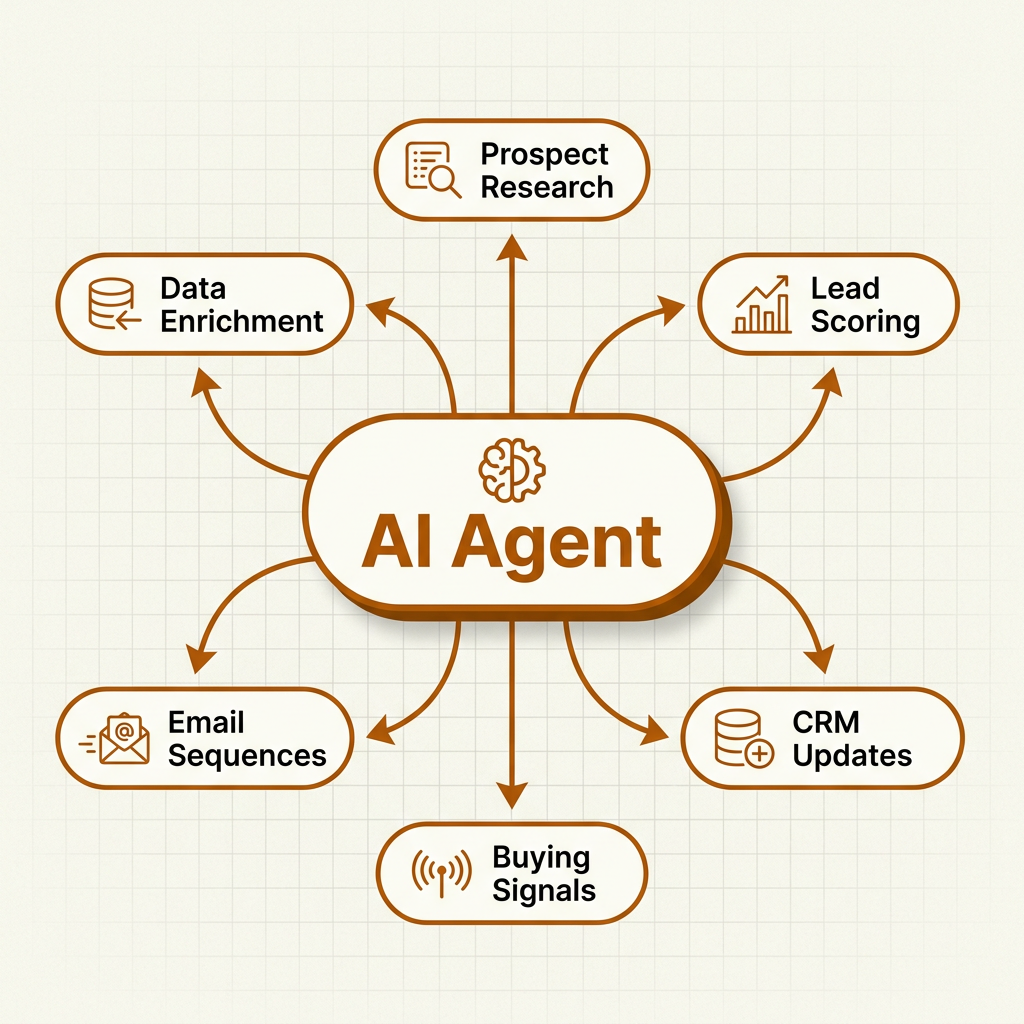
Six core revenue workflows an AI agent can run autonomously — mirroring how Claude Code navigates a codebase.
Claude Code matters to sales for the same reason a self-driving car matters to logistics: it's not about the specific vehicle, it's about the control system. Look at what a senior SDR does to qualify an inbound lead: check the CRM for history, research the account on LinkedIn and the company site, cross-reference firmographics, hunt for buying signals in B2B sales like funding or exec hires, score against ICP, update the record, then route to the right AE. That's a multi-step workflow that uses multiple tools and requires judgment. Structurally, it's the same shape as Claude Code navigating a repo.
Boston Consulting Group observed that early-adopter companies pairing human sellers with AI agents reported meaningful gains in customer acquisition, upselling, and cross-selling performance (BCG, 2025). Those results are from early adopters, which is the point: when the tooling is still rough, the advantage shows up first for teams willing to operationalize it. As agentic systems get more dependable, the gap between "agent-assisted" and "manual" revenue orgs will widen quickly.
Agentic AI vs. Traditional Sales Automation
Most sales orgs already automate plenty. Sequences send emails on a timer. Lead scoring assigns points for form fills. Zapier shuttles fields between tools. But it's all rule-based: if X happens, do Y. Agentic AI in sales is a different category. Monday.com (2026) defines agentic AI as autonomous systems that execute tasks, make decisions, and adapt their behavior without constant supervision. Traditional automation follows a script. An agent can assemble the script on the fly, then revise it when reality doesn't match your assumptions.
| Dimension | Traditional Automation | Claude Code / Agentic AI |
|---|---|---|
| Decision-making | Executes predefined rules (if/then) | Reasons through ambiguity with autonomy |
| Adaptability | Brittle when inputs shift | Changes approach as new information appears |
| Tool use | Typically one integration per workflow | Chains tools (CRM, enrichment APIs, web) in a single run |
| Data handling | Mostly structured fields | Understands unstructured text, sites, and documents |
| Error recovery | Stops or fails silently | Detects failures, retries, and adjusts tactics |
| Setup | No-code or low-code builders | Natural language instructions with guardrails |
| Scalability | Linear: more rules means more upkeep | Handles new cases without constantly adding rules |
| The shift from rule-based automation to agentic reasoning changes what sales teams can delegate to software. |
A concrete example makes the difference obvious. Traditional automation might enrich a lead from a single firmographic source and flag it if revenue exceeds $10M. An agentic system would pull firmographics, notice a recent product launch (an unstructured signal), check whether that launch lines up with your use case, adjust the score, draft an outreach angle that references the launch, and write back to the CRM with the reasoning. That end-to-end chain (actions, tool calls, and judgment) is what makes agentic AI sales workflows meaningfully different, not just "more automated."
Sales Workflows AI Agents Can Automate Today
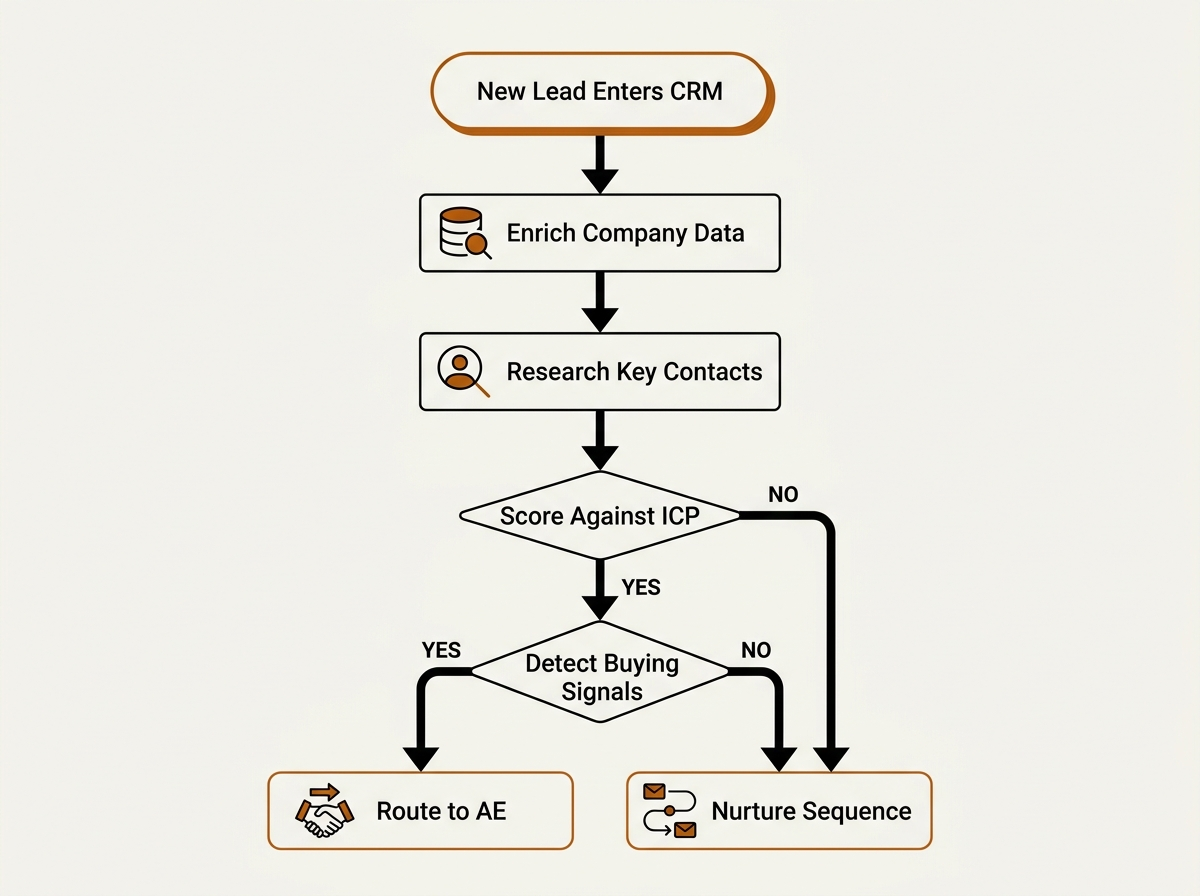
An agentic workflow routes leads from CRM entry through enrichment, scoring, and signal detection automatically.
AI Prospect Research and Lead Qualification
Prospect research is where outbound time goes to die, and it's also where agentic AI shows value fastest. Instead of an SDR burning 15 minutes per account across LinkedIn, company pages, and news tabs, an agent can run the same sweep in seconds. It pulls firmographics, identifies likely decision-makers, checks for tech stack signals, and turns the mess into a qualification brief you can actually act on. Platforms like Bitscale operationalize this with AI prospect research workflows that take raw lists and return verified contacts, company context, and intent signals.
Qualification also gets less simplistic. Instead of scoring on three static fields, an agent can weigh dozens of signals: hiring patterns, technology adoption, competitive displacement angles, and what executives are saying publicly. Just as important, it can leave a paper trail. Rather than a binary "qualified/unqualified," the AE gets the why, the context that changes the first call from guessing to diagnosing.
CRM Updates and Data Hygiene
Every sales leader knows the CRM is only as good as the last rep who touched it, which is why it drifts into fiction. Reps avoid updates, fields go stale, and duplicates multiply. An agentic system treats CRM maintenance the way Claude Code treats a codebase: it keeps checking for inconsistencies, fills missing fields from enrichment sources, merges duplicates, and logs activity notes from emails and calls. This isn't a weekly batch cleanup. It's closer to continuous integration for revenue data, and it shows up directly in forecast accuracy and pipeline visibility.
Buying Signal Detection and Sales Workflow Automation
Buying signals don't live in one place. They're scattered across job posts, press releases, G2 reviews, LinkedIn activity, funding news, and install-base data. No human can watch all of that across a territory without turning it into a full-time job. An AI agent can monitor the feeds, match signals to your ICP, and trigger the right sales automation workflows automatically. A VP of Engineering posting about scaling pain becomes a prompt for your infrastructure pitch. A competitor changing their pricing page becomes an alert for your displacement playbook.
Clean Data Is the Foundation (Skip This at Your Own Risk)
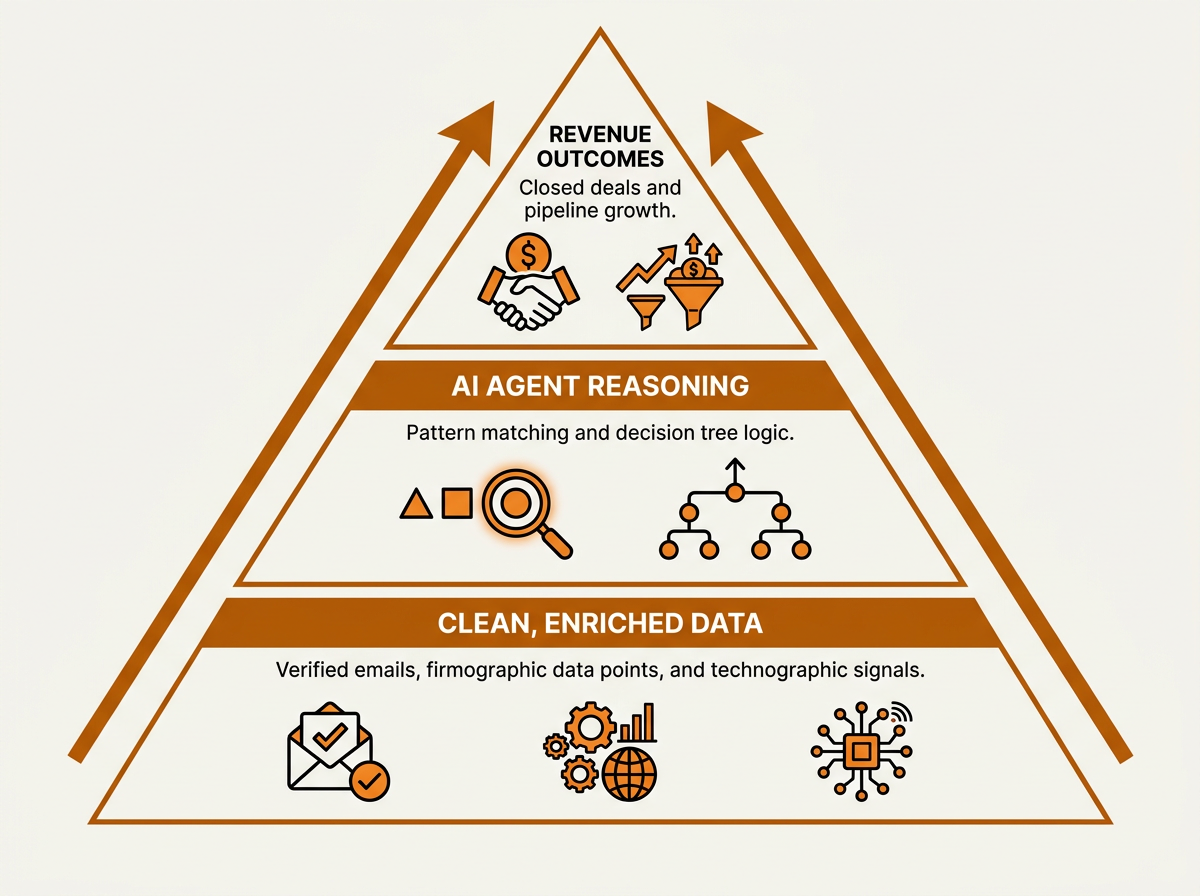
Agentic AI is only as good as the data it reasons over — enrichment is infrastructure, not a nice-to-have.
Most agentic AI conversations politely step around the part that actually makes or breaks the rollout: data. If your CRM is full of outdated titles, wrong emails, and missing firmographics, an agent will still produce outputs, they'll just be confidently wrong. "Garbage in, garbage out" doesn't fade with smarter models. It gets sharper, because the system can act on the garbage without waiting for a human to notice.
That's why enrichment isn't a nice-to-have. It's infrastructure. Before you deploy an AI agent in sales, you need verified work emails, current job titles, accurate revenue and headcount, tech stack signals, and recent intent. Bitscale's sales intelligence solutions are built for that baseline: contact and company enrichment, work email and phone lookup, intent data, and CRM sync, delivered through a no-code interface that doesn't require engineering time.
Claude Code vs. No-Code GTM Platforms
A fair question follows: if Claude Code is what agentic AI looks like when it works, should sales teams just run Claude Code? No. Claude Code is designed for software development: terminal-first, codebase-native, and aimed at people comfortable operating in that environment. Revenue teams need the same principles wrapped around GTM systems and GTM constraints. That's the role no-code platforms fill.
| Capability | Claude Code (Developer Tool) | No-Code GTM Platform (e.g., Bitscale) |
|---|---|---|
| Primary user | Software engineers | Sales, RevOps, and marketing teams |
| Interface | Terminal / CLI | Visual workflow builder |
| Data sources | Codebases, file systems | CRM, enrichment APIs, intent providers, LinkedIn |
| Output | Code changes, commits, test results | Enriched leads, qualified lists, CRM updates, sequences |
| Setup time | Minutes (for developers) | Minutes (for non-technical users) |
| Sales-specific workflows | None built in | Prospect research, lead scoring, buying signals, outbound triggers |
| CRM integration | Requires custom development | Native sync with major CRMs |
| Agentic reasoning | Yes (within code context) | Yes (within GTM context) |
| Claude Code and no-code GTM platforms share agentic principles but serve different users and use cases. |
The point isn't that one replaces the other. Claude Code is the proof that the agentic loop holds up under real-world pressure. No-code GTM platforms like Bitscale take that loop and translate it into workflows a RevOps manager or SDR leader can deploy without writing code. If you want to see how an AI agent for sales behaves in a sales context, that's the practical route.
Practical GTM Implications: What Changes Now
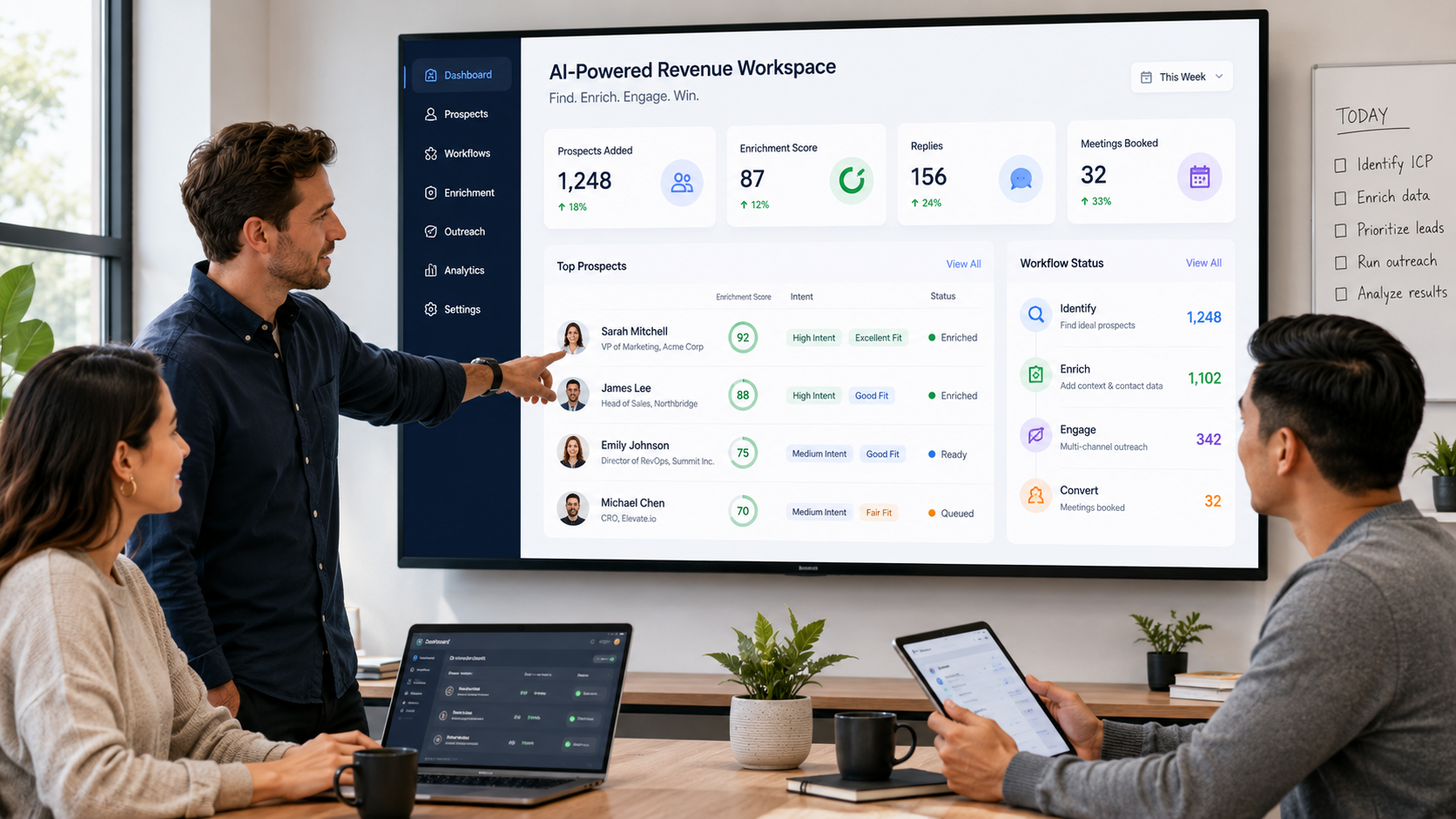
Revenue teams adopting agentic workflows shift from manual research to strategic decision-making.
Agentic AI doesn't automatically mean smaller sales teams. It means less time spent on the parts of the job nobody wants to do and more time spent on the parts that actually move deals. Data entry, manual research, and CRM babysitting shrink. Conversations, negotiation, and account strategy expand. Here's how that shows up by function.
For SDRs and BDRs: The prospecting grind shifts from "build and research" to "review and act." Instead of hand-building lists and trying to research 30 accounts a day, an SDR can work from AI-enriched briefs and put their energy into the message and the moment. The result is more qualified conversations per rep, not just more activity. Teams evaluating the best AI tools for sales are already moving in this direction.
For RevOps: Data quality stops being a background chore and becomes a first-class operating system decision. RevOps defines enrichment sources, qualification criteria, and routing logic that agents execute consistently. The job shifts from maintaining brittle Zap chains to designing workflows with guardrails. Knowing the sales funnel end to end matters even more, because an agent can't route cleanly through stages you haven't defined cleanly.
For Sales Leaders: Forecasting gets less theatrical because the CRM is closer to the truth. Coaching gets more precise because AI can surface the specific deals and signals that deserve human attention. The leadership question changes from "how do I get reps to update Salesforce" to "which workflows should be automated, and what do I want the agent to optimize for."
Getting Started: A Blunt Assessment
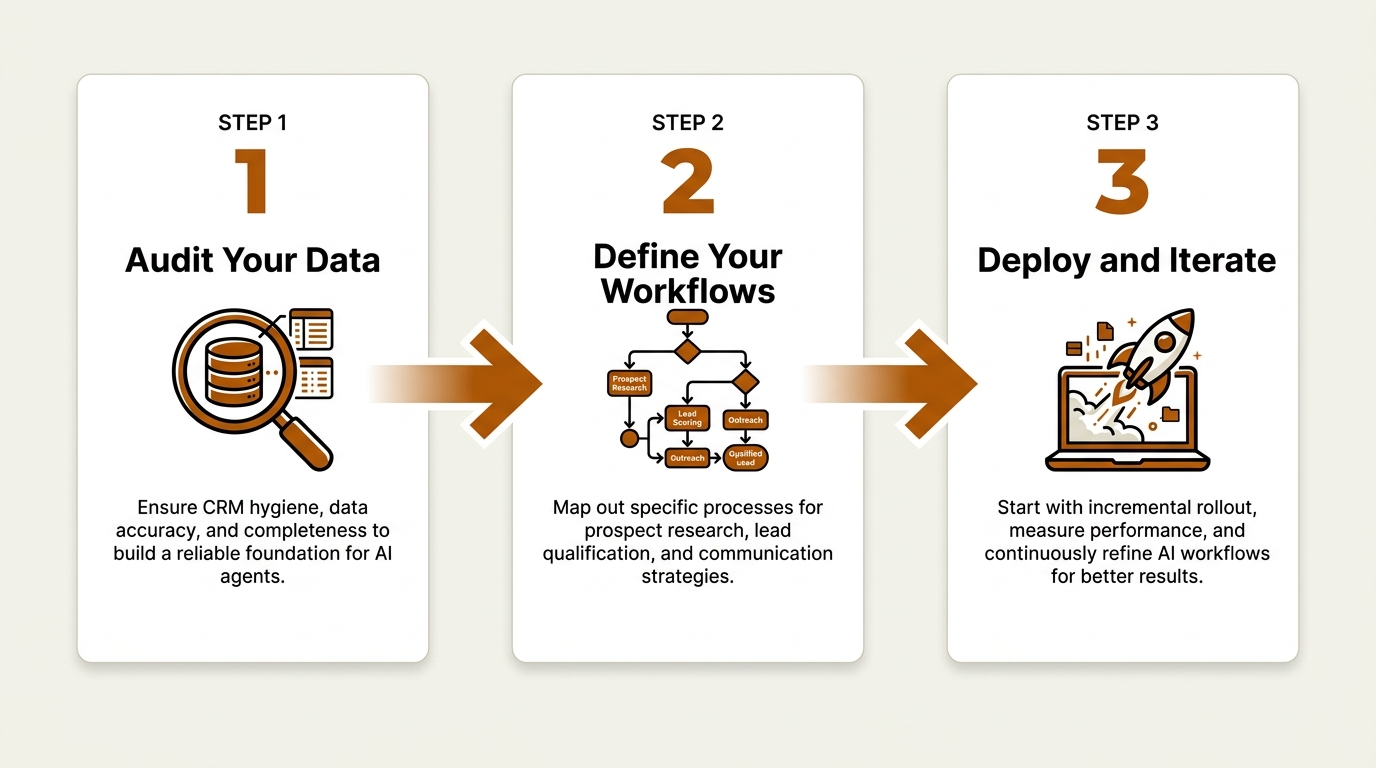
Implementation starts with data quality, not tool selection — before any platform evaluation.
Teams usually fail with AI sales tools for one boring reason: they skip the data audit. Before you evaluate platforms, answer a few questions without optimism. Is your CRM less than 30 days stale for active accounts? Do you have verified emails for at least 80% of target contacts? Are your ICP criteria documented well enough that a new hire could apply them the same way your best rep does? If any answer is no, start with enrichment and hygiene. The rest doesn't hold together without that base.
With the data baseline in place, map the manual workflows that chew up the most hours. For most orgs, it's prospect research, lead qualification, and CRM updates. Those are the first places agentic AI pays for itself because the volume is high and the steps are repeatable. Don't try to automate the entire revenue engine in one sprint. Pick one workflow, deploy it, measure time saved and downstream impact, then expand. Bitscale's ready-made sales automation workflows are built for that kind of incremental rollout.
If you're newer to what is B2B sales as it exists inside modern tech stacks, the learning curve is real, but it's not a blocker. No-code platforms have lowered the barrier. You don't need engineering to start building agentic workflows. You need a clear process, explicit definitions, and data you can trust.
Key Takeaways
- Claude Code shows AI agents can plan, execute, and self-correct across complex multi-step work. That same loop maps directly to sales operations.
- Agentic AI isn't traditional automation with better copy. It can reason through ambiguity, chain tools, and adapt without you constantly adding new rules.
- High-impact workflows for AI agents include prospect research, lead qualification, CRM maintenance, and buying signal detection.
- Clean, enriched data is non-negotiable. Without it, autonomous systems produce autonomous mistakes.
- No-code GTM platforms package agentic principles into sales-ready workflows that RevOps and sales teams can deploy without engineering support.
- Start with one high-volume manual workflow, prove the lift, then expand. Incremental adoption beats big-bang overhauls.
Frequently Asked Questions
What is Claude Code, and why should B2B sales teams care?
Claude Code is Anthropic's agentic coding tool that can navigate codebases, write changes, run tests, and commit updates. It's built for developers, but the workflow pattern behind it (planning, tool use, self-correction, and autonomous execution) is the same architecture showing up in the next generation of AI sales systems. For revenue teams, it's a preview of how agents will run prospect research, CRM updates, and lead qualification.
Can sales teams use Claude Code directly for prospecting or CRM management?
No. Claude Code runs in a developer terminal and is designed for software engineering work. Sales teams get the benefit through no-code GTM platforms like Bitscale, which apply the same agentic principles to sales workflows like enrichment, prospect intelligence, and CRM synchronization without requiring technical fluency.
How is agentic AI different from the sales automation tools I already use?
Traditional sales automation is mostly if/then logic, and it tends to break when inputs change. Agentic AI can reason through ambiguity, chain multiple tools in one task, interpret unstructured sources like news or LinkedIn posts, and adjust based on what happens. It's the difference between a fixed script and a system that can decide what to do next.
What sales workflows are best suited for AI agents?
The highest-ROI workflows are typically prospect research and list building, lead qualification against ICP criteria, CRM hygiene and updates, buying-signal monitoring across news and social sources, and personalized outreach drafting. These are high-volume tasks that require pulling together information from multiple places, which is exactly where agentic systems perform well.
What needs to be in place before implementing agentic AI for a sales team?
Start with data you can trust. CRM records should be current, email addresses verified, and ICP criteria documented clearly. Without reliable inputs, AI agents will make confident but incorrect decisions. Get enrichment and hygiene right first, then layer agentic workflows on top of your highest-volume manual processes.

Sanket
CEO | Co-Founder Bitscale


Sanket is the CEO and Co-Founder of Bitscale. He leads company vision and strategy, building the future of AI-driven sales intelligence for modern B2B teams. Sanket is obsessed with the intersection of AI and go-to-market, and has spent years studying how the best B2B companies find, engage, and convert customers at scale. He writes about company building, product strategy, and where AI is taking the sales industry.
Read other blogs
All Blogs
12 Best CRM Sync Tools for Revenue Teams in 2026
Compare 12 CRM sync tools for Salesforce and HubSpot, including enrichment, reverse ETL, and automation options for cleaner revenue data.
Sales Data Enrichment: A Buyer's Guide for Modern B2B Teams
Sales data enrichment helps B2B teams improve CRM records, routing, prospecting, and account prioritization. Compare workflows, costs, and vendor fit today.
What Is AI Prospect Qualification? A Practical Guide for Modern Revenue Teams
AI prospect qualification helps revenue teams enrich data, assess ICP fit, prioritize buying signals, and route the right accounts into CRM workflows.