**ZoomInfo vs. Bitscale in 2026: GTM Intelligence Platform vs. GTM Data Infrastructure**
<span style="white-space: pre-wrap;">Bitscale vs ZoomInfo: GTM Workflow System vs Data Platform</span>
Table of Contents
Explore Bitscale
Find decision makers, more insights and contact information about this company on Bitscale
Go-to-market teams in 2026 are not just shopping for more contacts. They are rebuilding how data moves through their GTM stack. As enrichment, routing, personalization, and sequencing become more automated, the differentiator is not who has the biggest database. It's who can turn messy lead lists into clean, usable, activated records across the tools your team already uses.
This shift explains why the comparison between ZoomInfo and Bitscale is so common. ZoomInfo has evolved from a database-first tool into a comprehensive GTM intelligence platform with its own workflow, enrichment, and AI capabilities. Bitscale takes a different approach as a workflow-first GTM data infrastructure, where enrichment is a repeatable system using waterfalls, AI agents, and over 100 data sources so the right data appears at the right moment in your outbound motion.
We will break down where each platform fits best, where they feel rigid, and why teams that care about data workflows (not just data volume) increasingly evaluate both options.
TL;DR
ZoomInfo is a GTM intelligence platform designed for enterprise scale, offering broad B2B data coverage, intent signals, and workflow automation tools within a unified ecosystem.
Bitscale is a workflow-first GTM data infrastructure that helps teams build, enrich, and activate lead data using 100+ sources, waterfall enrichment, and AI agents.
Teams that prioritize a unified platform combining proprietary B2B data, intent signals, integrations, and workflow automation may evaluate ZoomInfo.
Teams that value multi-source enrichment, AI research, buying signals, and configurable CRM-connected workflows may evaluate Bitscale for their GTM data layer.
The right choice depends less on feature checklists and more on how your team needs to build, enrich, and use data in its GTM workflows.
The Real Context Behind This Comparison
For a long time, outbound sales was simple: buy a database, export contacts, upload to a CRM, and start calling.
That model worked when volume mattered more than relevance.
In 2026, outbound looks very different. Teams are expected to:
- Work with cleaner, fresher data
- Enrich prospects with context and buying signals
- Personalize outreach at scale
- Operate with leaner budgets and fewer, more integrated tools
These changes make ZoomInfo and Bitscale relevant to teams comparing unified GTM intelligence with multi-source enrichment and workflow automation. They solve overlapping problems but in fundamentally different ways.
ZoomInfo: The All-in-One GTM Intelligence Platform
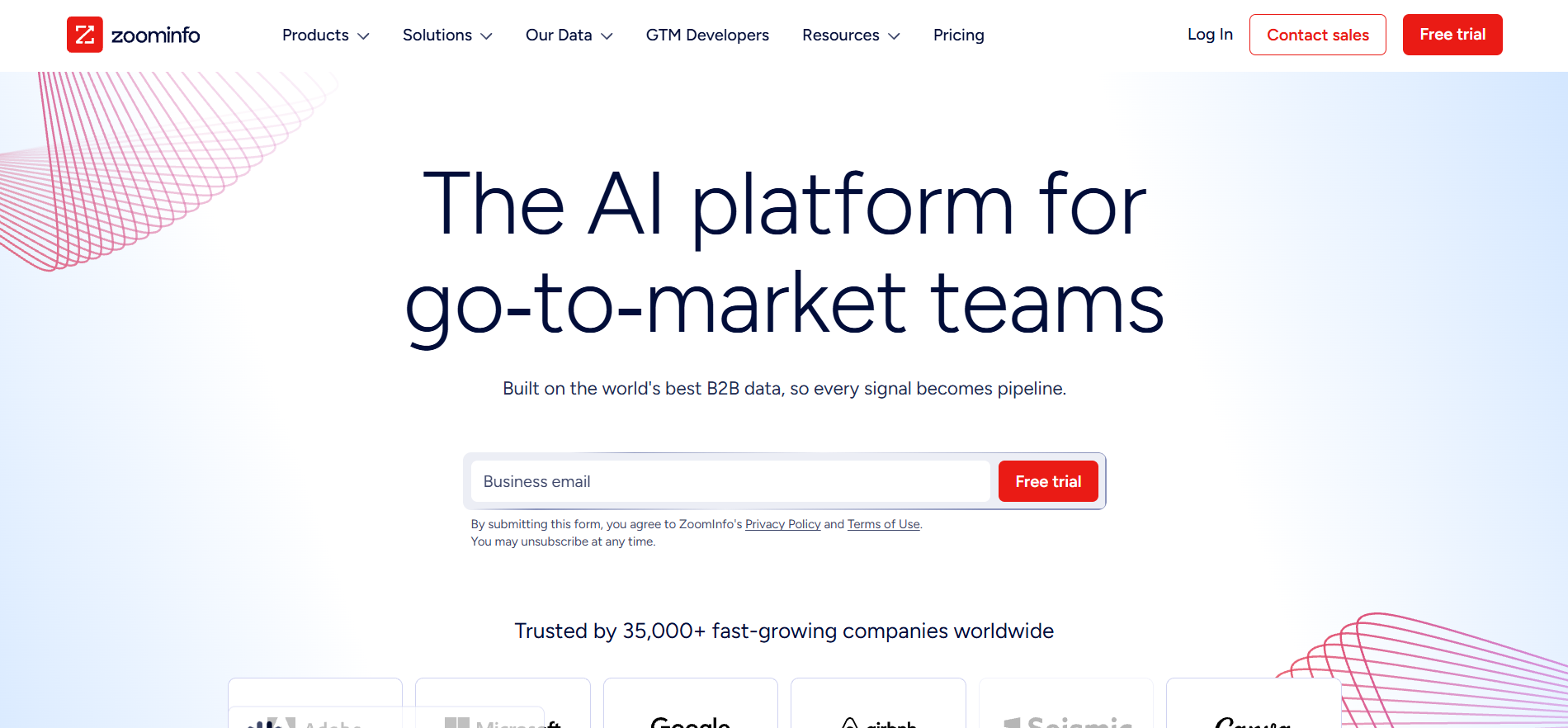
ZoomInfo has expanded from a database to a full GTM intelligence platform.
ZoomInfo's strength comes from its massive proprietary B2B database, which it has expanded into a unified GTM intelligence platform. It combines contact data, company intelligence, intent signals, and automation tools in one ecosystem.
When teams use ZoomInfo, they are typically:
- Searching ZoomInfo's database for contacts and companies
- Filtering by firmographics, intent topics, or technology usage
- Using ZoomInfo Workflows to enrich and route leads to their CRM
- Activating data within ZoomInfo's sales engagement and marketing tools
This makes ZoomInfo a strong fit for organizations that value:
- A single source of truth for GTM data
- Predictable, repeatable prospecting motions
- Proprietary global company and contact intelligence
The tradeoff is that teams should evaluate ZoomInfo's data model, package configuration, integrations, credit requirements, and contract terms against their existing stack. For many mature sales organizations, that is an acceptable trade for convenience and scale.
Bitscale: The Workflow-First GTM Data Infrastructure

Bitscale is designed as a GTM data workflow layer.
Bitscale approaches the same problem from a different angle.
Instead of asking "Which contacts can we export?", Bitscale asks: "What data does your GTM motion actually need, and how do we build it?"
Bitscale works as a GTM data infrastructure layer, not a static database. Teams use its spreadsheet-like interface to:
- Source leads from its database, CRMs, or other inputs
- Enrich records using more than 100 data sources and integrations on applicable plans
- Apply waterfall logic to improve phone and email accuracy
- Add custom data points researched by AI agents
- Push clean, enriched data into CRMs and outbound tools through native integrations
This makes Bitscale particularly useful for teams that:
- Need to combine multiple data sources to get complete coverage
- Require non-standard enrichment (e.g., specific signals, triggers, or niche attributes)
- Want granular control over how data is created, verified, and synced to their CRM
The tradeoff is that Bitscale is not a one-click export tool. Its value compounds when teams actively design and manage data workflows.
How Data and Features Differ in Practice
ZoomInfo provides proprietary global company and contact intelligence, but teams should test coverage using a representative sample from their own ICP.Its data is packaged within the SalesOS platform, which includes tools for enrichment, intent tracking, and workflow automation.
Bitscale's coverage is not tied to a single dataset. Instead, it is adaptable based on which of the 100+ providers are used in a waterfall, which enrichment fields matter to the GTM strategy, and whether AI agents are deployed to research live web data.
Phone Numbers, Emails, and Data Accuracy
ZoomInfo publishes a large proprietary dataset of business emails and direct-dial phone numbers. Test email validity, phone connect rates, and field coverage using records from your own target market before committing.
Bitscale emphasizes verification through redundancy. Its waterfall enrichment approach checks multiple providers in sequence, stopping once a verified phone number or email is found. This method is designed to improve coverage by checking providers sequentially and returning the first validated result.
Intent Signals and Buying Triggers
ZoomInfo offers robust intent data, tracking when companies research relevant topics online. This is a core part of its GTM intelligence platform and is most powerful when used within ZoomInfo's ecosystem to trigger automated workflows.
Bitscale treats intent as one of many possible buying signals. Teams can enrich records with third-party intent sources, hiring and funding signals, news updates, and custom triggers scraped from the web using AI agents. This allows intent data to be tailored to specific GTM hypotheses.
Automation and the Role of AI
ZoomInfo has invested significantly in automation through its Workflows feature, which can trigger actions in a CRM based on data changes and intent signals. The company also offers ZoomInfo Copilot and broader AI-powered GTM capabilities, with availability depending on the purchased package.
Bitscale is designed for automation-first GTM. Its AI agents can perform manual research tasks like scraping websites for niche data points, which can then be used to feed personalization variables into outbound copy or enrich CRM records automatically.
Pricing Philosophy and Buying Experience
ZoomInfo paid plans use custom annual pricing based on user licenses, credit consumption, required intelligence, integrations, features, and contract terms. ZoomInfo explicitly states that its pricing does not have a universal $15,000 starting point.
**Bitscale **publishes monthly and annual options. Its current monthly plans are Free, Growth at $349 per month, Booster at $799 per month, and custom Enterprise; credits are charged when a data provider returns a valid result. Two-way HubSpot integration starts on Growth, while Salesforce integration starts on Booster.
Neither model is inherently better; it depends on whether budget predictability or usage-based flexibility matters more to your organization.
The Verdict: Which Platform Is Right for Your Team?
This comparison isn't about which tool is better, but about which GTM philosophy your team follows.
**Choose ZoomInfo if:**Your organization needs proprietary B2B intelligence, intent signals, CRM integrations, automation, and a customized annual package that fits its data and workflow requirements.
Choose Bitscale if: Your team needs multi-source enrichment, AI research, buying signals, and configurable CRM-connected workflows with published monthly or annual plans.
In 2026, as outbound becomes more contextual and automation-driven, the choice between an integrated platform like ZoomInfo and a flexible infrastructure layer like Bitscale matters more than any single feature. The right decision depends on your team's operational maturity, budget, and long-term data strategy.
ZoomInfo vs. Bitscale Comparison
| Category | ZoomInfo | Bitscale |
|---|---|---|
| Core Model | All-in-one GTM intelligence platform | Workflow-first GTM data infrastructure |
| Primary Job | Search, filter, and activate data in a unified system | Build, enrich, and activate lead data from multiple sources |
| Data Sources | Proprietary B2B data combined with partner, behavioural, CRM, and conversation signals | 100+ data sources and integrations, plus AI agents | |
| Phone/Email | Proprietary business-email and direct-dial data | Multi-provider waterfall enrichment that returns the first validated result |
| Custom Fields | Packaged and configurable data fields according to the purchased capabilities | Custom enrichment fields and AI-researched attributes. |
| Intent | Native platform signals and workflows | Multi-source signals and custom AI triggers |
| Automation | Built-in Workflows and AI Copilot | AI agents and workflow-centric design |
| Pricing | Annual, quote-based contracts (starts ~$15k/yr) | Usage-based credits (starts with free plan) |
| Best For | Enterprise teams needing an all-in-one platform | Flexible GTM teams building a custom data stack |
Frequently Asked Questions
1. Is Bitscale a direct replacement for ZoomInfo?
Bitscale may replace parts of a ZoomInfo workflow when multi-source enrichment, AI research, buying signals, and CRM-connected automation cover the required use cases. Teams should test both platforms against the same ICP sample and workflow requirements.
2. What is the biggest difference between Bitscale and ZoomInfo?
The biggest difference is the architectural approach. ZoomInfo offers a unified GTM intelligence platform where data and workflows live in one ecosystem. Bitscale provides a flexible data infrastructure layer that allows teams to build their own data using multiple providers, enrichment waterfalls, and AI agents.
3. Which tool is better for personalized outbound?
Bitscale supports custom enrichment fields and AI-assisted web research that can provide additional context for personalized outreach.
4. How do phone numbers and emails compare?
ZoomInfo provides proprietary contact data, while Bitscale uses waterfall enrichment to check multiple providers sequentially and return the first validated result. Test both on the same ICP sample to compare coverage and validity.
5. Does ZoomInfo or Bitscale provide better intent data?
ZoomInfo has a powerful native intent data solution integrated into its platform, which is a key strength for its users. Bitscale allows teams to combine multiple intent sources, hiring signals, and other buying signals to create a more customized view of intent.
6. How do pricing models differ?
ZoomInfo uses custom annual paid plans based on user licenses, credits, required intelligence, integrations, features, and contract terms, and it does not publish a universal starting price. Bitscale publishes monthly and annual credit-based plans, with credits charged when a provider returns a valid result.
7. Which tool is more flexible for RevOps?
Bitscale gives RevOps teams configurable enrichment logic, AI research, buying-signal workflows, and CRM sync options, with capabilities and limits varying by plan..
8. Can I enrich existing CRM data with both tools?
Yes. Both platforms offer robust CRM enrichment. ZoomInfo can enrich data in real-time or on a schedule. Bitscale is designed for bulk and real-time CRM enrichment, using its multi-source waterfalls to fill gaps and keep records fresh.
Read other blogs
All Blogs
Salesforce in Claude (Claudeforce): what sellers get, and what it means for your CRM data
Salesforce in Claude puts your live CRM inside Claude with 37 sales skills. What sellers get, who can use it, and how to get your CRM data ready first.
Forward deployed engineer vs. GTM engineer: what each role does and which one you need
Forward deployed engineer vs GTM engineer: what each role builds, who it works for, tools, KPIs and posted 2026 pay, plus which one your company needs.
Clay vs Claude for GTM: what each does, and the better setup (2026)
Clay vs Claude: one is an enrichment tool, the other an AI assistant. What each does for GTM, when you need a data tool, and the setup that uses both well.