Best Cognism Alternative in 2026: Bitscale vs Cognism Compared
Table of Contents
Explore Bitscale
Find decision makers, more insights and contact information about this company on Bitscale
Outbound teams today are no longer evaluating tools only on how many contacts they can export. Instead, they're asking deeper questions: How accurate is the data? How flexible are the workflows? Can this system adapt to our GTM motion without adding more tools?
Both platforms help teams find and enrich B2B leads-but they are built with very different priorities. Cognism positions itself as a compliance-first sales intelligence provider, while Bitscale focuses on being a flexible data and workflow layer for outbound GTM teams. Understanding that distinction is key to making the right decision.
TL;DR
- Cognism is a sales intelligence platform offering prospecting, CRM enrichment, Data-as-a-Service, compliant B2B data, buying signals, and phone-verified contacts.
- Bitscale is a workflow-first GTM enrichment system that helps teams build, verify, and activate data using multiple sources, enrichment waterfalls, and AI agents.
- Cognism works best for teams that want a compliance-led, ready-made dataset.
- Bitscale works best for teams that want custom enrichment, automation, and flexibility across different GTM motions.
- The choice depends on whether you want a single trusted data provider or a system that adapts to how your team builds outbound data.
Understanding Cognism's Approach to Sales Intelligence
Cognism is built around a centralizedB2B contact database, similar in concept to other traditional sales intelligence tools, but with a clear differentiator: compliance.
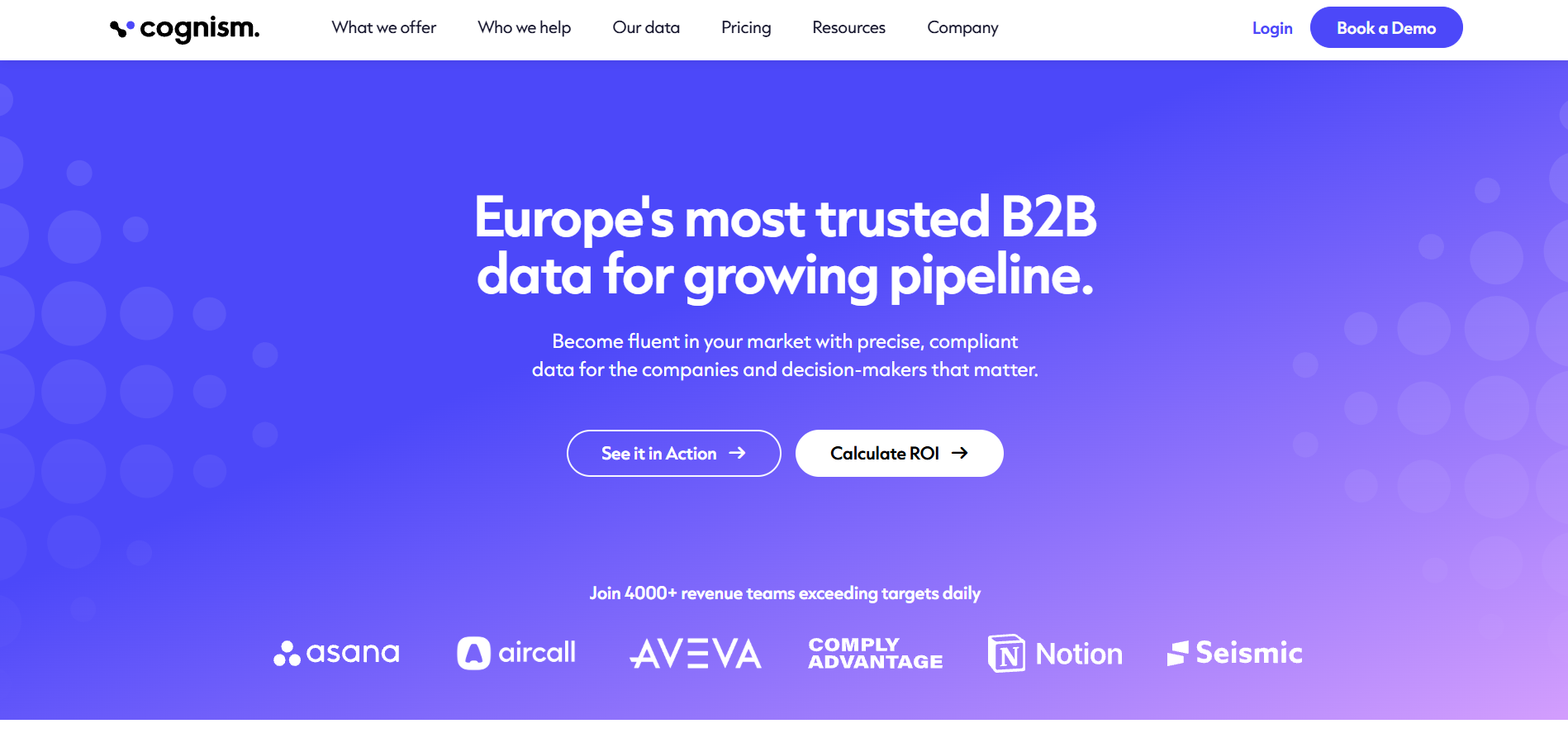
Source: Cognism
The platform places heavy emphasis on:
- GDPR and regional data regulations
- Compliance-focused data sourcing and Do-Not-Call and TPS screening
- Phone-verified mobile numbers (often referred to as "Diamond Data")
For teams operating in Europe, the UK, or compliance-sensitive markets, this positioning is critical. Cognism's value lies in giving sales teams confidence that the data they're using aligns with regulatory expectations.
In day-to-day use, Cognism typically functions as:
- A place to search and filter contacts
- A source of compliant phone numbers and emails
- A database that integrates with CRM and outbound tools
This makes Cognism a strong fit for organizations that prefer structure, predictability, and compliance assurances over deep customization.
How Bitscale Takes a Different Path
Bitscale approaches the same problem-finding and enriching leads-from a different starting point.

Rather than relying only on its own contact and company data, Bitscale also acts as a GTM data layer that combines data sources, enrichment waterfalls, AI research, and activation workflows. Teams use it to:
- Combine multiple data providers
- Enrich records through waterfall logic
- Add custom fields and niche datapoints
- Use AI agents to research live web data
- Push enriched records directly into CRM or outbound tools
Rather than asking "What does the database already know?", Bitscale asks:"What does your GTM strategy need to know-and how do we build that data?"
This makes Bitscale especially relevant for teams that:
- Operate across multiple ICPs or geographies
- Need enrichment beyond standard firmographic fields
- Want to reduce dependency on a single data source
Data Coverage and Market Focus
Cognism's data coverage is particularly strong in EMEA and global markets, where compliance requirements are stricter and data quality varies significantly. Its curated approach emphasizes consistency and regulatory alignment, while its CRM Enrichment and Data-as-a-Service products support CRM updates, API access, bulk delivery, and configurable enrichment workflows.
Bitscale's coverage expands based on the sources and workflows configured by the team. Because Bitscale can combine its own search data with multiple enrichment sources, workflows can be adapted to:
- New markets
- New ICP definitions
- Emerging signals or attributes
In practice, Cognism offers certainty, while Bitscale offers adaptability.
Phone Numbers, Emails, and Verification
Cognism is well known for its focus on phone-verified mobile numbers, which is a major reason many teams adopt the platform. This is particularly valuable for SDR teams relying heavily on cold calling in regulated regions.
Bitscale takes a different route by using multi-source verification. Through enrichment waterfalls, phone numbers and emails are checked across several providers, stopping when a verified match is found. This approach:
- Reduces reliance on any single provider
- Broadens the available coverage for niche or hard-to-reach personas
- Allows teams to tune accuracy vs volume based on use case
The difference is less about which is "better" and more about control versus curation.
Intent Data and Buying Signals
Cognism integrates intent data (often through third-party partnerships) to help identify accounts that may be actively researching solutions. This data is surfaced in a standardized way, making it easy for teams to act on without complex setup.
Bitscale treats intent as a customizable enrichment layer. Teams can enrich records with:
- Third-party intent signals
- Hiring and growth indicators
- News and funding events
- AI-researched triggers specific to their GTM motion
This allows intent to be tailored to very specific hypotheses, rather than relying on generalized "in-market" signals.
Automation, AI, and Workflow Depth
Cognism combines data access with CRM enrichment, Data-as-a-Service, AI company research, AI search, CSV enrichment, and buying-signal workflows. Bitscale differentiates through configurable multi-source waterfalls, AI research, and broader GTM workflow orchestration.
Bitscale is designed for automation-first outbound. AI agents can research websites, extract custom attributes, classify leads, and support hyperpersonalization. Bitscale's CRM enrichment capabilities separately detect job changes, bounced emails, and dead domains. Over time, this allows teams to replace manual SDR research with repeatable systems.
Pricing and Buying Experience (High-Level)
Cognism uses quote-based pricing for its Standard and Pro prospecting packages. CRM Enrichment and Data-as-a-Service are available as add-ons or separate products, and the public pricing page does not specify contract length.
Bitscale uses transparent, credit-based pricing, allowing teams to start small, experiment, and scale usage as workflows mature. This model is often preferred by startups, agencies, and RevOps-led teams.
Final Perspective
The choice between Cognism and Bitscale is not about features-it's about philosophy.
Cognism is ideal for teams that want a trusted, compliance-first data provider, especially in regulated markets.
Bitscale is ideal for teams that see data as something to be built, enriched, and activated through workflows, rather than simply consumed.
Frequently Asked Questions
1. Is Bitscale a replacement for Cognism?
Bitscale is not a direct one-to-one replacement. Cognism is a compliance-first sales intelligence database, while Bitscale is a GTM workflow and enrichment system.
2. What is the biggest difference between Bitscale and Cognism?
The biggest difference is how data is handled. Cognism provides curated, compliant data from a centralized database. Bitscale allows teams to build and enrich data using multiple sources, workflows, and AI agents.
3. Which tool is better for GDPR-focused teams?
Cognism is often preferred by teams operating in Europe or other regulated markets due to its strong compliance positioning. Bitscale can support compliant workflows but gives teams more responsibility in how data sources are configured.
4. How do phone numbers compare between Bitscale and Cognism?
Cognism emphasizes phone-verified mobile numbers within its database. Bitscale uses enrichment waterfalls to verify phone numbers across multiple providers, which can improve accuracy for niche personas.
5. Does Bitscale offer intent data like Cognism?
Bitscale does not rely on a single native intent source. Instead, it allows teams to enrich records with multiple intent providers, hiring signals, news events, and AI-researched triggers.
6. How do pricing models differ?
Cognism uses quote-based Standard and Pro packages, with credits used to reveal, enrich, or export contacts. Bitscale publishes monthly credit-based plans that scale by available credits and features.
7. Which tool is better for RevOps and experimentation?
Bitscale offers configurable enrichment logic, multi-source waterfalls, AI research, and CRM workflows. Cognism offers prospecting, CRM enrichment, Data-as-a-Service, AI research, and buying signals within more standardized packages.
8. Can both tools enrich existing CRM data?
Yes. Cognism offers CRM enrichment, CSV enrichment, API access, bulk delivery, exports, and integrations. Bitscale supports bulk enrichment, multi-source waterfalls, spreadsheet workflows, and ongoing CRM enrichment.
9. Which tool is better for startups?
Bitscale offers free and monthly credit-based plans that can suit teams testing flexible workflows. Cognism markets its platform to SMB, mid-market, and enterprise teams, with pricing available from sales.
10. When does it make sense to use both Cognism and Bitscale?
Cognism focuses on compliance-oriented B2B data and sales intelligence, while Bitscale differentiates itself through configurable multi-source enrichment, data verification, AI research, personalization, and GTM workflow automation.
Read other blogs
All Blogs
12 Best CRM Sync Tools for Revenue Teams in 2026
Compare 12 CRM sync tools for Salesforce and HubSpot, including enrichment, reverse ETL, and automation options for cleaner revenue data.

Sales Data Enrichment: A Buyer's Guide for Modern B2B Teams
Sales data enrichment helps B2B teams improve CRM records, routing, prospecting, and account prioritization. Compare workflows, costs, and vendor fit today.

What Is AI Prospect Qualification? A Practical Guide for Modern Revenue Teams
AI prospect qualification helps revenue teams enrich data, assess ICP fit, prioritize buying signals, and route the right accounts into CRM workflows.