BDR Automation: How Modern Revenue Teams Scale Pipeline
Table of Contents
Explore Bitscale
Find decision makers, more insights and contact information about this company on Bitscale
BDR automation is one of those phrases that means something different depending on who you ask. Corner ten revenue leaders and most will point to an email sequencer. That framing misses where the real leverage is. The teams pulling ahead are automating the whole prospecting chain: account research, contact enrichment, lead qualification, CRM hygiene, and outreach prep, so human BDRs can spend their day on the conversations that actually create pipeline.
AI-assisted BDR workflows are being adopted at a rapid pace as organizations modernize prospecting and pipeline generation. Across the B2B landscape, companies are shifting headcount and investment toward AI-augmented sales roles, while traditional SDR and BDR job descriptions are being rewritten to reflect new tooling expectations. That does not mean BDRs are going away. It means the job is being re-cut around automation, with humans kept where judgment and relationships matter. What follows is that split: what BDR automation really includes, how to draw the AI/human line, where platforms like Bitscale fit, and how to implement it without turning relationship-driven selling into a spam factory.
What BDR Automation Actually Means (Beyond Email Sequences)
A lot of "BDR automation" products earned their stripes as outreach tools. They let reps send more emails with less effort. That was meaningful several years ago; now it is the baseline. The constraint moved upstream. Reps were never slow at hitting send. They were slow at everything required to earn the send: choosing the right accounts, finding the right people, figuring out who is in-market, and getting clean data into a CRM that leadership will actually trust for forecasting.
A modern automation program covers the entire top-of-funnel workflow. That includes AI prospect research to identify and score target accounts, contact enrichment to surface verified emails and phone numbers, intent data and buying signals to flag accounts showing purchase behavior, automated lead qualification against your ICP, CRM automation that keeps records clean without constant rep babysitting, and orchestration that connects the steps into one operating system. Outreach is the last mile. Treating it as the whole product is how teams end up with more activity and the same pipeline.
Traditional BDR Workflow vs. Automated BDR Workflow
The point is not to eliminate work; it is to move effort to where it pays off. Many repetitive sales activities, from data entry to list building, can be automated, freeing BDRs to focus more on customer engagement and strategic conversations. Organizations that adopt sales development automation consistently report significant reductions in manual effort across the prospecting workflow. That time is not found in one big win. It comes from shaving minutes off a dozen repetitive steps.
| Workflow Step | Traditional (Manual) | Automated (AI-Assisted) |
|---|---|---|
| Account Research | LinkedIn and Google rabbit holes, consuming substantial time per account | AI research pulls firmographic, technographic, and funding context in seconds |
| Contact Discovery | Directory searches and email-format guesswork | Automated enrichment retrieves verified work emails and direct dials across providers |
| Buying Signal Detection | Occasional news alerts and intuition | Always-on monitoring of job posts, tech installs, funding, and web activity |
| Lead Qualification | Rep-by-rep judgment against loose criteria | Automated scoring against ICP fit and intent thresholds |
| CRM Data Entry | Manual logging after interactions (and often skipped) | CRM automation syncs enriched records, activities, and scores automatically |
| Outreach Preparation | Writing from scratch or lightly templated notes | AI drafts personalized messaging from research context; rep reviews and sends |
| Reporting | Weekly spreadsheet exports with lagging visibility | Real-time dashboards with attribution by source, signal, and workflow |
| Prioritization | Working a static list from top to bottom | AI ranks accounts by a composite of fit, intent, and recent engagement |
| The shift is not about removing steps. It is about automating the repetitive parts so BDRs focus on high-judgment activities. |
AI Responsibilities vs. Human Responsibilities
The most common GTM automation failure is treating it like a headcount substitute. That is not how durable programs work. Automation is great at volume, consistency, and pattern-matching across messy data. People are still better at nuance: reading the room, building trust, and adjusting in real time. If you do not draw a clean boundary, you get the worst of both worlds: reps stuck doing machine work, and machines sending tone-deaf outreach that quietly taxes your brand.
| Responsibility | Owned By | Why |
|---|---|---|
| Aggregating firmographic and technographic data | AI | Fast coverage across thousands of accounts |
| Monitoring intent signals and buying triggers | AI | Continuous, real-time processing is the whole job |
| Scoring and ranking accounts by ICP fit | AI | Reduces subjective bias in prioritization |
| Enriching contacts with verified emails and phones | AI | Instant cross-checking across multiple providers |
| Syncing records to CRM with standardized fields | AI | Fewer manual-entry errors and better data hygiene |
| Interpreting account context for personalized messaging | Human | Judgment on tone, timing, and relevance |
| Building multi-threaded relationships within accounts | Human | Trust is earned through real interaction |
| Handling objections and navigating complex buying committees | Human | Empathy and adaptation cannot be templated |
| Deciding when to escalate or disqualify | Human | Strategic calls require context |
| Refining ICP definitions based on closed-won patterns | Human + AI | AI surfaces patterns; humans validate and adjust |
| Clear ownership prevents both wasted rep time and impersonal automation. |
The Nine Components of a Complete BDR Automation Stack
If you are shopping for BDR automation software, you need a clear definition of "complete." Most vendors cover two or three pieces well and leave you to stitch the rest together. A smaller set can support all nine components in one motion. Here is the full stack, and what each layer is supposed to deliver in the real world.
1. Account Research and AI Prospect Research
Everything starts with the account list. Automated prospecting builds that list from firmographic filters (industry, headcount, revenue, geography), then adds the context reps normally hunt for: technographics (which tools a company uses), funding history, and basic org structure. Platforms like Bitscale pull those sources into a single research layer, so reps are not bouncing between LinkedIn, Crunchbase, and a dozen open tabs. For a more detailed walkthrough, see this breakdown of AI prospect research.
2. Contact Enrichment
Picking the right account is only step one; you still need the right people. Contact enrichment automates the retrieval of work emails, direct phone numbers, titles, and reporting relationships. Strong systems do not rely on a single database. They "waterfall" across multiple providers, then verify deliverability before anything lands in your CRM and starts polluting your sequences.
3. Buying Signals and Intent Data
ICP fit tells you who could buy. Signals tell you who is trying to buy right now. That can look like job postings tied to your product, technology changes, leadership moves, funding announcements, or web activity on competitor and review sites. Workflow automation platforms ingest those signals and use them to continuously re-rank accounts, so your BDRs are not working last month's priorities.
4. Lead Qualification and Scoring
Manual qualification is slow, inconsistent, and hard to audit. Automated lead qualification applies your ICP rules programmatically, scoring every account on fit, intent, and engagement. The practical effect is simple: prioritization stops being a debate and starts being a system, which makes pipeline generation easier to manage and easier to improve.
5 through 9: CRM Sync, Outreach Prep, Reporting, Governance, and Orchestration
The rest of the stack is where programs either scale cleanly or collapse under their own weight. CRM automation keeps your database accurate without asking reps to do clerical work after every touch. Outreach preparation uses the research context to draft personalized messaging that a rep can edit, approve, and send. Reporting connects pipeline outcomes back to specific workflows and signals, so ops can double down on what works. Governance covers data privacy requirements and cadence limits. Orchestration is the glue: the workflow engine that triggers each step in sequence, routes exceptions, and keeps the whole system from turning into a pile of disconnected automations.
Automation Capabilities and Business Value
When revenue leaders evaluate outbound automation, the conversation drifts toward activity metrics: more sends, more tasks, more "touches." A better test is to map each capability to the operational problem it solves and the business value that falls out, without pretending every workflow instantly doubles productivity.
| Capability | What It Does | Business Value |
|---|---|---|
| Multi-source account enrichment | Pulls firmographic, technographic, and intent data into one view | Better ICP match rates and fewer wasted touches |
| Real-time signal monitoring | Watches job posts, tech changes, funding, and web activity | Reps engage when an account is most receptive |
| AI-powered lead scoring | Ranks accounts using a composite of fit, intent, and engagement | Pipeline is ordered by likelihood to convert, not by whoever got added first |
| Automated CRM sync | Writes enriched records and activity logs back to the CRM automatically | Forecasting improves because the underlying data is complete |
| Workflow orchestration | Chains research, enrichment, scoring, and outreach prep into triggered sequences | Fewer handoff gaps and faster time-to-first-touch |
| Compliance and governance rules | Applies cadence limits, opt-outs, and data retention policies | Lower legal risk and protected sender reputation |
| Outreach personalization at scale | Generates tailored draft messaging from research context | Higher response rates because outreach is specific, not generic |
| Each capability solves a specific operational problem. The value compounds when they work together. |
How Bitscale Unifies the BDR Automation Stack
Most teams end up assembling a patchwork: one tool for enrichment, another for intent, another for sequencing, another for CRM sync, plus the glue code and spreadsheets that keep it from falling apart. That stack can work, but it is brittle. Data lives in silos, integrations break, and ops spends more cycles maintaining workflows than improving them.
Bitscale takes the opposite approach: one GTM automation platform that combines AI prospect research, buying signals, company and contact enrichment, CRM sync, ready-made sales workflow automation templates, and integrations with outbound tools. Instead of stitching point solutions together, teams build an end-to-end prospecting workflow in a single interface. A typical flow starts with an ICP-based account list, enriches contacts with verified emails, scores accounts using intent signals, syncs qualified leads into the CRM, and prepares personalized outreach drafts, without a rep touching a spreadsheet. For packaging and scale, you can review Bitscale pricing.
Implementing BDR Automation Without Losing the Human Edge
Most rollouts stumble for the same reason: teams automate outreach first and leave research for later. That is backwards. The highest-leverage wins are the tasks that eat the most time while adding the least strategic value. Start there, and your BDRs will feel the improvement immediately without sacrificing the human side of selling.
Step 1: Audit Where Your BDRs Actually Spend Time
Before buying anything, have reps track their time for two weeks. In most orgs, the majority of the day disappears into research, data entry, and list building. That is your automation target. BDR expectations continue to increase year over year, with quotas and coverage requirements rising even when headcount stays flat. Automating upstream work is how you create capacity without asking reps to sprint forever.
Step 2: Define Your ICP and Qualification Criteria Before Automating
Automation scales whatever you feed it, including bad inputs. If your ideal customer profile is fuzzy, you will simply produce more low-quality leads, faster, and burn your team's attention in the process. Get specific on firmographics, technographics, and the behavioral criteria you trust. Then translate those definitions into a scoring model that the team can inspect and refine.
Step 3: Layer in Signals and Orchestration Gradually
Trying to automate the entire motion on day one is how implementations become shelfware. Start with account research and enrichment. When that is stable, add buying-signal monitoring. Next, introduce automated scoring and CRM sync. Only then connect outreach preparation. Validate each layer before stacking the next one. This pacing also gives BDRs time to adjust their day-to-day workflow and build trust in the system's outputs.
Advanced Considerations: Governance, Data Quality, and Multi-Channel Orchestration
Once the basics are working, the advantage shifts from "we automated" to how well you run the system. Teams that treat automation as set-and-forget eventually hit the same walls: deliverability issues, decaying data, and compliance headaches. The difference between an early program and a mature one is usually governance and discipline, not another sequence template.
Data decay is relentless. B2B contact data changes continuously as people switch jobs, companies restructure, and email domains shift. Automation needs a regular re-enrichment cadence, not a one-time cleanup. Many teams find that scheduling re-verification on a quarterly basis for active pipeline contacts is a practical starting point. Treat this as ongoing hygiene, not a special project.
Multi-channel orchestration matters more than volume. Strong outbound programs coordinate email, LinkedIn, phone, and even direct mail into one coherent sequence. Automated LinkedIn prospecting is a good example of the right split: automation does the research and prep; the rep owns the connection request and the conversation. Sending the same message across every channel at once is not orchestration. Sequencing touches with spacing and context is.
Governance protects your domain and your brand. Put hard caps on daily send volume, enforce opt-out handling, and add human review checkpoints before any automated message goes out. Nothing tanks a domain reputation faster than an unchecked engine firing thousands of poorly targeted emails. The operational controls are not bureaucracy; they are what make scale sustainable.
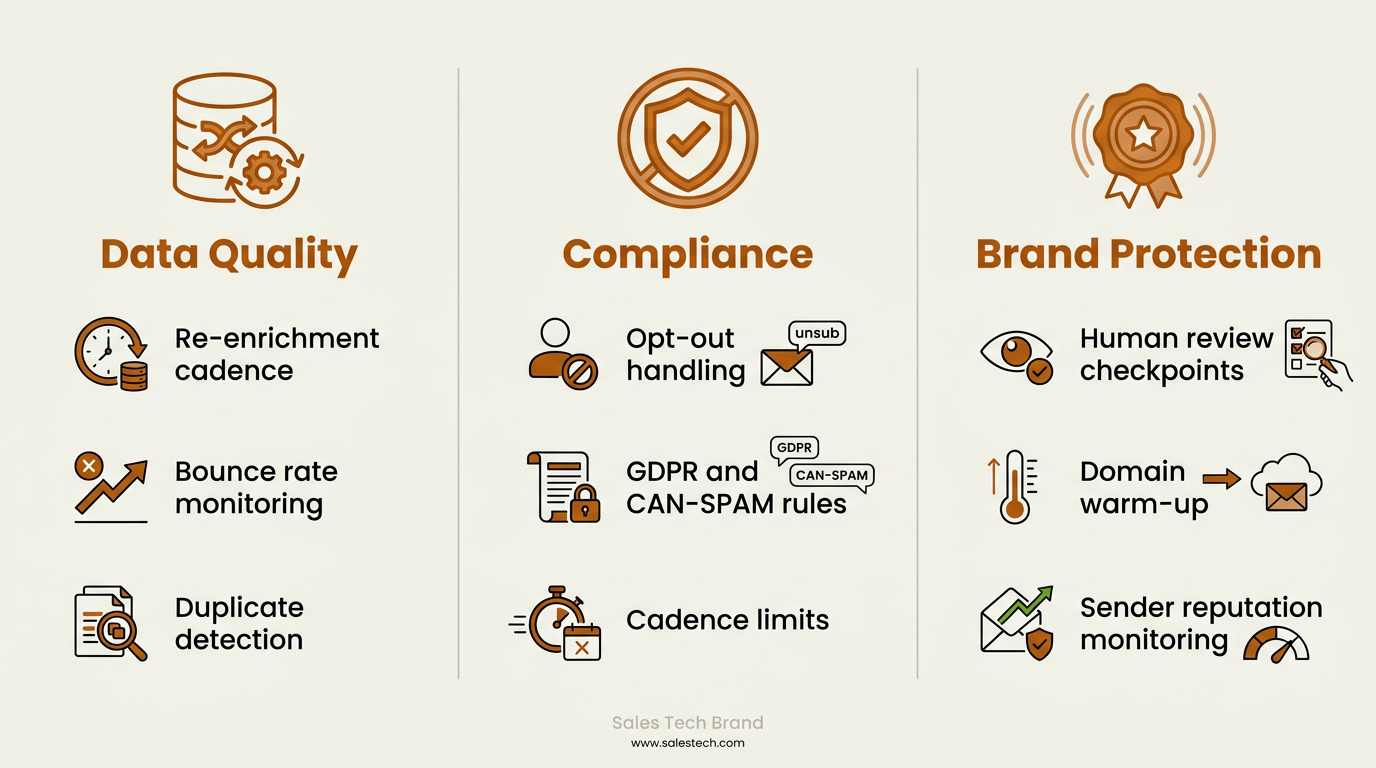
Governance is what keeps BDR automation sustainable — data hygiene, compliance rules, and brand safeguards all in one framework.
Key Takeaways
- BDR automation is not email sequencing. It is the orchestration of account research, enrichment, signals, scoring, CRM sync, outreach prep, reporting, and governance into a unified workflow.
- AI handles volume and data processing. Humans handle relationships, judgment, and creative engagement. Make that boundary explicit.
- Automate upstream work (research, enrichment, scoring) before you touch outreach. That is where the time savings actually live.
- Governance, data quality, and multi-channel coordination separate durable programs from teams that simply bought another tool.
- Platforms like Bitscale consolidate the GTM automation stack so you are not relying on a fragile chain of point solutions.
Frequently Asked Questions
Does BDR automation replace human BDRs?
No. BDR automation is built for repetitive, data-heavy work like research, enrichment, and CRM updates. Human BDRs still own relationship building, objection handling, and strategic engagement. The goal is to pull low-value busywork out of the day so reps can spend more time in conversations that create pipeline.
What is the difference between BDR automation and outbound automation?
Outbound automation usually means sequencing and send-volume tooling. BDR automation is broader: it orchestrates the full prospecting workflow, including account research, contact enrichment, buying-signal detection, lead qualification, CRM synchronization, and outreach preparation. Outbound execution is the final step, not the system.
How long does it take to implement a BDR automation platform?
Implementation timelines vary by organization size and existing infrastructure, but a phased approach works well for most teams. The Foundation phase covers auditing current workflows and defining ICP criteria. Data Readiness focuses on connecting enrichment sources and validating data quality. The Automation phase layers in signal monitoring, lead scoring, and CRM sync. The Optimization phase adds outreach preparation, orchestration tuning, and performance reporting. Trying to ship the full stack at once tends to create cleanup work that slows adoption, so building each phase on a stable foundation is the more reliable path.
What buying signals should BDR automation track?
The signals that tend to be most actionable include job postings for roles your product supports, technology stack changes, leadership transitions, funding announcements, and engagement with competitor or review sites. Bitscale and similar platforms monitor these continuously and use them to re-rank accounts by conversion likelihood.
How does AI prospect research differ from traditional list building?
Traditional list building is mostly static filtering (industry, headcount, location) against a single database. AI prospect research blends firmographic, technographic, intent, and behavioral data from multiple sources, then scores and ranks accounts dynamically. The output is a prioritized list that updates with market conditions, not a one-time export.

Sanket
CEO | Co-Founder Bitscale


Sanket is the CEO and Co-Founder of Bitscale. He leads company vision and strategy, building the future of AI-driven sales intelligence for modern B2B teams. Sanket is obsessed with the intersection of AI and go-to-market, and has spent years studying how the best B2B companies find, engage, and convert customers at scale. He writes about company building, product strategy, and where AI is taking the sales industry.
Read other blogs
All Blogs
12 Best CRM Sync Tools for Revenue Teams in 2026
Compare 12 CRM sync tools for Salesforce and HubSpot, including enrichment, reverse ETL, and automation options for cleaner revenue data.
Sales Data Enrichment: A Buyer's Guide for Modern B2B Teams
Sales data enrichment helps B2B teams improve CRM records, routing, prospecting, and account prioritization. Compare workflows, costs, and vendor fit today.
What Is AI Prospect Qualification? A Practical Guide for Modern Revenue Teams
AI prospect qualification helps revenue teams enrich data, assess ICP fit, prioritize buying signals, and route the right accounts into CRM workflows.