B2B Sales Productivity: How Modern Revenue Teams Sell More by Doing Less Manual Work
Table of Contents
Explore Bitscale
Find decision makers, more insights and contact information about this company on Bitscale
Many B2B sales reps spend a significant portion of their week on prospect research, CRM updates, administrative work, internal coordination, and other non-selling activities instead of customer conversations. For most revenue teams, the real quota killer is not the pitch or the product. It is the pile of repetitive work that keeps sellers away from buyers.
B2B sales productivity has very little to do with motivational posters or another round of time-blocking. It is a systems problem: strip out the manual steps that burn seller hours, then replace them with automated, AI-powered workflows that run in the background. This guide breaks down where modern revenue teams win back selling time, from prospect research and lead enrichment to CRM automation, buying signals, and RevOps alignment. The org chart can change, but the playbook does not: automate the repeatable work and keep humans focused on the parts that still require judgment.
What you'll find in this guide:
- The real cost of manual sales work and why typical productivity advice misses the bottleneck
- AI-assisted sales activities compared side-by-side with their manual counterparts
- Enrichment, signals, and intelligence as the baseline for sales efficiency
- CRM synchronization and workflow automation that survives past the first month
- RevOps optimization and why aligned teams out-execute siloed ones
- Implementation advice including common mistakes and a practical rollout sequence
Why Traditional Sales Productivity Advice Falls Short
Most sales productivity advice stays at the individual level: block your calendar, batch your inbox, focus on the highest-priority accounts. None of that is useless. It just dodges the structural constraint. If a rep needs 15 minutes to research one prospect, then has to update CRM fields after every call, then shuffles the same data across three tools before starting a sequence, the throughput problem is baked in. Calendar discipline cannot outrun broken plumbing.
McKinsey has consistently found that high-performing sales organizations outperform their peers by combining operational efficiency, automation, standardized processes, and stronger data-driven decision-making (McKinsey, 2023). The separation was not about motivation. It was operational: reclaiming seller time through shared services and automation, using data to prioritize high-value opportunities, and developing talent around those systems. Organizations that invested in shared services and automation consistently reported measurable gains in sales productivity.
The gap between high-performing and average teams keeps widening for a simple reason: the tooling has matured. AI prospect research, real-time buying signals, automated enrichment, and CRM synchronization are not "someday" features anymore. The best teams run them every day, and the compounding effect shows up in pipeline coverage and rep capacity.
Manual vs. AI-Assisted Sales Activities
If you want to see where the gains come from, do not start with abstract claims about AI. Start with the work itself. Below is a task-by-task comparison of common sales activities, mapped to what they look like when the manual steps are removed.
| Sales Activity | Manual Approach | AI-Assisted Approach |
|---|---|---|
| Prospect research | Google the company, scan LinkedIn, read press releases, take notes manually | AI agent pulls firmographics, technographics, recent news, and org charts in seconds |
| Contact enrichment | Search LinkedIn, guess email formats, use free email verifiers one at a time | Automated enrichment waterfall finds verified work emails and direct dials across multiple data providers |
| Company enrichment | Visit company website, check Crunchbase, manually log industry and size | Platform auto-fills company data (revenue, headcount, tech stack, funding) from aggregated sources |
| Identifying buying signals | Monitor news alerts, check job boards, review social feeds manually | AI surfaces intent data, hiring patterns, tech installs, and funding events as scored signals |
| CRM data entry | Copy-paste from spreadsheets, manually update fields after calls | Bi-directional CRM sync writes enriched data and activity logs automatically |
| Lead routing | Manager reviews spreadsheet, assigns leads by territory or round-robin manually | Rules-based or AI-scored routing distributes leads instantly based on fit, intent, and rep capacity |
| Outreach sequencing | Write individual emails, track replies in inbox, set manual follow-up reminders | Multi-channel sequences triggered by prospect behavior with automated follow-ups |
| Pipeline review | Reps self-report deal status in weekly meetings | AI flags stalled deals, missing next steps, and at-risk opportunities in real time |
| The shift from manual to AI-assisted workflows affects every stage of the sales lifecycle. |
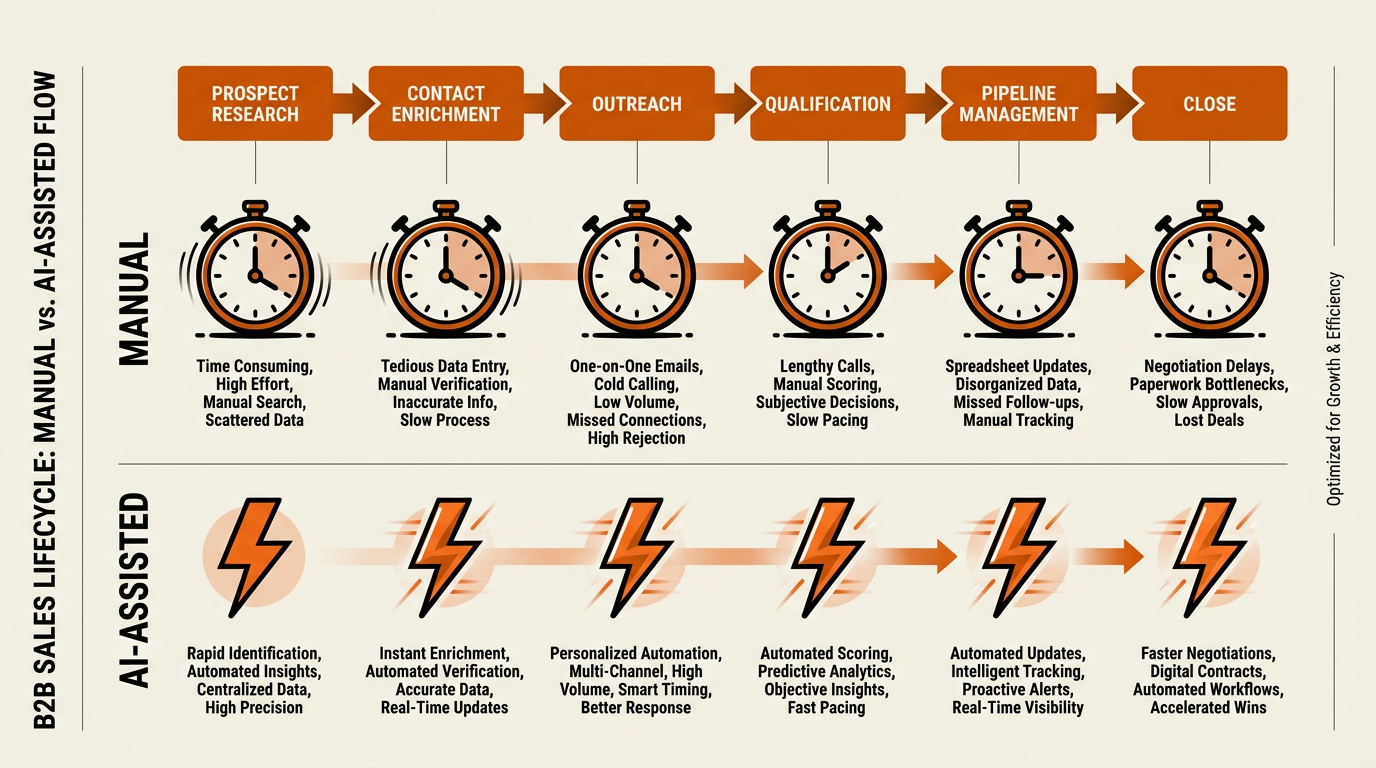
At every stage of the B2B sales lifecycle, AI-assisted workflows dramatically cut time-to-action versus manual effort.
Sales Intelligence and Enrichment: The Foundation of Efficiency
A common misstep: teams buy sales engagement first (sequencers, dialers, schedulers) and treat data as something they will clean up later. That order is backwards. A polished sequence sent to the wrong person at the wrong company, using an old email address, does not create pipeline. It creates bounces, spam complaints, and reps who stop trusting the system.
Sales intelligence and lead enrichment are the infrastructure work most teams would rather skip, but it is what makes everything downstream behave. Contact enrichment automatically appends verified work emails, phone numbers, job titles, and seniority to prospect records. Company enrichment fills in firmographic and technographic context: revenue range, employee count, industry classification, technology stack, and funding history. Put together, reps get enough context to personalize and enough confidence that the message will actually land. If you are building this from scratch, a step-by-step lead enrichment guide can help you set up the workflow without creating new data debt.
Strong enrichment systems rely on a waterfall: query multiple data providers in sequence and fall back when the first source comes up empty. Coverage goes up fast compared to betting on a single database. Platforms like Bitscale pair that waterfall enrichment with AI prospect research, so list building and enrichment happen in one workflow instead of being spread across five tools and a spreadsheet.
Buying Signals That Actually Drive Prioritization
Enrichment tells you who to contact. Buying signals tell you when it is worth the rep's attention. An account that just raised a Series B, posted three SDR openings, and installed a competitor last month is not the same conversation as a cold logo with no movement. Modern sales intelligence platforms track intent across hiring activity, technographic changes, funding events, web engagement, and content consumption, then score accounts by purchase readiness. To understand buying signals more clearly, it helps to group them by type: behavioral, firmographic, and technographic.
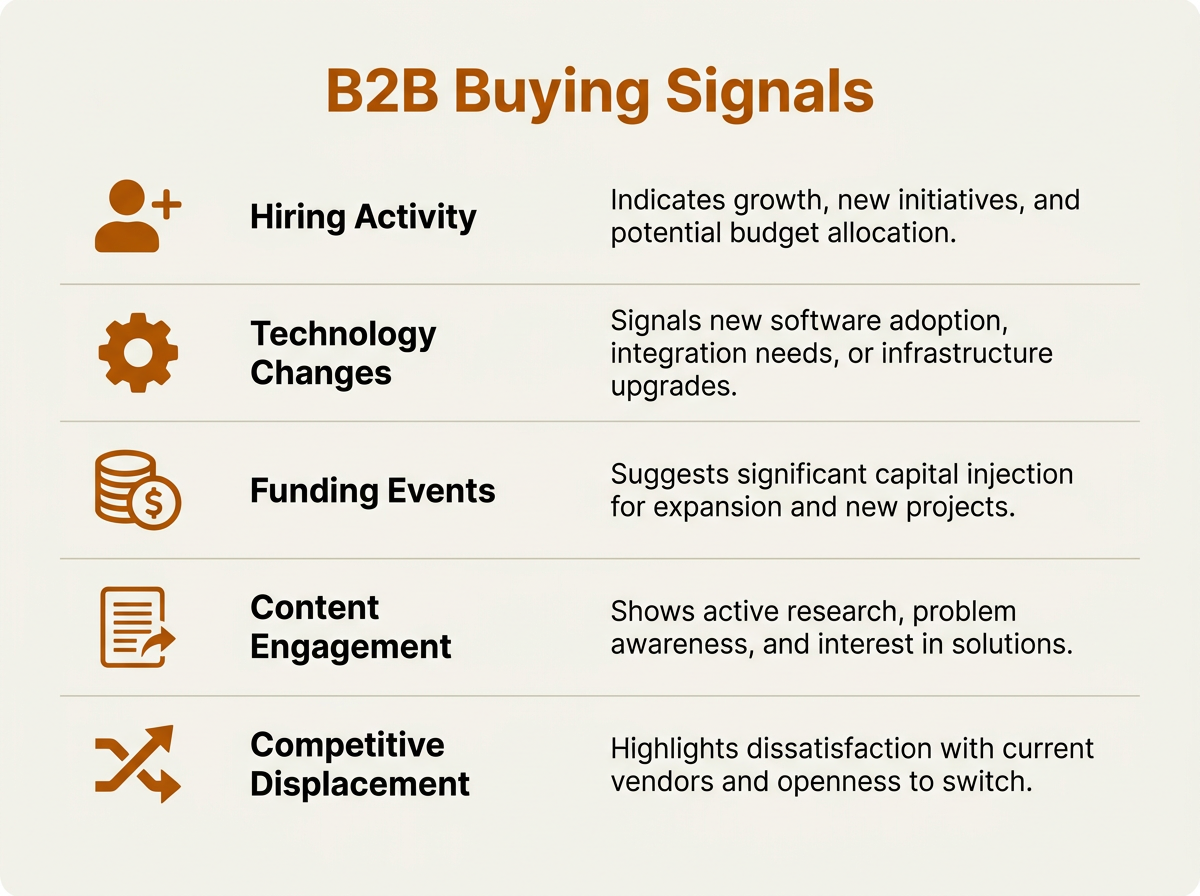
Combining multiple signal types produces more reliable prioritization than any single indicator.
CRM Automation and Workflow Automation That Sticks
CRM automation is where revenue teams tend to burn goodwill. Every org has tried some version of "we're keeping Salesforce clean this quarter." It usually holds for a few weeks, then reality wins. The issue is not rep discipline. Manual CRM hygiene asks sellers to do work that does not help them in the moment. They update a field so someone else can run a report, which is a tough ask when quota is looming.
The practical fix is to stop relying on humans for data plumbing. With bi-directional CRM sync, enriched prospect data flows into your CRM automatically, and CRM changes flow back to your sales tools without anyone copying and pasting. Book a meeting, the record updates. Enrichment finds a new phone number, it writes to the contact. The "I'll update it later" bucket disappears because there is nothing left to remember.
Workflow automation takes the same idea beyond CRM and applies it to the weekly grind your team repeats: pull new signups, enrich them, score them, route qualified leads, then trigger outreach. Those steps do not need to live in five different tabs. They can run as one triggered workflow. Bitscale provides ready-made sales workflows that chain list building, enrichment, scoring, CRM sync, and outbound tool integrations into repeatable processes. If you want to start with ABM, implementing workflow automation is a solid entry point.
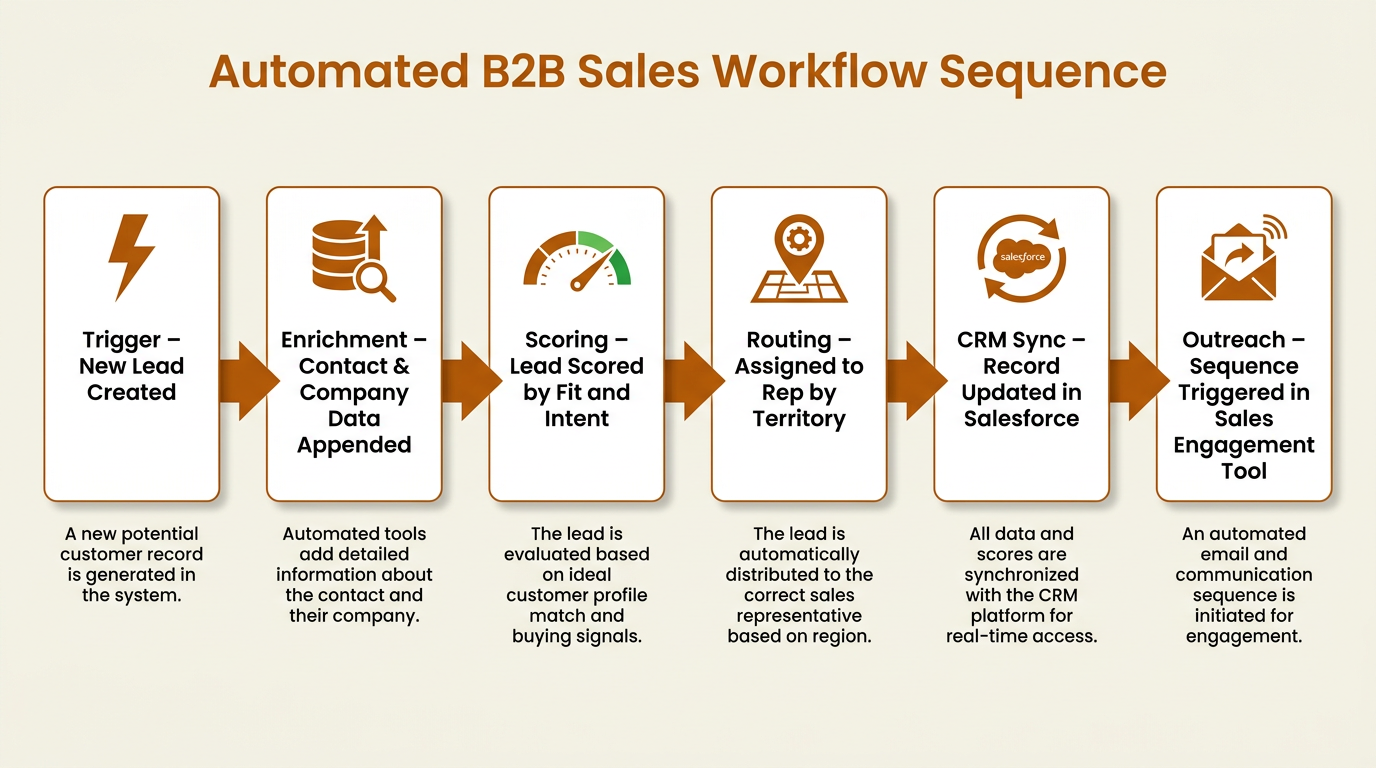
End-to-end automation eliminates handoff gaps where leads go stale — no manual steps required.
Common Productivity Challenges and Modern Solutions
Not every efficiency issue calls for another tool. Some problems are process design. Others are the result of too many point solutions that never got stitched together. Here is how the most common productivity drains map to their root causes and the fixes that actually change day-to-day rep behavior.
| Challenge | Root Cause | Modern Solution |
|---|---|---|
| Reps spend hours researching prospects | No centralized intelligence layer | AI prospect research that aggregates firmographic, technographic, and intent data in one view |
| High email bounce rates | Stale or unverified contact data | Multi-provider enrichment waterfall with real-time verification |
| Leads sit unworked for days | Manual routing and unclear ownership rules | Automated lead routing based on territory, fit score, and rep capacity |
| CRM data is incomplete or outdated | Reps responsible for manual data entry | Bi-directional CRM sync that writes enriched data automatically |
| Pipeline reviews are based on gut feel | No standardized deal health metrics | AI-scored pipeline with flags for stalled deals and missing next steps |
| Marketing and sales misaligned on lead quality | No shared definitions or data model | RevOps-driven lead scoring with unified data across teams |
| Too many tools, too many tabs | Point solutions acquired piecemeal over time | Consolidated GTM platform that handles enrichment, signals, workflows, and CRM sync |
| Most productivity challenges trace back to fragmented data or manual handoffs between systems. |
Revenue Operations: Aligning Teams for Sales Efficiency
Revenue operations (RevOps) is the operating model that lets automation scale without turning into chaos. Without it, sales ops optimizes for pipeline velocity, marketing ops chases MQL volume, and customer success ops focuses on retention, all with different tools, different data, and different definitions. Organizations that align sales, marketing, and customer success through a RevOps operating model often achieve stronger operational coordination, cleaner data, more consistent forecasting, and more efficient revenue execution.
RevOps is not just an org chart choice. It is a data architecture choice. When sales, marketing, and CS work from the same source of truth for account data, enrichment, and engagement history, you cut the reconciliation work that eats analyst time and produces dueling dashboards. If you are evaluating your stack, exploring the best RevOps tools available is a practical way to spot gaps and overlaps.
| Revenue Team | Biggest Time Sink | Automation Opportunity | Expected Outcome |
|---|---|---|---|
| SDRs / BDRs | Manual prospect research and list building | AI-powered list generation with auto-enrichment | More outreach volume with higher personalization |
| Account Executives | CRM updates and pipeline admin | Bi-directional CRM sync and AI deal scoring | More time in discovery calls and negotiations |
| Sales Managers | Manual pipeline reviews and forecasting | Automated deal health dashboards | Faster coaching cycles and more accurate forecasts |
| Marketing Ops | Lead scoring and handoff processes | Unified scoring models with shared enrichment data | Higher-quality MQLs and smoother handoffs |
| RevOps / Sales Ops | Data cleaning and tool integration maintenance | Consolidated GTM platform with native integrations | Fewer tools to manage, cleaner data, faster reporting |
| Each team has distinct productivity bottlenecks, but the solutions share a common thread: better data and fewer manual steps. |
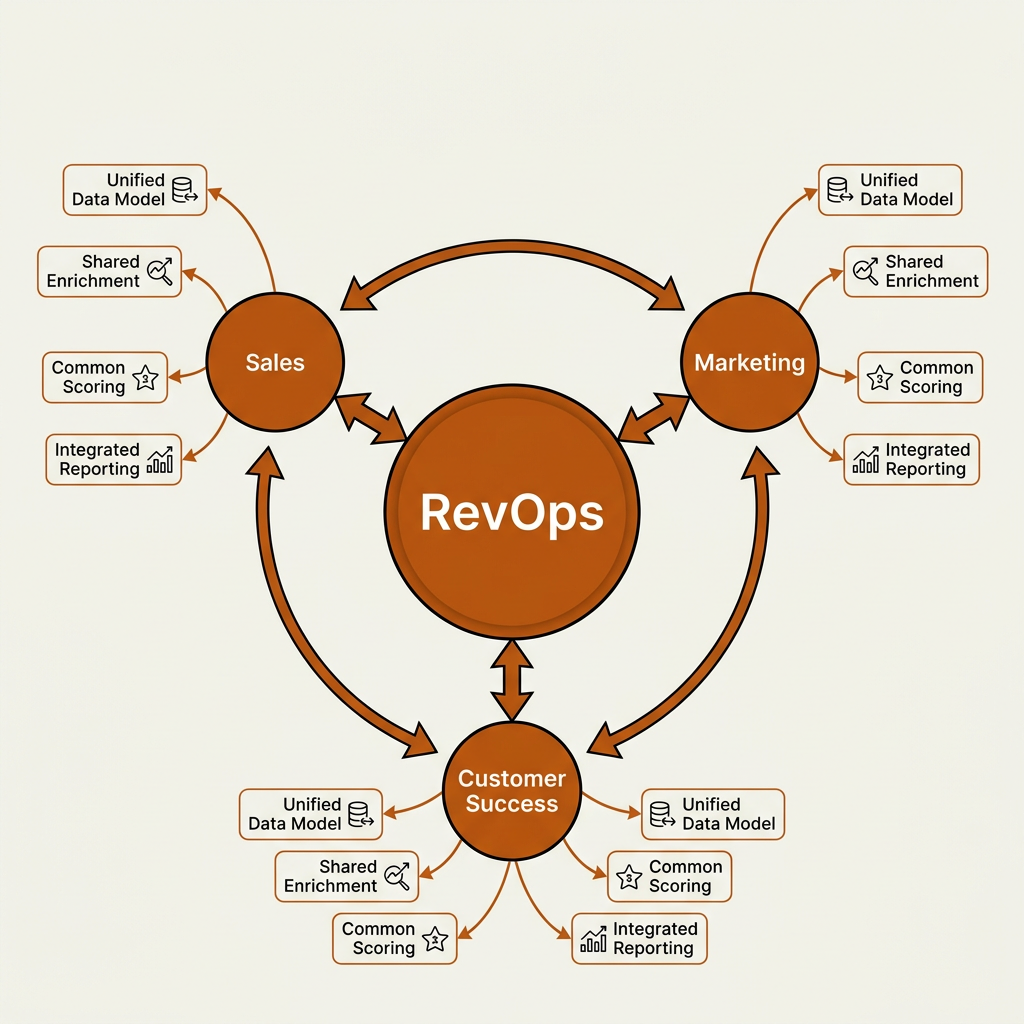
RevOps creates a shared data infrastructure that eliminates silos across every revenue function.
Implementation: Where to Start and What to Avoid
Many organizations report that AI reduces repetitive administrative work across the sales cycle. The greatest business value, however, comes when the time saved is intentionally redirected toward customer-facing activities such as prospecting, discovery calls, account planning, and relationship building. The tech does its job; the rollout is where teams stumble. Use the sequence below to introduce sales automation in a way that sticks, without turning "time saved" into time wasted.
A Practical Starting Sequence
- Start with enrichment, not engagement. Fix the data before you accelerate outreach. Sending more emails to bad addresses only scales your bounce rate.
- Audit your current stack honestly. Most teams end up with 3 to 5 overlapping tools. Consolidating to a platform like Bitscale's Sales Intelligence solution that covers enrichment, signals, research, and CRM sync cuts integration overhead and reduces data fragmentation.
- Automate one workflow end-to-end before expanding. Pick the highest-volume, most repetitive process (often new lead enrichment and routing) and automate it completely. Validate the impact, then widen the scope.
- Define what reps should do with saved time. If each rep recovers several hours a week but there is no expectation to spend that time on more discovery calls or strategic account planning, the gain leaks into busywork and idle time.
- Measure inputs, not just outputs. Track enriched leads worked, response rates by signal type, and time-to-first-touch, not only closed revenue. Those leading indicators show whether automation is changing behavior.
Common Mistakes That Kill Adoption
Most rollouts fail for organizational reasons, not technical ones. A team buys a powerful platform, pilots it with two enthusiastic reps, declares victory, then pushes it to 50 reps who never asked for it. Adoption drops off within a month. Another common mistake is automating a broken process. If your lead routing logic is wrong, automation just delivers the wrong leads faster. Fix the rules first, then automate. Finally, avoid over-engineering before you have volume. A five-step enrichment waterfall with custom scoring is hard to justify if you are only processing 200 leads a month. Start with the minimum that works, then add complexity when the data supports it.
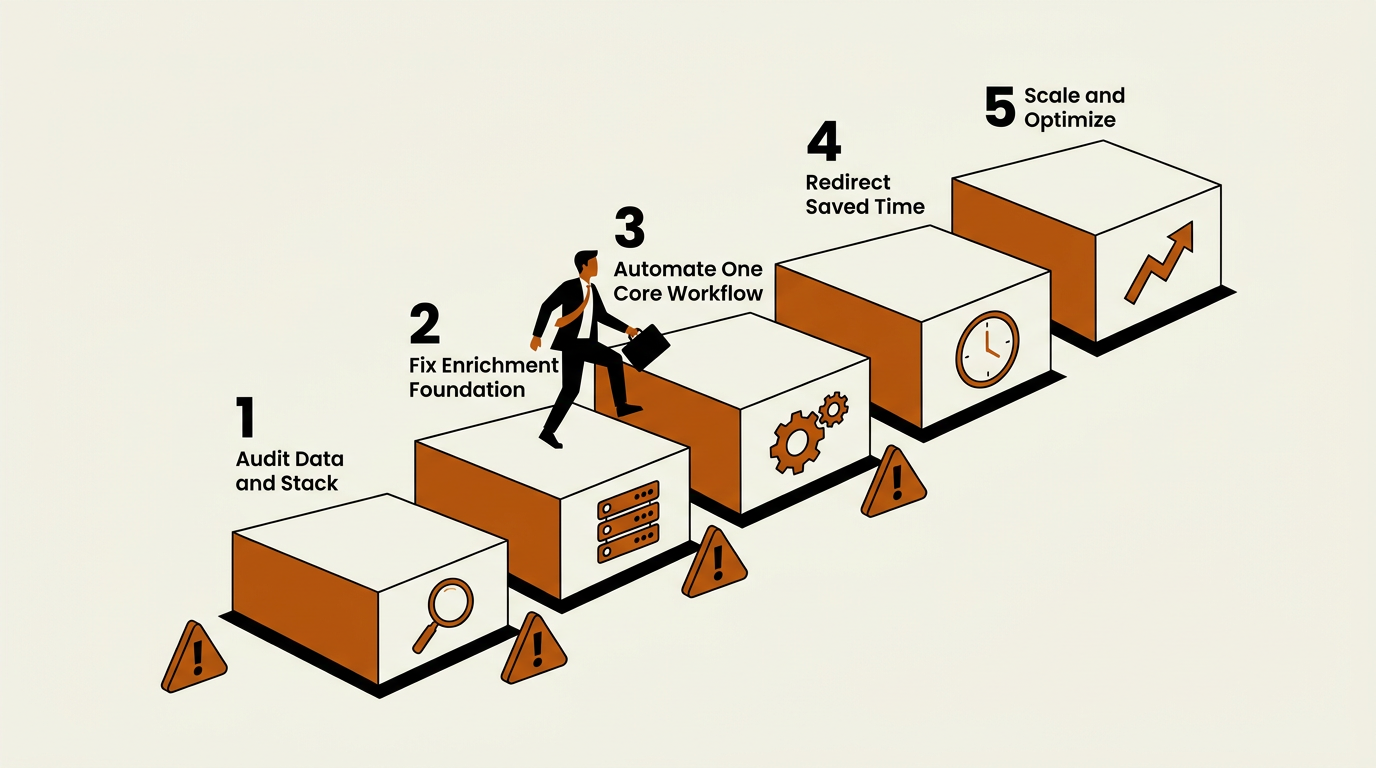
A phased staircase approach helps revenue teams avoid the most common automation adoption failures.
Choosing a Platform: What to Look For
B2B sales tech is crowded for a reason: Apollo.io, Clay, Lusha, Cognism, and Instantly.ai each cover a real slice of the workflow. The problem is that most tools live in one layer: data, enrichment, sequencing, or intent. Productivity gains compound when those layers are connected. Enrichment that feeds scoring, scoring that triggers routing, routing that launches a sequence, and everything logging back to CRM without manual handoffs produces a very different outcome than five disconnected point solutions.
Bitscale is built around that connected model as a unified GTM platform. It brings together B2B lead and account list building, contact and company enrichment (including work email and phone lookup), AI prospect research, intent and buying signals, ready-made sales workflows, CRM sync, and outbound tool integrations in one system. The pitch is not that any single feature is magical. It is that the integration removes the manual glue work that drains ops hours and creates data gaps. When comparing top AI platforms for B2B sales, focus less on which tool wins a feature checklist and more on which platform removes the most steps between "identify a prospect" and "start a conversation."
Key Takeaways
B2B sales productivity improves when manual work is designed out of the sales lifecycle, not when reps are told to manage their time harder. The biggest automation wins tend to come from prospect research, contact and company enrichment, CRM synchronization, lead routing, and workflow orchestration. Buying signals turn prioritization into a data problem instead of a guessing game. RevOps alignment makes those gains stack across sales, marketing, and customer success instead of creating new silos and new cleanup work.
Your next steps:
- Audit how reps actually spend their week and identify the top three manual tasks by hours consumed.
- Pressure-test your data foundation (enrichment coverage, contact accuracy, CRM completeness) before you automate anything downstream.
- Pilot one end-to-end automated workflow, measure the impact, and expand from there.
- Explore how a consolidated platform like Bitscale can replace fragmented point solutions with a unified GTM system.
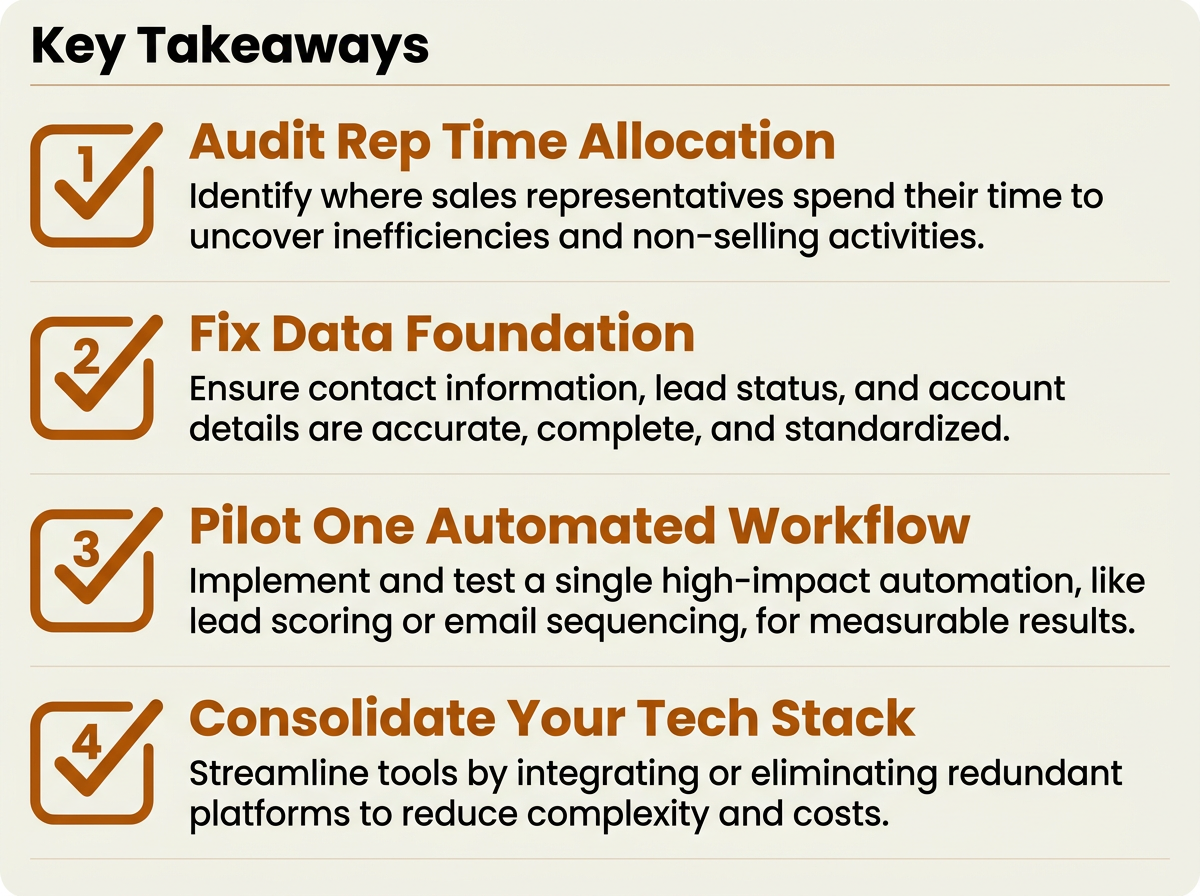
Four foundational steps to improving B2B sales productivity — sequence matters more than speed.
Frequently Asked Questions
What is B2B sales productivity, and how is it different from general productivity?
B2B sales productivity is a measure of how efficiently a revenue team turns selling time and resources into pipeline and closed revenue. General productivity advice tends to focus on personal habits. Sales productivity work targets the structural friction in the sales cycle: manual research, data entry, lead routing, and a fragmented tool stack. The goal is simple: increase the share of rep time spent in high-value selling motions.
How does sales automation differ from sales engagement?
Sales automation is the broader effort to remove manual steps across the full sales process, including enrichment, CRM sync, lead routing, and data management. Sales engagement is the communication layer: email sequences, call cadences, and social touches. Automation is the infrastructure; engagement is one workflow that runs on top of it. If you automate engagement before fixing the underlying data, you just ship inaccurate outreach faster.
What are the first steps to improving sales efficiency with AI?
Start with a time audit: where are reps spending hours that do not involve buyers? The usual culprits are prospect research and CRM updates. Fix the data foundation next with automated enrichment, then layer in AI for scoring, routing, and outreach. Platforms like Bitscale support that order by letting teams build enrichment and research workflows first, then expand into signals and CRM automation as they prove value.
How do buying signals improve sales prioritization?
Buying signals (hiring activity, technology changes, funding events, content engagement) are indicators that an account is in-market or moving toward a purchase decision. When you score accounts using those signals, reps spend their time on prospects with a higher likelihood of converting instead of working lists alphabetically or by recency. It is one of the cleanest ways to improve efficiency without adding headcount.
Can small sales teams benefit from RevOps and workflow automation?
Yes. RevOps basics (shared data, unified definitions, cross-functional alignment) matter at any size. Smaller sales teams often benefit disproportionately from workflow automation because it allows them to handle more prospecting, enrichment, CRM management, and follow-up activity without adding equivalent administrative effort. Ready-made workflow templates, like those available in Bitscale, reduce setup effort so small teams can get moving without a dedicated ops hire. For more on the broader B2B prospecting process, Bitscale's blog covers tactical approaches.

Sanket
CEO | Co-Founder Bitscale


Sanket is the CEO and Co-Founder of Bitscale. He leads company vision and strategy, building the future of AI-driven sales intelligence for modern B2B teams. Sanket is obsessed with the intersection of AI and go-to-market, and has spent years studying how the best B2B companies find, engage, and convert customers at scale. He writes about company building, product strategy, and where AI is taking the sales industry.
Read other blogs
All Blogs
12 Best CRM Sync Tools for Revenue Teams in 2026
Compare 12 CRM sync tools for Salesforce and HubSpot, including enrichment, reverse ETL, and automation options for cleaner revenue data.
Sales Data Enrichment: A Buyer's Guide for Modern B2B Teams
Sales data enrichment helps B2B teams improve CRM records, routing, prospecting, and account prioritization. Compare workflows, costs, and vendor fit today.

What Is AI Prospect Qualification? A Practical Guide for Modern Revenue Teams
AI prospect qualification helps revenue teams enrich data, assess ICP fit, prioritize buying signals, and route the right accounts into CRM workflows.