The Modern B2B Sales Playbook: Data, Prospecting, and Automation
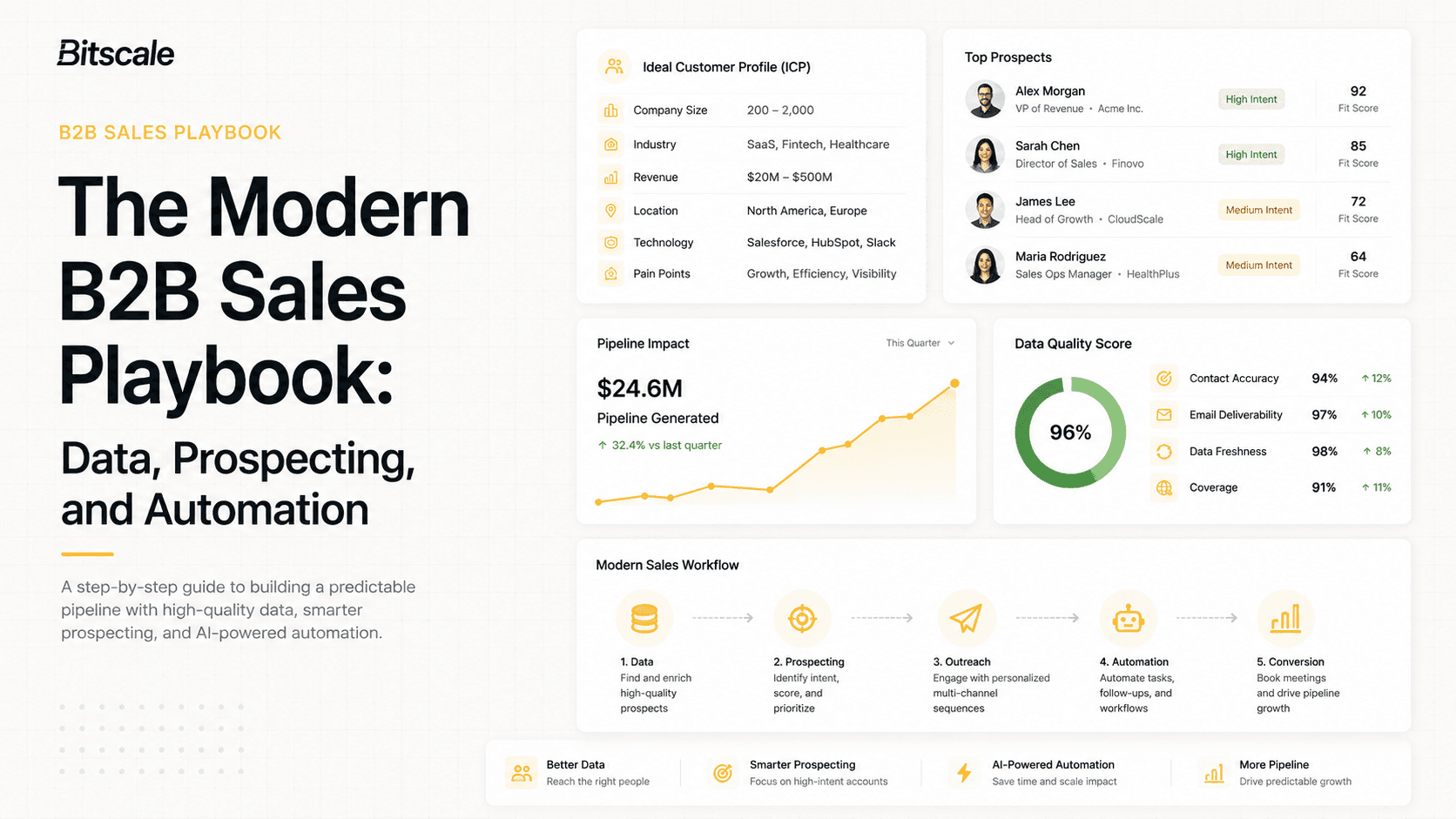
Table of Contents
Explore Bitscale
Find decision makers, more insights and contact information about this company on Bitscale
B2B sales has been rewritten in the last three years in a way the prior decade never managed. Buyers do their homework before they ever take a call, committees keep getting bigger, and the flood of account data has made spray-and-pray prospecting a fast way to burn budget. McKinsey reports that roughly two-thirds of B2B buyers now prefer remote or digital self-service interactions over traditional face-to-face meetings. The teams pulling away are the ones treating data quality, workflow design, and automation as front-line advantages, not back-office housekeeping.
This playbook lays out the modern B2B sales motion end to end, from process fundamentals to automation patterns that hold up in the real world. If you are running a five-person SDR pod at a SaaS startup or owning pipeline ops for a mid-market services firm, the goal is the same: repeatable execution you can measure and improve. Here is the roadmap.
Sections in this guide:
- The B2B Sales Process, Deconstructed, stages, cycle length, and why formalization matters.
- Building a B2B Sales Strategy That Scales. ICP definition, channel mix, and qualification.
- Prospecting in the Data Era, list building, enrichment, and intent signals.
- Pipeline Management and the B2B Sales Funnel, metrics, stage hygiene, and forecasting.
- Automation That Actually Works, where to automate, what to keep human, and tool selection.
- Advanced Plays, multi-threading, signal-based sequencing, and common mistakes.
- FAQ, five questions sales leaders ask most often.
The B2B Sales Process, Deconstructed
A B2B sales process is the repeatable path a seller uses to move a prospect from first touch to closed-won. Organizations with a documented sales process are generally better positioned to onboard new reps, identify bottlenecks, improve forecast accuracy, and create consistent customer experiences. And yet plenty of orgs still run on tribal knowledge, with every rep freelancing their own version of the motion. That holds up right until you need to onboard quickly, find where deals are leaking, or forecast without squinting.
Most B2B sales cycles land somewhere between 60 and 120 days (Highspot, 2026), while enterprise deals with six-figure contracts routinely push past six months. Knowing your cycle length is not a dashboard vanity metric. It dictates how far ahead you need to prospect, when marketing programs should peak, and how hard you can press on discounting if you are trying to pull deals into quarter end.
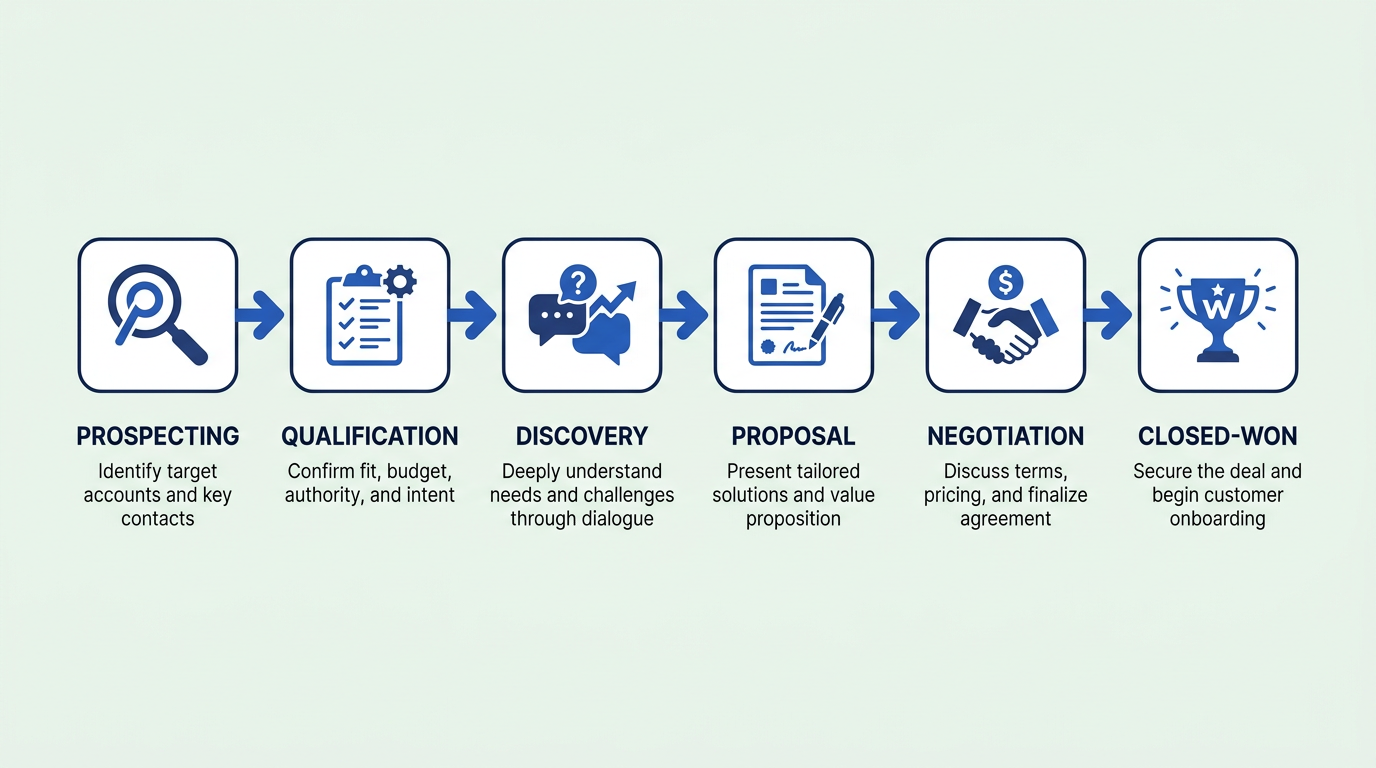
Most B2B sales motions sit in one of two buckets: inbound-led (marketing creates interest, sales qualifies and converts) and outbound-led (reps proactively work a target account list). The strong teams blend the two: inbound captures existing demand, outbound manufactures demand inside the ICP you actually want. If you want a more detailed mapping of funnel stages to real buyer behavior, this sales funnel explained guide is a useful reference.
Building a B2B Sales Strategy That Scales
Strategy sits above process. Your B2B sales strategy is the set of choices that defines who you sell to, how you reach them, and why they should care. Skip that work and even a beautifully documented process just accelerates the wrong accounts through your pipeline.
Defining Your Ideal Customer Profile
Start with the customers you would happily clone. Pull the firmographics (industry, headcount, revenue, geography), then layer in behavior: which accounts onboarded fastest, expanded the most, and churned the least? Where those overlap, you have the beginnings of an ICP you can defend with data. SaaS teams often slice by company size and tech stack; services firms tend to anchor on vertical fit and deal complexity. The tighter the ICP, the less time reps spend chasing accounts that were never going to close.
Qualification Frameworks
BANT (Budget, Authority, Need, Timeline) is the classic, but many modern teams lean on MEDDIC or SPICED because they better reflect how B2B buying actually works today. Buyers increasingly complete much of their research independently before speaking with sales, while purchasing decisions often require alignment across multiple stakeholders. A strong qualification framework forces rigor early: map the buying committee, identify the economic buyer, and surface blockers before they harden into late-stage "no decision."
Channel mix belongs in the strategy layer, too. If you want a broader view of how teams balance product-led and sales-led motions, this complete GTM strategy breakdown is worth keeping handy.
Prospecting in the Data Era
Prospecting is where pipeline quality usually gets decided. Target the wrong accounts and you are dead on arrival. Work from stale contact data and you will tank deliverability and waste dials. Default to generic messaging and you will sound like everyone else. Modern prospecting fixes those issues by treating data as an input you actively manage, not a spreadsheet you import once and forget.
List Building and Contact Enrichment
The old workflow looked like this: buy a static list from a broker, dump it into the CRM, and hope half the emails still land. The newer workflow is dynamic by design: build lists that stay filtered to your ICP, then enrich each record with verified work emails, direct dials, technographics, and recent company events. Apollo.io and Cognism helped popularize this model; Bitscale pushes it further by pairing data enrichment solutions with ready-made prospecting workflows so teams are not hand-assembling a pipeline out of disconnected tools.
Enrichment also cannot be a one-and-done task. People change jobs, companies get acquired, and phone numbers rot. High-performing teams run enrichment on a schedule, then flag records that fall below a confidence threshold so reps are not working off fiction. If you are sorting out what to refresh and when, the difference between intent data, enrichment, and sales signals is more than semantics.
Intent Signals and Buying Triggers
Your ICP tells you who is a fit; intent tells you who is a fit right now. Signals can come from website visits, content downloads, G2 category research, job postings for relevant roles, or technographic changes like adopting a competitor. When a VP of Revenue Operations at a 200-person SaaS company starts researching "sales automation platforms" on review sites, that is a cue to move fast. Waiting weeks turns a warm signal into background noise. For a clean taxonomy of what counts, this piece on understanding B2B buying signals lays it out.
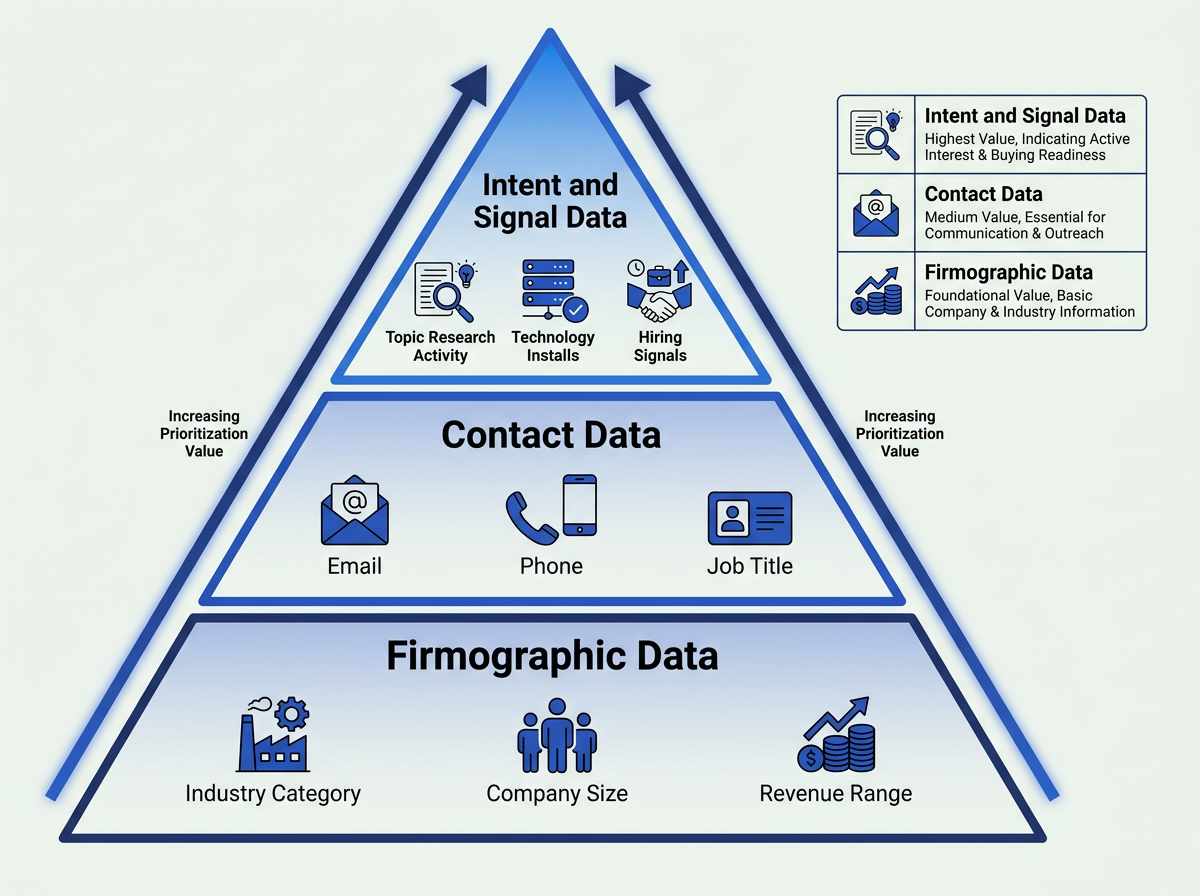
Teams leaning on AI for prospect research are seeing meaningful time savings in list building, which is the point: less time assembling inputs, more time in conversations that create pipeline.
Pipeline Management and the B2B Sales Funnel
A B2B sales funnel is the model for how prospects move from awareness to purchase. By the time an opportunity hits the decision stage, buyers typically pull in 6 to 10 decision-makers, each with their own priorities (Outreach.io, 2025). That is why pipeline management is not just about pushing deals forward. It is about coordinating consensus across a committee that does not share a single definition of value.
| Metric | What It Measures | Why It Matters |
|---|---|---|
| Win Rate | Share of qualified opportunities that close | Shows rep effectiveness and how well you are qualifying deals |
| Average Deal Size | Average revenue per closed-won deal | Shapes headcount plans and quota math |
| Sales Velocity | Revenue generated per day across the pipeline | Rolls win rate, deal size, cycle length, and volume into a single number |
| Stage Conversion Rate | Drop-off between funnel stages | Highlights where deals stall so you can address the underlying cause |
| Pipeline Coverage Ratio | Total pipeline value divided by quota | Signals whether you have enough opportunities to hit the target |
| Tracking these five metrics weekly gives sales leaders early warning on pipeline health. |
A common operational mistake is treating the funnel like a straight line. Real deals double back. A champion leaves, a new stakeholder shows up, budget gets reshuffled. Your CRM stages need to allow backward movement, and your forecast should penalize deals that regress. Accurate forecasting usually comes down to one habit: being honest about stage regression instead of letting optimism stand in for evidence.
Automation That Actually Works
Automation in B2B sales should not be framed as replacing reps. It is about stripping out low-value work that can swallow 60%+ of a seller's week: data entry, list cleanup, follow-up scheduling, CRM updates, lead routing. Put that on rails and you buy back hours for discovery calls and the relationship work that actually moves deals.
Where to Automate (and Where Not To)
High-value automation targets:
- Lead enrichment on ingest, new leads from forms or imports get enriched with firmographic, technographic, and contact data before a rep ever sees them.
- Sequence enrollment, prospects matching specific criteria are automatically added to the right outbound cadence.
- CRM field updates, deal stage, last activity date, and engagement scores update without manual logging.
- Meeting routing, inbound demo requests route to the correct rep based on territory, segment, or round-robin rules.
- Stale deal alerts, deals with no activity for X days trigger a Slack notification or manager task.
Keep humans in the loop for discovery, negotiation, and any moment where the buyer expects someone to listen, diagnose, and adapt in real time. Let automation do the plumbing; let reps do the persuasion. Clay and Instantly.ai each cover slices of the workflow (enrichment and cold email, respectively). Bitscale bundles enrichment, list building, and workflow orchestration into ready-made playbooks so teams are not duct-taping five tools together with Zapier and praying the integrations keep holding.
If you want a step-by-step look at automated GTM motions for SaaS, the GTM Automation Playbook gets into tool stacks, sequencing logic, and the failure modes teams run into when they scale.
The Cost of Poor Data Quality
Most sales playbooks rush past this part, even though it is where a lot of performance quietly dies. Bad data does not just create bounced emails. It contaminates everything downstream. Reps burn cycles calling wrong numbers. Sequences keep hitting people who left months ago. Pipeline reporting gets inflated because duplicates create phantom opportunities. Territory rules break when firmographic fields are inconsistent.
A technology company we spoke with found that 30% of their CRM contacts had outdated job titles after just 12 months. Outbound reply rates had cratered, and it was not because the team suddenly forgot how to write. The problem was decay. The fix was not a heroic cleanup sprint, but a recurring enrichment workflow that validated records monthly and flagged changes for rep review.
Fragmented workflows make the damage worse. When enrichment lives in one tool, sequencing in another, and CRM sync depends on a third integration, data gets dropped in the handoffs. Fields map wrong, updates lag, and nobody can point to a single source of truth. Collapsing those steps into a unified platform, whether that is Bitscale or a comparable stack, shrinks the surface area where errors creep in.
Advanced Plays: Multi-Threading, Signal Sequencing, and Common Mistakes
Once the basics are handled (clean data, a defined process, and automation that runs reliably), you can start running the plays that separate competent teams from consistently high-performing ones.
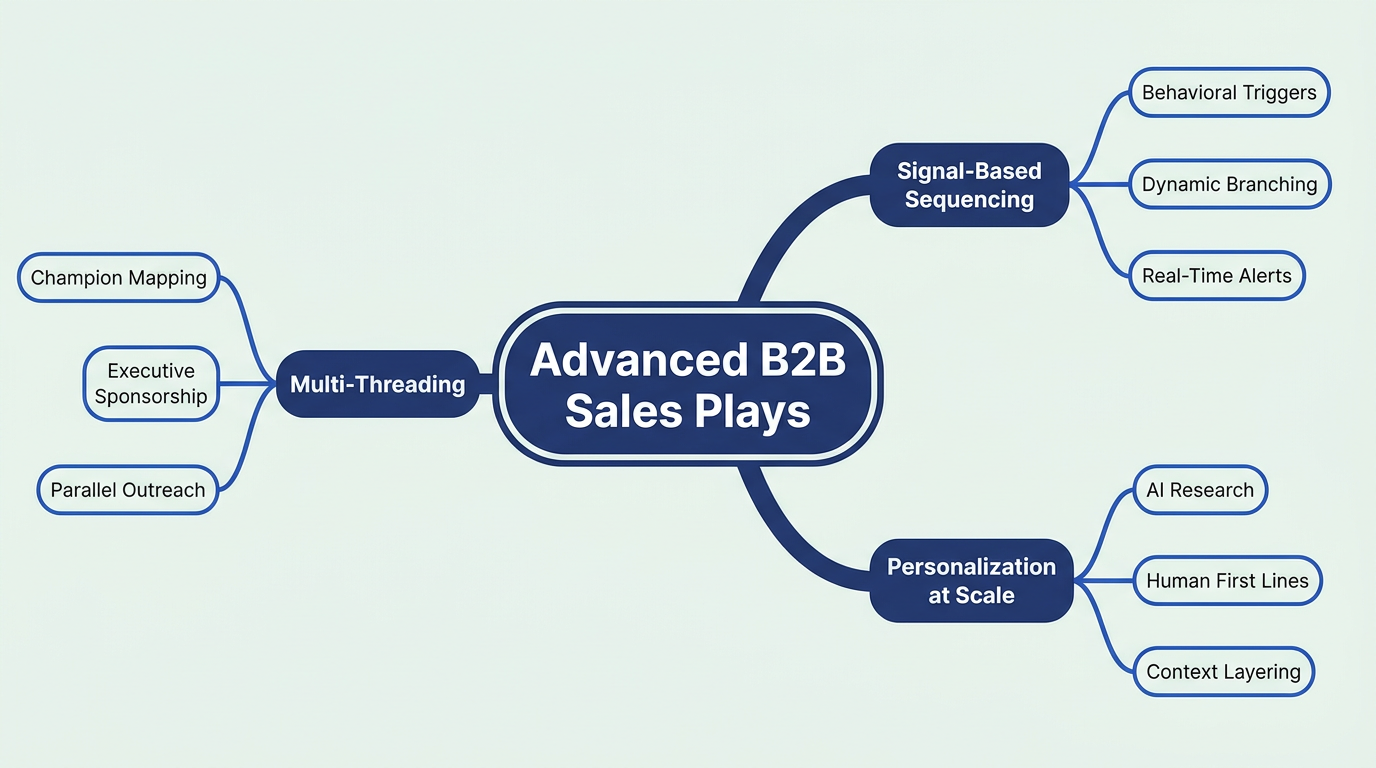
Multi-threading is building relationships with multiple stakeholders in the same account at the same time. Single-threaded deals are brittle: if your one contact leaves or gets overruled, the opportunity usually dies with them. Multi-threaded deals close at significantly higher rates because you are building alignment across the committee, not betting on a single champion. This ABM workflow automation guide breaks down how mid-market teams operationalize that approach with account-based plays.
Signal-based sequencing swaps one-size-fits-all cadences for sequences that branch based on behavior. Rather than sending the same five emails to everyone, you change the next step based on what the prospect did: opened email two but did not reply, send a case study; visited the pricing page, trigger a direct-dial task. It does require tight integration between enrichment, sequencing, and the CRM, but the lift in reply rates is usually worth the setup.
What most teams get wrong: they automate the part that should stay human. Dropping {{first_name}} and {{company}} into a template is not personalization, it is mail merge. Calling out a specific initiative the company announced last quarter is personalization. The best setups use automation to surface context (recent funding, new hires, tech stack changes), then let the rep write the first line themselves. That combination of machine speed and human relevance is where outbound starts working again.
Key Takeaways and Next Steps
Modern B2B sales is a systems problem. The teams driving the most revenue per rep are not always the ones with the flashiest closers. They are the ones with clean data, disciplined process, and automation that makes good habits the default. Takeaways:
- Formalize your B2B sales process and measure stage conversion rates weekly. Consistent processes make onboarding easier, improve forecasting accuracy, and help revenue teams identify bottlenecks before they impact pipeline.
- Build your ICP from actual customer data, not assumptions. Overlay intent signals to prioritize accounts showing active buying behavior.
- Treat data quality as an ongoing discipline, not a quarterly cleanup project. Recurring enrichment prevents the slow decay that kills outbound performance.
- Automate data entry, lead routing, and CRM hygiene. Protect rep time for discovery, negotiation, and relationship building.
- Multi-thread every deal above your average contract value. Single-threaded deals are fragile.
- Invest in a unified workflow layer (like Bitscale's Playbooks) that connects enrichment, sequencing, and CRM sync to reduce tool sprawl.
Buying committees are not shrinking, and buyers are not going back to a world where they need a rep for basic information. The sales motions that keep winning will be the ones built on accurate data, repeatable workflows, and automation that strengthens human judgment instead of trying to replace it.
Frequently Asked Questions
What is the typical length of a B2B sales cycle?
Most B2B sales cycles run 60 to 120 days (Highspot, 2026). Enterprise deals with larger contract values and more stakeholders often stretch beyond six months. Track cycle length by segment so your forecast reflects reality, not averages that hide the variance.
How many stakeholders usually influence a B2B purchase?
Outreach.io (2025) puts the decision stage at 6 to 10 decision-makers, often with competing priorities. That is exactly why stakeholder mapping and multi-threading matter: you are selling into a committee, not a single inbox.
What is the difference between intent data and enrichment data?
Enrichment data fills in attributes about a contact or company (job title, revenue, tech stack). Intent data captures behavioral signals that suggest active research and near-term buying interest. You need both, but intent is what helps you prioritize timing. For the full comparison, see intent data, enrichment, and sales signals.
What actually improves outbound reply rates?
Start with fundamentals: verified emails and accurate titles so you are not sending to dead addresses or the wrong roles. Then earn relevance by anchoring outreach to specific company events or initiatives. Signal-based sequencing, where cadences branch based on behavior, tends to beat static sequences. Do not confuse mail-merge tokens with personalization.
When is it worth investing in sales automation?
Once you have a repeatable process and at least two to three reps, automation tends to show clear ROI. Begin with CRM hygiene (auto-updating fields, deduplication) and lead enrichment on ingest. As you scale, add sequence enrollment, meeting routing, and stale deal alerts. The objective is to give reps more selling time, not to automate the selling itself.

Sanket
CEO | Co-Founder Bitscale


Sanket is the CEO and Co-Founder of Bitscale. He leads company vision and strategy, building the future of AI-driven sales intelligence for modern B2B teams. Sanket is obsessed with the intersection of AI and go-to-market, and has spent years studying how the best B2B companies find, engage, and convert customers at scale. He writes about company building, product strategy, and where AI is taking the sales industry.
Read other blogs
All Blogs
12 Best CRM Sync Tools for Revenue Teams in 2026
Compare 12 CRM sync tools for Salesforce and HubSpot, including enrichment, reverse ETL, and automation options for cleaner revenue data.
Sales Data Enrichment: A Buyer's Guide for Modern B2B Teams
Sales data enrichment helps B2B teams improve CRM records, routing, prospecting, and account prioritization. Compare workflows, costs, and vendor fit today.
What Is AI Prospect Qualification? A Practical Guide for Modern Revenue Teams
AI prospect qualification helps revenue teams enrich data, assess ICP fit, prioritize buying signals, and route the right accounts into CRM workflows.