B2B Sales Meaning: Definition, Examples, and How It Works
Table of Contents
Explore Bitscale
Find decision makers, more insights and contact information about this company on Bitscale
B2B sales (business-to-business sales) is the work of selling products or services from one company to another. Compared with selling to consumers, B2B selling is aimed at organizations, where purchases usually run through more stakeholders, longer timelines, and bigger contract values.
If you have been searching for the b2b sales meaning because you want something usable, start here. This piece lays out the b2b sales definition, a set of real-world examples, the typical process from first touch to onboarding, and where B2B differs from B2C. If you are brand new to sales or moving into a B2B seat, the goal is simple: give you a mental model you can use on your next prospecting session, call, or pipeline review.
What Is B2B Sales? The Fundamentals
B2B sales, in plain terms, is any commercial transaction where the buyer is a business rather than an individual. A cybersecurity firm selling endpoint protection to a hospital network, a steel manufacturer supplying an automotive plant, a SaaS company licensing CRM software to a marketing agency: all of these count as business to business sales.
The scale is hard to overstate. The B2B eCommerce market alone is projected to reach $36 trillion by 2026 (International Trade Administration, 2026). It outstrips most B2C categories because B2B deals are often larger, repeatable, and funded out of operating budgets instead of personal wallets. The average B2B buying committee involves five people in the decision-making process (EBQ / HubSpot, 2024), which is why consensus-building and multi-threaded outreach show up in every serious B2B motion.
One nuance that gets missed in a lot of basic explainers: B2B sales is not one single playbook. It ranges from transactional, self-serve purchases (a small team grabbing a $50/month tool) to enterprise deals that drag on for a year and need executive sponsorship. The underlying principles stay consistent, but the tactics change fast once you move upmarket.
Real-World B2B Sales Examples
Examples land the idea faster than another definition.
- SaaS subscriptions: Slack sells its collaboration platform to enterprises like IBM. The deal can include IT security reviews, procurement negotiation, and multi-year terms.
- Manufacturing supply chains: A semiconductor company like TSMC produces chips for Apple. Contracts are often set years ahead, with strict quality and volume commitments.
- Professional services: Deloitte runs consulting engagements for Fortune 500 companies. Each engagement is scoped, staffed, and priced through a formal proposal process.
- Wholesale distribution: Sysco supplies food products to restaurant chains. Orders tend to be recurring, relationship-driven, and managed through dedicated account teams.
The common thread is process. These deals usually come with an evaluation period, a formal buying path, and an ROI-first lens rather than an impulse purchase. That is the DNA of B2B selling.
How the B2B Sales Process Works
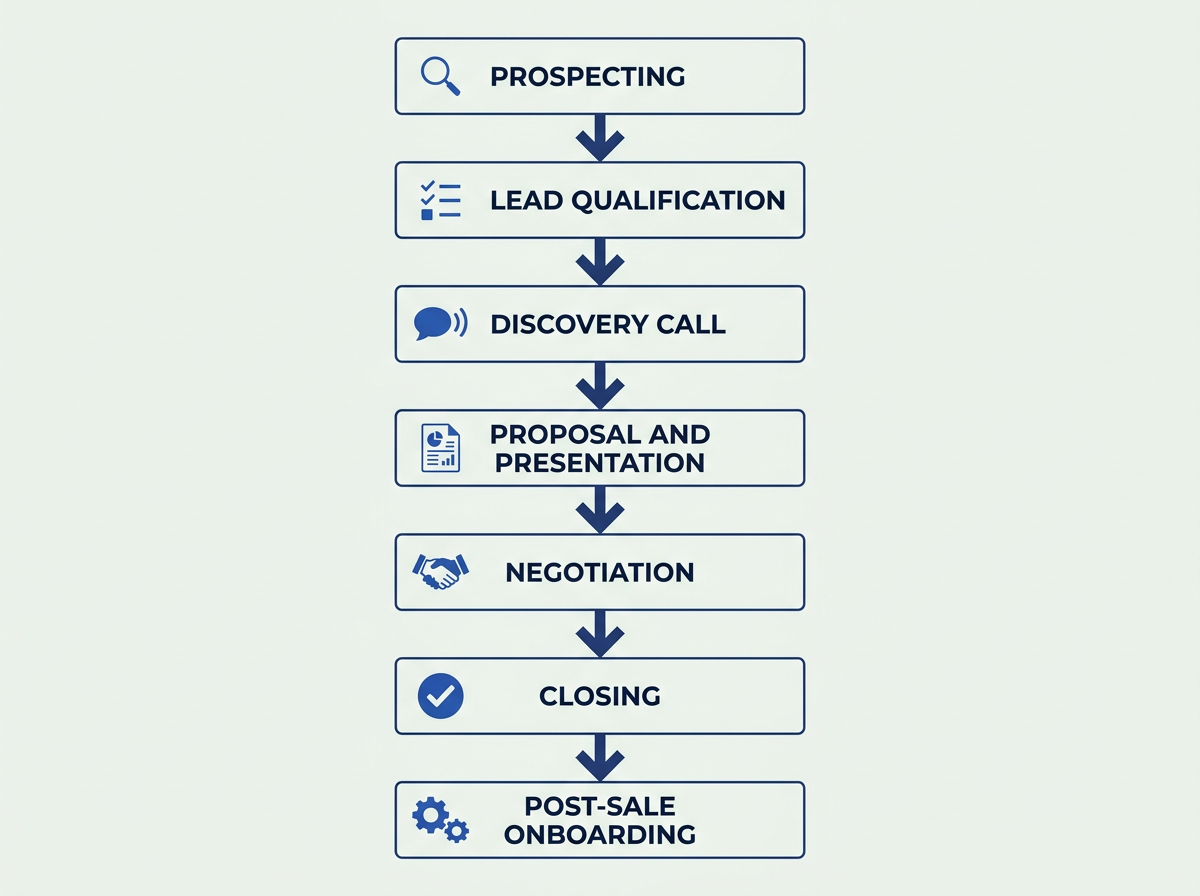
The b2b sales process is rarely a clean straight line, but most deals still move through a familiar set of stages. The average B2B buying cycle was 10 months in 2025, down from 11 months in 2024 (6Sense Buyer Experience Report, 2025). When you can name the stage, you can usually diagnose the problem: where deals get stuck, what information is missing, and which stakeholders are not yet engaged.
Prospecting and Lead Generation
It starts with picking the right accounts, not blasting a list. Prospecting means identifying companies that match your ideal customer profile (ICP) and the people inside those companies who influence or own the decision. Modern teams lean on lead enrichment platforms to append firmographic and technographic data to raw prospect lists, turning a company name into a usable profile: revenue, headcount, tech stack, plus verified contact details. If you are standing up your first outbound motion, exploring the best B2B contact databases is a practical place to begin.
Qualification Through Closing
Once a prospect engages, qualification is where you separate curiosity from an actual deal. You are looking for budget, authority, need, and timeline. Discovery calls then do the real work: unpacking pain points and mapping the buying committee. Proposals should reflect the prospect's specific constraints, and negotiation typically pulls in procurement, legal, and finance on the buyer side. After the contract is signed, onboarding is not a formality; it is how customers hit time-to-value, which feeds retention and expansion revenue. If you want a clearer view of how the stages stack together, the sales funnel explained resource breaks down each layer.
Where Sales Intelligence and Buying Signals Fit
Timing is often the difference between "nice meeting" and pipeline. Sales intelligence tools pull signals like job changes, funding rounds, technology adoption, and content engagement to flag accounts that are actively in-market. Those buying signals tell you when to reach out, not just who to reach out to. By 2025, 80% of all B2B sales interactions are expected to happen on digital platforms (Gauss Development / Gartner, 2025), which makes digital signals more valuable than ever. Teams that wire intent data into CRM workflows can prioritize the right accounts and avoid burning cycles on prospects who are not ready. For more on what to watch and how to use it, see understanding buying signals.
B2B vs B2C Sales: Key Differences
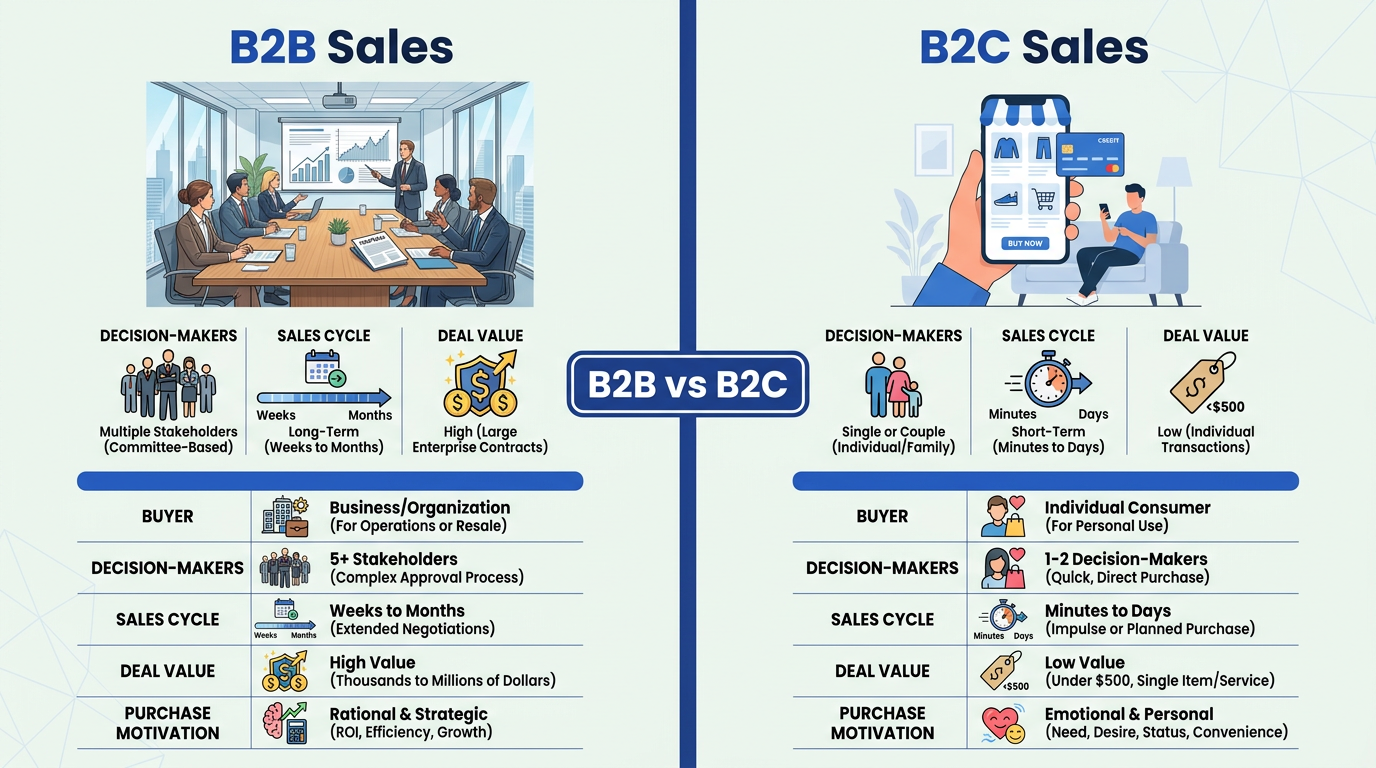
The B2B vs B2C question comes up constantly. The practical difference is that B2B sales usually carry higher transaction values, longer cycles, and more decision-makers (Salesforce, 2026). Here is the clearest side-by-side view.
| Dimension | B2B Sales | B2C Sales |
|---|---|---|
| Buyer | Companies and buying committees | Individual consumers |
| Decision-makers | Average of 5 stakeholders | Usually 1 or 2 people |
| Sales cycle length | Weeks to months (avg. 10 months for complex deals) | Minutes to days |
| Deal value | Thousands to millions of dollars | Typically under $500 |
| Relationship focus | Long-term and account-based | Transactional and brand-driven |
| Purchase motivation | ROI, efficiency, compliance | Personal need, emotion, convenience |
| Sales channels | Direct sales, partnerships, digital platforms | Retail, eCommerce, marketplaces |
| B2B vs B2C sales comparison based on common deal characteristics. |
Building an Effective B2B Sales Stack
Theory does not move pipeline; systems do. A modern B2B sales stack usually starts with a CRM (Salesforce, HubSpot), then adds a sales intelligence layer for research and enrichment, an outbound sequencing tool, and integrations that keep data in sync so reps are not stuck doing manual entry.
Platforms like Bitscale's sales intelligence solution roll lead enrichment, work email and phone lookup, intent signals, and ready-made outbound workflows into one place. The point is straightforward: less time lost to research and admin, more time spent in actual conversations. If you are comparing vendors, this roundup of top sales intelligence tools is a solid reference list.
Once a team has basic outbound working, account-based strategies are the next step up: sales and marketing coordinate around a short list of high-value targets instead of treating every lead as equal. The ABM workflow automation guide covers how mid-market teams put that into practice.
What Most People Get Wrong About B2B Selling
The most persistent myth is that B2B buying is purely rational. Because the buyer is a business, the story goes, the decision is just spreadsheets and ROI math. In reality, committees are made of people, and people carry incentives: career upside, risk tolerance, and the need to protect credibility. Strong B2B sellers speak to the company-level outcome and the individual stakeholder's worries. Skip the human layer and even a technically superior product can lose to a competitor that built more trust.
The other unforced error is treating every lead like it deserves the same effort. Without solid lead enrichment and qualification, reps waste hours on accounts that will never close. Putting data quality first (accurate contact info, firmographic fit, intent signals) compounds later in the funnel. If you are building a prospecting stack, get enrichment and CRM hygiene right before you scale outbound volume.
Key Takeaways
- The b2b sales meaning is simple: selling products or services from one business to another, usually with higher stakes and longer cycles than consumer sales.
- A structured b2b sales process (prospecting, qualification, discovery, proposal, negotiation, close, onboarding) gives teams a repeatable way to win deals.
- Sales intelligence, lead enrichment, and buying signals help high-performing teams prioritize instead of guessing who to call next.
- B2B and B2C differ on buyer complexity, deal size, cycle length, and how much the relationship matters.
- Clean data and tight CRM workflows should come before you crank up outreach volume.
Frequently Asked Questions
What does B2B sales mean in simple terms?
B2B sales is when one business sells products or services to another business. A cloud hosting company selling server capacity to a software startup is a straightforward B2B transaction.
What is the difference between B2B and B2C sales?
B2B sales sell to organizations and usually require longer cycles, multiple decision-makers, and larger deal sizes. B2C sales sell to individual consumers and tend to close faster at lower values, driven more by personal preference.
How long does a typical B2B sales cycle last?
It depends on complexity. The 6Sense Buyer Experience Report puts the average B2B buying cycle at 10 months in 2025. Smaller transactions (like a lightweight SaaS subscription) can close quickly, while enterprise deals often run six months or more.
What skills are most important for B2B sales?
Consultative selling, active listening, and the ability to work a multi-stakeholder buying committee matter most. Technical fluency in your category and comfort with sales intelligence tools also separate top performers. Tracking the right SDR metrics helps reps improve over time.
How do I get started with B2B sales prospecting?
Start by defining your ideal customer profile (industry, company size, geography, pain points). Use lead enrichment and contact database tools to build tight prospect lists with verified emails and phone numbers. Add intent data so you can prioritize accounts showing active buying signals, then run your outreach through email workflows designed for B2B.

Sanket
CEO | Co-Founder Bitscale


Sanket is the CEO and Co-Founder of Bitscale. He leads company vision and strategy, building the future of AI-driven sales intelligence for modern B2B teams. Sanket is obsessed with the intersection of AI and go-to-market, and has spent years studying how the best B2B companies find, engage, and convert customers at scale. He writes about company building, product strategy, and where AI is taking the sales industry.
Read other blogs
All Blogs
12 Best CRM Sync Tools for Revenue Teams in 2026
Compare 12 CRM sync tools for Salesforce and HubSpot, including enrichment, reverse ETL, and automation options for cleaner revenue data.
Sales Data Enrichment: A Buyer's Guide for Modern B2B Teams
Sales data enrichment helps B2B teams improve CRM records, routing, prospecting, and account prioritization. Compare workflows, costs, and vendor fit today.
What Is AI Prospect Qualification? A Practical Guide for Modern Revenue Teams
AI prospect qualification helps revenue teams enrich data, assess ICP fit, prioritize buying signals, and route the right accounts into CRM workflows.