AI Search and B2B SEO: How Modern GTM Teams Win Visibility in the Age of ChatGPT and Perplexity
Table of Contents
Explore Bitscale
Find decision makers, more insights and contact information about this company on Bitscale
AI search is changing how B2B buyers find options, pressure-test claims, and build a shortlist. AI-powered search experiences, from conversational chatbots to AI-generated summary panels, are becoming an increasingly common part of how buyers research vendors, compare products, validate claims, and narrow their choices. Industry research from firms like G2 and Forrester consistently shows that a growing share of B2B software buyers now incorporate AI chatbots into their research workflows, and that these tools are actively reshaping how buyers evaluate and shortlist solutions. For GTM teams, that creates a new kind of visibility math: your content still has to win Google's ranked results, but it also has to show up in the synthesized answers produced by ChatGPT, Perplexity, Gemini, and Copilot.
This piece breaks down how AI search actually works, why it complements (rather than replaces) traditional SEO, and what CMOs, RevOps leaders, demand gen teams, and content marketers should prioritize now to defend and grow discoverability. Here is the roadmap for what's next.
Sections covered:
- What AI Search Actually Is (and what it is not)
- How AI Answer Engines Retrieve and Synthesize Information
- AI Search Complements Traditional SEO (comparison tables included)
- The Signals That Drive AI Visibility for B2B Brands
- A GTM Playbook for AI Search Optimization
- Common Mistakes and Recommended Strategies
- FAQ
What AI Search Actually Is
AI search is a search experience powered by large language models (LLMs): you ask a question in plain language, the system pulls relevant material from multiple sources, then it assembles a direct answer instead of handing you ten blue links. As IBM explains, AI search engines use NLP, machine learning, and LLMs to interpret context and intent, moving far past simple keyword matching.
The AI search surfaces B2B buyers run into most often include ChatGPT (OpenAI), Perplexity, Google Gemini, Microsoft Copilot, and Google AI Overviews (the AI-generated summary panels that appear directly in Google Search results). Google continues expanding AI-generated search experiences across supported regions and products, making these summaries a regular part of how users interact with search results. Industry analysts broadly expect AI-assisted search experiences to play a growing role in digital discovery alongside traditional search engines. That expectation is already starting to look less like a theory and more like a visible trend.
One distinction matters for planning: AI search is not "Google, but replaced." It is an extra layer sitting alongside it. AI-generated referrals currently represent a relatively small share of overall B2B organic traffic, but the growth rate is significant and consistent. Forrester's ongoing analysis of AI-powered search in B2B marketing supports this trajectory. The people using these tools tend to be early in the journey, forming preferences before they ever land on a vendor site, which makes the channel disproportionately influential relative to its current volume.
How AI Answer Engines Retrieve and Synthesize Information
A lot of people talk about ChatGPT or Perplexity as if they simply "know" the answer. In practice, the process is far more procedural. Ask a question like "What are the best tools for B2B lead enrichment?" and most answer engines run a sequence that looks like this:
- Intent parsing: The model classifies what you're asking for (comparison, definition, recommendation) and extracts the entities involved (B2B, lead enrichment, tools).
- Retrieval: Systems like Perplexity and ChatGPT with browsing fetch material in real time, pulling from indexed pages. Google AI Overviews typically draw from Google's existing index.
- Source scoring: Retrieved pages are weighed for authority, recency, structural clarity, and topical relevance. Clear headings, structured data, and entity-rich writing tend to score better.
- Synthesis: The model merges information from multiple sources into a single response, often weaving together points and examples.
- Citation: Some engines (Perplexity, AI Overviews) attach source links. Others (ChatGPT) may mention brands and products without consistently linking back.
For B2B marketers, the takeaway is practical: if your pages aren't easy for retrieval systems to parse, score, and cite, you won't show up during a growing share of buyer research. That's the job of answer engine optimization (AEO), sometimes also called generative search optimization (GEO).
AI Search Complements Traditional SEO
The "SEO is dead" storyline is one of the most damaging ideas floating around B2B marketing right now. SEO isn't dead; the search surface is getting bigger. Traditional SEO still drives the bulk of organic pipeline for most B2B companies, and the basics (crawlability, page speed, backlinks, content quality) still decide whether you earn visibility at all. AI search optimization sits on top of those fundamentals. Forrester's analysis on AI-powered search in B2B marketing frames the shift well: it's moving from keywords to context, not from SEO to some entirely separate discipline.
| Dimension | Traditional SEO | AI Search Optimization |
|---|---|---|
| Primary goal | Rank on SERPs for target keywords | Get cited or mentioned in AI-generated answers |
| Content format | Long-form pages, blog posts, landing pages | Structured Q&A, entity-rich documentation, FAQs |
| Key signals | Backlinks, keyword relevance, page authority | Topical authority, entity clarity, structured data, content freshness |
| User interaction | Click-through to website | Zero-click answer (brand mention, sometimes with citation link) |
| Measurement | Rankings, organic traffic, CTR | Brand mentions in AI outputs, citation frequency, referral traffic from AI engines |
| Content structure | Optimized for crawlers and human readers | Optimized for retrieval, parsing, and synthesis by LLMs |
| AI search optimization extends traditional SEO rather than replacing it. |
Search engines, AI models, platform capabilities, integrations, and retrieval behaviors evolve over time. Verify current features and implementation guidance directly with each platform provider. Where teams go off-track is treating AI SEO and traditional SEO as two parallel programs that need separate owners, separate calendars, and separate content. In reality, the pages that get pulled into AI answers are usually the same pages that earn organic rankings. The delta is mostly about structure and connectivity: how you format information, how consistently you name entities, and how cleanly you link related concepts together.
The Signals That Drive AI Visibility for B2B Brands
Google still cares about familiar inputs like backlinks and site quality. AI answer engines lean on a different (but overlapping) set of signals when deciding what to retrieve and what to cite. Getting clear on those signals is table stakes for LLM SEO and the practical versions of "ChatGPT SEO" teams are now asking for.
Structured Content and Schema Markup
Retrieval systems are much better at extracting meaning from structured pages than from a wall of prose. Clear H2/H3 hierarchies, FAQ schema, HowTo schema, and product schema increase the odds your content is retrieved and interpreted correctly. That's less a theory than a reflection of how retrieval-augmented generation (RAG) pipelines operate. When product pages ship without structured data, you're forcing AI systems to guess what you sell, who it's for, and how it compares.
Topical Authority and Entity Optimization
AI models look for depth and consistency before they treat a domain as a credible source worth citing. One standalone post on "lead enrichment" rarely earns a mention in a Perplexity answer. A connected cluster of 15 pages that covers workflows, data providers, CRM integration, and compliance reads like real expertise and builds topical authority. Entity optimization is the discipline of naming your brand, products, and core concepts consistently across your site, docs, and third-party profiles. When Bitscale publishes content on AI prospect research, for example, repeating the same entities ("AI prospect research," "B2B lead enrichment," "intent signals") across multiple pages strengthens the association in both Google's Knowledge Graph and the patterns LLMs learn from their training data. This kind of account intelligence and contact enrichment consistency is what separates brands that get cited from those that get overlooked.
Documentation, FAQs, and Internal Linking
Help centers, knowledge bases, and FAQ pages show up in AI citations more often than most teams expect. The format matches the way LLMs generate responses: question in, answer out. Internal linking is the connective tissue that turns a pile of pages into a navigable cluster for both crawlers and retrieval bots. A well-linked documentation hub functions like a lightweight knowledge graph that AI systems can traverse. The principle is straightforward: build logical, well-connected internal linking structures that make important pages easy for users, crawlers, and AI retrieval systems to discover. If internal links are shallow and most pages only get discovered via the blog index, you're making it harder to earn AI visibility.
| Traditional Ranking Factor | Corresponding AI Visibility Signal |
|---|---|
| Backlink quantity and quality | Brand mentions and citations across the web (linked or unlinked) |
| Keyword density and placement | Entity clarity, semantic coverage, and natural language alignment |
| Domain Authority score | Topical authority across a content cluster |
| Page speed and Core Web Vitals | Content accessibility and crawlability for retrieval bots |
| Meta tags and title optimization | Structured data, schema markup, and clear heading hierarchy |
| Content length | Answer completeness and specificity for the query |
| AI visibility signals overlap with but are not identical to traditional ranking factors. |
A GTM Playbook for AI Search Optimization
Theory is cheap; execution is where AI search programs either compound or stall. Turning AI content optimization into a repeatable modern GTM strategy motion means assigning concrete work to specific teams. More B2B organizations are incorporating generative AI into vendor research and purchasing workflows, which effectively pulls every GTM function into the AI search loop. GTM engineering teams that treat AI search readiness as a cross-functional priority, rather than a siloed SEO task, are the ones building durable visibility.
For Content and Product Marketing
Start by reshaping your existing winners around the questions buyers actually type into chatbots. Those prompts tend to be more conversational and more comparative than classic keyword queries ("What is the difference between Clay and Apollo for lead enrichment?" instead of "lead enrichment tools"). Create dedicated comparison pages, feature explainers, and use-case documentation that answers those prompts directly. On core product pages, add FAQ schema with 5 to 10 questions that cover pricing, integrations, use cases, and alternatives. Platforms like Bitscale, which combine buyer intent signals with AI prospect research and CRM synchronization, help teams prioritize the topics and questions target accounts are actively researching.
For SEO and Technical Teams
Run a structured data audit and treat gaps like technical debt. Roll out Organization, Product, FAQ, and HowTo schema where it fits. Then look at internal linking with a ruthless product mindset: build logical, well-connected structures that make important product pages easy for users, crawlers, and AI retrieval systems to discover, and ensure contextual links from related blog and documentation pages reinforce those connections. In analytics, where available, monitor referral traffic from AI-powered search experiences, conversational interfaces, and emerging answer engines using your analytics platform. Pair that with tracking brand mentions in AI outputs via manual spot-checks or emerging monitoring tools. That's Perplexity SEO and ChatGPT SEO in day-to-day terms.
For RevOps and Sales Enablement
AI search doesn't stop at the marketing boundary. Sales teams win when the brand shows up in AI-generated answers while prospects are still orienting themselves. RevOps automation should make sure the modern GTM data stack routes intent signals back to content and product marketing, so publishing decisions reflect what buyers are actually asking. Bitscale's workflow automation and revenue intelligence capabilities connect those signals to CRM records, giving reps visibility into which accounts have been researching relevant topics through AI-assisted channels. Teams focused on pipeline generation find that this feedback loop compounds over time, turning content investments into measurable pipeline contributions.
| GTM Function | Primary AI Search Action | Expected Benefit |
|---|---|---|
| Content Marketing | Create structured, question-driven content clusters | Higher retrieval rate in AI-generated answers |
| Product Marketing | Maintain entity-consistent product documentation | Accurate brand representation in AI citations |
| SEO | Implement schema, optimize internal linking, monitor AI referrals | Improved visibility across both SERPs and AI engines |
| RevOps | Feed intent and buying signals back to content strategy | Content aligned with actual buyer research patterns |
| Sales Enablement | Use AI-cited content in outbound sequences | Higher credibility when prospects have already seen the brand in AI answers |
| Each GTM function plays a distinct role in building AI search visibility. |
Common Mistakes and Recommended AI Search Strategies
| Common Mistake | Why It Hurts | Recommended Strategy |
|---|---|---|
| Treating AI search as separate from SEO | Creates duplicate efforts and inconsistent content | Integrate AI search optimization into existing SEO workflows |
| Publishing thin, keyword-stuffed pages | LLMs deprioritize low-quality, repetitive content | Create comprehensive, entity-rich content that answers real buyer questions |
| Ignoring structured data and schema | Retrieval systems cannot parse unstructured content efficiently | Implement FAQ, Product, Organization, and HowTo schema site-wide |
| No internal linking strategy | Content clusters appear disconnected to crawlers and AI retrieval bots | Build contextual internal links between related product, blog, and documentation pages |
| Failing to monitor AI search mentions | You cannot optimize what you do not measure | Track brand mentions in ChatGPT, Perplexity, and AI Overviews; monitor AI referral traffic in analytics |
| Each mistake has a direct, actionable counterpart. |
Here's the uncomfortable part: plenty of B2B companies pour money into paid search and outbound while neglecting the organic and AI channels where buyers form their first impressions. If a prospect asks Perplexity "What tools help with B2B sales productivity?" and your competitor gets the mention, you've lost ground before your SDR's email arrives. Teams that review best AI tools for sales and marketing teams and invest in lead enrichment workflows are building the kind of content infrastructure AI engines repeatedly reward. Pairing that with company enrichment and AI sales agents coverage strengthens the topical cluster further.
Advanced Considerations: Edge Cases and Expert-Level Nuance
If you're still fixing crawlability, site structure, and basic schema, this section can wait. If you already have the fundamentals in place, these are the nuances that tend to separate "we show up sometimes" from "we show up everywhere."
Multi-model consistency matters. ChatGPT, Perplexity, Gemini, and Copilot don't share the same retrieval mechanics or training data cutoffs. When a brand appears in Perplexity but not in ChatGPT, it's usually a consistency gap driven by thin third-party coverage or stale signals in the model's view of the world. The fix isn't to chase one engine's quirks; it's to build a wide enough content and citation footprint that multiple models encounter your brand during retrieval.
Third-party entity reinforcement. AI models lean on independent sources (review sites, analyst reports, community discussions) to validate brand claims. If your site calls you a leader in B2B sales intelligence but no outside source backs it up, LLMs treat the claim as unverified. Mentions in G2 reviews, industry publications, and community forums aren't just PR optics; they act as AI visibility inputs. That maps cleanly to the EEAT framework (Experience, Expertise, Authoritativeness, Trustworthiness) Google uses for quality assessment and that AI models tend to mirror implicitly.
Programmatic content at scale. If you have a large catalog or multiple segments to serve, programmatic content generation (using AI to draft structured pages for each use case, integration, or vertical) can expand coverage quickly. The tradeoff is quality: scale can dilute authority if it turns into thousands of thin pages. Bitscale's approach of combining account intelligence with go-to-market strategy and data execution helps teams choose what to publish based on real buyer intent, rather than flooding the index with low-signal content. Teams exploring AI for B2B sales at scale benefit from this intent-driven publishing model.
Key Takeaways and Next Steps
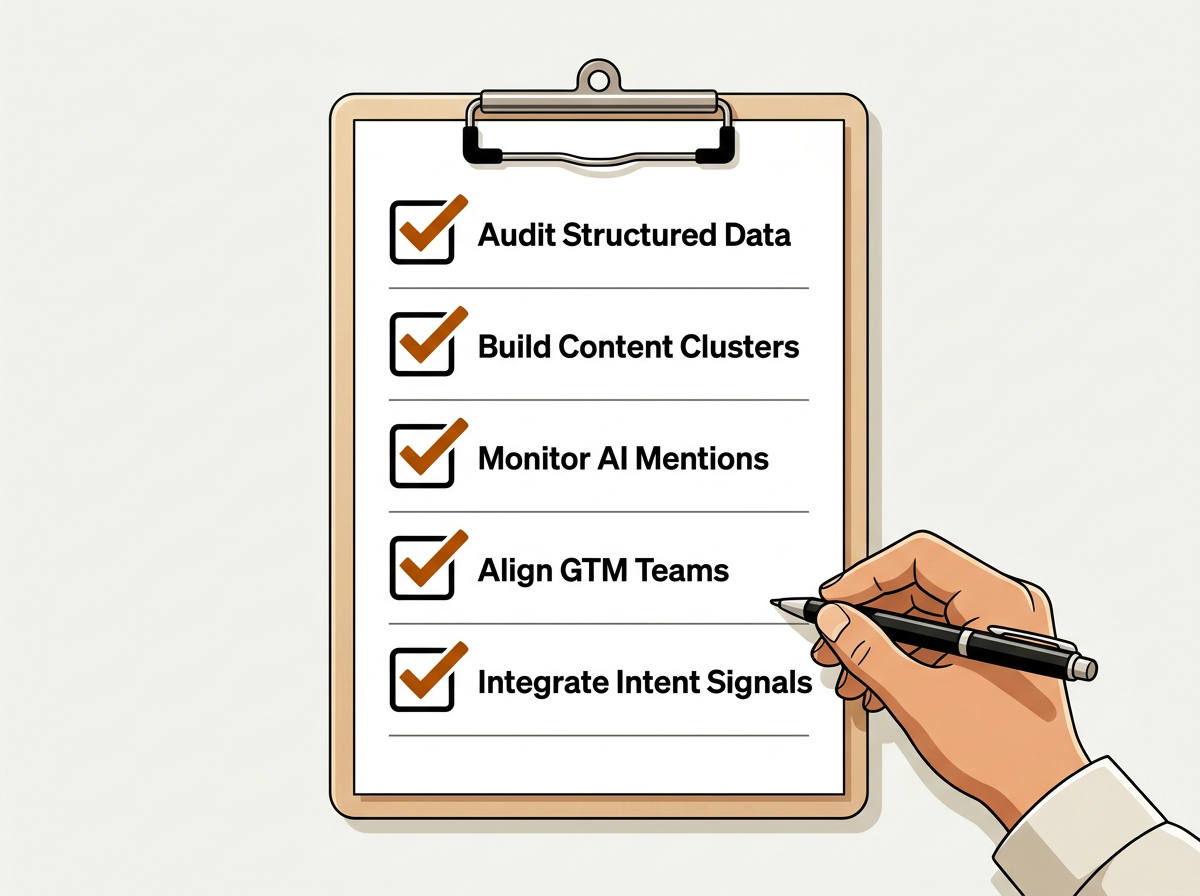
Five structured actions every B2B GTM team should prioritize for AI search readiness.
- AI search is an expanding layer on top of traditional SEO, not a replacement. Invest in both.
- Structured content, schema markup, topical authority, and entity consistency are the primary drivers of AI visibility.
- Answer engine optimization (AEO) requires content formatted for retrieval and synthesis, not just ranking.
- Every GTM function (content, product marketing, SEO, RevOps, sales enablement) has a role in AI search readiness.
- Monitor your brand's presence in ChatGPT, Perplexity, Gemini, and Google AI Overviews. Measurement drives improvement.
- Platforms like Bitscale help connect buyer intent, account intelligence, and B2B sales productivity workflows to the content strategy that fuels AI search visibility.
The next phase of B2B visibility will reward teams that treat AI search as a force multiplier on their existing SEO investment, not a reason to abandon it. The same content infrastructure that earns Google rankings also gives ChatGPT, Perplexity, and other answer engines something clean to retrieve and cite. Start with a structured data audit, build content clusters around real buyer questions, and connect intent signals back to your publishing cadence so the system keeps improving. Learn more about modern B2B sales workflows and GTM strategy with Bitscale.
Frequently Asked Questions
Is AI search taking over from Google for B2B buyers?
No. AI search is an additive channel, not a wholesale replacement. AI-generated referrals currently represent a relatively small share of overall B2B organic traffic, even as they continue to grow at a significant pace. Google still drives the majority of organic traffic, but AI answer engines are increasingly shaping early research and vendor shortlists.
What is the difference between SEO and answer engine optimization (AEO)?
Traditional SEO is about ranking pages in search engine results. AEO is about getting content retrieved, summarized, and cited by AI answer engines like ChatGPT, Perplexity, and Google AI Overviews. AEO puts extra weight on structured content, entity clarity, FAQ coverage, and topical authority. In practice, the overlap is large, and many AEO improvements lift traditional SEO performance too.
How can I tell whether my brand shows up in AI search results?
Right now it takes a mix of manual checks and analytics. Run the queries your buyers use in ChatGPT, Perplexity, and Gemini and see which brands get mentioned or cited. Where available, monitor referral traffic from AI-powered search experiences and conversational interfaces using your analytics platform. Emerging tools are starting to automate mention tracking. Bitscale's intent and buying signals can also indicate when target accounts are researching topics tied to your products, which is a useful proxy for AI-influenced discovery.
What content tends to perform best in AI search for B2B?
FAQ pages, product documentation, comparison guides, how-to articles, and structured knowledge bases tend to outperform generic blog posts in AI retrieval. Content that answers a specific question, uses a clear heading hierarchy, and includes schema markup is more likely to be cited. See top AI platforms for B2B sales for examples of structured B2B content.
Should we invest in AI search optimization now, or wait?
Now. The same investments that improve AI visibility (structured data, topical authority, entity optimization) also strengthen traditional SEO, so starting early compounds rather than distracts. With a growing majority of B2B buyers planning to use generative AI in their purchase process, waiting effectively hands early-stage mindshare to competitors who are already optimizing.

Sanket
CEO | Co-Founder Bitscale


Sanket is the CEO and Co-Founder of Bitscale. He leads company vision and strategy, building the future of AI-driven sales intelligence for modern B2B teams. Sanket is obsessed with the intersection of AI and go-to-market, and has spent years studying how the best B2B companies find, engage, and convert customers at scale. He writes about company building, product strategy, and where AI is taking the sales industry.
Read other blogs
All Blogs
12 Best CRM Sync Tools for Revenue Teams in 2026
Compare 12 CRM sync tools for Salesforce and HubSpot, including enrichment, reverse ETL, and automation options for cleaner revenue data.

Sales Data Enrichment: A Buyer's Guide for Modern B2B Teams
Sales data enrichment helps B2B teams improve CRM records, routing, prospecting, and account prioritization. Compare workflows, costs, and vendor fit today.
What Is AI Prospect Qualification? A Practical Guide for Modern Revenue Teams
AI prospect qualification helps revenue teams enrich data, assess ICP fit, prioritize buying signals, and route the right accounts into CRM workflows.