AI SDR vs Human SDR: Which Approach Wins in 2026?
Table of Contents
Explore Bitscale
Find decision makers, more insights and contact information about this company on Bitscale
The AI SDR vs human SDR argument has moved on from "can it even work?" to "where does it belong?" Not long ago, most sales leaders were still testing whether AI sales agents could carry outbound at all. Now AI SDR software is booking real meetings, while human SDRs still pull ahead when deals get messy and multi-threaded. So no, this isn't a binary choice. It's a design problem: what should AI own, what should humans own, and where do you want a handoff instead of a hard line?
This comparison breaks sales development into ten dimensions, from prospect research to governance, and assigns each one to the right owner. The goal is practical: a hybrid SDR workflow that protects pipeline quality and keeps spend pointed at the work that actually benefits from a human. The same framework applies if you're running a five-person startup or a 200-seat enterprise team; the mix just changes with deal complexity.
The Quick Verdict: AI SDR vs Human SDR
Neither approach "wins" across the board. AI SDRs are strongest in high-volume, data-heavy work: list building, CRM enrichment, and the first layer of outreach sequencing. Human SDRs still matter for relationship building, nuanced objection handling, and steering enterprise deals through committees. Industry observations consistently point to the same pattern in top-performing teams: AI qualifies at scale, humans carry the conversation with context. If you're forced into a single choice, a small team on a tight budget will get more leverage from AI sales automation for repetitive tasks. If you're selling six-figure contracts to a buying group, you still need experienced human SDRs running point. For most B2B orgs, the best answer is both, deliberately paired.
Evaluation Criteria: What Actually Matters
Before you compare AI and human SDRs tool-by-tool, set the scoreboard. Revenue teams don't live in feature checklists; they live in outcomes like pipeline quality, speed to lead, and clean handoffs. These ten dimensions cover the SDR workflow end to end, including the operational layer that usually gets ignored until it breaks.
- Prospect Research, finding and enriching target accounts and contacts
- Buying Signals, detecting intent and timing indicators
- Lead Qualification, scoring and routing inbound and outbound leads
- CRM Enrichment, keeping contact and account data accurate and complete
- Personalization, tailoring messages to individual prospects
- Outreach Execution, sending emails, LinkedIn messages, and making calls at scale
- Objection Handling, responding to pushback with nuance
- Relationship Building, earning trust over multi-touch, multi-stakeholder cycles
- Governance, compliance, brand safety, and data quality controls
- Scalability, growing output without proportionally growing headcount
Where AI SDRs Excel
AI sales development reps earn their keep when the work is repetitive, data-dense, and time-sensitive. AI prospecting tools can scan thousands of accounts overnight, cross-reference firmographic and technographic data, and surface contacts that fit your ideal customer profile. Done well, AI for prospect research turns what used to be weekly manual list building into background infrastructure.
Buying signal detection is another place where machines simply have more surface area than people. Tools like Bitscale can aggregate job changes, funding rounds, tech stack shifts, and engagement patterns into one workflow, so teams can act on buying signals while the window is still open. CRM enrichment follows the same playbook: fill missing fields, normalize titles, and flag stale records continuously, without waiting for someone to notice the data drift.
Outreach execution is where the volume gap becomes obvious. AI SDRs can dramatically increase outreach capacity compared to a single human rep by automating sequencing, follow-ups, and A/B testing across channels without fatigue, vacation gaps, or calendar math. That matters for top-of-funnel coverage, especially in categories where speed to lead decides who gets the first meeting.
Where Human SDRs Remain Essential
Humans still win when the job requires judgment, empathy, and real-time adaptation. Enterprise sales is the obvious example: buying committees of five to ten stakeholders, competing priorities, and politics you only learn by listening. Recent industry research consistently lands in the same place: human SDRs continue to outperform AI here because relationships and internal buyer dynamics decide whether a deal moves or stalls.
Objection handling is the cleanest dividing line. An AI sales assistant can handle the predictable pushback with pre-trained responses. But when a CFO ties an integration concern to a recent acquisition, the conversation stops being a script. A human can probe, adjust the framing, and decide what to escalate on the spot. The same dynamic shows up in long sales cycles: trust builds through actual dialogue, not a perfectly-timed template.
Meeting quality is where the difference shows up on the dashboard. Human-booked meetings consistently post stronger show rates and higher conversion to pipeline compared to AI-booked meetings, because the prospect has already had a real conversation with someone who understood the problem and set expectations. If your business cares more about qualified pipeline than raw meeting count, human SDRs remain the foundation.
Head-to-Head: AI SDR vs Human SDR Comparison
| Dimension | AI SDR | Human SDR |
|---|---|---|
| Prospect Research | Scans thousands of accounts in minutes; cross-references firmographic, technographic, and intent data | Does deeper qualitative research on strategic accounts; catches nuances AI misses |
| Buying Signals | Monitors signals at scale (job changes, funding, tech installs) in real time | Interprets ambiguous signals; connects dots across conversations and context |
| Lead Qualification | Scores leads instantly using predefined criteria; handles high volume | Uses judgment on edge cases; qualifies based on tone, urgency, and fit |
| CRM Enrichment | Runs continuous, automated data hygiene and field population | Adds qualitative notes, relationship context, and deal intelligence |
| Personalization | Generates tailored first lines and templates from data inputs | Writes genuinely personal messages tied to specific pain points or context |
| Outreach Execution | Significantly higher volume; multi-channel sequencing without fatigue | Stronger reply rates on warm and complex outreach; shifts tone in real time |
| Objection Handling | Covers common, predictable objections with scripted responses | Handles nuanced, emotional, or multi-layered objections with empathy |
| Relationship Building | Keeps consistent touchpoints; never misses a follow-up | Builds trust, rapport, and long-term partnerships through real connection |
| Governance | Applies compliance rules, opt-out handling, and send limits automatically | Uses brand judgment in sensitive situations; escalates edge cases |
| Scalability | Scales close to linearly with minimal cost increase | Scaling requires hiring, onboarding, and ramp time; SDR turnover adds ongoing cost |
| Neither column is uniformly stronger. The winning strategy combines both. |
Task Ownership: What Belongs to AI, Humans, or Both
Strengths are interesting; ownership is actionable. If you want a hybrid model that actually runs, you need a clear answer to "who owns what" across the SDR job. This table assigns major tasks to AI, humans, or shared ownership based on where each resource creates the most value.
| Task | AI-Owned | Human-Owned | Shared |
|---|---|---|---|
| Account list building | ✔ | ||
| Contact enrichment and verification | ✔ | ||
| Intent and buying signal monitoring | ✔ | ||
| Lead scoring (initial) | ✔ | ||
| Lead qualification (final) | ✔ | ||
| First-touch email sequences | ✔ | ||
| Cold calling | ✔ | ||
| LinkedIn engagement | ✔ | ||
| Objection handling (common) | ✔ | ||
| Objection handling (complex) | ✔ | ||
| Multi-stakeholder deal navigation | ✔ | ||
| CRM data hygiene | ✔ | ||
| Meeting booking and scheduling | ✔ | ||
| Post-meeting follow-up sequences | ✔ | ||
| Compliance and opt-out management | ✔ | ||
| Pipeline reporting and analytics | ✔ | ||
| Shared tasks benefit from AI doing the prep work and humans making the final call. |
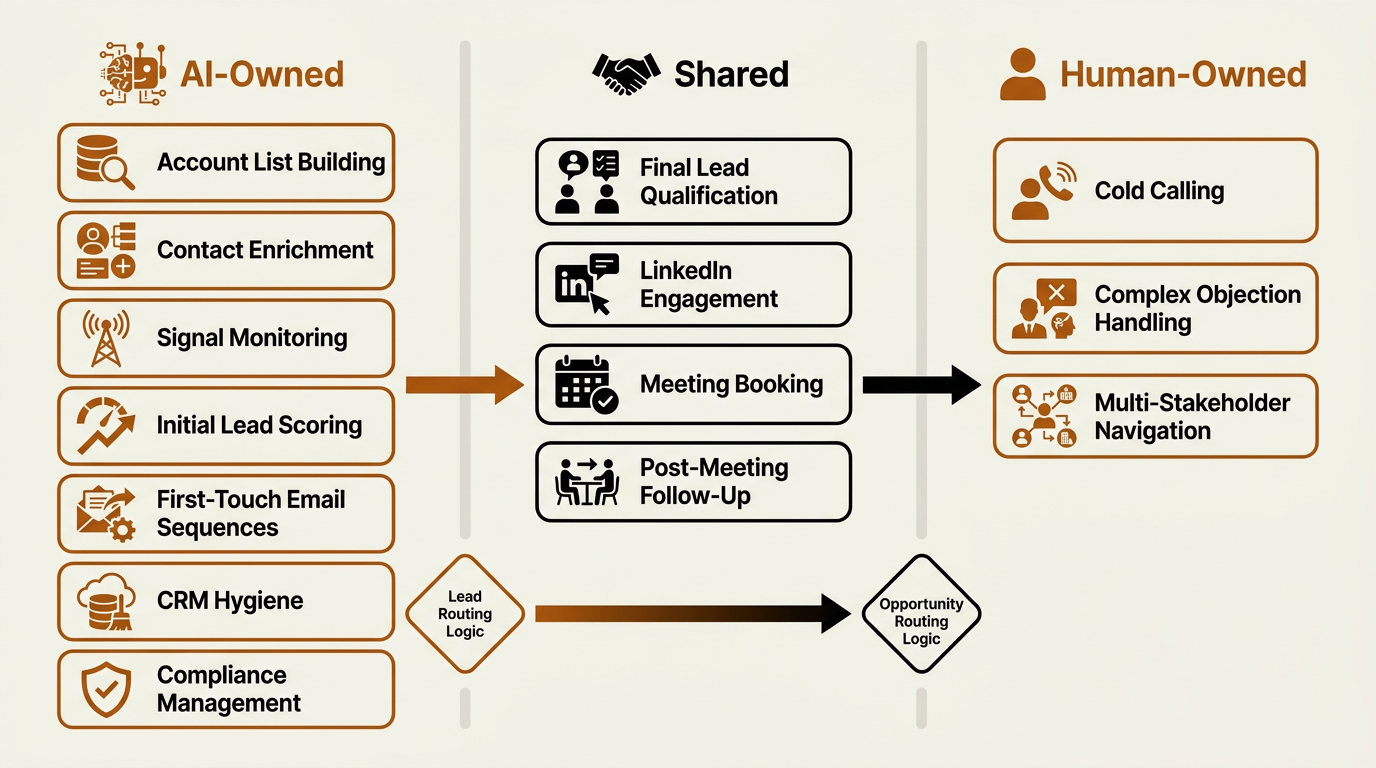
A well-designed hybrid workflow routes each SDR task to the highest-value resource.
Designing Hybrid SDR Workflows by Company Size
The right AI/human mix isn't a philosophy; it's a function of deal complexity, ACV, and how your team is staffed. A seed-stage startup selling a $500/month product has a different operating model than an enterprise vendor closing large deals through procurement. Use the table below as a starting point, then adjust for sales cycle length and what your buyers expect from the first conversation.
| Company Size | AI SDR Role | Human SDR Role | Recommended Mix |
|---|---|---|---|
| Startup (1-20 employees) | Handles all prospecting, enrichment, and initial outreach | Founder or AE handles qualified conversations and closing | 90% AI / 10% human |
| SMB (21-200 employees) | Owns list building, CRM enrichment, signal monitoring, and first-touch sequences | 1-3 SDRs focus on warm follow-up, calling, and complex qualification | 70% AI / 30% human |
| Mid-Market (201-1000 employees) | Powers research, scoring, and multi-channel sequencing at scale | SDR team handles calling, relationship building, and enterprise qualification | 50% AI / 50% human |
| Enterprise (1000+ employees) | Supports research, data hygiene, and signal alerts; augments SDR capacity | Large SDR team owns outreach strategy, stakeholder mapping, and deal progression | 30% AI / 70% human |
| Higher deal complexity and longer sales cycles shift the balance toward human SDRs. |
The ratios above are illustrative examples, not universal recommendations. The appropriate balance for your organization depends on several factors, including deal complexity, average sales cycle length, team maturity, customer expectations during the buying process, and your broader GTM strategy. Use these as a starting framework and calibrate based on your own pipeline data and buyer feedback.
The pattern is consistent: as deals get harder, the human share goes up. Even then, AI should still run the data foundation that keeps reps effective. Enterprise SDRs shouldn't be burning hours on manual list building when that same time could be spent on calls and account strategy, with outbound sales automation covering the repetitive layers.
The Cost and Quality Tradeoff
On paper, the economics look lopsided. AI SDRs carry significantly lower marginal operating costs than human SDRs, which require ongoing compensation, benefits, management overhead, and development investment. Cost per meeting follows the same pattern: AI-generated meetings are far cheaper to produce at volume. If you stop the analysis there, AI looks like the obvious answer.
Quality is where the spreadsheet gets complicated. Human-booked meetings convert better because the prospect has already had a real interaction with someone who understood the problem and set expectations. AI-booked meetings are cheaper, but they tend to arrive with lower engagement and often demand more AE work to turn into a credible opportunity. The ROI question isn't cost per meeting. It's cost per qualified opportunity that actually progresses. Teams that understand what B2B sales actually requires optimize for pipeline quality first, then volume.
Pure human models also carry a cost most teams underestimate until it hits them: turnover. SDR roles tend to experience relatively high turnover compared with many other sales positions, and each exit kicks off recruiting, hiring, and onboarding all over again. The disruption compounds quickly, especially in growing teams. AI SDRs don't quit, don't need ramp time, and don't walk out with institutional knowledge. A hybrid model reduces both quality risk (AI-only) and turnover risk (human-only).
How Bitscale Powers the Hybrid SDR Model
Hybrid workflows fall apart when the "AI layer" lives in a separate stack that humans don't trust or can't see. Bitscale is built to keep those layers together in one GTM workspace. It combines B2B lead and account list building, contact and company enrichment, work email and phone lookup, AI prospect research, intent and buying signal monitoring, ready-made sales workflows, CRM sync, and outbound tool integrations.
Bitscale works well for hybrid teams because it doesn't posture as a replacement for SDRs. It takes on the repetitive, data-heavy work (enrichment, signal detection, list building, sequence triggers) so human reps can spend their time where it pays off: calling, relationship building, and complex qualification. Ready-made workflows reduce the need to engineer automation from scratch, and CRM sync keeps the system of record intact. If your team is evaluating whether AI SDR tools actually replace human SDRs, Bitscale's stance is straightforward: augment the team, don't erase it.
Other Tools in the AI SDR Ecosystem
Bitscale isn't the only option. Most teams end up with a mix of tools, because different products specialize in different layers of the SDR workflow.
Clay (clay.com) is well known for enrichment and waterfall-style contact lookups. Ops-heavy teams like it because it offers granular control over how data gets sourced and stitched together. The tradeoff is overhead: that flexibility comes with setup time and a learning curve. If you want ready-made workflows instead of building your own logic, Clay can feel like work.
Apollo.io (apollo.io) pairs a large contact database with built-in sequencing, making it a practical all-in-one for many SMB teams. Its breadth is a strength, though accuracy varies by region and industry. Lusha (lusha.com) is tighter in scope and leans into contact accuracy, especially direct dials and verified emails, so it often complements a broader platform. Cognism (cognism.com) is a common pick for European and GDPR-compliant data, with strong phone-verified mobile coverage. For EMEA-focused teams, it tends to be the first stop for compliant contact data.
Instantly.ai plays a different role: deliverability and the infrastructure for high-volume sending. It's designed for teams scaling cold email without getting buried in spam folders. It handles execution well, but it doesn't do research or enrichment, so it usually sits next to a data platform. If you're comparing AI sales assistants, you'll notice a pattern: many tools cover one or two layers, while platforms like Bitscale try to cover the full stack.
Governance, Compliance, and Brand Safety
Governance is the part of the AI SDR vs human SDR debate that teams often skip until something goes wrong. Scaling outbound with AI introduces real risk: messaging opted-out contacts, tripping regional data rules, or generating copy that overpromises what your product does. Humans can apply judgment in the moment, but they also make mistakes, especially when quota pressure meets a messy process.
High-performing hybrid teams bake governance into the workflow instead of treating it like a policy doc. AI should handle the rule-based controls (suppression lists, send limits, opt-out processing, data retention), while humans review edge cases and approve messaging for sensitive accounts. Platforms that centralize automation and CRM sync, like Bitscale, make this easier because compliance controls live in one place rather than being scattered across five tools. Improving B2B sales productivity isn't just about moving faster; it's about moving faster without creating avoidable risk.
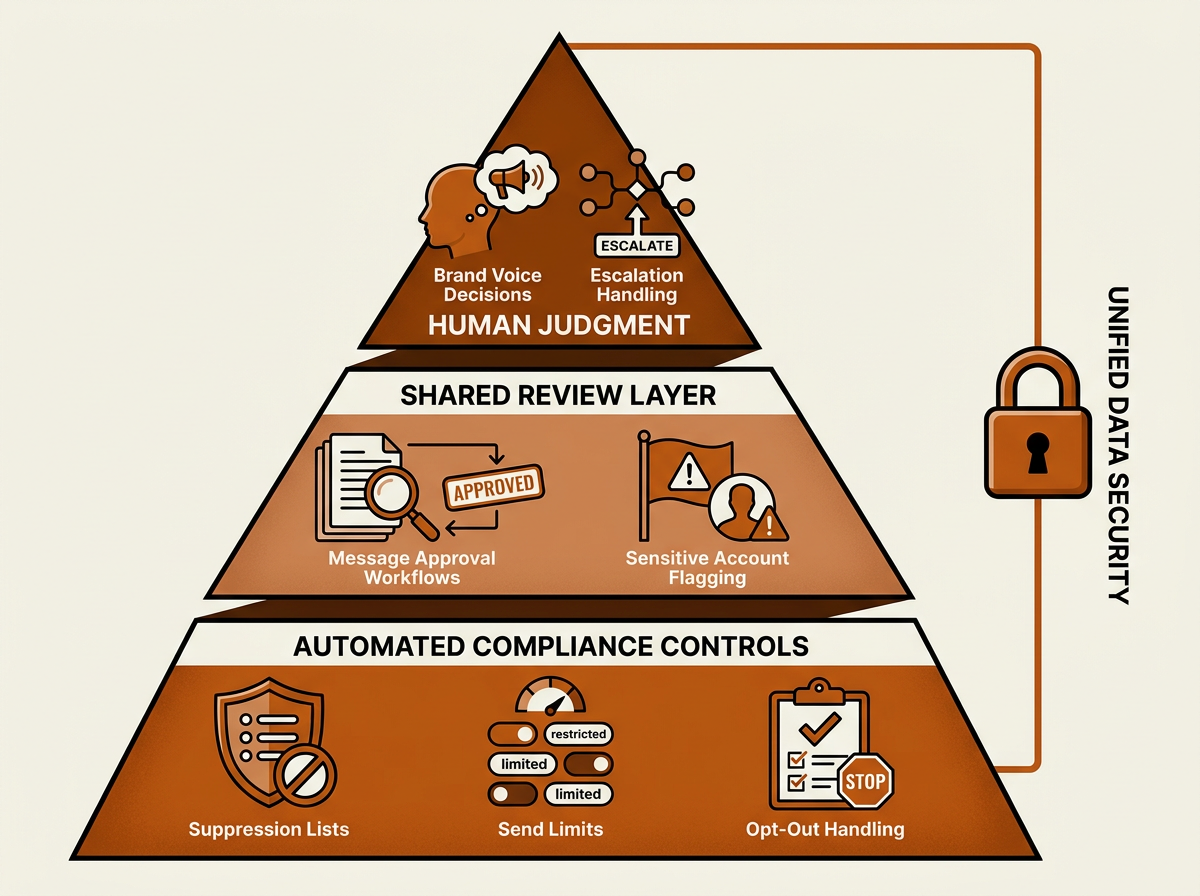
Governance works best when AI enforces rules and humans handle edge cases and brand decisions.
Putting It All Together: A Practical Playbook
If you're redesigning your SDR function, start with operating principles, not headcount math or tool demos. These are the moves that tend to hold up across different markets and team sizes.
- Audit your current workflow task by task. Map every activity your SDRs perform today against the task ownership table above. Call out what's already automated, what should be automated, and what still needs human skill.
- Start AI adoption with data infrastructure. Prospect research, CRM enrichment, and buying signal monitoring are safer starting points because they don't touch prospects directly. Get these stable before you automate outreach.
- Measure meeting quality, not just meeting volume. Track show rates, conversion to opportunity, and average deal size by source (AI-booked vs. human-booked) so you can see what each channel really produces.
- Protect your human SDRs' time. Every hour spent on manual data entry or list building is an hour not spent selling. Push that time back toward calling, relationship building, and complex qualification.
- Build governance from day one. Don't treat compliance as a cleanup project after you've scaled. Put suppression lists, send limits, and message review into the workflow before you turn on AI outreach.
The teams that look strong aren't the ones that bet everything on AI or refused to touch it. They're the ones that built intentional workflows where AI and human SDRs each do the work they're suited for. Recent industry analysis on whether AI will replace sales jobs makes the point cleanly: AI is stripping out low-value tasks, not eliminating salespeople. That shift makes the strategic, consultative parts of the SDR job more valuable, not less.
Frequently Asked Questions
Can an AI SDR fully replace a human SDR?
For most B2B organizations, not end to end. AI SDRs are effective at high-volume, data-intensive work like list building, enrichment, and running initial outreach sequences. Human SDRs are still needed for complex objections, multi-stakeholder enterprise deals, and relationship building. The strongest teams run a hybrid model and are explicit about the handoffs.
What is the cost difference between an AI SDR and a human SDR?
AI SDRs carry significantly lower marginal operating costs than human SDRs, which require ongoing compensation, benefits, management overhead, and development investment. Cost per meeting is also far lower for AI-generated outreach. The catch is quality: human-booked meetings tend to produce stronger engagement and convert to pipeline at higher rates because the prospect has already had a real conversation with someone who understood the problem.
How does Bitscale support a hybrid AI and human SDR workflow?
Bitscale is a unified GTM platform that covers AI prospect research, buying signal monitoring, CRM enrichment, and outbound workflow automation. It takes the data-heavy, repetitive layers off your reps so human SDRs can focus on calling, relationship building, and higher-judgment qualification. Ready-made workflows and CRM sync help keep execution and reporting in one system. Current plans are listed on Bitscale pricing.
What meeting quality differences exist between AI-booked and human-booked meetings?
AI SDRs can dramatically increase outreach volume by automating sequencing and follow-ups across channels, but the meetings they book tend to produce weaker engagement. Human-booked meetings consistently show stronger attendance and higher conversion to qualified pipeline because the prospect has already built context and trust through a real conversation. That gap is why teams should track cost per qualified opportunity, not just cost per meeting.
What's the best AI-to-human SDR ratio for my company?
It depends mostly on deal complexity. Startups often lean heavily on AI for prospecting and initial outreach, while enterprise teams with long cycles and large buying committees rely more on human SDRs. Mid-market orgs commonly end up near a balanced split. The deciding factors include sales cycle length, team maturity, customer expectations, and how much of your SDR motion relies on relationship building and multi-stakeholder navigation.

Sanket
CEO | Co-Founder Bitscale


Sanket is the CEO and Co-Founder of Bitscale. He leads company vision and strategy, building the future of AI-driven sales intelligence for modern B2B teams. Sanket is obsessed with the intersection of AI and go-to-market, and has spent years studying how the best B2B companies find, engage, and convert customers at scale. He writes about company building, product strategy, and where AI is taking the sales industry.
Read other blogs
All Blogs
12 Best CRM Sync Tools for Revenue Teams in 2026
Compare 12 CRM sync tools for Salesforce and HubSpot, including enrichment, reverse ETL, and automation options for cleaner revenue data.
Sales Data Enrichment: A Buyer's Guide for Modern B2B Teams
Sales data enrichment helps B2B teams improve CRM records, routing, prospecting, and account prioritization. Compare workflows, costs, and vendor fit today.
What Is AI Prospect Qualification? A Practical Guide for Modern Revenue Teams
AI prospect qualification helps revenue teams enrich data, assess ICP fit, prioritize buying signals, and route the right accounts into CRM workflows.