AI Lead Agents: How Autonomous Prospecting Works in 2026
Table of Contents
Explore Bitscale
Find decision makers, more insights and contact information about this company on Bitscale
The AI lead agent has moved past pitch-deck hype. In 2026, the majority of B2B sales organizations have adopted AI in some form across their prospecting workflows, and a growing share are handing the repetitive, data-heavy parts of outbound to autonomous agents. These systems find prospects, enrich records, qualify leads against your ICP, watch for buying signals, and write clean updates back to the CRM, without a rep living in fifteen tabs.
Below is a practical look at how AI lead agents work in the real world, how they differ from the automation sales teams have relied on for years, and what you need under the hood to make them dependable. If you are evaluating your first ai sales agent or tightening up an existing autonomous prospecting workflow, the focus is the same: fundamentals, workable architecture, and the data layer that decides whether the agent creates pipeline or just creates activity.
What Is an AI Lead Agent?
An AI lead agent is an autonomous software system that discovers prospects, enriches records, qualifies leads, detects buying signals, and updates CRM systems with minimal human intervention.
AI Lead Agent Behavior: What Sets It Apart
An AI lead agent is an autonomous software system that runs high-volume outbound prospecting work: identifying prospects, executing personalized outreach, and tracking engagement signals, so reps can spend their time on qualified conversations (Aircall, 2026). That definition is intentionally wide because "agent" is less about a single feature and more about behavior. Unlike static automations, agents make decisions. A traditional sequence tool will send email three on day five no matter what. A lead generation agent takes in new information (a job posting, a funding round, a spike in website visits) and decides whether to advance, pause, or reroute a prospect.
A drip campaign behaves like a conveyor belt: predictable, linear, and indifferent to context. An AI lead agent looks more like a researcher with a rubric and the discretion to skip obvious bad fits. It cycles through discovery, enrichment, qualification, and action, repeating until it produces leads that actually deserve a rep's attention.
The Autonomous Prospecting Loop: How AI Agents Find and Qualify Leads
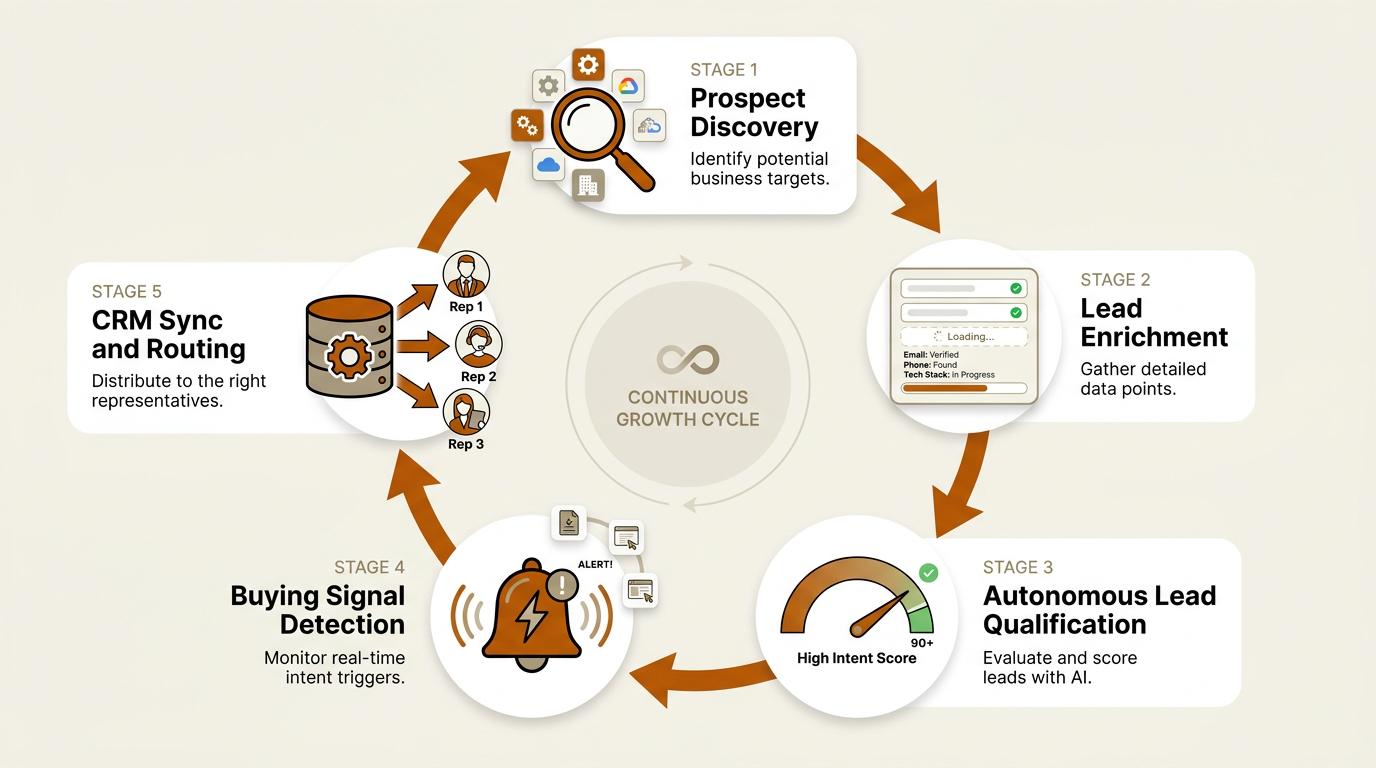
The continuous five-stage loop ai lead agents run to surface, qualify, and route prospects automatically.
Most sales AI agents run the same five-stage loop. If you can name each stage, you can evaluate vendors faster and diagnose where your current stack is leaking signal.
1. Prospect Discovery
The loop starts with scanning, not list-pulling. The agent watches structured and unstructured sources: company databases, job boards, news feeds, LinkedIn activity, technographic registries, and intent data providers. Instead of exporting a static list, it applies filters continuously. A SaaS company selling to mid-market finance teams, for example, might tell the agent to surface companies with 200 to 2,000 employees, headquartered in North America, and hiring for a CFO or VP Finance. Matches keep coming as the world changes, not as a one-time CSV. For a deeper look at how teams structure this step, see AI-powered prospect research.
2. Lead Enrichment
Discovery gives you raw records, and raw records are almost always incomplete. The agent fills in the missing pieces by pulling work emails, direct dials, company revenue, tech stack data, and recent news mentions across multiple providers. This step dictates everything that follows. If the agent cannot verify an email or pin down the right decision-maker title, "qualification" turns into educated guessing. Platforms like Bitscale's data enrichment engine pull multiple sources in one pass, replacing the old patchwork of manual lookups and fragile API chains.
3. Autonomous Lead Qualification
Once the record is enriched, the agent scores it against your ICP. That is more than firmographics. Modern ai lead generation agents factor in technographic fit, hiring patterns, funding events, and even sentiment pulled from earnings calls. The deliverable is a ranked queue that a rep can work, not an unsorted spreadsheet that still needs triage. Teams that pair this with AI lead scoring spend less time debating who to contact and more time running real conversations.
4. Buying Signal Detection
Timing is the difference between interruption and relevance. AI agents watch for buying signals: a competitor's renewal window coming up, a new VP landing in the org chart, a surge of visits to your pricing page, or a relevant G2 review. Detecting buying signals across thousands of accounts is not a human-scale task, but an agent can run it quietly in the background. For a ranked list of signal sources, see best intent data tools in 2026.
5. CRM Automation and Routing
The loop only pays off when it lands in the CRM. The agent creates or updates records, attaches enrichment fields, logs qualification scores, and routes leads to the right rep or sequence. Skip this, and you end up with a shadow system that nobody trusts. Solid CRM automation means deduplication logic, field mapping, and ownership rules that match how your team actually works. Miss those basics and you get duplicate contacts, conflicting fields, and fast-growing skepticism. For setup guidance, see CRM lead management and enrichment.
AI Lead Agents vs. Traditional Sales Automation
Sales teams are not new to automation: drip sequences, list imports, and simple scoring rules have been around for years. The move to AI prospecting is not just "faster automation." It is a different operating model. Traditional tools execute rules you wrote in advance. AI agents interpret incoming data, make judgment calls, and adjust as conditions change. The table below lays out the differences that matter in day-to-day RevOps work.
| Capability | Traditional Automation | AI Lead Agent |
|---|---|---|
| Prospect discovery | Manual list building or static database exports | Continuous scanning across multiple sources with ICP filters |
| Lead enrichment | Single-provider lookups, often manual | Multi-source enrichment in a single automated pass |
| Qualification | Rule-based scoring (title = VP +10 pts) | Contextual scoring using firmographic, technographic, and intent data |
| Buying signals | Limited to form fills and email opens | Monitors hiring, funding, tech installs, competitor activity, web visits |
| CRM updates | Batch imports, frequent duplicates | Real-time sync with deduplication and field-level mapping |
| Adaptability | Static until a human edits the rules | Learns from rep feedback and outcome data |
| Key differences between legacy automation and modern AI lead agents. |
Industry analysts, including Gartner, have noted that B2B sales organizations adopting generative AI for prospecting and meeting preparation are seeing significant reductions in time spent on manual research and administrative tasks. That gain only shows up when reps trust what the agent produces, which is why the data layer ends up being the real constraint.
Why Clean Data Is the Real Bottleneck for AI Prospect Research
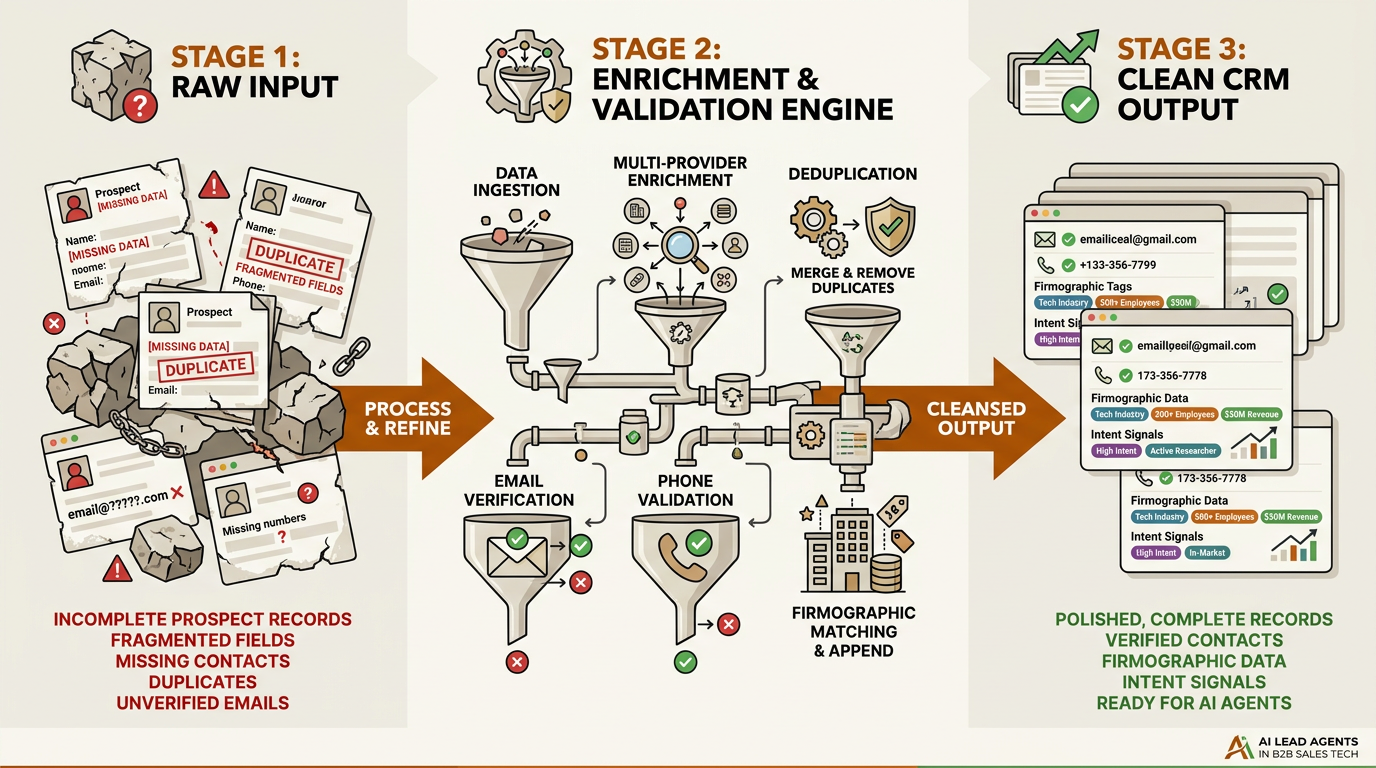
Poor data quality — not model capability — is what breaks most ai lead agent deployments.
When teams struggle with AI lead agents, the root cause is usually not the model. It is the inputs. An agent qualifying against stale firmographics will confidently route bad-fit accounts to your reps. An agent enriching from a single email provider will rack up bounces that hurt deliverability. In practice, the plumbing matters more than the agent's "reasoning" headline.
That is the lane platforms like Bitscale's AI Agent occupy. Bitscale handles the enrichment, prospect intelligence, buying-signal aggregation, and CRM synchronization that agents rely on to stay grounded. Instead of stitching together six point solutions with brittle integrations, teams use Bitscale as the data backbone: verified work emails and phone numbers, multi-provider company and contact enrichment, intent signals, and workflows that write clean records into Salesforce, HubSpot, or other CRMs. The agent can decide what to do next; Bitscale supplies the facts it decides with.
Across the B2B sales landscape, the consensus among revenue leaders is clear: AI agents have moved from experimental to essential for teams that need to scale outbound without scaling headcount proportionally. Still, essential does not mean effortless. Teams that shore up enrichment and data quality before rolling out an agent tend to hit value faster and avoid the classic garbage-in, garbage-out loop. For a broader view of how enrichment, signals, and outreach tools connect, see how to build a prospecting stack in 2026.
What Most Teams Get Wrong When Deploying Sales AI Agents
A few failure modes show up again and again when B2B teams adopt AI prospecting workflows. The first is automating the blast radius before proving the targeting. Teams wire an agent into the CRM and outbound sequencer on day one, before they have validated that the qualification logic matches their real ICP. The predictable outcome is a wave of poorly targeted emails and a bruised domain reputation. Start with the agent in "suggest mode" so it proposes leads for human review before any outreach goes live.
The second mistake is treating the agent like a black box you either trust or do not. MIT Sloan research, cited by Outreach, shows the highest forecast accuracy comes from combining algorithmic pattern recognition with human contextual judgment. Prospecting follows the same rule. Reps should audit agent-qualified leads weekly, flag false positives, and feed corrections back into the system. Without that feedback loop, the agent drifts from what your team actually sells.
The third is underestimating CRM hygiene. If your CRM is already full of tens of thousands of contacts with inconsistent naming and no deduplication rules, an agent will not tidy it up; it will amplify the mess. Fix the fundamentals before you let an autonomous system write at scale.
Key Takeaways
- An AI lead agent can run the full prospecting loop: discovery, enrichment, qualification, signal detection, and CRM sync.
- Unlike traditional automation, agents make context-aware decisions and adjust based on new data and rep feedback.
- Data quality is the biggest determinant of whether an agent produces pipeline or noise. Build enrichment infrastructure first.
- Platforms like Bitscale provide the enrichment, signals, and CRM synchronization layer agents need to stay reliable.
- Roll agents out in review mode before you automate outreach. A short human QA window prevents expensive misfires.
- Investment in AI-driven prospecting is accelerating across B2B sales, with organizations of every size building agent capabilities into their revenue workflows. The real question is not adoption; it is whether your data foundation makes adoption pay off.
Frequently Asked Questions
How does an AI lead agent differ from a chatbot?
A chatbot waits for an inbound question and replies in a conversational UI. An AI lead agent is proactive: it scans external sources to find, enrich, and qualify outbound prospects without someone starting the conversation.
Can AI lead agents replace SDRs entirely?
Not in 2026. Agents can cover research, data collection, and first-pass qualification at scale, but humans still run complex deals, work buying committees, and build trust. The strongest setups use agents for volume while reps focus on high-value conversations.
What data sources do AI prospecting agents typically use?
Common inputs include company databases, LinkedIn profiles, job boards, technographic registries, intent data providers, news feeds, SEC filings, and website visitor tracking. Platforms like Bitscale pull multiple enrichment and signal sources into one workflow.
How do I measure the ROI of an AI sales agent?
Use operational and pipeline metrics: qualified leads per week, time-to-first-meeting, CRM field completeness, email bounce rate, and pipeline generated from agent-sourced leads. Then compare them to the same numbers from your prior manual or semi-automated process.
What is the biggest risk of autonomous lead qualification?
Overconfidence in bad inputs. If your ICP rules or enrichment data are wrong, the agent will still prioritize and route accounts with conviction. Regular human review and feedback loops keep qualification aligned over time.

Sanket
CEO | Co-Founder Bitscale


Sanket is the CEO and Co-Founder of Bitscale. He leads company vision and strategy, building the future of AI-driven sales intelligence for modern B2B teams. Sanket is obsessed with the intersection of AI and go-to-market, and has spent years studying how the best B2B companies find, engage, and convert customers at scale. He writes about company building, product strategy, and where AI is taking the sales industry.
Read other blogs
All Blogs
12 Best CRM Sync Tools for Revenue Teams in 2026
Compare 12 CRM sync tools for Salesforce and HubSpot, including enrichment, reverse ETL, and automation options for cleaner revenue data.
Sales Data Enrichment: A Buyer's Guide for Modern B2B Teams
Sales data enrichment helps B2B teams improve CRM records, routing, prospecting, and account prioritization. Compare workflows, costs, and vendor fit today.
What Is AI Prospect Qualification? A Practical Guide for Modern Revenue Teams
AI prospect qualification helps revenue teams enrich data, assess ICP fit, prioritize buying signals, and route the right accounts into CRM workflows.