AI for B2B Go-to-Market: How Modern Revenue Teams Build Smarter GTM Workflows in 2026
Table of Contents
Explore Bitscale
Find decision makers, more insights and contact information about this company on Bitscale
B2B go-to-market has changed shape. AI for B2B go-to-market is no longer something teams tack onto a pitch deck; it is increasingly the operating layer for how strong revenue orgs pick accounts, engage buyers, and move pipeline to close. AI has become a mainstream capability across modern revenue organizations, supporting prospecting, forecasting, CRM automation, lead scoring, and sales engagement. While adoption continues to accelerate, relatively few organizations have fully operationalized autonomous AI workflows across the entire GTM lifecycle. That gap between "we have AI" and "AI runs the work" is where execution breaks down.
This piece traces the AI GTM lifecycle end to end: ICP development and prospect discovery, CRM synchronization, pipeline analytics, and revenue forecasting. It is written for revenue leaders, sales managers, and RevOps practitioners who want a grounded view of what AI changes and what stays stubbornly the same across the GTM org. The structure is straightforward: the foundations behind AI-powered GTM, the workflows AI enables at each stage, three comparison tables that make the shift from manual to intelligent execution concrete, plus implementation strategy, governance, and the mistakes that tend to repeat.
What AI-Powered GTM Actually Means (and What It Doesn't)
A B2B go-to-market strategy still boils down to the same sequence: define the ideal customer, find them, reach them, and convert them. AI does not rewrite that playbook. It shrinks the time between steps, pulls patterns out of messy data that humans rarely spot in the moment, and cuts the manual data work that eats a significant portion of a rep's week. Investment in AI-powered sales software continues to grow as organizations automate prospecting, CRM management, forecasting, and revenue operations. That trajectory tracks with operational demand, not just vendor noise.
What AI-powered GTM does not mean: swapping your sales team for chatbots, or pretending one platform will cover every job in the stack. Modern GTM technology stacks span multiple layers (data, signals, engagement, AI, CRM, and more), and they often represent a significant software investment, making platform consolidation and workflow efficiency increasingly important. The hard part is rarely procurement. It is getting those layers to behave like a workflow instead of a pile of tools.
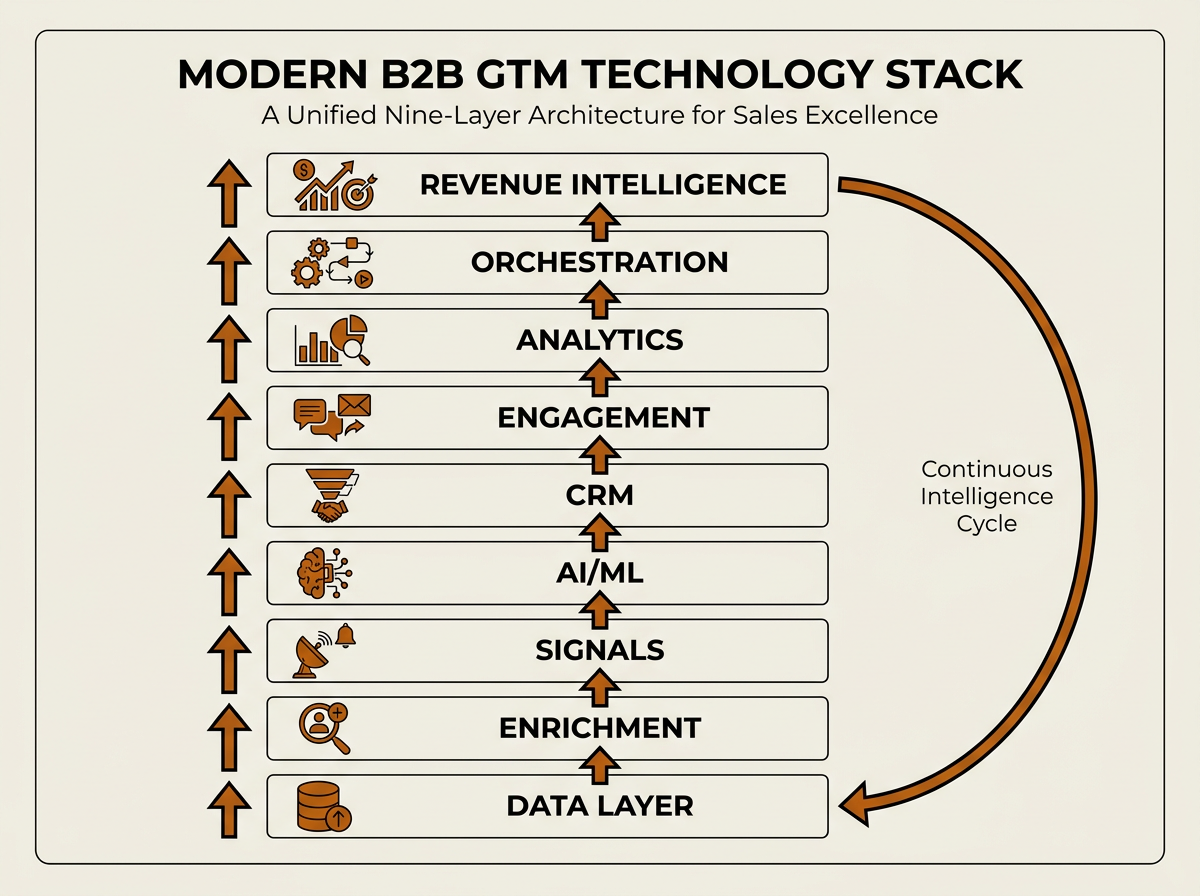
Modern GTM stacks span nine layers — getting them to act as one workflow is the real challenge.
Traditional GTM vs AI-Powered GTM
The shift from legacy GTM to AI-powered GTM is not a set of small optimizations. It changes how teams spend time, how they decide what matters, and how quickly they react to buyer behavior.
| GTM Function | Traditional Approach | AI-Powered Approach |
|---|---|---|
| ICP Development | Firmographic filters based on past wins; updated quarterly | Dynamic ICP models trained on win/loss data, technographics, and behavioral patterns; updated continuously |
| Prospect Discovery | Manual list building from static databases | AI prospecting across multiple data sources with real-time enrichment and deduplication |
| Buying Signals | Tracked manually via intent data vendors or anecdotal rep feedback | Aggregated buying signals from job postings, funding events, tech installs, and content engagement, scored automatically |
| Lead Scoring | Rule-based scoring with arbitrary point values | Predictive models that weight dozens of variables and retrain on closed-won outcomes |
| Sales Engagement | Templated sequences sent on fixed cadences | Adaptive sequences that adjust timing, channel, and messaging based on prospect behavior |
| Forecasting | Rep-submitted estimates reviewed in pipeline meetings | AI-generated forecasts combining deal velocity, engagement signals, and historical close rates |
| CRM Management | Manual data entry, frequent field decay | CRM automation with auto-enrichment, activity logging, and data validation |
| Comparison of traditional and AI-powered GTM across seven core functions. |
AI Across the GTM Lifecycle: From ICP to Closed Revenue
ICP Development and Prospect Discovery
Most teams treat the ICP as a document: define it once, revisit it when pipeline starts to wobble. AI pushes the ICP closer to a living model by continuously reading closed-won and closed-lost data alongside firmographic, technographic, and behavioral attributes. Instead of a static line item like "Series B SaaS companies with 50 to 200 employees," an AI-driven ICP model surfaces the combinations of attributes that actually correlate with conversion. A company that just hired a VP of Revenue Operations, rolled out a new CRM, and expanded into a new region can be a better bet than one that simply checks your firmographic boxes.
Once your ICP is dynamic, AI prospect research turns discovery into an actual workflow instead of a scavenger hunt. Platforms like Bitscale blend B2B lead and account lists with contact and company enrichment, pulling work emails, phone numbers, and org context into one workspace. The payoff is simple: fewer tabs, fewer copy-pastes, and fewer "I'll clean this up later" lists that never make it into the CRM.
Enrichment, Buying Signals, and Sales Intelligence
B2B contact and company data changes continuously, making ongoing enrichment an important part of maintaining CRM quality. AI sales intelligence platforms respond with continuous enrichment: verifying emails, appending direct dials, updating job titles, and flagging contacts who have moved roles. Bitscale's enrichment workflows run across multiple data providers at once, cross-checking results to push accuracy higher without forcing reps into manual validation loops.
Understanding buying signals is where sales intelligence starts to look meaningfully different from "we have better data." Signals show up as funding rounds, leadership changes, technology adoption, hiring spikes in the right departments, or engagement with competitor content. AI can aggregate those inputs from public sources, score them against your ICP, and route high-intent accounts to the right rep or sequence. Signal-driven prospecting often produces stronger engagement than untargeted outreach because it prioritizes accounts showing meaningful buying activity. It is also why teams that invest in signal infrastructure tend to see measurable improvements in reply rates and pipeline quality.
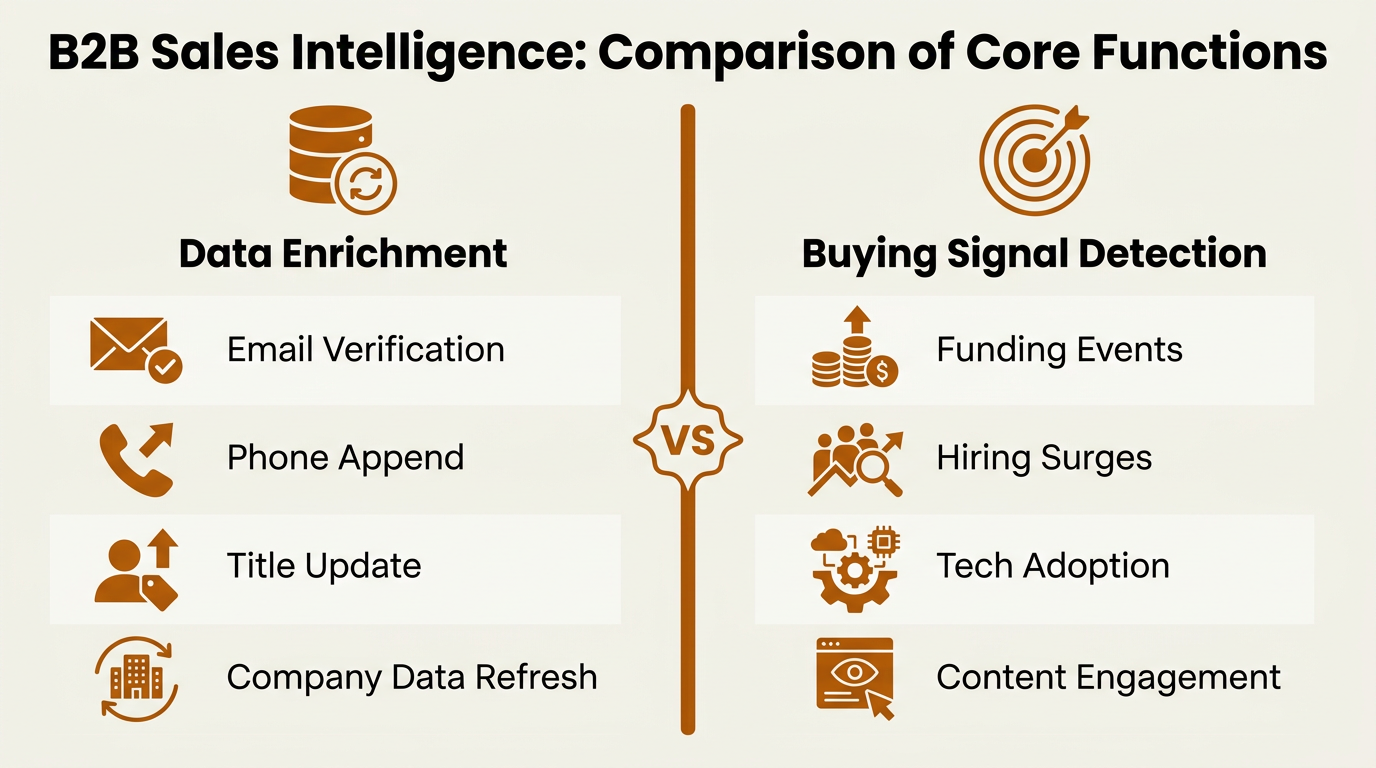
Enrichment fills in missing data fields; buying signals reveal when an account is ready to engage.
CRM Synchronization and Sales Engagement
CRM automation is the connective layer most GTM stacks never quite finish. Reps lose hours to activity logging, stage updates, and duplicate cleanup. AI-driven CRM sync tackles that by pushing enriched data, engagement history, and signal scores straight into the CRM record as the work happens. Bitscale offers native CRM synchronization and outbound tool integrations, which keeps data moving both ways between prospecting workflows and the system of record.
On the engagement side, AI sales automation shifts outreach based on what prospects actually do. If someone opens an email three times but stays silent, the workflow can escalate to a phone task or move the next touch to LinkedIn. If a prospect clicks a pricing link, the system can trigger a higher-urgency notification to the account owner. That is not an edge case; it is table stakes across tools like Apollo.io, Instantly.ai, and Bitscale's ready-made sales workflows.
Manual vs AI-Assisted GTM Workflows
The table below breaks common workflow steps into their manual version and their AI-assisted version. The point is not that the workflow disappears. The point is that the slow, repetitive substeps finally do.
| Workflow Step | Manual Process | AI-Assisted Process |
|---|---|---|
| Build target account list | Export from LinkedIn Sales Navigator, clean in spreadsheet, deduplicate manually | AI generates list from ICP model, enriches and deduplicates automatically |
| Find contact information | Search multiple databases, copy-paste into CRM | Multi-provider waterfall lookup returns verified emails and phones in one step |
| Research accounts before outreach | Read company website, recent news, LinkedIn posts (15-20 min per account) | AI prospect research summarizes company context, recent events, and personalization hooks in seconds |
| Score and prioritize leads | Sales manager reviews list and assigns tiers based on gut feel | Predictive lead scoring ranks accounts by conversion probability |
| Log CRM activity | Rep manually enters notes, updates fields after each call | Auto-capture syncs emails, calls, and meetings to CRM records |
| Forecast quarterly revenue | Reps submit estimates, manager adjusts based on experience | AI model weighs deal signals, historical patterns, and pipeline velocity |
| Manual versus AI-assisted workflows across six common GTM activities. |
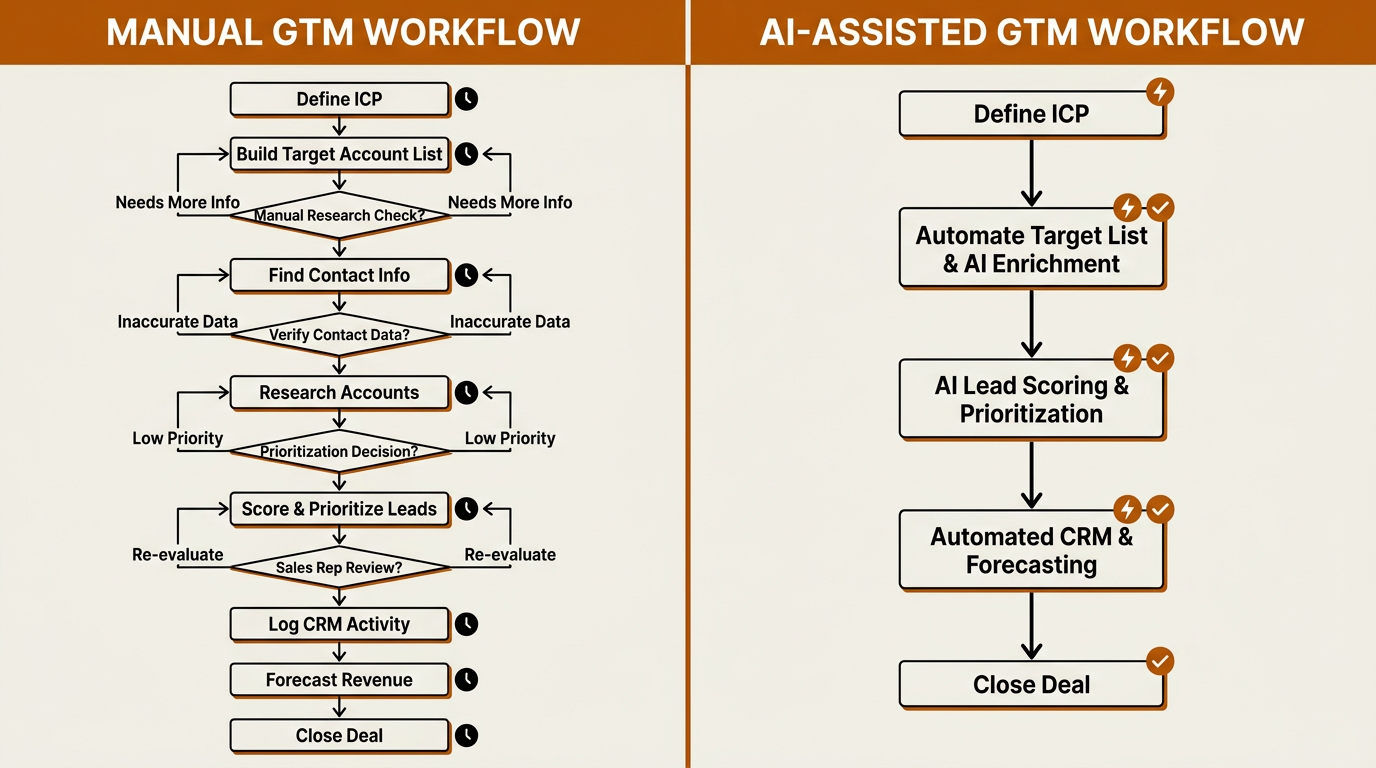
AI-assisted workflows cut manual touchpoints at every stage while preserving human decision-making.
AI Use Cases by Revenue Team
AI lands differently depending on where you sit in the GTM org. The table maps common use cases to the team that typically owns the workflow. Several capabilities (enrichment and CRM sync, for example) show up everywhere, but ownership matters because it dictates configuration, SLAs, and what "good" looks like.
| Revenue Team | Primary AI Use Cases | Example Tools/Capabilities |
|---|---|---|
| Sales Development | AI prospecting, contact enrichment, sequence optimization, buying signal alerts | Bitscale (enrichment + signals), Cognism, Lusha |
| Account Executives | Deal intelligence, AI-generated meeting prep, competitive insights, forecast inputs | CRM-native AI, Bitscale AI prospect research |
| Revenue Operations | RevOps automation, pipeline analytics, data hygiene, workflow orchestration | Bitscale CRM sync, Salesforce Einstein |
| Marketing | Lead scoring handoff, intent data activation, ABM targeting | Bitscale buying signals, 6sense, Demandbase |
| GTM Engineering | Custom workflow building, API integrations, data pipeline management | Bitscale workflows, Clay, custom scripts |
| AI use cases mapped to the revenue team with primary ownership. |
The emerging role of gtm engineering is worth calling out because it is becoming the glue between RevOps and sales execution. GTM engineers build custom data pipelines, configure enrichment waterfalls, and stitch tools together via APIs so the stack behaves like a system. Platforms like Bitscale and Clay have accelerated this shift by making workflow building more no-code and low-code, which lets teams prototype and ship automations without waiting on engineering sprints. For more on designing that connective tissue, see how to build a scalable GTM automation stack.
Pipeline Analytics, Forecasting, and AI Revenue Operations
Pipeline analytics and forecasting are where ai revenue operations shows up on the scoreboard. Traditional forecasting leans on rep-submitted estimates, and everyone knows how that goes: early-stage deals get inflated, late-stage deals get sandbagged, and managers layer their own bias on top. The forecast becomes a negotiation artifact more than a prediction.
AI forecasting models pull in deal-level signals (stage duration, email engagement, meeting frequency, stakeholder involvement, historical close rates for similar deals) and output probability-weighted projections. Organizations increasingly view AI-assisted forecasting as an important capability for improving pipeline visibility, forecasting accuracy, and operational planning. Accuracy matters, but the bigger operational win is earlier signal. When a deal's predicted close probability drops significantly mid-quarter, the system can surface the risk before the rep admits the deal is slipping.
RevOps automation does not stop at forecasting. The same modeling approach extends into territory design, quota modeling, and capacity planning. AI can simulate how adding two SDRs in Q3 changes pipeline coverage, or how redrawing territory boundaries redistributes workload. Work that used to take weeks of spreadsheet iteration can move faster and with clearer assumptions. Teams getting started here can use GTM automation explained as a practical baseline.
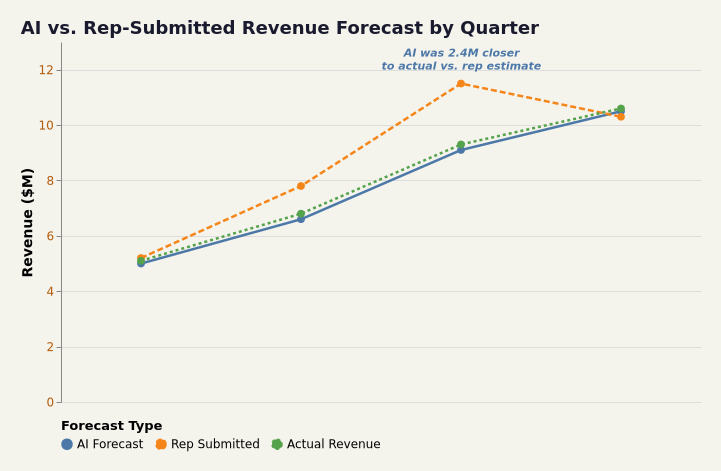
AI forecasting surfaces deal risk earlier than rep estimates, closing the gap on pipeline visibility.
Implementation Strategy: What Most Teams Get Wrong
Most teams get tripped up by the same move: layering AI on top of processes that are already broken. If your CRM is full of gaps, AI will accelerate bad outputs. If your ICP is fuzzy, AI will help you find more of the wrong accounts, faster. Start with data quality and process clarity, then automate.
A practical implementation sequence:
- Audit your data foundation. How complete are CRM records? What percentage of contacts have verified emails? How often are deal stages updated? Close the obvious gaps first.
- Define your ICP with data, not assumptions. Analyze your last 50 closed-won deals. What firmographic, technographic, and behavioral attributes do they share? Use that as the training set for your AI model.
- Start with one workflow, not ten. Choose the highest-friction manual process (often list building or enrichment) and automate it end-to-end before you expand. Bitscale's ready-made sales workflows are built for this kind of focused rollout.
- Measure before and after. Track time-to-first-touch, data completeness rates, and pipeline conversion at each stage. Without baselines, you are guessing.
- Iterate based on output quality, not volume. Sending 10x more emails is not a win if reply rates crater. AI should tighten targeting and timing, not just increase throughput.
Governance, Data Privacy, and Responsible AI in GTM
AI is pushing B2B buying away from vendor-led persuasion and toward buyer-controlled, AI-driven procurement. That shift comes with governance questions revenue teams have to own. When AI generates personalized outreach at scale, "relevant" can turn into "creepy" quickly. When AI scores leads using behavioral data, privacy rules (GDPR, CCPA, and emerging state-level laws) determine what you can collect and how you are allowed to use it.
Practical governance for AI GTM looks like operations work: document the data sources feeding enrichment and scoring models, honor opt-outs across every automated sequence, keep human review checkpoints for AI-generated content before it reaches prospects, and audit model outputs regularly for bias or drift. This is not paperwork to toss over the wall to legal. It affects deliverability, brand reputation, and the trust you need to earn (and keep) with the market.
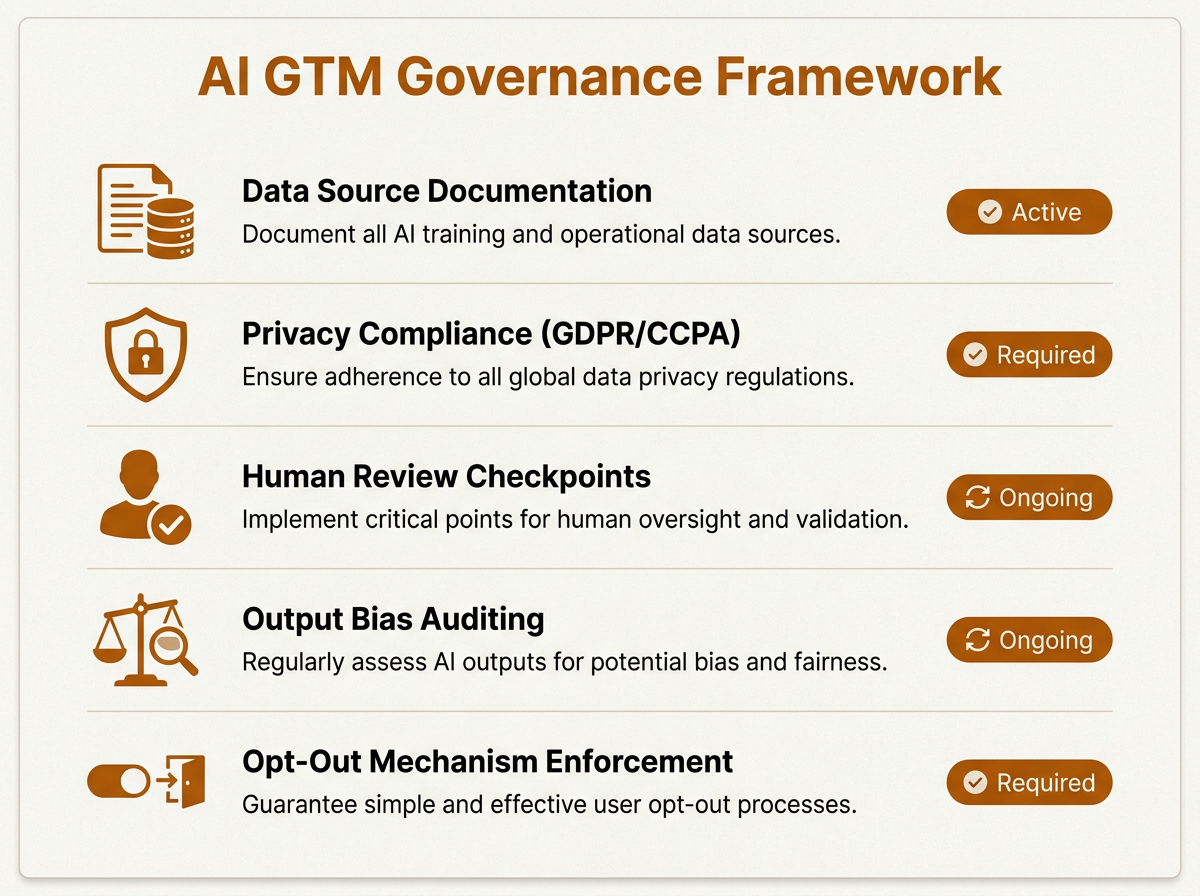
A governance framework keeps AI-powered GTM workflows compliant, unbiased, and buyer-trustworthy.
Best Practices for Scaling AI Go-to-Market Workflows
Teams that scale ai go to market workflows tend to share the same operating habits. They treat AI like infrastructure, not a feature toggle. They invest in GTM engineering so workflows can be maintained and extended as requirements shift. And they avoid the trap of trying to automate everything at once.
One practice that gets less attention than it deserves is closing the feedback loop between AI outputs and the humans doing the work. When a rep tags an AI-recommended account as "not a fit," that decision should feed back into the model. When an AI-generated email earns a negative reply, that outcome should be captured as a learning signal. Without feedback loops, models drift and the organization stops trusting the recommendations. Platforms like Bitscale support this by centralizing prospect data, enrichment results, and engagement outcomes in one place, which makes it easier to see what is working and what needs to change. Teams running account-based motions can use ABM workflow automation for a more focused implementation path.
Budgeting needs the same realism. Modern GTM technology stacks often represent a significant software investment, making platform consolidation and workflow efficiency increasingly important. Consolidation is not just a finance exercise; it is an integration strategy. A platform that bundles enrichment, signals, research, and CRM sync (like Bitscale) reduces both spend and the operational drag of stitching together five or six point solutions, lowering administrative overhead and simplifying day-to-day operations. Explore Bitscale's pricing to compare a unified platform against a fragmented stack.
Key Takeaways
- AI for B2B go-to-market reshapes every stage of the revenue lifecycle, from ICP development through forecasting, but it only pays off on top of clean data and clear processes.
- While AI adoption across revenue teams is widespread, the gap between using AI for point tasks and running fully autonomous workflows remains significant for most organizations.
- GTM engineering is becoming the bridge between RevOps and sales execution, building automated pipelines that connect data, signals, and engagement.
- Governance is operational, not optional: data privacy, human review checkpoints, and model auditing protect deliverability, reputation, and trust.
- Start with one high-friction workflow, measure the delta, then expand. Platforms like Bitscale that unify enrichment, buying signals, AI prospect research, and CRM sync make scaling less brittle.
- Explore top AI software for revenue teams to evaluate how different platforms fit your GTM architecture.
Frequently Asked Questions
What falls under AI for B2B go-to-market?
AI for B2B go-to-market spans the revenue lifecycle: ICP modeling, prospect discovery, contact and company enrichment, buying signal detection, lead scoring, sales engagement optimization, CRM automation, pipeline analytics, and revenue forecasting. It is rarely a single product. It is a set of capabilities wired into day-to-day GTM workflows.
How is AI prospecting different from traditional list building?
Traditional list building is usually a static export filtered by firmographics. AI prospecting is more dynamic: it identifies accounts that match your ICP using behavioral, technographic, and intent signals, then enriches and deduplicates contacts automatically. Platforms like Bitscale pair multi-source enrichment with AI prospect research so teams get lists that are ready to work, not lists that still need cleanup.
What is GTM engineering, and why does it matter?
GTM engineering is an emerging role that blends RevOps context with technical execution to build, maintain, and improve automated go-to-market workflows. GTM engineers configure enrichment waterfalls, build API integrations, and manage data pipelines. As AI GTM tools get more capable, this role becomes the difference between disconnected tools and a cohesive system.
How do I avoid the common mistakes when implementing AI in my GTM stack?
The most common failure mode is putting AI on top of poor data and unclear processes. Start by auditing CRM quality, defining your ICP using closed-won analysis, and automating one high-friction workflow before you expand. Measure time-to-first-touch, data completeness, and conversion rates so you can judge impact based on outcomes, not activity.
Can one platform cover enrichment, buying signals, and CRM sync?
Yes. Platforms like Bitscale consolidate B2B lead lists, contact and company enrichment, buying signals, AI prospect research, CRM synchronization, and outbound tool integrations in a single workspace. That consolidation reduces integration overhead and lowers per-user costs compared to assembling five or six separate point solutions.

Sanket
CEO | Co-Founder Bitscale


Sanket is the CEO and Co-Founder of Bitscale. He leads company vision and strategy, building the future of AI-driven sales intelligence for modern B2B teams. Sanket is obsessed with the intersection of AI and go-to-market, and has spent years studying how the best B2B companies find, engage, and convert customers at scale. He writes about company building, product strategy, and where AI is taking the sales industry.
Read other blogs
All Blogs
12 Best CRM Sync Tools for Revenue Teams in 2026
Compare 12 CRM sync tools for Salesforce and HubSpot, including enrichment, reverse ETL, and automation options for cleaner revenue data.
Sales Data Enrichment: A Buyer's Guide for Modern B2B Teams
Sales data enrichment helps B2B teams improve CRM records, routing, prospecting, and account prioritization. Compare workflows, costs, and vendor fit today.
What Is AI Prospect Qualification? A Practical Guide for Modern Revenue Teams
AI prospect qualification helps revenue teams enrich data, assess ICP fit, prioritize buying signals, and route the right accounts into CRM workflows.