Agentic AI for Revenue Teams: A Practical Guide for Modern B2B Teams
Table of Contents
Explore Bitscale
Find decision makers, more insights and contact information about this company on Bitscale
Agentic AI for revenue teams has moved from experimentation into production. Across enterprise sales organizations, AI agents are rapidly becoming a standard part of prospecting, lead qualification, and pipeline management. Even so, a lot of revenue leaders still lump agentic AI in with chatbots or basic workflow triggers. That confusion is costly: agentic AI can reason through multi-step work, choose an execution path, call external tools, and adjust when the inputs change. It is not a smarter chatbot. It is an orchestration layer that can sit across your go-to-market motion.
Below, we cover the foundations of what is agentic AI, how it shows up in revenue operations, where it tends to drive measurable lift, and how to deploy it without stripping out the judgment that actually closes deals. If you run a lean SDR pod or a full enterprise revenue org, the goal is the same: clear frameworks, side-by-side comparisons, and governance principles you can use immediately. What follows:
- Foundations: What makes agentic AI fundamentally different from automation and AI assistants
- Revenue workflows: Prospect research, buying signals, CRM enrichment, lead qualification, and pipeline prioritization
- Comparison tables: Traditional automation vs. AI assistants vs. agentic AI, plus task ownership mapping
- Governance and oversight: Building responsible AI operations that scale
- Enterprise implementation: A phased approach to deploying agentic AI across your GTM stack
What Makes Agentic AI Different (and Why Revenue Teams Should Care)
IBM defines agentic AI as a system that achieves goals with limited supervision by using AI agents that mimic human decision-making. AWS frames it similarly, emphasizing that these systems operate independently and adapt to new information instead of marching through a fixed script. The practical difference from rule-based automation or typical AI sales assistants is the planning loop: you give the system a goal ("find and qualify net-new accounts in the fintech vertical"), it breaks that into subtasks, picks the right tools, executes, checks its own work, and iterates.
In revenue operations, that planning loop matters because it lets one agent (or a set of specialized agents) chain prospect research, enrichment, signal detection, and scoring without someone hand-wiring every step. A Zapier-style workflow runs the same sequence every time a trigger fires. An AI sales assistant is reactive: it drafts, answers, or summarizes when a human asks. Agentic AI sits in the middle of the motion and decides which action to take next, in what order, based on the live state of your pipeline and data.
| Dimension | Traditional Automation | AI Assistant | Agentic AI |
|---|---|---|---|
| Trigger model | Rule-based (if/then) | User prompt | Goal-driven, self-directed |
| Adaptability | None (fixed logic) | Limited (single turn) | High (re-plans on new data) |
| Multi-step reasoning | No | Partial | Yes, with tool orchestration |
| Human involvement | Setup and maintenance | Per-interaction prompting | Strategic oversight and guardrails |
| Example in sales | Auto-assign lead to rep | Draft a follow-up email | Research account, enrich CRM, score lead, route to best rep |
| Error handling | Fails or skips | Asks user for clarification | Retries with alternative approach |
| Agentic AI introduces planning and self-correction that neither automation nor assistants provide. |
Core Revenue Workflows Where Agentic AI Creates Impact
Agentic AI is not a magic upgrade for every revenue task. The wins cluster in workflows that pull from multiple data sources, require repeated judgment calls, and have an obvious feedback loop you can measure and tune. Here are five places where agentic AI in sales tends to show up on the dashboard.
AI Prospect Research and Account Discovery
Manual prospect research routinely consumes a substantial portion of an SDR's week, pulling time away from conversations that actually advance deals. An agentic system does more than pull a list from a single database. Given an ideal customer profile, it can sweep across sources like company sites, job postings, SEC filings, and technographic databases, then synthesize what it finds into a ranked account list with reasoning attached. Platforms like Bitscale pair AI prospect research with enrichment and signal detection, so the deliverable is not just names in a spreadsheet. It is a prioritized set of accounts with enough context for a rep to act right away.
Buying Signals and Intent Detection
Buying signals only matter if they land with the right rep at the right moment. Agentic AI can monitor intent data, technographic shifts, hiring patterns, and funding events on an ongoing basis. When something trips, the agent should not stop at a Slack ping. It can check the signal against your ICP, confirm whether the account already exists in your CRM, fill in missing fields, and deliver a qualified alert with suggested next steps. This is where autonomous AI sales capabilities earn their keep: the system carries the work from detection through routing, while the rep decides whether and how to engage.
CRM Enrichment and Data Hygiene
Dirty CRM data quietly wrecks forecasting and makes every downstream workflow less reliable. Agentic AI treats enrichment as continuous maintenance, not a one-time import. Bitscale's AI Agent can validate and refresh contact details, firmographics, and deal metadata over time. When sources disagree, it uses confidence scoring instead of steamrolling fields. The outcome is a CRM that stays usable without forcing reps to play full-time data steward after every call.
Lead Qualification and Pipeline Prioritization
Organizations that apply AI to lead prioritization consistently report meaningful improvements in conversion rates and pipeline efficiency, particularly when the underlying data is clean and the qualification criteria are well defined. Agentic AI is a step beyond static lead scoring. It can re-evaluate leads as conditions change, weighing recent engagement, firmographic fit, buying signals, and even current team capacity. Prioritization becomes dynamic: new data comes in, the agent re-ranks opportunities, and the deals most likely to close this quarter rise to the top. That is what people are usually reaching for when they talk about an AI SDR or AI sales assistant doing qualification at scale.
Task Ownership: What Stays Human, What Gets Delegated
A common adoption failure is treating agentic AI like an on/off switch: either it replaces the team or it is a glorified tool. In practice, task ownership sits on a continuum. Some work is safe to hand off end-to-end. Some is better as AI-supported judgment. And some, especially relationship-driven work, should stay fully human. The table below lays out that split across typical revenue tasks.
| Revenue Task | Human-Led | AI Assistant | Agentic AI |
|---|---|---|---|
| Strategic account planning | ✓ (owns) | Provides data summaries | Surfaces insights, flags risks |
| Prospect list building | Reviews output | Suggests names on request | ✓ (builds, enriches, ranks autonomously) |
| Email personalization | Approves final copy | Drafts on prompt | Generates and A/B tests variants |
| Discovery call preparation | Runs the call | Pulls basic info | ✓ (compiles account dossier, competitive intel, talking points) |
| Deal negotiation | ✓ (owns) | Suggests pricing benchmarks | Models scenarios, flags margin risk |
| CRM data entry | Spot-checks | Auto-fills some fields | ✓ (continuous enrichment and validation) |
| Pipeline forecasting | Makes final call | Generates reports | Runs probabilistic models, highlights anomalies |
| Relationship building | ✓ (owns entirely) | Reminds of follow-ups | Tracks engagement patterns |
| Agentic AI handles execution-heavy tasks while humans retain strategic and relationship-driven responsibilities. |
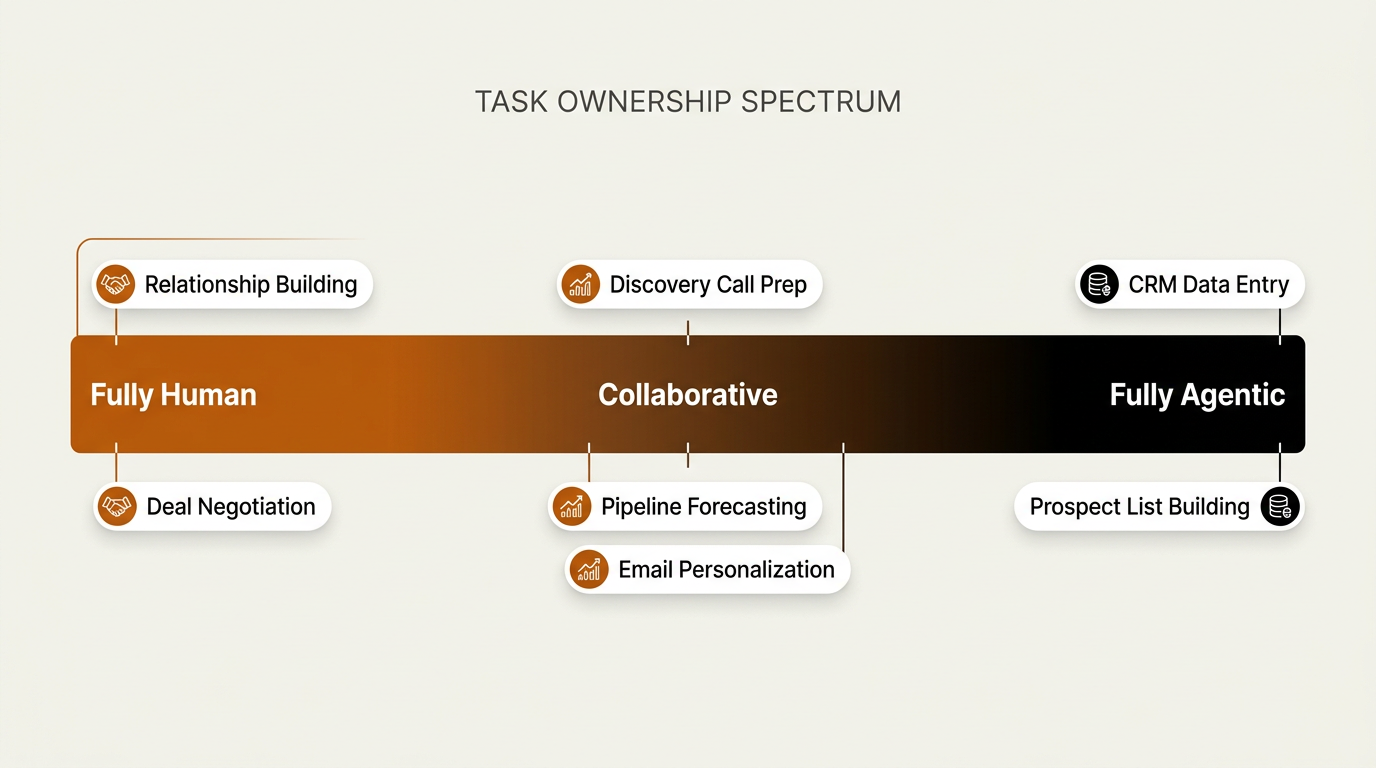
Most revenue tasks fall in the collaborative middle, not at either extreme.
AI Governance and Human Oversight in Revenue Operations
Agentic AI capabilities are becoming increasingly common in enterprise software and revenue operations. As adoption accelerates, governance stops being a nice-to-have. Without guardrails, an agent can send unauthorized communications, overwrite critical CRM fields, or make qualification calls that drift from your sales strategy.
Strong AI governance for revenue teams comes down to three pillars. Start with scope boundaries: spell out which actions an agent can take on its own and which ones require approval. A sensible setup might auto-enrich CRM records but require manager sign-off before re-assigning a deal. Next, audit trails: every agent action should be logged with its reasoning so the team can inspect decisions after the fact. When a lead gets disqualified, you need the why, not just the outcome. Third, feedback loops: agents get better when humans correct them. If a rep overrides a qualification decision, that override should flow back into the system. Teams getting the most out of GTM automation treat governance like a product they maintain, not a PDF they file away.
One point worth being explicit about: AI SDR tools are not a substitute for human SDRs. They take on the repetitive execution layer (data gathering, initial qualification, CRM updates) so SDRs can spend their time on discovery, judgment calls, and the relationship work that moves deals forward.
Business Benefits and Operational Impact
The performance data around agentic AI is starting to look less like hype and more like an operating shift. Organizations that have deployed agentic AI in their revenue workflows consistently report improvements across several dimensions: higher sales representative productivity, stronger pipeline visibility, more accurate lead qualification, and faster deal progression. These gains tend to be most pronounced when teams pair agentic capabilities with clean CRM data, well-defined ICPs, and strong governance practices. The pattern is clear across early adopters: agentic AI does not replace sales judgment, but it removes the manual bottlenecks that slow judgment down.
| Benefit Area | Operational Impact | Source |
|---|---|---|
| Sales productivity | Teams consistently report that reps spend more time selling and less time on administrative tasks | Early adopter consensus |
| Lead conversion | Organizations with AI-driven lead prioritization see measurable improvements in conversion rates | Industry reporting |
| Deal velocity | Faster deal progression due to reduced manual handoffs and real-time pipeline re-ranking | Industry reporting |
| Revenue growth | Revenue gains observed when agentic AI is paired with strong data quality and governance | Industry reporting |
| Data accuracy | Continuous CRM enrichment reduces manual entry errors and improves forecast reliability | Industry consensus |
| Rep time allocation | Agentic AI significantly reduces repetitive administrative work, freeing reps for customer-facing activities | Industry benchmarks |
| Measurable benefits reported by organizations deploying agentic AI in revenue operations. |
Enterprise Implementation: A Phased Approach
Rolling out agentic AI across a revenue org is not something you knock out over a weekend. The implementations that stick follow a phased rollout: earn trust early, lock in governance, then expand with intent. Here is the typical shape of that rollout.
Foundation. Start with the unglamorous work: audit CRM data quality, document your ICP, and map revenue workflows end to end. From there, pick one workflow that has high volume and lots of repetitive, data-dependent steps. For many teams, that is prospect research or CRM enrichment. Choose a platform that supports AI workflow automation natively instead of forcing you to build custom integrations for every handoff. Bitscale, for example, offers ready-made sales workflows, CRM sync, and outbound tool integrations as a unified GTM platform, which reduces the need to stitch together multiple point solutions.
Pilot. Launch the first agentic workflow with a human-in-the-loop at every decision point. If the agent qualifies leads, have a rep review every qualification for the first stretch of the pilot. Track accuracy, quantify time saved, and log the cases where the agent disagrees with the rep. This is the calibration window, and it is also where you harden the audit trail your governance model depends on.
Scale. Once the pilot is stable, expand into adjacent workflows: buying signal detection, pipeline prioritization, and multi-channel outreach orchestration. Human review should shift from blanket approval to exception handling (the agent runs inside defined boundaries; humans step in when the agent flags uncertainty or when outcomes drift outside expected ranges). Put dashboards in place that show agent performance next to rep performance so leadership can manage one revenue engine, not two parallel systems. For a broader look at the vendor landscape, see our roundup of top AI software for revenue teams.
What Most Teams Get Wrong About Agentic AI Adoption
A few failure modes show up again and again across B2B revenue orgs at different levels of AI maturity. The first is using AI agents for sales as a substitute for process design. If your lead qualification criteria are fuzzy or your ICP is poorly defined, an agentic system will scale the ambiguity. Get the process right first, then automate it.
The next mistake is trying to do too much in the first deployment. Teams that attempt to launch research, enrichment, qualification, and outreach orchestration all at once tend to bog down. Pick one workflow, prove it works, then expand. The third mistake is skipping the feedback loop. Agentic systems improve through corrections; if reps override decisions and those overrides never make it back into the model, nothing gets better. Treat human corrections like the training data they are.
There is also a quieter category error: confusing AI workflow automation with agentic AI. Automation runs a fixed sequence. Agentic AI chooses which sequence to run based on context. If your "AI agent" is really a linear workflow with an LLM step bolted on, you are missing the planning and adaptation that make agentic systems worth the operational change. MIT Sloan's explanation of agentic AI makes the distinction cleanly: agentic systems rely on multiple orchestrated agents making semi-autonomous decisions, not single-purpose bots following scripts.
Key Takeaways and Next Steps
Agentic AI revenue teams run on a different operating model than traditional sales orgs. The system takes on data-heavy execution work (research, enrichment, qualification, routing), while humans keep control of strategy, relationships, and final calls. The teams seeing the strongest results are not swapping people for autonomous systems. They are adding an orchestration layer that makes the team faster and the pipeline more legible.
Actionable next steps for revenue leaders:
- Audit your current CRM data quality and ICP documentation before evaluating any agentic AI platform.
- Identify your single highest-volume, most repetitive revenue workflow as a pilot candidate.
- Evaluate platforms like Bitscale that unify prospect research, enrichment, signals, and workflow automation in one system rather than requiring custom integrations.
- Establish governance guardrails (scope boundaries, audit trails, feedback loops) before deploying any agent in production.
- Measure agent performance alongside rep performance from day one to build organizational trust and identify calibration needs.
Frequently Asked Questions
How is agentic AI different from a traditional AI sales assistant?
An AI sales assistant is prompt-driven and typically handles one task at a time (draft an email, summarize a call). Agentic AI starts with a goal, plans a multi-step approach, selects tools, then adjusts based on what it finds. IBM's framing is useful here: agentic AI mimics human decision-making to reach goals with limited supervision, while assistants need guidance interaction by interaction.
Will agentic AI replace my SDR team?
No. Agentic AI takes on repetitive execution work (data gathering, initial qualification, CRM updates) so human SDRs can spend more time on discovery conversations and relationship building. The reported outcomes are productivity gains, not headcount replacement. For more detail, see AI SDR tools and how teams actually use them.
What is the typical timeline for implementing agentic AI in revenue operations?
Rollout duration depends on several factors, including organizational readiness, existing data quality, governance maturity, and the complexity of the workflows you plan to automate. Most organizations follow a three-phase approach (Foundation, Pilot, Scale), where each phase is sized to the team's capacity and confidence. Compressing phases before the team has built trust in agent outputs usually shows up later as weak calibration and low adoption.
How do I ensure data quality when using AI agents for CRM enrichment?
Use a platform that applies confidence scoring when sources conflict instead of overwriting fields automatically. Require audit trails for every CRM update the agent makes, and run periodic spot-checks during the pilot. Bitscale's enrichment workflows include validation steps and CRM sync designed to preserve data integrity across sources.
What governance framework should I use for agentic AI in sales?
Anchor governance in three pieces: scope boundaries (which actions need approval), audit trails (a log of every action plus reasoning), and feedback loops (human overrides flow back into the model as training data). Treat it as an operating system you evolve as agent capabilities expand, not a one-time policy exercise.

Sanket
CEO | Co-Founder Bitscale


Sanket is the CEO and Co-Founder of Bitscale. He leads company vision and strategy, building the future of AI-driven sales intelligence for modern B2B teams. Sanket is obsessed with the intersection of AI and go-to-market, and has spent years studying how the best B2B companies find, engage, and convert customers at scale. He writes about company building, product strategy, and where AI is taking the sales industry.
Read other blogs
All Blogs
12 Best CRM Sync Tools for Revenue Teams in 2026
Compare 12 CRM sync tools for Salesforce and HubSpot, including enrichment, reverse ETL, and automation options for cleaner revenue data.
Sales Data Enrichment: A Buyer's Guide for Modern B2B Teams
Sales data enrichment helps B2B teams improve CRM records, routing, prospecting, and account prioritization. Compare workflows, costs, and vendor fit today.
What Is AI Prospect Qualification? A Practical Guide for Modern Revenue Teams
AI prospect qualification helps revenue teams enrich data, assess ICP fit, prioritize buying signals, and route the right accounts into CRM workflows.